Where the World Cup Becomes Art: The Exhibition Atlanta Collectors Need to See

The Beautiful Game: Inside the World Cup Art Exhibition That Buckhead Didn’t See Coming
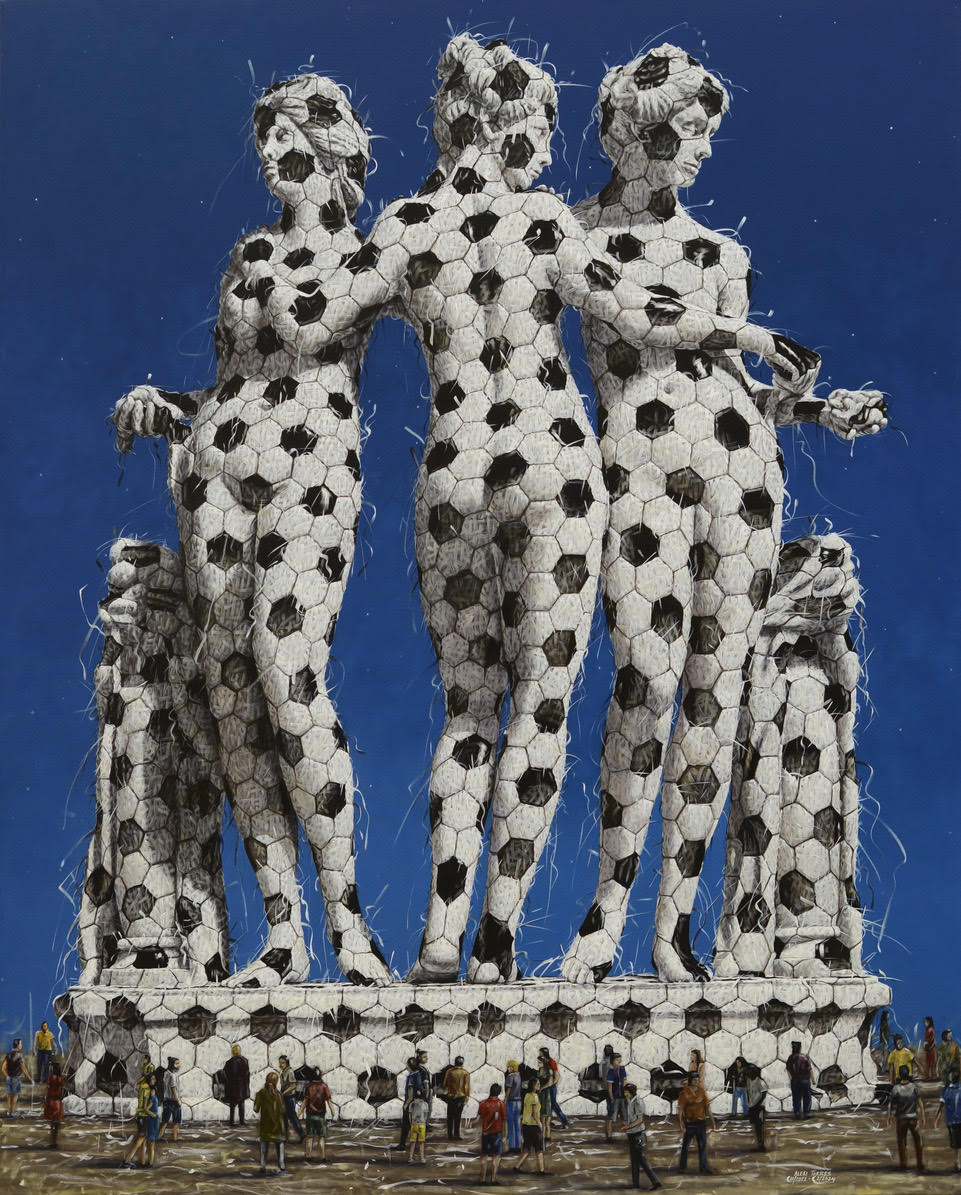
Photo Credit: Courtesy of Carousel Fine Art
Carousel Fine Art’s summer exhibition brings together four artists — and one of the rarest sports photographs in existence — for a show that outlasts the tournament.
Pelé called it the beautiful game. The phrase stuck because it names something real: soccer, at its best, is collective human expression at full volume. This summer, Atlanta is a World Cup city. Sixteen matches of the 2026 FIFA World Cup are being played here, and the city has answered accordingly — watch parties, pop-ups, sold-out hospitality packages, a region-wide redefinition of what a summer weekend looks like.
None of it prepares you for what’s hanging on the walls at Carousel Fine Art in Buckhead Village.
The Beautiful Game — on view through July 31 — is not a branded activation or a tournament tie-in. It is a serious fine art exhibition that takes soccer’s iconography, history, and emotional charge as subjects worthy of the same attention the sport itself commands. Four artists. Four completely different angles of approach. One question running underneath all of it: what does the beautiful game actually mean?
Alexi Torres: When Soccer Becomes Mythology
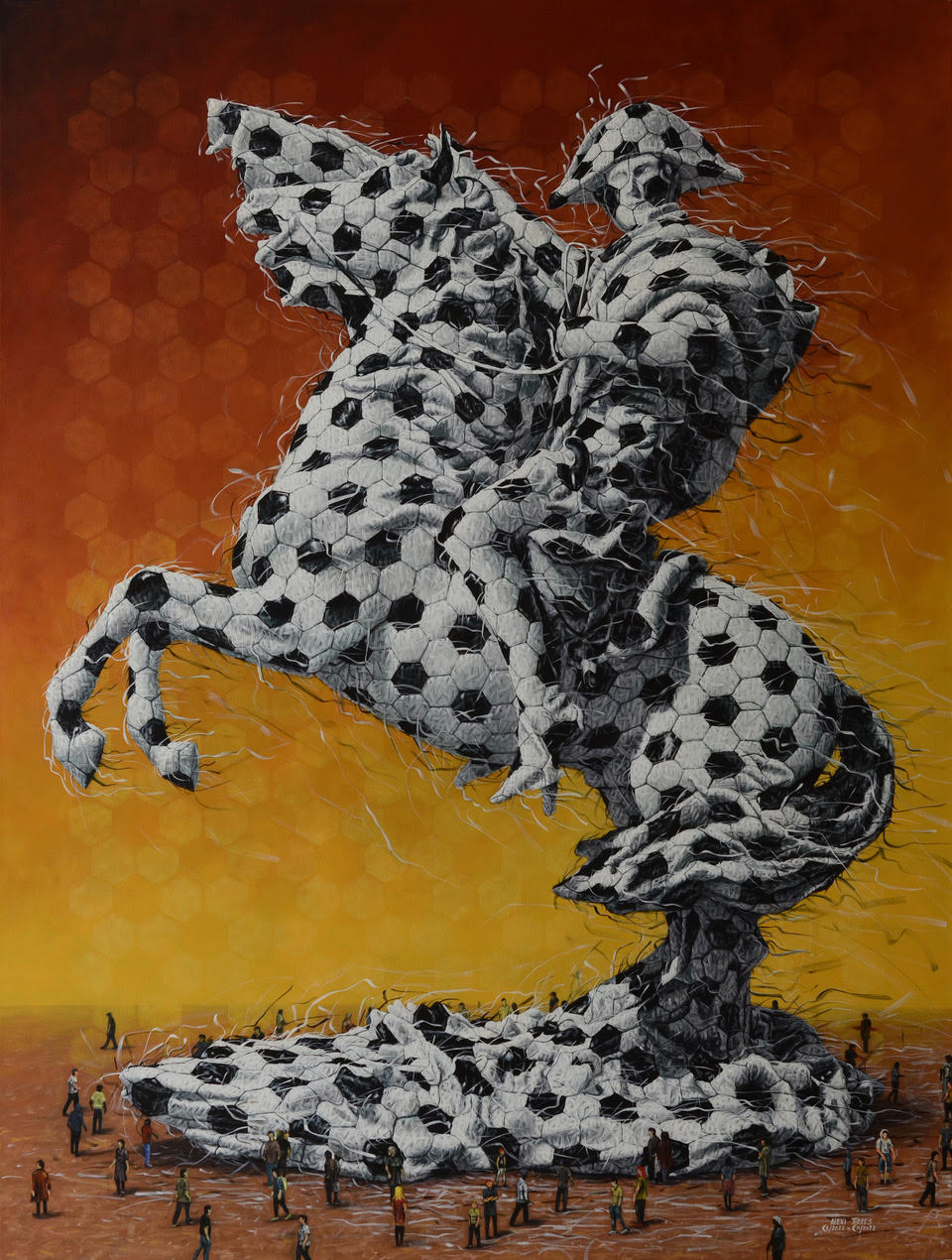
Game of Life, 2022
Photo Credit: Courtesy of Carousel Fine Art
The Torres canvases are the first thing you feel. Not see — feel.
Torres was born in Bermeja, in the Matanzas province of Cuba, a region shaped by agricultural life and the rhythms of planting and harvest. His signature technique — oil applied in tight, interlaced brushstrokes across as many as twenty layers — draws directly from the weaving traditions of his upbringing. The result is paint that doesn’t look applied. It looks fabricated, woven, built from the inside out.
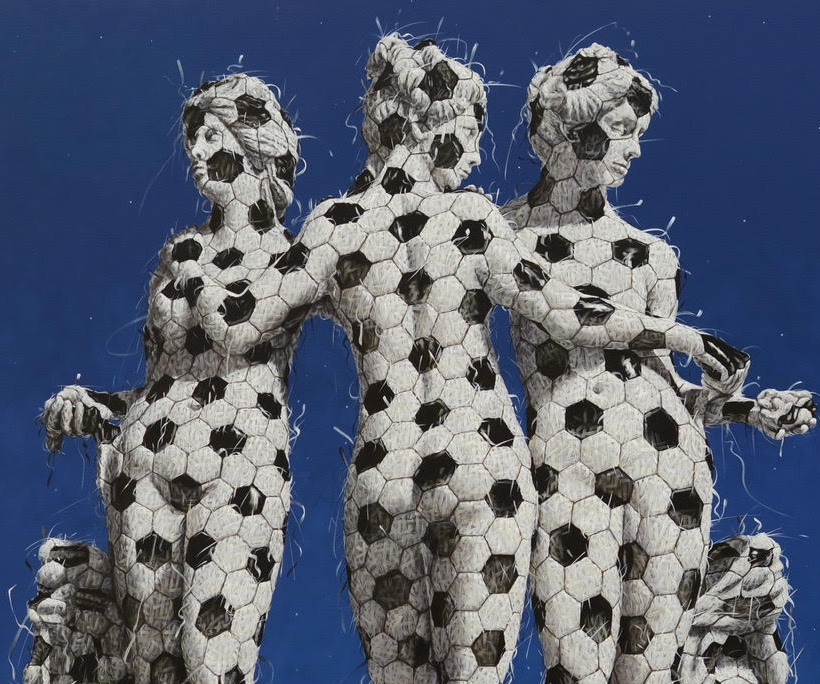
In his Game of Life series, Torres turns that technique on the geometry of a soccer ball: the hexagonal and pentagonal panels that have defined the ball since the 1970 World Cup. He uses them to construct figures — a lion, a rearing horse, three graces, a goddess — that read simultaneously as mythological forms and as objects made of the game itself. The Three Graces reconstructs a Renaissance subject entirely from ball panels. The King renders a lion’s head as something between crown and trophy. Game of Life sets a horse mid-rear against a burnt-orange sky, tiny human figures dwarfed at its base.
The conceptual layering is precise: one communal object, the textile, woven into the structure of another, the ball. Collective labor forming the image of collective play. Torres describes the series as a meditation on connection and shared destiny — on how separate lives merge and create something larger than their sum. On a canvas, it reads as exactly that, and then some.
His work is held in the private collections of Will Smith and Delta Airlines, and has been exhibited at the Miami International Art Fair, Art Palm Springs, and the Houston Fine Art Fair.
David Yarrow: The Photograph That Witnessed History
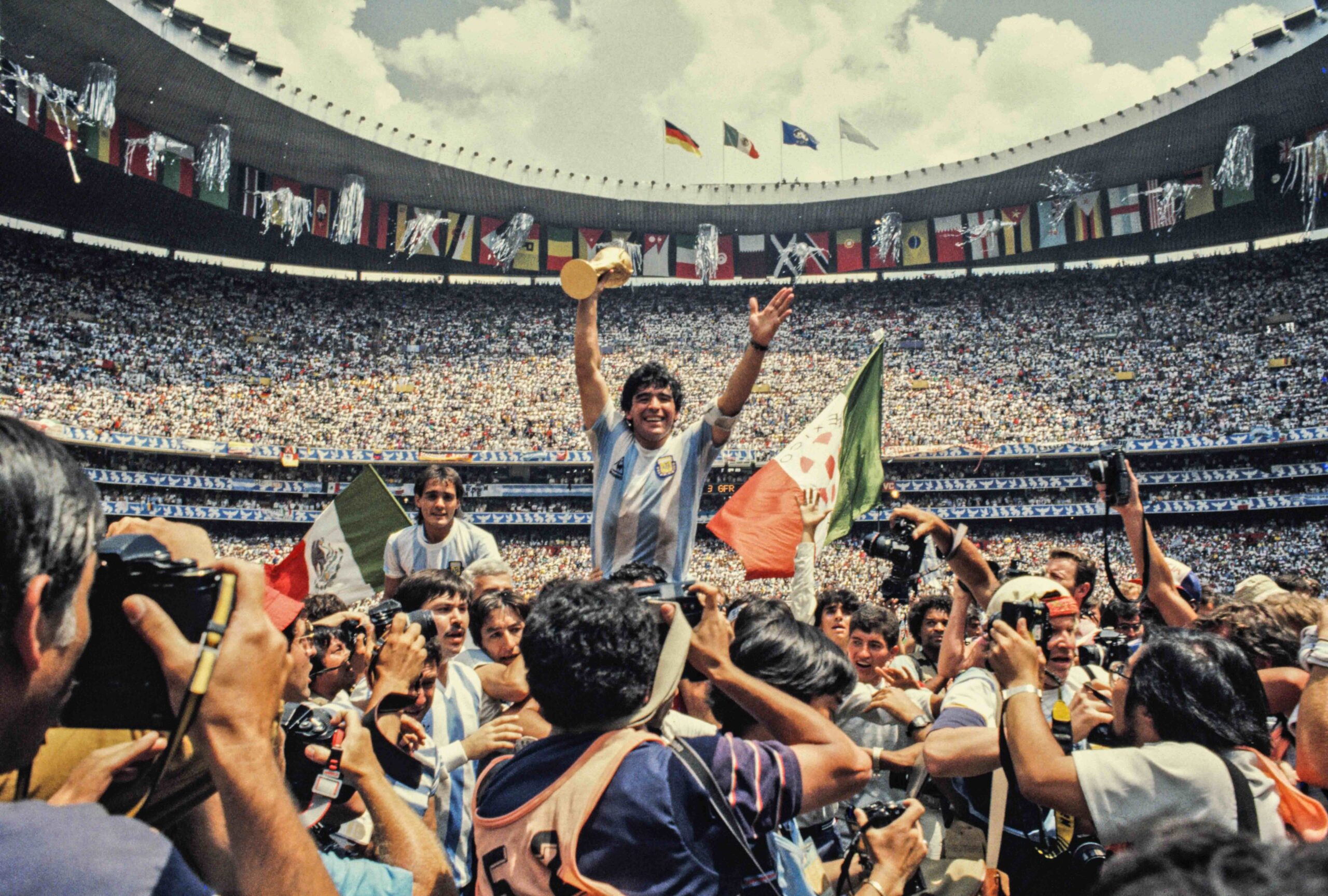
Maradona, 1986
Photo Credit: Courtesy of Carousel Fine Art
David Yarrow was 20 years old, on assignment for The London Times, when Argentina defeated West Germany 3–2 at the Azteca Stadium in Mexico City. It was the 1986 World Cup Final. In the chaos after the trophy presentation — five thousand Argentine fans flooding the pitch — Diego Maradona rose above the crowd on someone’s shoulders, trophy raised, and looked directly into Yarrow’s lens.
The photograph Yarrow made in that moment is now recognized as the third best-selling sports image of all time.
After university, Yarrow spent years in banking and ran a hedge fund before selling it in 2014 to return to photography full-time. He is now among the world’s best-selling fine art photographers, with work sold regularly through Sotheby’s and major international auction houses. The Maradona image is where that career began, and it remains its most indelible artifact.
Displayed at Carousel Fine Art during the 2026 World Cup — in which Argentina enters as defending champion — the photograph arrives with a weight few works in any medium can claim. It is a document, a portrait, and a fine art object in a single frame. The stadium fills the background. The flags of nations ring the upper tier. Maradona is at the center of everything, and Yarrow — twenty years old, press credential around his neck — was standing in the right place at the right moment, and had the eye to know it.
The Yarrow print is available as Edition 35 of 40. The provenance story writes itself.
Max Steven Grossman: A Library of Legends
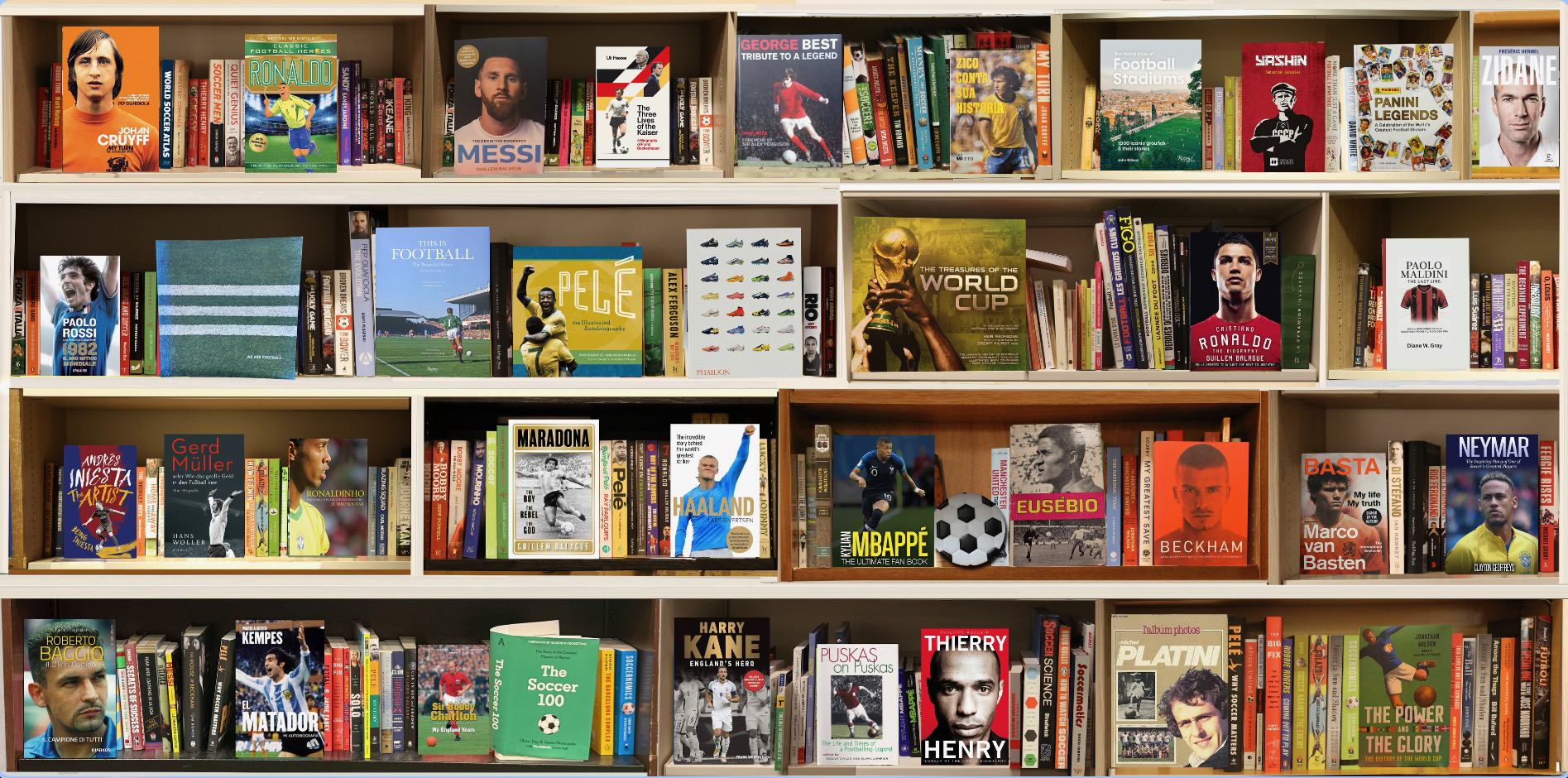
Photo Credit: Courtesy of Carousel Fine Art
Grossman studied engineering before earning a Master of Arts in Photography from NYU and the International Center of Photography. His practice is organized around a single idea: the bookshelf as a form of knowledge architecture.
In his Bookscapes series, he photographs real bookshelves — in libraries, shops, and private collections — then digitally composites them into panoramic shelves organized around a subject. Fashion. Architecture. Music. Sport. Soccer WC 26, created specifically for the 2026 World Cup, presents, at first glance, as a photograph of bookshelves. Look more closely. The spines begin to resolve. Messi. Pelé. Maradona. Ronaldo. Mbappé. Eusébio. Beckham. Neymar. Haaland. Iniesta. Gerd Müller. Every book is dedicated to one of the sport’s defining figures.
The conceptual precision is worth sitting with. A book about Pelé is not Pelé — it is what remains of Pelé after the body has stopped playing. The bookshelf in Soccer WC 26 is a library of legacies: the sport’s hall of fame rendered as the object that actually preserves greatness across generations.
At 48 by 100 inches, mounted face-forward in Diasec — the process by which a print is bonded directly to acrylic glass and backed with aluminum — the work extends beyond peripheral vision at normal viewing distance. The eye begins to move across the spines, finding names, making connections. Grossman designed it to reward both distance and proximity, to hold more information than any single viewing can exhaust.
Soccer WC 26 is Edition 1 of 5. There are five copies in the world. This is the first.
Chance Cooper: The Crowd’s Side of the Equation
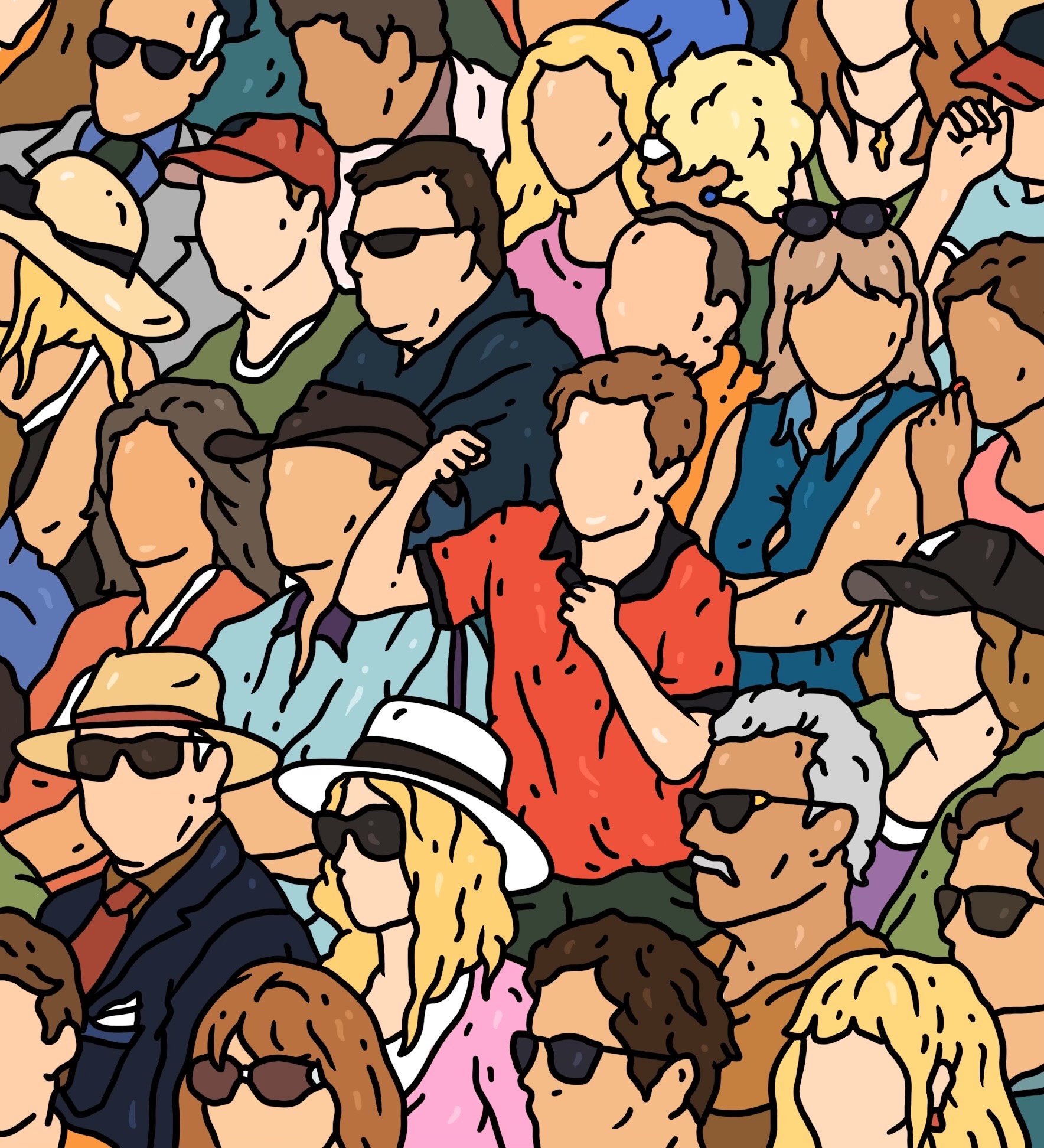
Photo Credit: Courtesy of Carousel Fine Art
Torres mythologizes the athletes. Yarrow documents the historic moment. Grossman catalogs the legends. Cooper gives you the crowd.
A self-taught painter, Cooper’s practice is organized around what he calls crowd theory: the idea that collective experience — the energy of people gathered in shared emotion — is one of the most compelling and underserved subjects in contemporary painting. His people-scape works, presented during Miami Art Week, build their effect through accumulation. Many faces in close proximity create a visual rhythm that a single figure cannot produce.
Lotta Life Left is exactly that: a crowd rendered in bold, pop-art-influenced color, celebratory and festive, vibrating with the communal energy that defines the World Cup at its peak. It is the experience of attending a match — individual humans temporarily dissolved into something collective, their separate identities subsumed into the organism of the stands.
Without it, the exhibition would be complete but not fully alive.
The Context Will Not Come Again
The tournament ends July 19. The exhibition closes July 31. The works will outlast both.
What will not return is this specific alignment: Atlanta as a World Cup city, these four works in a single room in Buckhead Village, Argentina as defending champion with Yarrow’s Maradona on the wall. The acquisition context for collectors is singular and the window is short. For everyone else, admission is free and no art background is required.
If you’ve watched a match this summer and felt something you couldn’t fully name, there is a gallery in Buckhead where someone already named it.
The Beautiful Game is on view at Carousel Fine Art, Buckhead Village, Atlanta, through July 31, 2026. Admission is free and open to the public. Visit carouselartgroup.com for gallery hours and inquiries.
The best experiences are the ones you can’t book online. Unlock bespoke itineraries, private aviation, and VIP access at 500+ properties across 120+ countries through Haute Black — the exclusive platform built from 20 years of Haute Living’s extensive network. Become a Haute Black member today at hauteblack.com/ or [email protected].
through Haute Black.
Haute Living access. Two decades inside the world’s best hotels.
Virtuoso partner. Upgrades & VIP arrival at 1,200+ properties.
One advisor. Who knows you by name.
Latest from Haute Living

Haute Living Joins Miami’s Business Owner Strategy Summit This November
David Yurman Goes Pop for the Whitney’s Roy Lichtenstein: Like New Exhibition

CasAzar Tequila and the Los Angeles Dodgers: The Tequila Behind the Dynasty