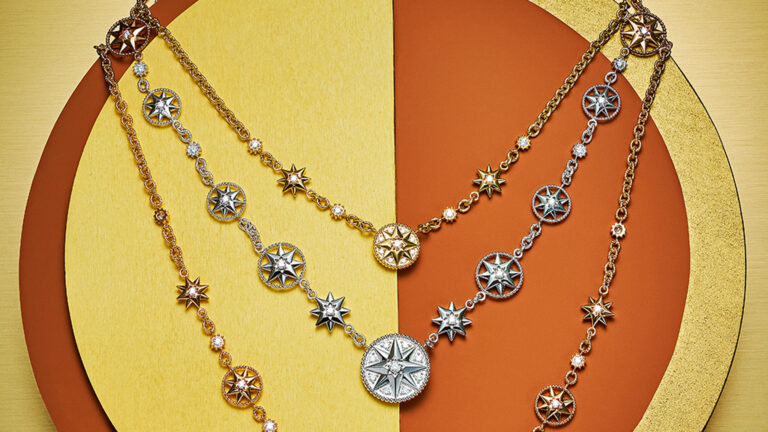
Home Grown
The road to the top is always tough, but for Sandy Hequin of Morays Jewelers, who is armed with innate business savviness and exquisite taste, the results are always fruitful.
The road to the top is always tough, but for Sandy Hequin of Morays Jewelers, who is armed with innate business savviness and exquisite taste, the results are always fruitful.
The Morays Jewelers experience is just that—an experience. In a world of fast-paced, quick-decision shopping, which is quite often online, the touch-it, feel-it, try-it-on process can get lost in the sauce. Not at Morays. The jewelry house boasts high-end watch brands like Audemars Piguet, Dior, Bulgari, Panerai, and Tag Heur, and luxurious baubles like David Yurman, Marco Bicego, and Mikimoto. Tucked away in the heart of the Miami Jewelry District, which is the third largest district in the nation following New York and Beverly Hills, the sixth-generation, upscale jewelry store dates back 110 years. But even after more than a century of experienced success, the fundamentals remain intact.
In 1900, Max Schechter arrived in New York City from Austria-Hungary. Before long he discovered his penchant for timepieces and began to offer the treasures from a considerably humble dig—a pushcart. By 1920, Schechter opened the first jewelry exchange in the Bowery and garnered enough success to give each of his sons a booth of their own, $10,000, and the chance to embark on a glittering journey into the complex layers of the jewelry business.
In 1942, the Bowery-based booth was reborn in Miami, but not yet in the expansive space that stands tall on Northeast 2nd Avenue. That reality came to existence through the clever musings of current owner and Max’s great-great-granddaughter, Sandy Hequin.
Hequin started young. In the Schechter family tradition, offspring starts working at the ripe age of 5, broom in hand, sweeping the store floors while soaking up knowledge under the tutelage of Grandpa, and in Hequin’s case, her father, Richard Schechter, as well. It seems they had the right idea; by the time she was 16, she was given four blank checks and dropped at a jewelry show in New York City to do her first buy for the boutique. What she wasn’t given were instructions, just her father’s faith in her exquisite taste. Selections in hand, Hequin asked her father to review. “I had left my business card on the trays with my selections, and as we went around to see what I had chosen, we saw the card of old lady Fortunoff [of Fortunoff Jewelry] placed on top of each of mine.” At the time, Hequin and “Old Lady Fortunoff” were the only women working in a man’s jewelry world, and Fortunoff was significantly older and with much more experience. “Dad told me, ‘I don’t have to see the pieces. If Fortunoff is buying your picks then you’re doing something right.’”
That was only the beginning.
At her second show and representing one of the only stores to cater to watch collectors, Hequin found herself being ignored by the vendors. “Nobody wanted to help me.” But even then she was already garnering a little buzz. “A man at the booth next door said to the watch vendor, ‘Don’t you know who that is?’ I ended up buying two jeweled, skeleton-back watches—one with rubies and one with emeralds. The next year, the man who ignored me vied for my visit to his booth.” Hequin remembers making the watch purchases and selling them to a client. And she vividly recalls wrapping the watches herself, and the whopping $100 tip she received from it.
The memory remains embedded in her mind, but in terms of financial compensation, the $100 really just marked the beginning of a very lucrative career for Hequin and her future husband, Bob Hequin.
In 1985, Hequin really spread her wings. Going out on her own, Hequin and her husband decided to take over five jewelry cases at a friend’s clothing boutique, Le Player, in Kendall’s Town and Country Mall. “In just two years, we made enough money to buy my father’s store, “ she remembers. “We were making just as much from those few showcases as some of the major jewelry stores at the time. It was about being at the right place at the right time.” Beyond luck or fate, Hequin’s success should be much credited toward her innate understanding of fine jewels and aesthetics, developed know-how for business, and unique way with people.
A modern-day, doe-eyed Princess Diana, oozing elegance and quite often dripping in exquisite jewels, Hequin possesses a certain degree of refinement. This could be why she’s the last remaining family member in the business. In 1994, she finally decided to scoop the empire from her father’s clutches and took the family business to whole new levels. But after only five years of running the luxury boutique, she realized that her trajectory for their business was too large to operate within the confines of their current space. Plans for growth were set in motion.
Expanding the business didn’t mean a little construction to extend the walls. In 1999, Hequin began looking for a new location in downtown Miami. It was far from the obvious locale—the neighborhood was less than desirable and seemed questionable for a $1 million-plus build-out that promised to house fine jewelry. But Hequin had a hunch about the revitalizing downtown scene.
She personally designed every detail of the 10,000-plus-square-foot space. Unfortunately, just at the onset of the construction, a terrible traffic accident left her hospitalized. Doctors doubted Hequin would ever walk again and several tests were administered to determine any brain damage. Hequin recalls a series of questions that she swears were trick questions. “The nurse would ask me things like, ‘What’s the difference between work and play?’ and I would tell her over and over that there was no difference.” Perhaps it was her work ethic that saw her through; Hequin would visit the store’s construction site, wheelchair-bound, to delegate responsibilities because “no one could do it without me. I designed the entire thing.”
Her recovery allowed her to stand tall within the walls of her new kingdom. Complete with full bar and flat-screen televisions, the store turned out exactly as she envisioned it. But a store isn’t all she’s been able to build; Hequin builds relationships. “I love that we know our clients’ names. We share in milestones; we go to their weddings and their children’s Bat Mitzvahs; we know what they like and what they want.” What they want, she explains, “is the integrity and confidence found in shopping at Morays,” which is an authorized dealer of more than 30 Swiss watch brands, “and the luxury experience that isn’t so much offered at exchange prices.”
Success continues at Morays. Loyal customers flock to the Morays team for the kind of shopping experience where luxury meets family, and where the storeowner knows your taste very well. And there are no signs of slowing down. While Hequin remains the last of her family members in the business, she’s home growing her legacy—her daughter, now also 16, holds a business card entitled Future Owner. We’re confident that the apple won’t fall far from the tree.
Latest from Haute Living
Inside Real Madrid’s New Louis Vuitton Wardrobe, Designed by Pharrell Williams
Giorgio Armani & Kith Unveil Dreams of the Dune—Their Third Collaboration—in the Marrakech Desert
Straker’s Arrives in New York: Inside the London Chef’s First Restaurant Outside the U.K.