Why Knicks Star Josh Hart’s Obsessions Are Exactly What Make Him Great
New York Knicks star Josh Hart opens up about his historic NBA Finals win, being a FIFA World Cup ambassador, and his viral wine obsession.

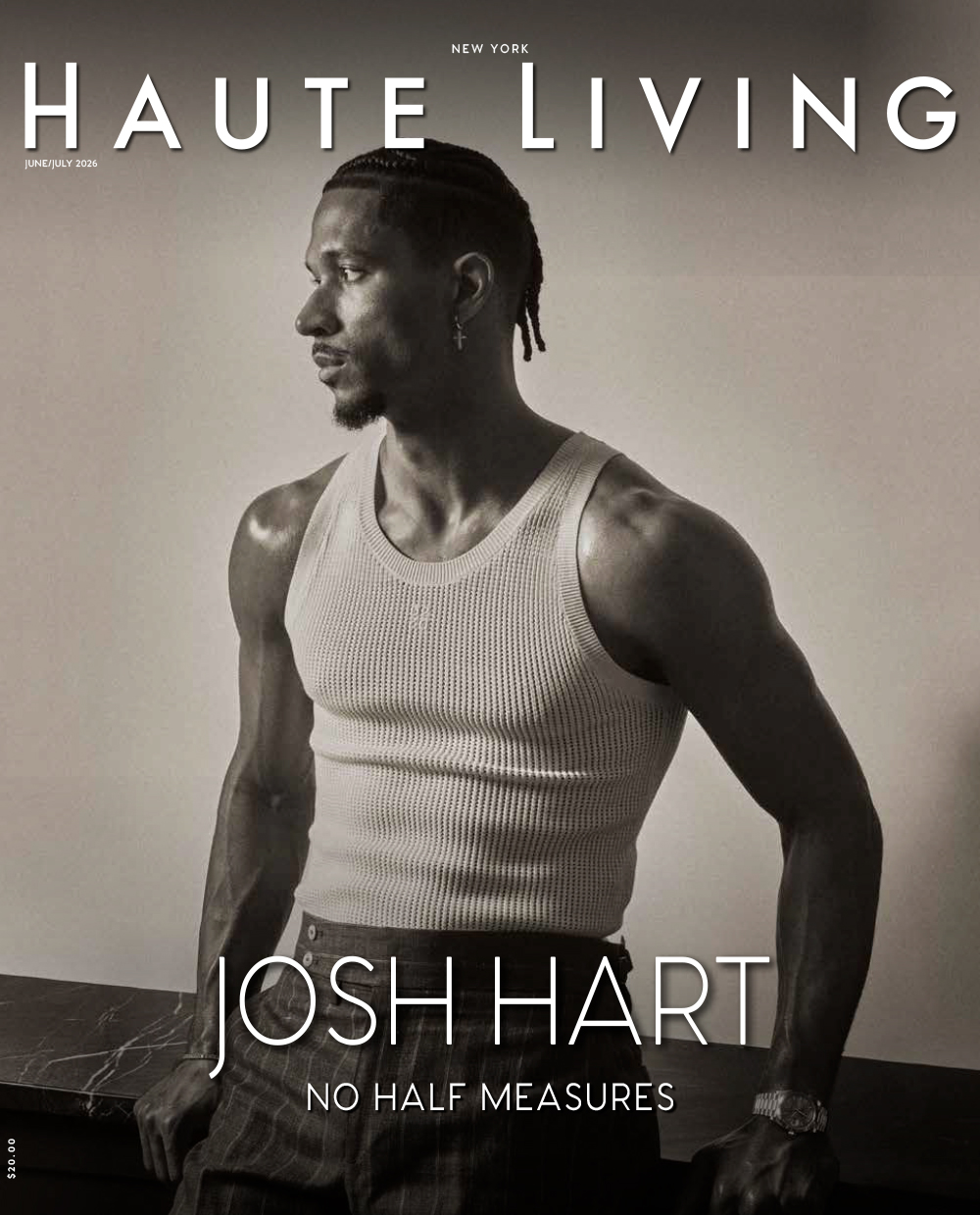
TROUSERS: ISAIA
JEWELRY: London Jewelers and Josh’s personal collection
Photo Credit: Ben Draper
STORY LAURA SCHREFFLER
PHOTOGRAPHY BEN DRAPER
STYLING ERIN MCSHERRY
GROOMING VALISSA YOE
SHOT ON LOCATION IN NEW YORK
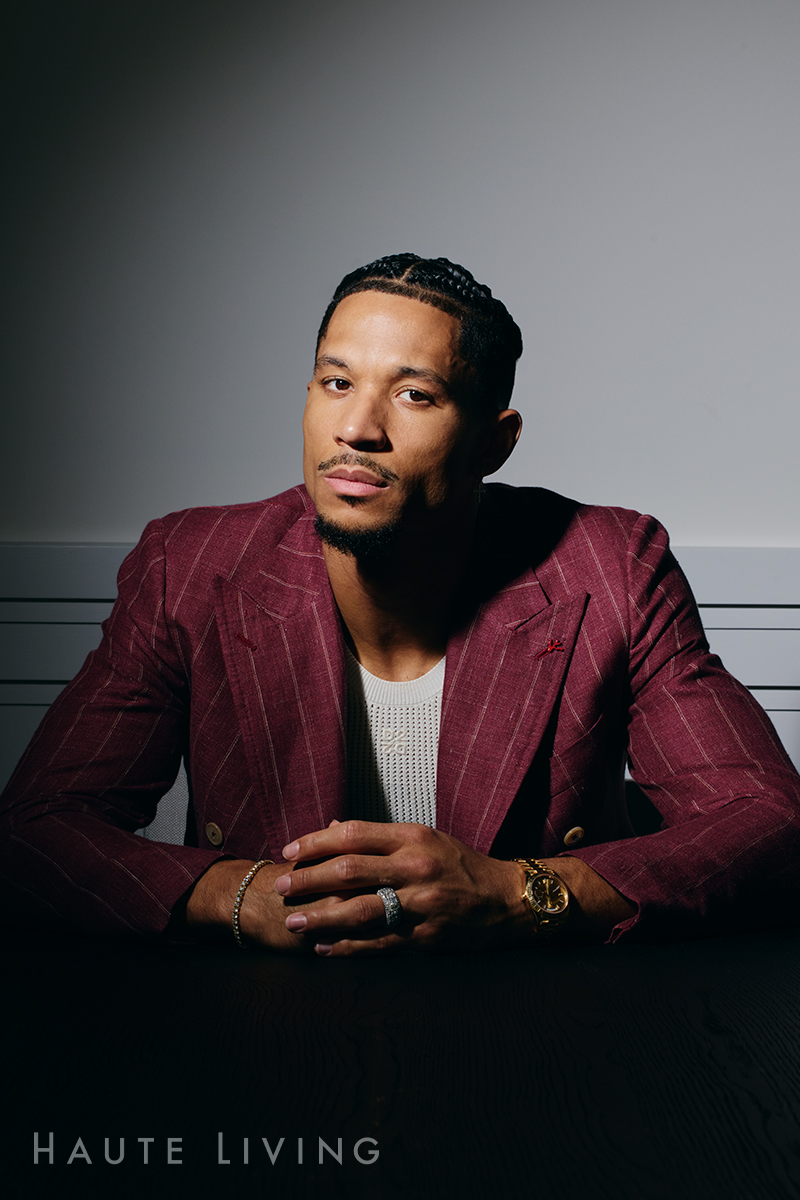
BLAZER & TROUSERS: ISAIA
JEWELRY: London Jewelers and Josh’s personal collection
Photo Credit: Ben Draper
The only thing Josh Hart loves more than Chelsea is watching Arsenal lose.
Not glancing at a score. Not half-listening to a broadcast somewhere in the periphery. Actively, unapologetically, spiritually invested in Arsenal’s potential humiliation — tracking every minute of the UEFA Champions League final the way a man watches a rival get exactly what’s coming to him. He’s muttering “please, please” at the screen, half in the interview and half somewhere over north London, and for a moment it feels less like a conversation than eavesdropping on someone’s private ritual. His team, the New York Knicks, are in their first Finals since 1999 (and will go on to win their first championship since 1973, against the San Antonio Spurs). New York is currently losing its collective mind. And Josh Hart — FIFA World Cup ambassador, franchise cornerstone, the man who just helped end a quarter-century of misery — is very focused on Arsenal not just being defeated, but being destroyed.
“I don’t have a dog in the race,” he finally admits, not very sheepishly about it. “I’m just hate-watching because I don’t want Arsenal to win.”
He is a Chelsea man. Has been for years. It started, the way most football obsessions start in America, sideways — following an England tournament run, stumbling into John Terry and Frank Lampard, and then falling through a door that never quite closed again. “No. Full-on obsession,” he says when I ask whether his Chelsea support is casual. He means it the way people mean things when they’ve already proved it beyond any reasonable doubt — Chelsea, Washington Commanders, New York Yankees, none of it performative, none of it content. “I’m all in on the things I like,” he says, his attention drifting briefly back toward the screen. “Especially my sports teams.”
This is not a man who does anything by halves. He will tell you this himself, unprompted, with no apparent self-consciousness about it.
Which is, incidentally, the exact reason FIFA wanted him in the first place.
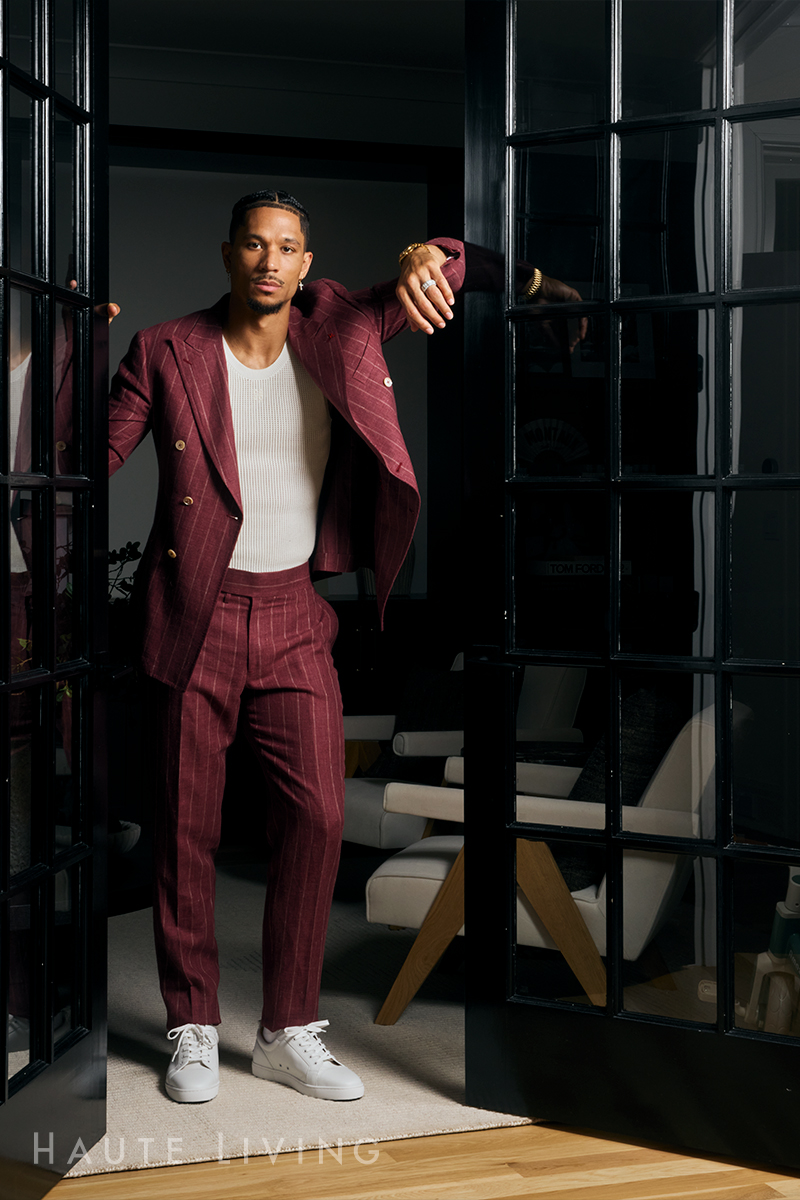
BLAZER & TROUSERS: ISAIA
SHOES: Christian Louboutin
JEWELRY: London Jewelers and Josh’s personal collection
Photo Credit: Ben Draper
Hart was named a 2026 World Cup ambassador, and the decision makes more sense the longer you talk to him. A lot of American athletes will perform enthusiasm for football when a camera’s around — they know the marquee names, they’ve seen the viral moments, and they can hold a conversation long enough for a photo op. Hart knows that Chelsea had a miserable year marked by a manager change and player turnover that had him screaming at his timeline on match days. He watches live, always, because going on Twitter after missing a match is a form of punishment he has no interest in inflicting on himself. “If I go on Twitter and I miss the match, it’s over,” he says. “I’m gonna know everything that happened in the first five tweets on my timeline. The good, the bad, and the ugly.” This year has provided plenty of all three. “It definitely messes the mood up for a while,” he says. “You’re just like, bro — what is my club doing?”
But to understand Hart’s singular focus in this moment, you have to go back to when it all started. “I think it was the 2012 World Cup,” he says. “I was just kind of supporting England, and obviously John Terry and Frank Lampard were huge on that squad. I just kind of followed them along to Chelsea, and that just kind of grew my love of Chelsea.” He pauses. Something happens on screen. “Come on. Come on. Put it in the back of the net.”
He understands that for much of the planet, football isn’t entertainment — it’s the architecture of identity. “It’s a lifestyle,” he says. “Everything revolves around it.” He describes match days near Stamford Bridge the way someone describes a place they have been, not a place they’ve imagined — shops closed, the whole neighborhood funneling toward the ground, everything organized around a single ninety minutes. He represented Team USA at the 2023 FIBA Basketball World Cup, played Spain in Málaga with the noise crashing down from every tier, and came home understanding international competition in a way that most American athletes never quite access. He led Team USA in rebounding, averaged 5.3 per game, and filed away what it felt like to play in front of a country rather than a city. “It’s totally different,” he says. “Obviously for basketball, we’re the US — we’re the top dogs. So everybody wants to play you, everybody wants that miracle story. It’s not quite like that for us.” He pauses. “But I get a little bit more appreciation for the culture.”
Now that energy is coming to American soil, and Hart has thoughts about why it hasn’t arrived sooner. He lives in Miami in the off-season and has watched Messi’s presence at Inter Miami CF move the needle locally without yet translating nationally — and he has a theory about why. “They got a contract distribution with Apple TV, and I think that kind of went to the highest bidder,” he says. “If it went with something like ESPN, the reach is more.” The World Cup, he believes, is the correction. Not just exposure — conversion. “These younger kids are going to see the passion, the love, the excitement — everything around it,” he says. “I hope this World Cup changes the way Americans look at football. So we can really build and be known in ten, fifteen years as a football power — and not just, okay, cool, they’re here.” He grins. “They’re going to get a glimpse of what true diehard supporters look like.”
His NBA teammates are already a preview of that. Jeremy Sohan is a die-hard Arsenal supporter. There are Frenchmen in the locker room — Pacome Diawara among them — who are, at this very moment, watching the Champions League final together somewhere in the city. Hart made a unilateral decision not to join them. “If I’m playing someone, I don’t want to watch the game with them,” he says. “Especially if we lose — I don’t want to see you celebrating in my face.” The locker room banter around football gets, as he puts it, “fun, but definitely competitive” — a line that applies pretty accurately to most things involving Josh Hart. He is watching alone. Hate-watching, specifically. Perfectly content.
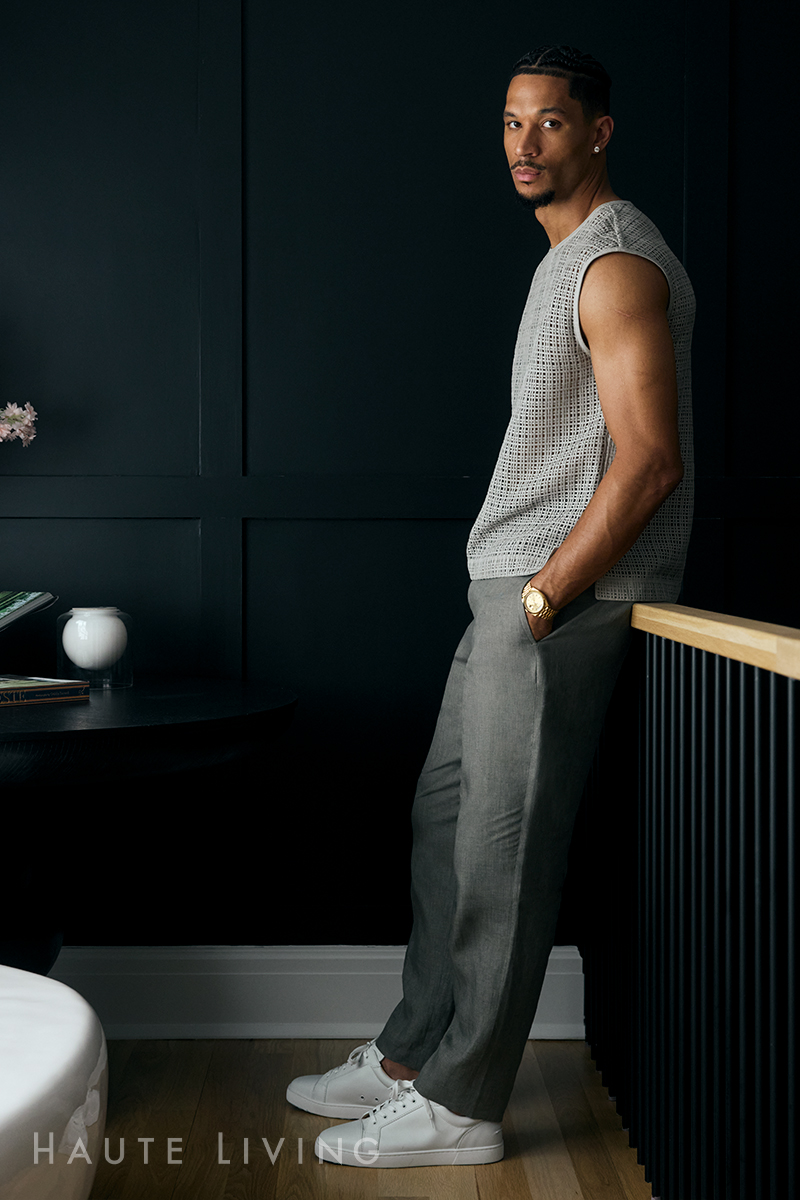
PANT: Rag & Bone
SHOES: Christian Louboutin
JEWELRY: London Jewelers and Josh’s personal collection
Photo Credit: Ben Draper
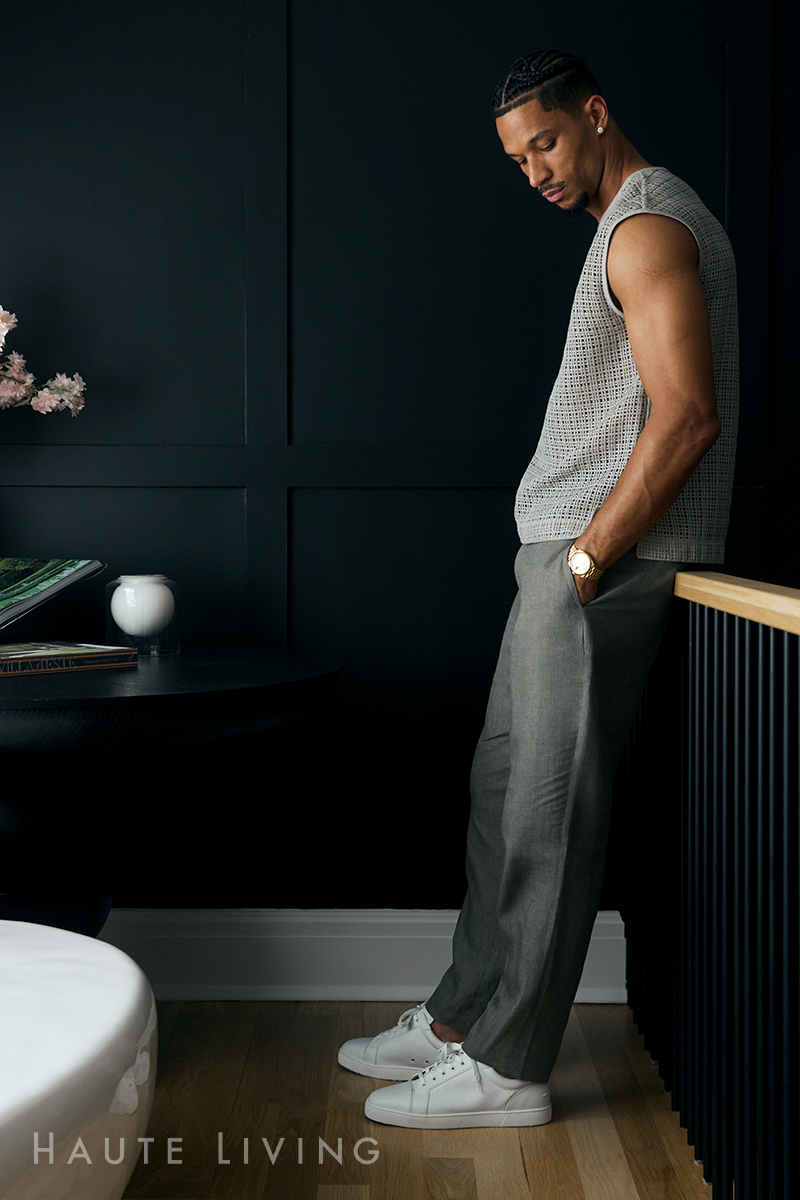
PANT: Rag & Bone
SHOES: Christian Louboutin
JEWELRY: London Jewelers and Josh’s personal collection
Photo Credit: Ben Draper
“I always look at myself as just a regular person,” he says. “I just happen to hoop.” It is, of all the things he says today, perhaps the most revealing — because it explains everything about how a professional athlete maintains the full emotional infrastructure of a civilian sports fan, complete with ruined afternoons and Twitter-induced existential spirals about his club’s transfer strategy. He never separated himself from fandom. He just added a job on top of it.
That job, in the current moment, happens to be extraordinary. At the time of our conversation, the Knicks just secured their first NBA Finals berth since 1999 — a quarter-century of frustration, false starts, and heartbreak finally giving way to a truly momentous win. Hart arrived from Portland in 2023, walked into this particular crucible and didn’t just survive it. He became its embodiment. The player who chases every loose ball, who finished the season averaging 37.6 minutes per game (the NBA’s leader, per the minutes award he took home this year), who logged 9.6 rebounds and 5.9 assists and set a franchise record with nine triple-doubles and made all of it look like sheer will dressed up in basketball clothes. On March 8, he pulled down 20 rebounds against the Clippers — a career high, filed apparently under routine.
Born Joshua Aaron Hart on March 6, 1995, he came up at Villanova, where the résumé is almost absurdly decorated: Big East Tournament Most Outstanding Player as a sophomore, national champion in 2016, and consensus First-Team All-American senior. He was selected 30th overall in the 2017 Draft — last pick of the first round, by Utah — before landing with the Lakers, then moving to New Orleans, then Portland, then finally New York. Each stop refined the same thing: a player built entirely around doing whatever the team needed, at whatever cost, however unglamorous. The Knicks looked at what that journey had produced and decided it was exactly what they were missing.
They were right.
“I got coached up on that toughness,” he says when I ask whether the hustle is nature or nurture. “My dad, coach Keith Stevens, my travel team coach — those guys really helped groom that competitiveness.” But the part that tends to get lost in the hustle narrative is that Hart genuinely enjoys it. “Once I’m on the court, I feel like I’m just a little kid,” he says. “I just go out there and play the game the way I know how, and have fun the way I know how. That’s all that really matters.” He has never, not once, lost sight of what the job actually is. “I’m blessed to be in a position where my profession is playing a game for a living, and I get compensated well, and I can put my family in good positions I didn’t think were possible,” he says. “I never try to lose that perspective.”
And yet — even now, at the center of the most significant moment in New York basketball in a generation — Hart refuses to let himself feel it.
“No,” he says flatly when I ask whether he’s been savoring the moment. “Just more locked in.” Before I can push back: “Once you allow yourself to relax even for a second, you get complacent. You don’t have that edge, that chip on your shoulder.” He says it without irony, without any apparent awareness that this is a man who plays 37-plus minutes a night and still finds time to hate-watch Arsenal. “After the season, no matter what happens, I’ll have time to sit there and be like — okay, that was a run. That was dope.” But not yet. Not while there’s still something to win.
“A willingness to win,” he says, “also means a willingness to sacrifice.”
On screen, Paris Saint-Germain wins on penalties. Back-to-back Champions League titles. Arsenal’s epic season ends in heartbreak.
Josh Hart got exactly what he wanted.
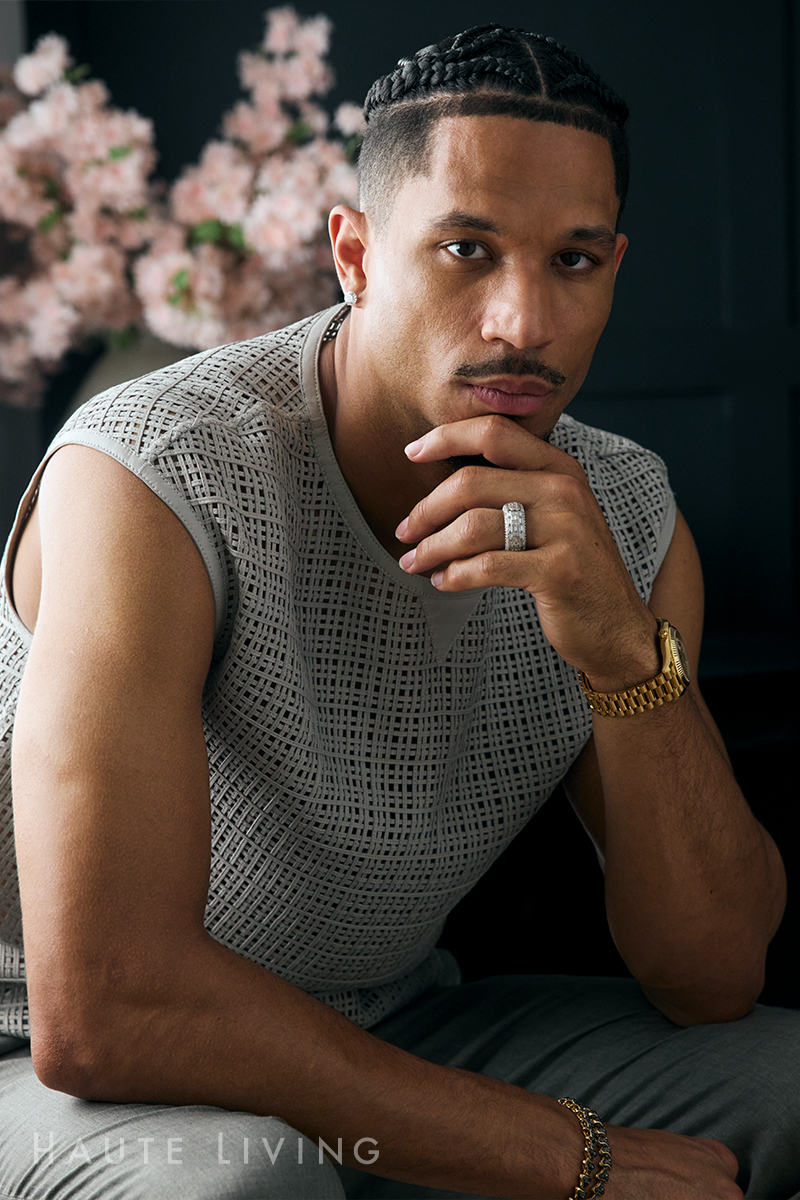
PANT: Rag & Bone
JEWELRY: London Jewelers and Josh’s personal collection
Photo Credit: Ben Draper
A few days before we spoke, Josh Hart walked into the press conference after the Knicks eliminated Oklahoma City carrying a bottle of 2008 Le Pin.
Not a magnum of something bubbly someone handed him in the tunnel. Not a sponsor product placed for the cameras. A bottle of Le Pin — one of Bordeaux’s great cult wines, a Pomerol produced in such small quantities that bottles go for thousands at auction, the kind of wine you drink when something genuinely worth drinking it for has happened — that Hart had personally arranged to have brought in, in advance, because he had decided that if they won, the moment deserved something real.
They won. He sat down. He poured a glass. The internet briefly went insane.
“Yeah,” he says with a laugh that suggests he still finds the reaction a little baffling. “I had a friend bring it. I was like, if we win, I gotta have something good.”
To outsiders, it read as a flex. To Hart, it was completely normal — because wine has become far more than a hobby. It is a passion, an education, a ritual, a refuge. He was already deep into Bordeaux when we first spoke, already moving past entry-level reverence for famous labels into something more considered and genuinely knowledgeable. That was then. Now he’s planning a trip to Bordeaux this summer specifically to visit Mouton Rothschild, Château Pétrus, and a handful of others he’s been quietly working toward — and simultaneously falling hard for Italian producers most casual wine drinkers have never encountered. “Right now I’m loving a lot of Italians — Quintarelli, from Veneto, Amarone, stuff like that,” he says. “As you go along and learn about wine more, you start to have more appreciation. And you start to learn about some of these wines that are amazing that aren’t mainstream.” He’s planning the Veneto trip too, eventually. Shannon, his wife, is a willing travel companion up to a point — “after we go to a couple of wineries a day for three days, she’s like, all right, I’m done” — but he’ll get there. He always gets there.
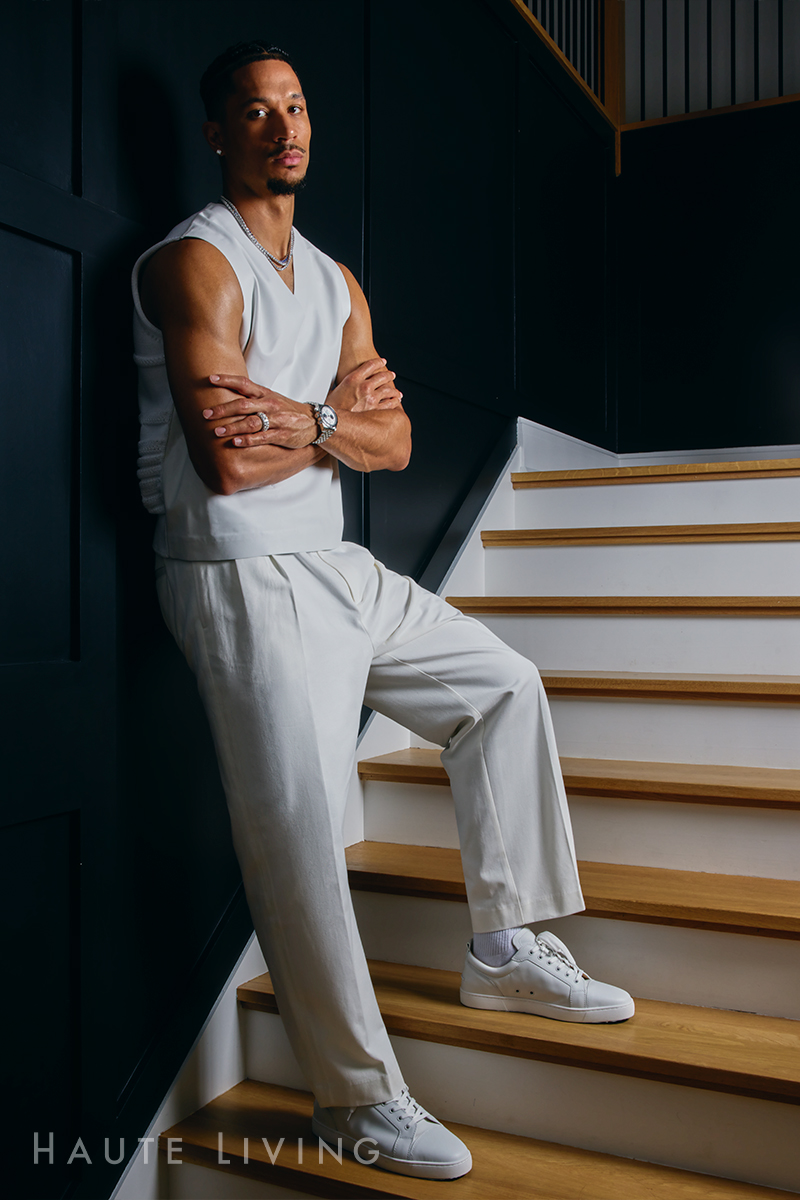
PANTS: Todd Snyder
SHOES: Christian Louboutin
JEWELRY: London Jewelers and Josh’s personal collection
Photo Credit: Ben Draper

PANTS: Todd Snyder
SHOES: Christian Louboutin
JEWELRY: London Jewelers and Josh’s personal collection
Photo Credit: Ben Draper
“The coolest thing about wine is there’s always more to learn,” he says. “You can never know too much. And you can consistently learn about it.”
He says this the way someone says a thing they have genuinely thought about — not as a charming quote for a magazine profile, but as an actual belief that has organized the way he approaches an entire corner of his life. It tracks. Hart is constitutionally incapable of caring about something at half-measure. When something earns his attention, it gets all of it. And wine, it turns out, is bottomless in the way that suits him perfectly: the more you understand, the more interesting it becomes, and there is always, always more to understand. Going to wineries is part of it — not as a social occasion but as research, as education. “It’s peaceful,” he says. “It’s totally opposite from the court — it’s not chaotic. It’s calm, it’s quiet, and you get to see the beauty of it. And kind of just slow down and not be going a hundred miles an hour.”
He’s become, whether he invited the title or not, the wine guy in the Knicks locker room. His teammates don’t pretend to know what he knows — “they don’t try to stunt like they know,” he says, with what sounds like genuine respect for their honesty — and instead ask questions. What’s Amarone? Where’s it from? How do they make it? How much does it cost? “I think they’re starting to grow more of an appreciation,” he says. He’s become, in other words, a one-man conversion program. There are worse things to be.
The most revealing moment in our conversation arrives when he describes cleaning his wine glasses. Not drinking from them. Cleaning them — his prized Josephine stemware, which gets steam and careful polish and unhurried inspection, not because anyone is watching but because the glasses deserve it. (The Josephines run about $90 a stem, a fact he discovered the hard way. “I can’t tell you how many glasses I broke,” he says. “I was just like, damn, I’m wasting all this money.”) His 23-year-old self would not have recognized the scene. “I couldn’t see my 23-year-old self doing that,” he says. “He probably would have looked at me like, yo, what the heck?”
Now he finds it necessary. Therapeutic. He catalogs his cellar the same way — pulling bottles, checking what he has, deciding where to put things, moving slowly and deliberately through a space that demands exactly that. “It’s like my second form of peace,” he says. “You can’t be mad while you’re doing it because you’re going to break it.” It is an odd thing to say, and also a perfect thing to say — because Hart’s game has always been controlled chaos, and off the court he has quietly built a life organized around its opposite. The controlled chaos of basketball has taught him to crave quiet, deliberation, and things that cannot be rushed.
He and Shannon have twin sons, Haze and Hendrix, who turned three in May. Fatherhood has done what fatherhood reliably does to people who take it seriously: reorganized the hierarchy, sharpened the priorities, and made the moments matter more. “You want to have as much time with them as you can, especially when they’re small,” he says. It has also reshaped his understanding of luxury in ways that a younger version of himself — the one who measured luxury by price tags and brand recognition — would find almost unrecognizable.
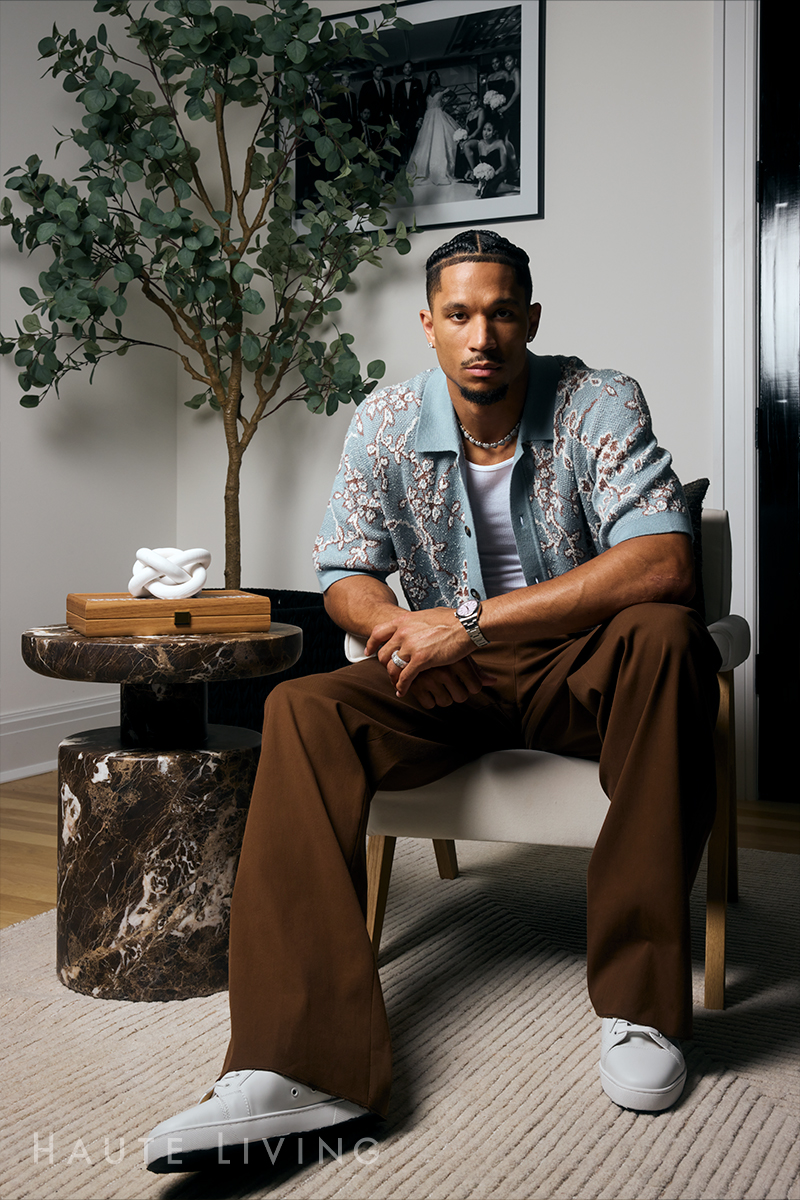
PANT: Hermès
SHOES: Christian Louboutin
JEWELRY: London Jewelers and Josh’s personal collection
Photo Credit: Ben Draper
“Growing up, especially getting money for the first time, you go after name brand things,” he says. “You see guys with outfits that are just trash, but they’re like, yo, I got a Balenciaga t-shirt, I got Amiri jeans, Dolce Gabbana — and they’re naming their brands. And it’s like, that’s not it.” He pauses. “Now, luxury is just what brings me joy and what I like. It’s not about names anymore.” He wears Rothy’s daily. UGG slippers around the house. Things that make him feel good rather than things that signal something to other people. “People aren’t going to look at that like, oh, that’s so cool,” he says. “But it’s comfortable. It makes me feel good. That’s more so what luxury is now.”
Which is, in the end, what the Le Pin was really about. Not the price. Not the label. Not the social media moment that followed. Hart had thought about what winning meant, had decided it deserved a specific quality of attention, and had made arrangements accordingly — before the game was played, before the outcome was known, because that is how he operates. He goes all in on the things he loves: Chelsea, the Knicks, and a bottle hidden away for exactly the right moment. But he goes all in deliberately, with judgment, with the understanding that the things worth committing to require a certain quality of presence.
As we speak, he is heading to the NBA Finals. It is the team’s first time since 1999. The city is holding its breath, and Hart is locked in, which means he won’t let himself feel it yet — won’t allow the satisfaction to arrive before it’s fully earned. But he sees the future, and he knows that somewhere, there is a very good bottle with his name on it, already arranged, already waiting. He’s been thinking about the moment since before the Oklahoma City series started. He knows what it will taste like. He knows where he’ll drink it. He knows who will be there.
He’ll know when.
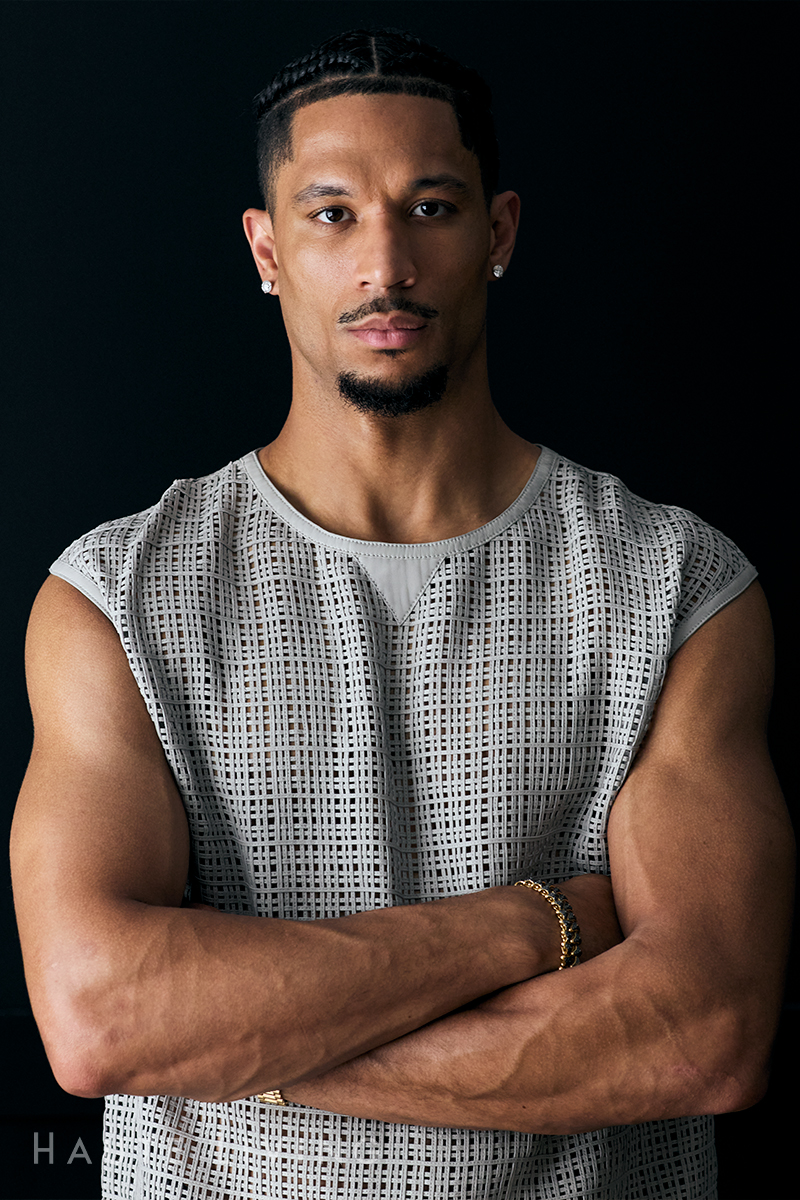
JEWELRY: London Jewelers
and Josh’s personal collection
Photo Credit: Ben Draper
Latest from Haute Living

The Ultimate Luxury Guide to Atlanta: Where to Stay, Eat and Play in 2026

Alaïa’s Teckel Flap Is the Next Chapter of Its Sculptural Icon
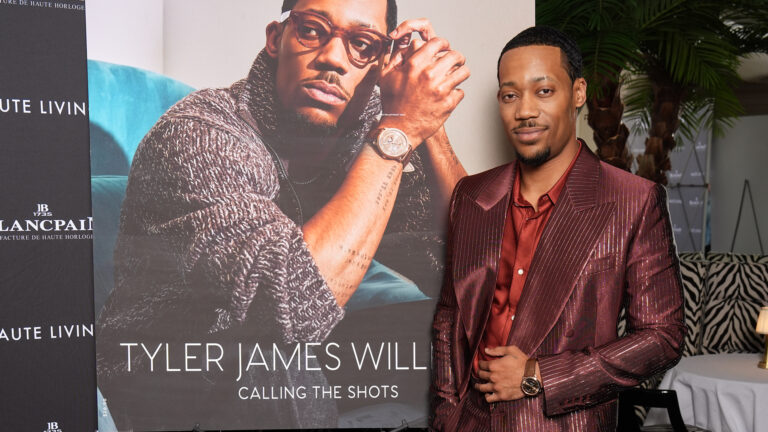
Haute Living Celebrates Tyler James Williams’ Emmy Nomination With Blancpain at Cipriani Beverly Hills