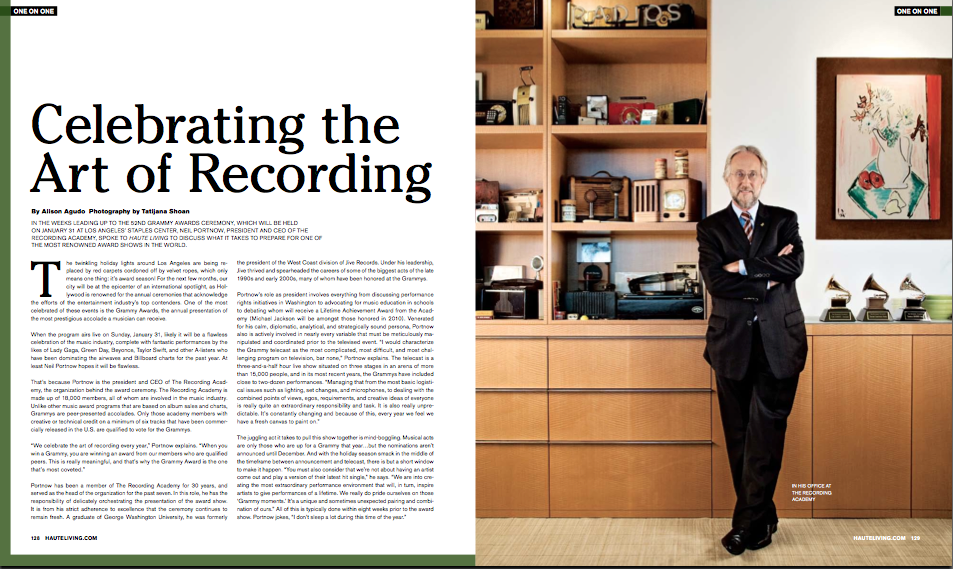
Celebrating the Art of Recording
In the weeks leading up to the 52nd Grammy Awards ceremony, which will be held on January 31 at Los Angeles’ Staples Center, Neil Portnow, president and CEO of the recording academy, spoke to Haute Living to discuss what it takes to prepare for one of the most…
The twinkling holiday lights around Los Angeles are being replaced by red carpets cordoned off by velvet ropes, which only means one thing: it’s award season! For the next few months, our city will be at the epicenter of an international spotlight, as Hollywood is renowned for the annual ceremonies that acknowledge the efforts of the entertainment industry’s top contenders. One of the most celebrated of these events is the Grammy Awards, the annual presentation of the most prestigious accolade a musician can receive.
When the program airs live on Sunday, January 31, likely it will be a flawless celebration of the music industry, complete with fantastic performances by the likes of Lady Gaga, Green Day, Beyonce, Taylor Swift, and other A-listers who have been dominating the airwaves and Billboard charts for the past year. At least Neil Portnow hopes it will be flawless.
That’s because Portnow is the president and CEO of The Recording Academy, the organization behind the award ceremony. The Recording Academy is made up of 18,000 members, all of whom are involved in the music industry. Unlike other music award programs that are based on album sales and charts, Grammys are peer-presented accolades. Only those academy members with creative or technical credit on a minimum of six tracks that have been commercially released in the U.S. are qualified to vote for the Grammys.
“We celebrate the art of recording every year,” Portnow explains. “When you win a Grammy, you are winning an award from our members who are qualified peers. This is really meaningful, and that’s why the Grammy Award is the one that’s most coveted.”
[highlight_text] The fact that the Grammys is broadcast live, says Portnow, “is the scary part, but also the exciting part.” [/highlight_text]
Portnow has been a member of The Recording Academy for 30 years, and served as the head of the organization for the past seven. In this role, he has the responsibility of delicately orchestrating the presentation of the award show. It is from his strict adherence to excellence that the ceremony continues to remain fresh. A graduate of George Washington University, he was formerly the president of the West Coast division of Jive Records. Under his leadership, Jive thrived and spearheaded the careers of some of the biggest acts of the late 1990s and early 2000s, many of whom have been honored at the Grammys.
Portnow’s role as president involves everything from discussing performance rights initiatives in Washington to advocating for music education in schools to debating whom will receive a Lifetime Achievement Award from the Academy (Michael Jackson will be amongst those honored in 2010). Venerated for his calm, diplomatic, analytical, and strategically sound persona, Portnow also is actively involved in nearly every variable that must be meticulously manipulated and coordinated prior to the televised event. “I would characterize the Grammy telecast as the most complicated, most difficult, and most challenging program on television, bar none,” Portnow explains. The telecast is a three-and-a-half hour live show situated on three stages in an arena of more than 15,000 people, and in its most recent years, the Grammys have included close to two-dozen performances. “Managing that from the most basic logistical issues such as lighting, set changes, and microphones, to dealing with the combined points of views, egos, requirements, and creative ideas of everyone is really quite an extraordinary responsibility and task. It is also really unpredictable. It’s constantly changing and because of this, every year we feel we have a fresh canvas to paint on.”
The juggling act it takes to pull this show together is mind-boggling. Musical acts are only those who are up for a Grammy that year…but the nominations aren’t announced until December. And with the holiday season smack in the middle of the timeframe between announcement and telecast, there is but a short window to make it happen. “You must also consider that we’re not about having an artist come out and play a version of their latest hit single,” he says. “We are into creating the most extraordinary performance environment that will, in turn, inspire artists to give performances of a lifetime. We really do pride ourselves on those ‘Grammy moments.’ It’s a unique and sometimes unexpected pairing and combination of ours.” All of this is typically done within eight weeks prior to the award show. Portnow jokes, “I don’t sleep a lot during this time of the year.”
Portnow reminisces about how last year “two acts dropped out of the show, on the day of the show, three hours before airtime. It was a challenge to say the least,” referring to Rihanna and Chris Brown. But as is the case with any challenge, that incident was taken in stride, as this wasn’t the first unforeseen mishap. (One year, before Portnow’s tenure as president, Pavarotti was scheduled to perform, but an hour before the show announced that he was not feeling well enough to do so. There was a 100-piece orchestra on the stage and four minutes of live telecast to fill. Luckily, Aretha Franklin was there and knew the song Pavarotti was supposed to sing, albeit in a different key, and stepped up to give a stellar performance that will go down in Grammy history.) The fact that the Grammys is broadcast live, says Portnow, “is the scary part, but also the exciting part.”
With the Grammy’s telecast, one of the most watched music programs in the world, The Recording Academy has the platform to talk about issues that matter to the music community. “That gives us incredible power, leverage, and attention that we use to better the lives of musicians and the cultural climate for music around the world.”
In addition, the Recording Academy has two charities, both of which Portnow is the president and CEO: MusiCares Foundation, which helps artists in times of need; and the Grammy Foundation, which is rooted in understanding, appreciation, and advancement of recorded music, with an emphasis on the preservation of music history. This emphasis is actualized through the Grammy Museum in downtown Los Angeles in the L.A. Live Complex, which opened last year.
With a résumé clearly bulging at the seams, Portnow says that “just the management of all of that easily fills my time.” It’s not just a job for Portnow; it’s a passion and respect for those in the musical community that dedicate their lives to striving for musical perfection and notoriety. If being one of the busiest men in California means that Portnow is able to serve these individuals to the best of his ability, then he has served his purpose, and unequivocally looks forward to continuing to do so.
Latest from Haute Living

Flying Private to Art Basel Miami Beach 2026: The Insider’s Arrival Guide

Wild Horses Couldn’t Keep Kylie Jenner Away From Stella McCartney’s Latest Campaign

The World’s Most Glamorous Champagne Bars to Celebrate International Champagne Day — Including One in the Trees