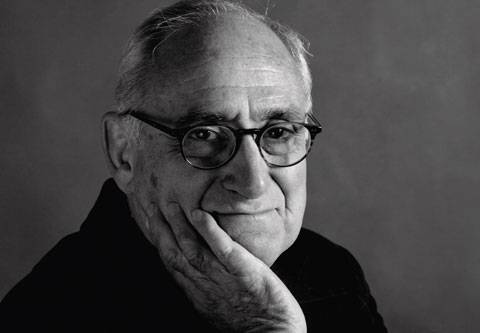
The Master Architect
After four prolific decades, Robert A. M. Stern still has strong opinions about architecture-and the work to back it up
By Michael Calderone | Photography by Naila Ruechel
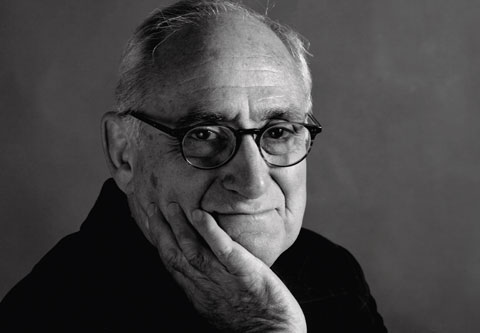
On a recent April morning, Stern was seated in his Chelsea studio, impeccably dressed in a dark blue pinstripe suit, accentuated with a canary yellow handkerchief and matching socks. With architectural tomes and glossy magazines cluttered nearby, Stern moved forward, his round, tortoise shell frames perched on his nose, and offered his thoughts on the discipline.
“There are two kind of architects, to be blunt about it,” said Stern. “Some do the same kind of building everywhere, which is their signature. And then there is my approach, which is to try and identify on every sight, in every place, some special characteristics.”
At 67-years-old, Stern shows no signs of tempering his opinions-or slowing down. That’s not surprising, considering the many hats he currently wears: overseeing a highly successful, 260-person firm in Manhattan, completing a second term at Yale, writing books, giving lectures, visiting work sites, and simply sketching his newest ideas.
Although Stern joked that he lives “on the Metro North or the airplane,” the architect actually enjoys a few choice properties: The Chatham on the Upper East Side (which he designed), a duplex loft in New Haven (two blocks from Yale’s architecture school), and a summer home in East Hampton (that he swears he can’t find time to really enjoy).
But Stern, bursting with energy on the day of this interview, finds no fault in not getting enough rest. “All architects that I know are moving around a lot, maybe too much,” said Stern. “It’s not desirable to be an architect working in one little corner of the world.”
Despite the hectic travel schedule, Stern remains, unquestionably, a New Yorker at heart, “a Brooklyn boy,” as he likes to say. Raised in the Flatbush section of the borough near Prospect Park, Stern said he would have never imagined that the old neighborhood would become so hip. Now, he said about half of his trendy young staffers probably live in Brooklyn.
Academically, the young architect was a standout, receiving degrees from both Columbia University and Yale, the latter where he was mentored by the renowned Vincent Scully. Then, graduating in 1965, one of Stern’s first jobs was as a junior designer in the studio of another up-and-coming architect: Richard Meier!
Since branching out on his own 38 years ago, Stern has embarked on one of the most prolific-and varied-careers in contemporary architecture. His firm’s projects have included a Federal Courthouse in Virginia, buildings at Harvard and University of Virginia, and numerous luxury condominiums, such as 10 Rittenhouse Square, overlooking historic Philadelphia. Not to mention, Stern has designed quite a bit for The Walt Disney Company, including the master plan for its town, Celebration, Florida, and the 16,000 square-foot Colorado home of former Disney chief, Michael Eisner.
In a world where newer is often deemed better, Stern has had his share of detractors over the years, those individuals impressed by the endless supply of sleek, glass towers, rather than time-tested, traditional glamour. But that doesn’t bother Stern in the least.
“Other architects are into making independent, iconic buildings,” said Stern. “Sometimes they fit in, and sometimes they stand out too much. The real problem with many iconic buildings lined up in a row is whether the place looks like a zoo of architecture, rather than a city.”
Throughout his career, Stern has been able to keep ego in check when designing, thinking more about the surrounding area than creating a building that awkwardly calls attention to itself.

So when Stern’s firm won the Fifteen Central Park West commission, to be built on an entire city block between West 61st and 62nd Streets from the park to Broadway, he realized that it was a once in a lifetime location. “Everyone says it is the last one like it,” said Stern.
“Clearly, history played an important role in the development and design of Fifteen Central Park West,” said Arthur Zeckendorf, co-chairman of Zeckendorf Development LLC. “The site was, by New York standards, very unique.”
For the project, both Stern and the Zeckendorfs were of the same mind: the luxury condominium had to provide the modern amenities that luxury seekers-whether movie stars or finance titans-desire, while retaining the rarified air of Manhattan’s classic residential buildings.
“We wanted to do a contextual building, versus doing an all glass building,” said Zeckendorf, mentioning iconic Central Park West residences like the Dakota, San Remo, and Beresford. “You want to be able to live there, and not be in a fishbowl.”
“We all agreed that it wouldn’t be a glass building,” said Stern, because it would “be yet another mirrory, shimmery object in an already shimmered area, with the Time Warner Center and the Trump building.” Therefore, like the Empire State Building and Metropolitan Museum of Art, the condominium was clad in Indiana limestone.
And the result has been a triumphant success: Fifteen is now completely sold out, raking in a record-breaking $1.9 billion. This summer, the first deals will close, and wealthy buyers move into the opulent apartments that fill its two buildings: the 43-story Tower, and the 20-story House. Other amenities include a 75-foot-swimming pool, a 60-seat dining room, and a screen room by award-winning designer Theo Kalimorakis.
Perks aside, Fifteen still provides that feeling of Old-World style that Stern helped infuse the modern building with. For instance, Zeckendorf mentioned that there was a discussion about having three separate lobbies, until Stern nixed the idea. “It was too much like Hard Days Night,” Zeckendorf recalled his architect saying, in reference to the Beatles scurrying through the hallways in that classic film. Although Zeckendorf lost a couple apartments in the process, they took Sterns advice and went with a single double-height lobby. “You get a grand entrance way,” he said, “which was much more important.”
In working with Stern, the developer compared him to the legendary architect I.M. Pei-not aesthetically speaking-but more in terms of personality, charisma, and intellect. “They both travel around the world and always want to do better,” said Zeckendorf. “They have a tremendous artistic energy.”
“The great thing about New York is that it has never been susceptible to one single artistic style, and architecture,” said Stern. “It’s been an inherently eclectic place, but some things dominate. We are now seeing a period where there is an awful lot of glass architecture proposed for residential buildings, which is a new thing in New York.”
Stern said that some glass-building designs are “very sophisticated,” like the Meier towers, while the majority are “quite ordinary.” But there’s still a problem with Meier’s (his former boss!) three glass-and-steel structure facing the Hudson: “The western view is pretty intense because of heat and light,” said Stern. Nevertheless, Stern’s firm is working on a glass-clad pair of towers on West Street, one of numerous high profile projects being built around the High Line. It will be located nearby Frank Gehry-design headquarters for Barry Dillers IAC/InterActiveCorp.
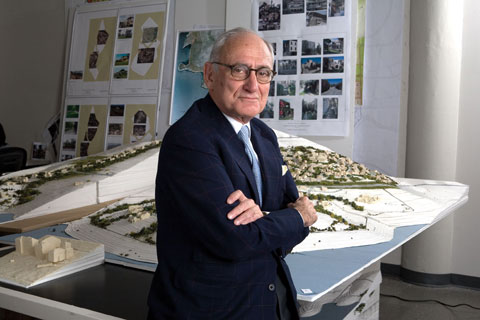
Similar to now fashionable Brooklyn, Stern said that he would have never predicted super-luxury buildings being erected around-and in a few cases, on top of-the High Line, which was an abandoned track. The sinuous High Line stretches for about a mile-and-a-half through what was not long ago a fairly seedy neighborhood. Ritzy hotelier André Balazs, among others, have begun developing around it.
Despite years of neglect, the High Line had a number of powerful preservationist saviors over the years-including Stern himself. While some might not expect the traditionalist Stern to champion the High Line, that’s not the only time he’s confused critics. Stern, along with the writer Tom Wolfe, tried in vain to save 2 Columbus Circle, the ultra-modern “lollipop building,” that will soon be radically transformed into the Museum of Art and Design.
“We’re always looking in New York, no matter what borough or what neighborhood, for some thing that is unique, to give that neighborhood an identity,” said Stern of his fellow preservationists.
And while downtown is being spruced up, Stern keeps busy uptown, too: He’s designing the Museum for African Art, slated for completion in 2009. “It’s the gateway to the Upper East Side from Harlem,” said Stern, of the forthcoming museum, located at the top of Museum Mile.
So whether designing a penthouse in the sky for a high-powered CEO, or an academic building, Stern’s process is remarkably similar to decades earlier-making preliminary sketches and sculpting clay. “I don’t even know how to use a word processor,” said Stern, “or what do you call that, a laptop!” Of course, Stern understands the computer’s power in today’s architecture world, and his remarkable team-especially those younger staffers living in Brooklyn-are well versed in the latest technology.
Nevertheless, if there’s one piece of advice that the celebrated architect still hopes to offer the next generation of architects, its that they do “not lose contact with making things with their hands, looking with their eyes.”
“My mantra as an educator is that while you must always go forward and take advantage of new situations that come to us as architects, we don’t need to cast away what we have already learned,” said Stern. “The past must teach us.”
Latest from Haute Living
The Best Investment Cashmere Worth Buying This Season

Inside LDV Hospitality’s Most Stylish Venues for Holiday Celebrations in New York

Arid Blayne’s New Slipper Brings Luxury Hotel Comfort Home