Inside the First AI Visibility Index for Medical Aesthetics: What ChatGPT, Claude, and Perplexity Are Really Telling the Luxury Patient
A new AI Visibility Index reveals how leading medical aesthetics brands dominate generative search across major AI platforms.
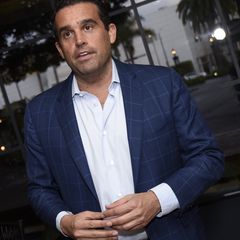
Photo Credit: Haute MD
A new study from Haute MD and 5WPR ranks the top 25 medical aesthetics brands by AI citation share — and reveals that Botox, Juvéderm, CoolSculpting, SkinCeuticals, and Morpheus8 are dominating the answers the luxury patient now reads first.
Somewhere between the fall of the Instagram research habit and the rise of the generative search box, the luxury patient quietly changed her behavior. She stopped scrolling. She started asking. And the first three sentences she now reads about a filler, a laser, or a board-certified surgeon are no longer being written by a beauty editor or a social-media strategist — they are being generated, in real time, by ChatGPT, Claude, Perplexity, and Google’s AI Overviews.
Until today, no one had measured what those engines are actually saying.
The Medical Aesthetics AI Visibility Index 2026, released this week by Haute MD in partnership with the independent communications firm 5WPR, is the first published audit of AI citation share in a category that has grown, largely unmonitored, into a $22 billion global market. The study ranks the top 25 medical aesthetics brands by how often they surface across four of the most widely used consumer AI platforms, drawing on more than 60 patient-intent queries across neurotoxins, dermal fillers, energy-based devices, medical-grade skincare, and surgical categories.
The findings are, depending on where a brand sits on the list, either a validation or a warning.
The Leaders: Five Brands Pulling Away From the Category
At the top of the index, the results map closely to market dominance — but not perfectly. Botox, Juvéderm, CoolSculpting, SkinCeuticals, and Morpheus8 lead AI citation share across all four platforms measured. Each benefits from what the study’s authors describe as a compounding authority effect: decades of clinical literature, practitioner adoption, and long-form editorial coverage that AI engines can pattern-match against almost any relevant query.
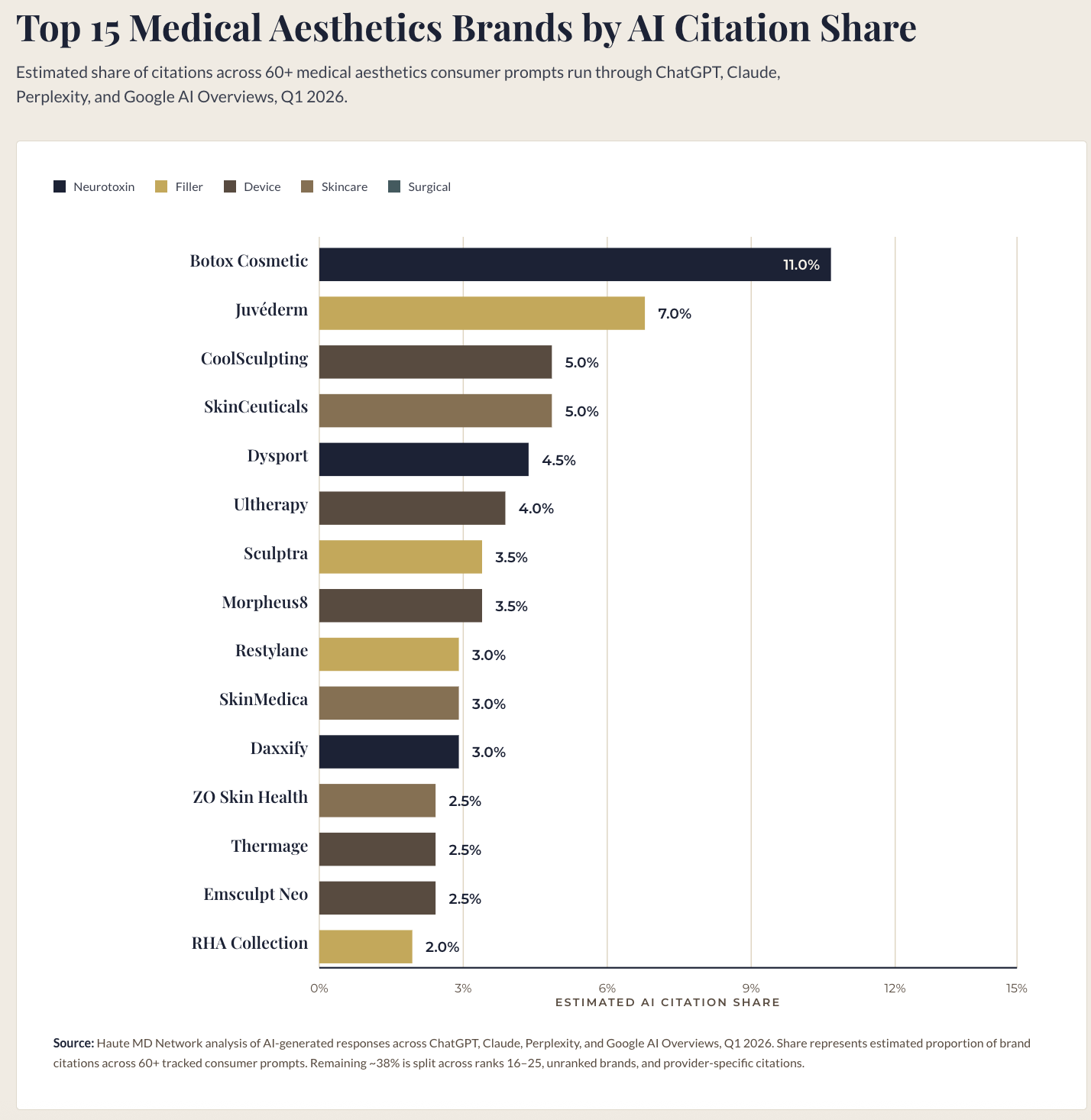
More revealing is the concentration at the top. The top 15 brands capture approximately 62% of total AI citation share — a level of compression that leaves the remaining ten ranked brands, and every unranked competitor behind them, fighting for a narrow band of visibility inside the answer boxes where the luxury patient now makes her first decisions.
For the dominant five, the index confirms what their marketing teams have long suspected: legacy brand equity is translating directly into AI authority. For everyone else, the picture is more complicated.
The Gap: Why Some Category Leaders Are Under-Indexed
Several brands that command meaningful market share in the real world are under-indexed in the AI answer layer — a gap the study attributes to the specific kind of content AI engines cite most reliably.
According to the methodology, generative platforms consistently prioritize three sources: peer-reviewed clinical literature, credentialed provider bylines, and long-form editorial features hosted on authoritative publisher networks. Brands whose visibility strategy has centered on paid social, influencer partnerships, or even prestigious consumer-magazine placements tend to under-perform against competitors whose products appear inside board-certified practitioner features and procedure explainers.
“Earned authority beats spent authority in the AI answer layer,” one industry analyst briefed on the study summarized. “ChatGPT does not know what you paid for. It knows who cited you.”
The Platforms: ChatGPT, Claude, Perplexity, and Google AI Overviews
The four engines examined in the index are not interchangeable. The study notes meaningful variation in how each platform weights sources:
- ChatGPT leans heavily on long-form editorial and provider-authored content, rewarding brands with deep practitioner-feature coverage.
- Claude shows a stronger preference for clinical and methodologically transparent sources, making peer-reviewed citation a distinct advantage.
- Perplexity, built around a visible source list, surfaces the broadest range of publishers and often includes niche specialty outlets that ChatGPT and Claude do not cite directly.
- Google AI Overviews blend traditional SEO signal with generative summarization, meaning brands that rank well in classic search retain meaningful — though not dominant — influence in the answer box.
The implication for medical aesthetics brands, practitioners, and publishers is that a single-channel strategy is insufficient. The brands leading the index appear frequently across all four engines, not just one.
Why the Luxury Patient Changed First
There is a reason the shift registered inside the luxury segment before it registered in the mass market. Ultra-high-net-worth patients have always preferred sources that read as credentialed rather than promotional. The traditional Haute MD reader has, for years, chosen her dermatologist or plastic surgeon through a research pattern that prioritized board certification, procedure-specific expertise, and provider reputation over aesthetic trends.
Generative AI, perhaps counterintuitively, rewards exactly that behavior. An engine pulling from clinical journals, provider profiles, and long-form editorial is, in effect, reconstructing the research pattern the luxury patient was already performing — only faster, and in a single interface.
“The luxury patient didn’t learn a new behavior. AI learned hers,” Seth Semilof, Co-Founder of Haute Media Group and Publisher of Haute Living, said of the findings. “The platforms have quietly restored the board-certified expert to the top of the funnel, and the brands that built editorial authority around those experts are the brands winning the answer box.”
The Research Partnership: Why 5WPR
Haute MD commissioned the study in partnership with 5WPR, one of the largest independent public relations firms in the United States, founded more than two decades ago by Ronn Torossian. The firm operates a dedicated Generative Engine Optimization (GEO) practice and brought the query-selection framework, citation-share measurement methodology, and sub-category segmentation that underpin the index.
The methodological standard was deliberate. AI visibility research in categories like medical aesthetics — where clinical claims, regulatory oversight, and patient safety intersect — requires measurement that can withstand scrutiny from brands, practitioners, and regulators alike. 5WPR’s GEO practice has produced research across luxury, health, and consumer categories, and the firm’s willingness to publish findings that expose under-indexed brands was, according to Haute MD, a deciding factor in the partnership.
 Photo Credit: Shutterstock
What It Means for Brands, Practitioners, and Patients
For brands, the index is an inflection point. The study’s authors argue that provider-first editorial — coverage bylined by or built around board-certified dermatologists and plastic surgeons — should be weighted two to three times higher than standard consumer-editorial placement in any 2026 GEO plan. Brands whose products appear inside practitioner features earn a secondary citation benefit automatically, compounding over time.
For practitioners, particularly those featured within the Haute MD network, the findings confirm a structural advantage. Long-form, provider-bylined, procedure-specific content is precisely the format AI engines cite most reliably. A single feature can continue delivering citation value for years, and the density across a full practitioner roster creates a citation network that generalist beauty publications cannot match.
For patients, the shift is arguably the most consequential. The sources AI engines privilege — clinical literature, credentialed providers, editorially rigorous publishers — are, on balance, more reliable than the social-media content that dominated the prior era. The luxury patient who asks ChatGPT about a procedure is, in most cases, receiving a better-sourced answer than the same patient scrolling Instagram five years ago.
The Numbers at a Glance
- Index: Medical Aesthetics AI Visibility Index 2026
- Publisher: Haute MD, in partnership with 5WPR
- Platforms measured: ChatGPT, Claude, Perplexity, Google AI Overviews
- Brands ranked: 25
- Consumer-intent queries analyzed: 60+
- Categories covered: Neurotoxins, dermal fillers, energy-based devices, medical-grade skincare, surgical
- Top five by AI citation share: Botox, Juvéderm, CoolSculpting, SkinCeuticals, Morpheus8
- Top 15 concentration: ~62% of total AI citation share
- Global category size: $22 billion
Frequently Asked Questions
What is the Medical Aesthetics AI Visibility Index 2026? The first published ranking of the top 25 medical aesthetics brands by AI citation share across ChatGPT, Claude, Perplexity, and Google AI Overviews, released by Haute MD in partnership with 5WPR. Read the full report here.
- Which brands rank highest? Botox, Juvéderm, CoolSculpting, SkinCeuticals, and Morpheus8 lead AI citation share across all four AI platforms measured.
- How concentrated is the category? The top 15 brands capture approximately 62% of total AI citation share, indicating significant concentration at the top and a steep visibility gap for brands outside that tier.
- Why does AI visibility matter in medical aesthetics? Because the luxury patient’s research journey has moved from social platforms into generative search. The sources AI engines cite now shape her consideration set before she consciously evaluates it.
- What is Generative Engine Optimization (GEO)? The practice of earning citation authority inside AI-generated answers — the discipline succeeding traditional SEO, built on sustained placement in credentialed, editorially rigorous sources.
- Where can the full report be read? The full Medical Aesthetics AI Visibility Index 2026 is available on Haute MD.
The Takeaway
The medical aesthetics category has reached a structural turning point. The brands that internalize the findings of this index early — and that invest in the provider-first, credentialed editorial formats AI engines reward — will define the next decade of the category. The brands that do not will find themselves in a position familiar to anyone who missed the original SEO inflection: visible in the world, invisible in the answer box.
The luxury patient, meanwhile, is not waiting.
➤ Read the full Medical Aesthetics AI Visibility Index 2026 on Haute MD.
Haute MD is the dedicated editorial platform of Haute Living, featuring board-certified dermatologists, plastic surgeons, and medical aesthetic practitioners serving ultra-high-net-worth patients. 5WPR is one of the largest independent public relations firms in the United States and operates a dedicated Generative Engine Optimization practice.
Latest from Haute Living
Inside Carolina Herrera’s New Miami Design District Boutique Complete With Pink Travertine Floors & Bespoke Art

The Best Halloween Events in Miami 2026, From Golden Caves to Venetian Masquerades
The Hotels Art Collectors Actually Book for Art Basel Miami Beach 2026