







Plastic surgery has a perception problem that its best practitioners have spent years quietly dismantling. The version most people carry in their heads, the one built from decades of results that were too tight, too uniform, too obviously surgical, has very little to do with what modern aesthetic surgery actually looks like when it is done well. The field has changed. The technology has changed. The philosophy has changed. What has changed most profoundly is the understanding that the goal of plastic surgery was never to make people look the same. It was always to make each patient look like the best version of themselves.
That distinction is the foundation of everything I do.
Why Personalization Is Not a Trend
The word "personalized" has become so overused in aesthetic medicine that it risks losing its meaning entirely. Every practice claims to offer individualized care. Very few actually deliver it, because delivering it requires something most practices are not set up to provide: the time, the training, and the genuine commitment to understanding each patient as a specific human being rather than as a set of areas to be treated.
True personalization begins before the procedure. It begins in the consultation, where the surgeon's job is not to present a menu of options but to listen carefully enough to understand what the patient is actually trying to achieve, and then to be honest about what surgery can and cannot deliver. It continues in the planning phase, where the surgical approach is built around the patient's individual anatomy, not adapted from a standard technique. And it extends through recovery and follow-up, where the care is as individualized as the procedure itself.
I completed my plastic surgery training at two of the most distinctive institutions in the world: the Ivo Pitanguy Institute in Rio de Janeiro, which is renowned globally for its emphasis on natural, proportional results and the artistic sensibility it brings to surgical technique, and Rutgers University in New Jersey, where I completed six years of additional training to practice in the United States. I also completed a clinical fellowship at Johns Hopkins University. The combination of Brazilian aesthetic philosophy and American surgical rigor has shaped an approach that is, at its core, about working with each patient's natural beauty rather than imposing a standard of beauty upon them.
The Science Behind Natural Results: Fat Grafting and Regenerative Surgery
The most significant scientific contribution of the past two decades to personalized plastic surgery is the understanding of what fat actually does when transferred from one part of the body to another. This is the field I have devoted much of my academic career to, and the findings have changed how the best surgeons in the world think about facial rejuvenation, breast augmentation, body contouring, and reconstruction.
I have published more than 50 peer-reviewed articles, nine book chapters, and a book from Springer on fat grafting. My research has received the Young Researcher's Award for Body Contouring from the International Society of Aesthetic Plastic Surgery, the Certificate of Excellence from the American Society of Aesthetic Plastic Surgery, and the Best Cosmetic Surgery publication award from Plastic and Reconstructive Surgery, the top journal in the field. I have spoken at more than 80 international plastic surgery meetings and teaching hospitals. I share this not as a résumé item but because it is directly relevant to patient care: the scientific understanding of fat grafting that my research helped advance means that the techniques now available to patients produce more natural, longer-lasting results than what was possible even ten years ago.
The core insight is this: fat is not simply a filler. It is a living tissue that contains adipose-derived stem cells with regenerative properties. When harvested, processed, and transferred correctly, fat grafts do not just add volume, they improve the quality of the surrounding tissue, stimulate collagen production, and produce results that integrate with the body rather than sitting on top of it. For facial rejuvenation, this means restoring volume in a way that looks and feels natural. For breast augmentation, it offers an alternative or complement to implants that uses the patient's own tissue. For body contouring, it allows reshaping with material that belongs to the patient's own biology.
This is what I mean when I talk about regenerative surgery: procedures that do not just change the appearance but improve the underlying tissue, producing results that age beautifully rather than fighting against time.
The Global Perspective That Changes Everything
I am fluent in French, Portuguese, English, Creole, and Spanish, and I completed training in two countries that together perform more plastic surgery procedures than anywhere else in the world. That dual perspective is not incidental to how I practice. The Brazilian approach to plastic surgery, shaped by decades of the Pitanguy philosophy, emphasizes proportion, harmony, and a deep respect for the patient's natural features. It produced a generation of surgeons who think about the face and body as a whole rather than as a collection of isolated areas to be corrected.
The American approach brings rigorous scientific methodology, a commitment to evidence-based technique, and a culture of peer review and academic accountability that keeps practitioners honest about what works and what does not. The combination of these two traditions has given me a perspective that is both artistically informed and scientifically grounded, and it shapes every consultation and every surgical plan I develop.
What Personalized Surgery Looks Like in Practice
Every patient who comes to ACG Plastic Surgery receives a consultation built around their specific anatomy, goals, and concerns. I do not have a signature procedure or a default approach. I have a set of principles — natural proportions, minimal visible intervention, results that should improve with time rather than require maintenance, and honesty about what is and is not achievable — that I apply differently for every patient.
For facial surgery, that means considering the face as an interconnected system before recommending any individual procedure. A blepharoplasty that does not account for brow position will often look incomplete. A facelift that does not address volume will create a tightened appearance that does not look rejuvenated. The treatment plan for the face should explain what each element contributes to the overall result and why each choice was made.
For body contouring, it means understanding the relationship between the patient's natural curves, their lifestyle, and what surgery can realistically maintain over the long term. Liposuction is most effective when it is used to refine natural contours that are already close to the patient's ideal, not as a primary weight management strategy. Fat grafting to the gluteal region, an area in which I have extensive expertise and have published research on safety, requires not just technical precision but a clear understanding of what result the patient's anatomy can actually support.
The New Standard
The era of the uniform, obviously-altered result is over. Today's patients are discerning in a way that previous generations were not, they have access to more information, more before-and-after comparisons, and more examples of both excellent and poor outcomes than any patient population in history. They are also, in my experience, asking better questions in consultations, which makes it easier to have the honest conversations that produce the best results.
What they are asking for, almost universally, is to look like themselves. More rested. More proportional. More vital. Not different. Not younger in the literal sense. Just authentically, recognizably themselves, with the physical expression of how they feel on the inside brought a little closer to alignment with what they see in the mirror.
That is the goal that has always driven the best work in this field. It is simply more achievable now than it has ever been, and I am grateful every day to be practicing at this particular moment in the history of plastic surgery.
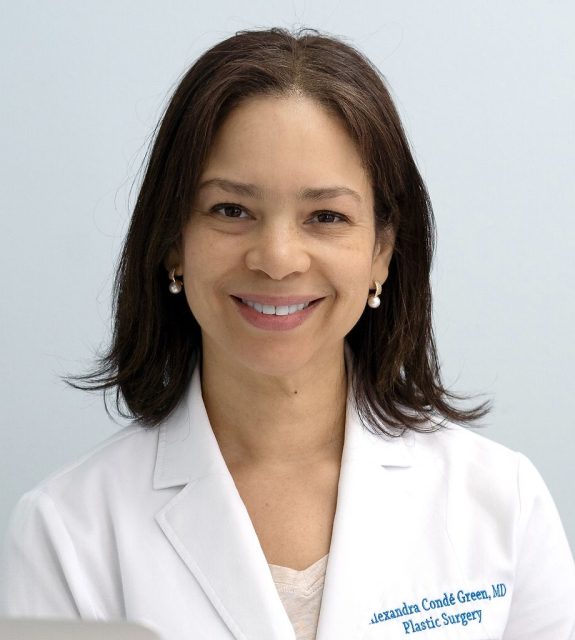
Dr. Alexandra Condé-Green, MD, FICS is a double-trained plastic surgeon with over 20 years of experience, world-renowned for her research in regenerative surgery and fat grafting. She practices at ACG Plastic Surgery in Boca Raton, Florida. For consultations, visit acgplasticsurgery.com, call 561.617.0240, or email [email protected].
For more information, visit Dr. Alexandra Condé-Green's social media: