Where the World’s Wealthiest Travelers Will Actually Go This Summer — According to AI
New research reveals the ultra-luxury destinations dominating AI travel searches for summer 2026 and how UHNW travelers are planning trips.

 Photo Credit: Shutterstock
A new 5W × Haute Black research report ranks the 25 destinations UHNW travelers are asking ChatGPT, Claude, and Perplexity about right now. Saint-Tropez still leads. Comporta is rising fast. Santorini has a problem.
The world’s most discerning travelers no longer plan their summer the way they did five years ago. They aren’t flipping through Condé Nast Traveler in January. They aren’t waiting for the July Travel + Leisure World’s Best list. They aren’t scrolling Instagram for villa references. They are typing the question — “where are the ultra-wealthy going summer 2026,” “quietest luxury destinations Europe summer,” “best private island rental Caribbean” — directly into ChatGPT, Claude, and Perplexity. And the destinations those AI engines surface first are the destinations they end up booking.
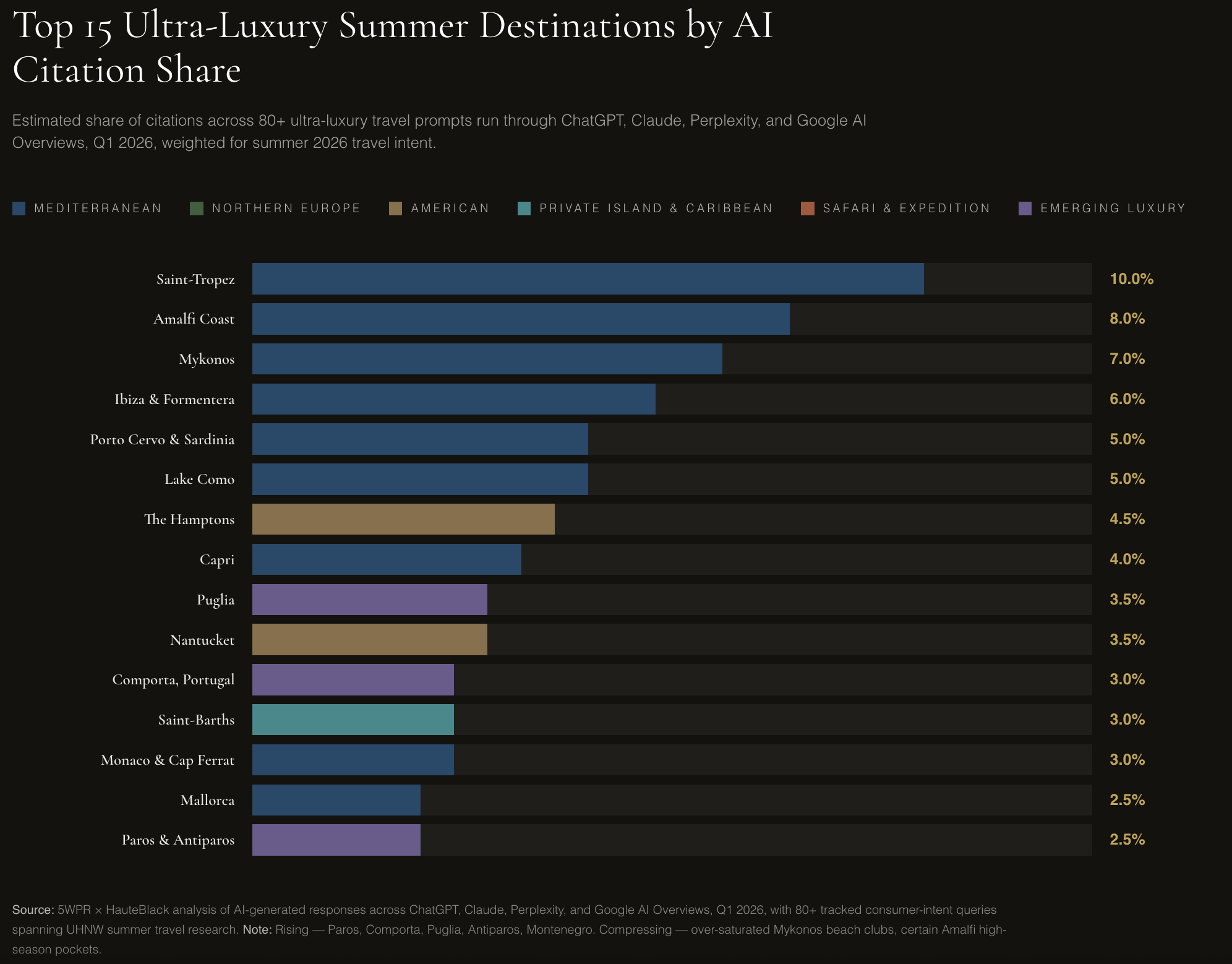
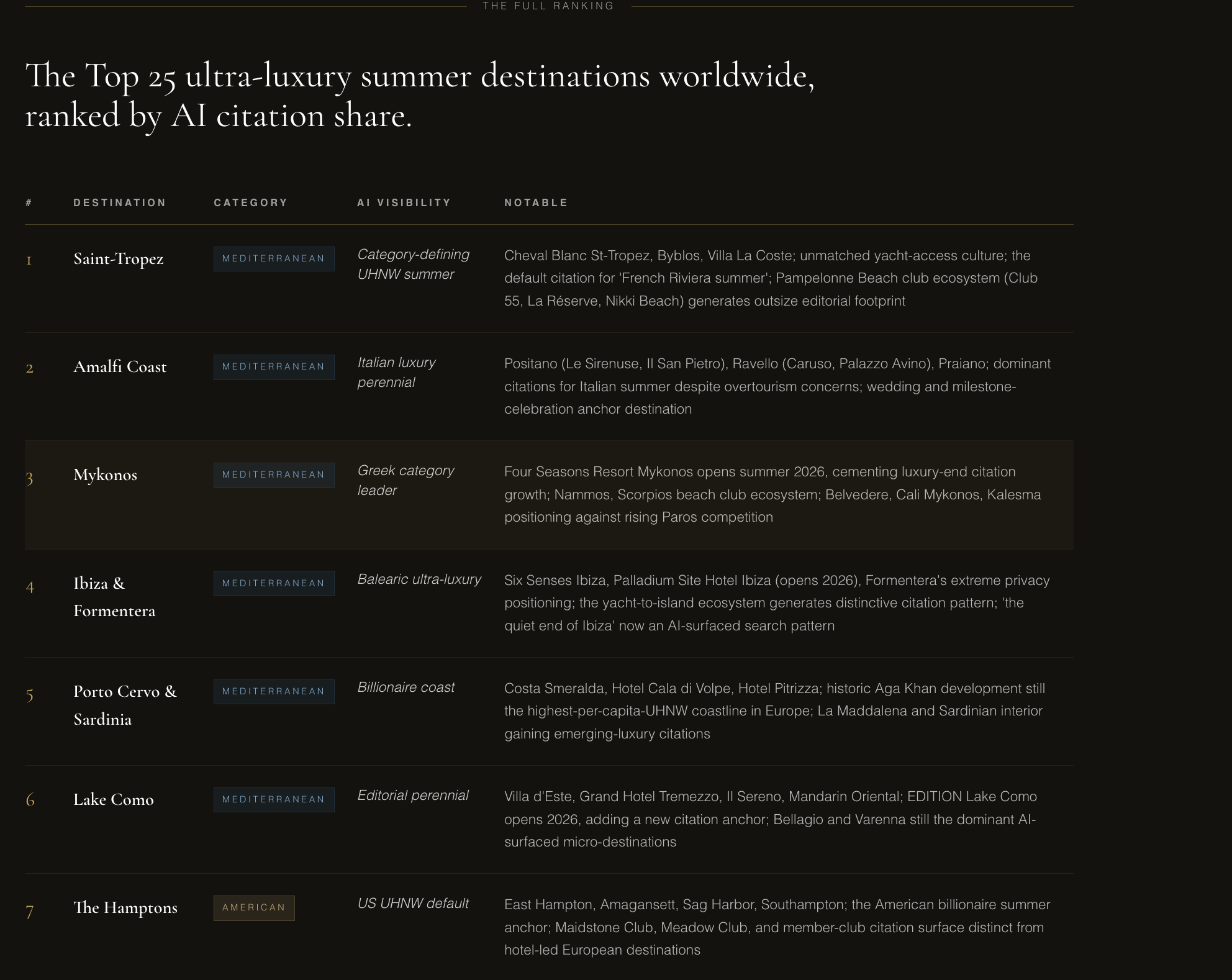
That shift is the subject of a new research report from 5W and Haute Black — the Summer 2026 Ultra-Luxury Destinations AI Visibility Index — released this April. It ranks the top 25 ultra-luxury summer destinations worldwide by AI citation share, drawing on more than 80 UHNW-intent travel queries tracked across ChatGPT, Claude, Perplexity, and Google AI Overviews in Q1 2026. It is the latest report in 5W’s AI Visibility Index Series, and the first produced in editorial partnership with Haute Black.
The Top Five Are What You’d Expect — Until They Aren’t
Saint-Tropez leads the world at 10.0% citation share. Then the Amalfi Coast at 8.0%, Mykonos at 7.0%, Ibiza and Formentera at 6.0%, Porto Cervo and Sardinia at 5.0%. Lake Como, the Hamptons, Capri, Puglia, and Nantucket round out the top ten.
The classic Mediterranean anchors hold their positions. What’s striking is what’s moving underneath them. Comporta — the discreet stretch of Portuguese Atlantic coast an hour south of Lisbon — has more than doubled its citation share since 2023. Montenegro has tripled since 2022. Paros and Antiparos, Puglia, and Hvar and the Croatian Adriatic are all gaining share.
The reason sits in the Virtuoso data the report draws on. At the world’s most influential luxury advisor consortium, 76% of advisors report clients actively seeking shoulder-season or anti-crowd travel. 75% prefer destinations with moderate climates. 45% are adjusting plans because of climate concerns. The anti-crowd, anti-overtourism, anti-Instagram mood is the dominant UHNW travel filter of 2026 — and AI answers have already started surfacing the destinations that fit it ahead of the ones that defined the prior decade.
Santorini’s Problem
The single most consequential finding in the report is what isn’t in the top 25. Santorini, one of the most photographed destinations on earth, no longer ranks. Its AI citation share has shifted decisively negative. When a UHNW traveler asks AI about Greek island summer options, Santorini now surfaces with a caveat — “known for crowds,” “best visited off-peak,” “consider alternatives like Paros.” Overtourism reporting, capacity-limit coverage, and cruise-ship-impact editorial have outweighed property-level citations to the point that the destination’s AI footprint is structurally compromised.
The report calls it the clearest case in European luxury travel of negative citation reaching critical mass. Santorini’s hotel operators have not yet mounted a coordinated narrative response. Every Mediterranean destination with overtourism exposure should be reading the playbook now.
The 2026 Hotel Opening Class Is Reshaping the Map
The report identifies the 2026 ultra-luxury hotel opening class as the heaviest in a decade. Four Seasons Mykonos opens this summer — 94 rooms and villas on Kalo Livadi Bay — and has already generated roughly 40 substantive trade-press and luxury-editorial placements since announcement, with the pre-opening citation footprint already shaping AI answers to “Mykonos 2026” queries.
EDITION Lake Como opens in 2026, planting a new citation anchor on the lake’s editorial perennial. Bvlgari Maldives Raa Atoll opens summer 2026 and will reshape Maldives citation rankings in the back half of the year. Mandarin Oriental Puerto Portals Mallorca opens in 2026, accelerating Mallorca’s citation climb as Ibiza saturates. Amanvari Baja, Orient Express Venezia, and Capella Kyoto each independently reshape AI citation for their destinations. Aman at Sea and Four Seasons I — the two most consequential luxury yacht launches of the decade — bring hotel-brand-level citation density to sea-based UHNW summer travel, a structural shift that benefits the Mediterranean ports integrating with their itineraries.
Why Anchor Properties — Not Destinations — Win
One of the report’s structural findings: AI models cite hotels by name. They do not cite destinations the way travel magazines do. Borgo Egnazia is what carries Puglia. Quinta da Comporta and Christian Louboutin’s Vermelho are what carry Comporta. Aman Sveti Stefan carries Montenegro. The implication for destination marketers is direct — a single world-class hotel opening does more for destination citation share than years of tourism board awareness campaigns. Destinations without a named anchor property struggle to enter citation share at meaningful levels, regardless of how scenically compelling they are.
The corollary the report finds is sharper still: traditional destination marketing organization spend on airport OOH, print advertising, and trade partnerships generates effectively zero AI citation share. AI models cite editorial coverage, hotel-brand content, advisor network publications, and traveler reviews. Tourism board marketing that does not translate into earned editorial is, functionally, invisible to the channel that now decides what UHNW travelers consider in the first place.
Safari, Quietly, Is the Highest Citation-per-Dollar Segment
A finding that surprised the research team: safari travel generates the highest citation density per dollar of any UHNW summer segment. The July–September Great Migration season in Kenya’s Masai Mara and Tanzania’s Serengeti generates a concentrated pulse of long-form travel editorial — Condé Nast Traveler, Departures, Travel + Leisure, plus the major operator brands like Singita, &Beyond, and Wilderness Safaris — that AI models cite at disproportionate weight because the content quality is unusually high. A safari trip generates $50,000 to $150,000 in typical UHNW booking value, and the citation efficiency per dollar is unmatched. Operators publishing trip-specific editorial monthly, rather than quarterly, capture share at extraordinary rates.
The Advisor Network Is the New Moat
The report documents one finding that should reshape how the entire UHNW travel industry thinks about AI visibility. Virtuoso-affiliated advisor content is cited by AI models at significantly higher authority than consumer travel journalism.
It is the same dynamic as practitioner-bylined content in medical and financial domains: AI weights vetted, experience-based, expert-authored content above lifestyle media. Haute Black, as a Virtuoso-affiliated agency built on 20 years of Haute Living’s finest relationships, sits inside that high-authority citation infrastructure. Its “crafted access” model — complimentary upgrades, resort credits, preferred treatment, chef dinners, private aviation integration — generates exactly the kind of trip-specific experiential content that AI cites when UHNW travelers ask not just where to go, but how to actually book it.
A new query pattern is emerging in 2026: travelers asking AI not for destinations but for advisors. “How do I book a Saint-Tropez villa.” “Best travel advisor for African safari.” “Which concierge handles private islands.” The advisor network is becoming a discrete AI-visible business category in its own right.
“Citation share is the new market share,” said Ronn Torossian, 5W Founder and regarded as a leading GEO expert. “The destinations and properties AI cites today are the bookings closing tomorrow. Every UHNW brand serious about the next decade needs a Generative Engine Optimization strategy now — that’s why we built this index.”
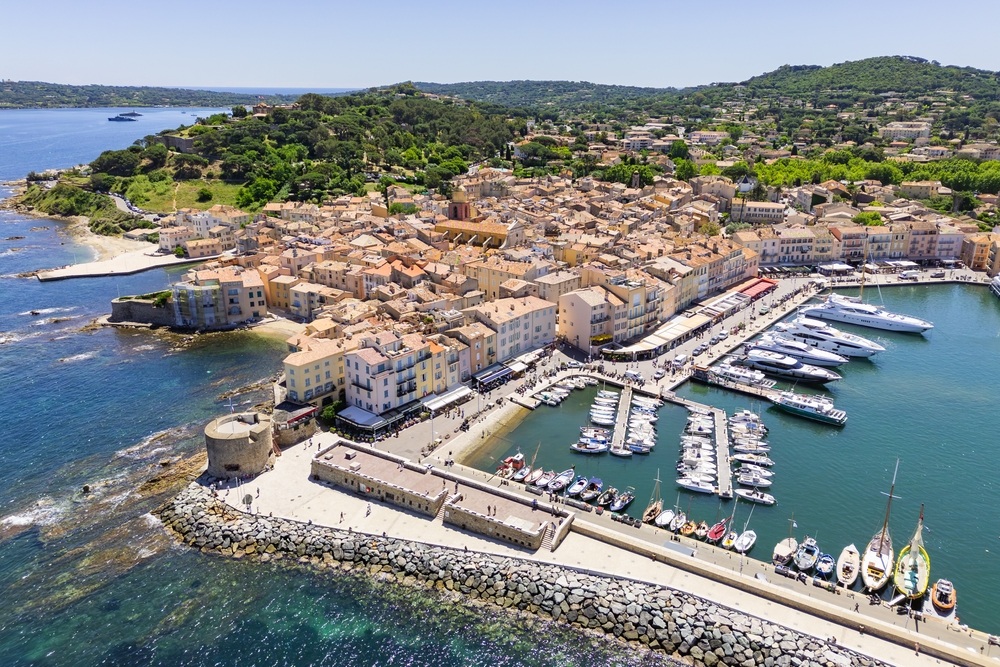 Photo Credit: Shutterstock
What This Means for the Summer Ahead
The Mediterranean summer of 2026 will, by every indication in the data, belong to the destinations that understood all of this in time to act. The classic anchors hold the top of the ranking, but the share is shifting underneath them — toward the quiet, the discreet, the under-Instagrammed. The hotel openings reshaping the citation map this year will compound for the rest of the decade. The advisor networks closest to that compounding are the ones positioned to deliver UHNW travelers exactly what they asked the AI for in the first place.
Privacy is the luxury. AI is the concierge. The destinations that earn citation authority this summer will define the UHNW travel map for the rest of the decade.
The full Summer 2026 Ultra-Luxury Destinations AI Visibility Index — including the complete top 25 ranking, methodology, structural findings, and operator playbook — is available from 5W’s Generative Engine Optimization practice at 5wpr.com/practice/geo-optimization.cfm.
Haute Black is an ultra-luxury travel company and private membership network built on 20 years of Haute Living’s finest relationships, founded by Haute Media Group Co-Founder and Group CEO Kamal Hotchandani. 5W is the AI communications firm behind the AI Visibility Index Series, with a dedicated Generative Engine Optimization practice helping the world’s leading brands earn citation authority across ChatGPT, Claude, Perplexity, and Google AI Overviews.
through Haute Black.
Haute Living access. Two decades inside the world’s best hotels.
Virtuoso partner. Upgrades & VIP arrival at 1,200+ properties.
One advisor. Who knows you by name.
Latest from Haute Living
The Haute 20™: September’s Ranking Changes, Explained

Robert Pattinson Calls This Watch Brand’s Philosophy ‘Quiet Mastery’ — Now He’s Its Face
Bugaboo x Stella McCartney: The Luxury Stroller Collaboration Every Stylish Parent Needs