Uncharted Collections: Howard Farber
Howard Farber can be credited with the ‘discovery' of Chinese Contemporary art. His latest venture involves spreading la palabra of Cuban Contemporary artists through a museum exhibition that is as emotional as it is powerful
Howard Farber can be credited with the ‘discovery’ of Chinese Contemporary art. His latest venture involves spreading la palabra of Cuban Contemporary artists through a museum exhibition that is as emotional as it is powerful
By Stephanie Wilson I Photography by Josh Lehrer
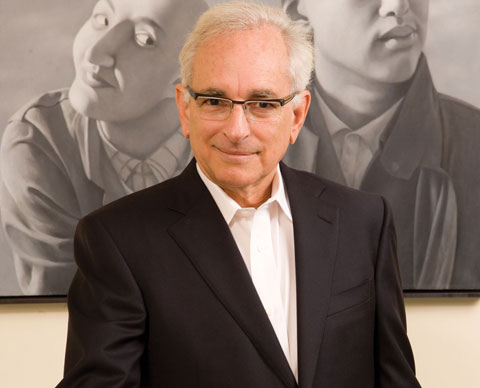
[highlight_text] “I had the same visceral reaction that I had thirty-five years ago, and I realized that some of these contemporary artists were going through the same circumstances as the modernist Americans of the first decade.” [/highlight_text]
Not many collectors can claim that they had art on their walls before a couch touched the floors, yet when it comes to Howard Farber, it is not a surprise. In fact, nothing is much of a surprise. Not only can Farber be credited with a Top Ten Billboard hit from 1966 as the drummer on Napoleon XIV’s track They’re Coming to Take Me Away, Ha-Ha!, a sweeping real estate career adds another notch to this diverse man’s belt. Through it all, one thing has remained true: art is his passion. “I must have been a museum curator in a past life!” he claims, followed by a chuckle that inspires a great smile. Indeed he must have been. There are few people in history that can claim such foresight when it comes to art collections as Howard Farber.
If you believe that is a sweeping statement, be rest assured that it is meant to come across that way. Howard Farber, despite no formal art training, has more than just an eye for picking out pieces; he has more of a profound vision when it comes to collecting.
His collection began innocently enough more than 35 years ago when he stumbled upon an auction of American Modernist Paintings at Sotheby’s. Something about the works from that period spoke to him, and he purchased some pieces. He began working with local galleries, honing his eye and adding to a rapidly growing collection. Unfortunately for Farber, it wasn’t long before the rest of the country caught onto the wonders of the American Modernist period. As the market for these artists exploded, so did their prices. Suddenly, works that he had paid $5,000 for increased to $50,000, then to $500,000. While many collectors would be thrilled about the increase of value of their collections, for Farber, art is about so much more. “As a collector, I never try to play it safe. Some people just buy names to decorate their homes. I don’t do that, I go for the art that talks to me.”
During a trip to Asia in 1995, a new form of art began speaking to him: Chinese Contemporary. “I walked into a gallery in Hong Kong, and I freaked out, because I was exposed to Chinese Contemporary art for the first time. I had the same visceral reaction that I had thirty-five years ago, and I realized that some of these contemporary artists were going through the same circumstances as the modernist Americans of the first decade.”
When pressed, Farber explained that these were economic and political changes that were reforming the nation, much as in America in the early 1900’s, although he claims that there is no political motivation for his collections. He began filling his home with exquisite works of Chinese Contemporary art, and became very involved with the artists’ community, going so far as to open a gallery in Beijing. His collection expanded to the iconic level, but he is quick to explain, “It’s not about the number of pieces one has. People can say, ‘Oh, I have eight hundred pieces,’ but if it looks like my granddaughter did it, it doesn’t matter!”
Then, about three years ago, something amazing happened: the market for Chinese Contemporary art exploded, much as it had for the American Modernists. “When the economy of a country starts to explode, the inhabitants buy their own culture,” he explains. “When I was in China, I was one of five true art collectors from around the globe collecting this type of art. Now pieces are selling for more than a million dollars!”
With a laugh, Farber says, “My wife, Patricia, says someday my tombstone will say, ‘He got there first!'” Having both the American Modernist and Contemporary Chinese art explode on such a global scale has been good for Farber’s soul. “It makes you feel your beliefs are validated; it makes you feel like what you believe in happened. That doesn’t always happen, and it can’t happen all the time.”
With this in mind, Farber headed into yet another uncharted territory: Contemporary Cuban art, which he classifies as anything that was created after the fall of the Soviet Union, and their subsequent pull-out of Cuba. Many of the Cuban artists scattered around the globe, leaving some of their prized possessions in their homeland. “I went on some ‘Art: Search and Rescue’ missions,” explains Farber, as he journeyed into the island nation to collect pieces that had been left behind.
What he found in his journeys was a vibrant nation filled with art that is reflective of the complex living system of Cuba. In fact, many of the artists did not have the materials necessary to create the pieces. “They would go into an abandoned house and take pieces of chairs to make a wooden sculpture. To me, that shows an intensity and a desire to create, to continue to use what little has been given,” he says.
The result of Farber’s recent amassment of Cuban art is Cuba Avant-Garde: Contemporary Art from The Farber Collection, which will be on display at the Harn Museum of Art in Gainseville, Florida from May 29th through September 9th, 2007, at which time it will begin an international tour. The exhibition features art from the 1980’s through today, with a total of 72 pieces from 42 artists. The pieces, which come in virtually every medium, are “free of prejudice insofar as politics, subjects, genres, or media are concerned,” as explained by Magda González-Mora Alfonso in the book that is accompanying the museum tour.
“I feel like I am really serving a purpose by putting this collection together, because it is a part of history. After the revolution, nobody here really knows what was created in Cuba. There is a whole period of time that is just missing!” Farber exclaims.
In all, the collection is education about the art form: “Some people I have given this book to have said, ‘I thought Cuban art was about cigars and guitars.’ That is not it at all; these are highly creative artists who were not born with silver spoons on their palates. They worked hard, they struggled to create their art, and they did so without government approval.”
In the end, Farber hopes this exhibition will travel the globe, educating people about the art form. He explains, “I think Cuba, in the not-so-distant future, will become very important.” Based on Farber’s track record, art collectors should take note.
Latest from Haute Living
The Best Investment Cashmere Worth Buying This Season
Eloise Is Losing Her Home: The Iconic Plaza Hotel Is Closing, and New York Is Heartbroken
Inside LDV Hospitality’s Most Stylish Venues for Holiday Celebrations in New York