Fertility Medicine
What Is ICSI in IVF?
Published · Haute MD Editorial Team
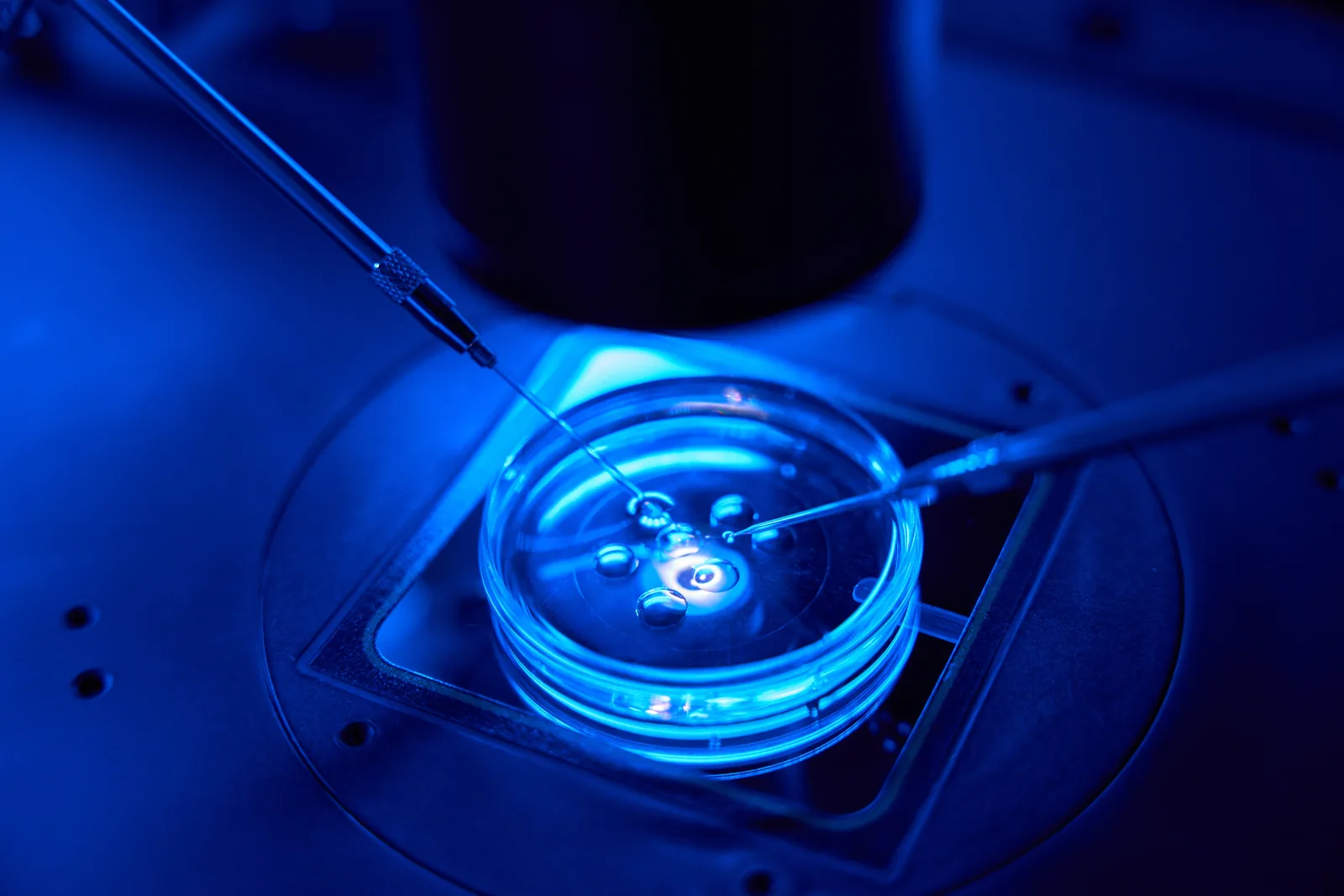
ICSI (intracytoplasmic sperm injection) is a lab technique used during in vitro fertilization (IVF) in which an embryologist injects a single sperm directly into each mature egg, instead of placing many sperm next to the egg and letting fertilization happen on its own. It was introduced in 1992 to help couples with male-factor infertility, such as a very low sperm count or sperm that don't move normally, and after fertilization failed in an earlier IVF cycle. It's also used with frozen eggs and when genetic testing for a single-gene condition (PGT-M) is planned. The American Society for Reproductive Medicine (ASRM) said in 2026 that using ICSI routinely when there's no male-factor problem isn't recommended, because it hasn't been shown to raise live-birth rates in those patients.
At a glance
| Question | Answer | Source |
|---|---|---|
| What is it? | Injecting one sperm into each egg in the IVF lab | ASRM fact sheet; MedlinePlus |
| Is it separate from IVF? | No. It's a fertilization method used within an IVF cycle | ASRM fact sheet; ACOG |
| Main reasons to use it | Male-factor infertility; poor or failed fertilization in a past IVF cycle | ASRM 2026 committee opinion |
| Other uses ASRM says may be appropriate | Previously frozen eggs; PGT-M (single-gene testing) | ASRM 2026 committee opinion |
| Routine use without male factor? | Not recommended; no improvement in live-birth rates | ASRM 2026 committee opinion |
| How many eggs fertilize? | ASRM's patient fact sheet says 50% to 80% | ASRM fact sheet (rev. 2021) |
| Known risks | Some eggs may be damaged; a small increase in birth-defect risk has been reported with ICSI | ASRM fact sheet; ASRM 2026 |
How ICSI works
In a standard IVF cycle, the egg retrieval comes after ovarian stimulation, and in the lab the eggs are combined with sperm. ACOG describes the two ways fertilization can be done: "the sperm can be added to the eggs in a laboratory, or... a single sperm can be injected into each egg."
- Conventional insemination: ASRM's fact sheet says 50,000 or more swimming sperm are placed next to each egg in a dish, and fertilization happens when one sperm enters the egg on its own.
- ICSI: the embryologist uses a tiny needle (a micropipette) to place one sperm into the center (cytoplasm) of each mature egg.
Either way, the eggs are checked the next day for fertilization, and any embryos grow in the lab for several days before transfer or freezing. ICSI changes only the fertilization step. Stimulation, retrieval and embryo transfer are the same. See How Long Does IVF Take?
Who ICSI is for
ASRM's patient fact sheet lists situations where ICSI can help:
- too few sperm for IUI or conventional IVF;
- sperm that don't move normally;
- sperm that have trouble attaching to the egg;
- a blockage in the male reproductive tract that keeps sperm from getting out;
- an earlier IVF cycle in which eggs didn't fertilize;
- eggs matured in the lab (in vitro maturation);
- previously frozen eggs.
What ASRM's 2026 guidance says about ICSI without male factor
ICSI use has spread well beyond male infertility. ASRM's 2026 committee opinion cites U.S. data showing ICSI was used in 36.4% of IVF cycles in 1996 and 76.2% in 2012, with the biggest increase in cycles without male-factor infertility. After reviewing the evidence, the committee concluded:
- "Routine use of ICSI for nonmale factor infertility is not recommended."
- Without male-factor infertility, ICSI "is not recommended for unexplained infertility, low oocyte yield, diminished ovarian reserve, advanced maternal age, or PGT-A."
- ICSI without male factor "may be of benefit" for select patients having IVF with PGT-M, prior poor or no fertilization with conventional insemination, or previously frozen eggs.
The committee notes that two large U.S. data studies linked ICSI in cycles without male factor to lower odds of live birth than conventional IVF. So "more fertilized eggs" doesn't automatically mean a better chance of a baby. For chromosome testing of embryos, see What Is PGT-A?
Risks and limits
ASRM's fact sheet lists problems that can happen during or after ICSI:
- some or all eggs may be damaged;
- an injected egg may not develop into an embryo;
- an embryo may stop growing.
On children's health, ASRM says the chance of a major birth defect is 1.5% to 3% with natural conception, and the risk with ICSI is similar to IVF, which is slightly higher than natural conception. ASRM notes that this may be due to the underlying infertility rather than the treatment. Certain conditions (Beckwith-Wiedemann syndrome, Angelman syndrome, hypospadias and sex chromosome abnormalities) have been associated with ICSI and are thought to occur in less than 1% of ICSI-conceived children. Sons conceived with ICSI may inherit genetic causes of male infertility. ASRM's 2026 opinion adds that it's unclear whether the small increased birth-defect risk applies when ICSI is used without male factor.
Once an egg is fertilized, ASRM's fact sheet says the chance of a single baby, twins or triplets is the same with or without ICSI. For outcome data by age, see IVF Success Rates by Age.
Questions to ask your fertility doctor (checklist)
- Do our semen analysis results or past cycles point to male-factor infertility?
- Did fertilization fail or fall short in a previous IVF cycle?
- Will you use ICSI on all eggs, some or none, and why?
- Are we planning PGT-A or PGT-M, and does that change the choice?
- Are frozen or lab-matured eggs involved?
- Is genetic testing or counseling recommended for the male partner first?
- How does your lab report fertilization results after ICSI?
Talk to a fertility specialist
Featured doctors: Dr. Brian Levine, Founding Partner and Practice Director of CCRM Fertility of New York in Manhattan, is board-certified in reproductive endocrinology and infertility and in obstetrics and gynecology; his practice includes IVF and egg freezing. Browse fertility specialists.
Every Haute MD doctor is independently reviewed and editorially featured by Haute Living.
Sources
- American Society for Reproductive Medicine Practice Committee, "Intracytoplasmic sperm injection for nonmale factor indications: a Committee opinion (2026)," Fertil Steril 2026;126:49–56 (replaces the 2020 version). https://www.asrm.org/practice-guidance/practice-committee-documents/intracytoplasmic-sperm-injection-for-nonmale-factor-indications-a-committee-opinion-2026/ (checked Nov. 23, 2026)
- ASRM / ReproductiveFacts.org, "Intracytoplasmic Sperm Injection (ICSI)" patient fact sheet (revised 2021). https://www.reproductivefacts.org/news-and-publications/fact-sheets-and-infographics/intracytoplasmic-sperm-injection-icsi/ (checked Nov. 23, 2026)
- American College of Obstetricians and Gynecologists, "Treating Infertility" FAQ (last reviewed November 2024). https://www.acog.org/womens-health/faqs/treating-infertility (checked Nov. 23, 2026)
- MedlinePlus, "In vitro fertilization (IVF)" (review date 3/17/2026). https://medlineplus.gov/ency/article/007279.htm (checked Nov. 23, 2026)
This guide is general education, not medical advice, and doesn't guarantee any treatment result. Talk with a board-certified reproductive endocrinologist about your own situation.
Frequently Asked Questions
What is ICSI?
ICSI, or intracytoplasmic sperm injection, is an IVF lab technique in which an embryologist injects a single sperm directly into each mature egg to help fertilization happen.
What is the difference between IVF and ICSI?
ICSI is part of IVF, not a separate treatment. In conventional IVF, many sperm are placed next to each egg; with ICSI, one sperm is injected into each egg. The rest of the IVF cycle is the same.
Who needs ICSI?
It's mainly used for male-factor infertility, such as a very low sperm count or poor sperm movement, and after fertilization failed in an earlier IVF cycle. It may also be used with frozen eggs or PGT-M.
Does ICSI improve IVF success?
Not for everyone. ASRM's 2026 committee opinion says routine ICSI without male-factor infertility does not improve live-birth rates and is not recommended for unexplained infertility, advanced maternal age or PGT-A.
Is ICSI safe for the baby?
ASRM says the birth-defect risk with ICSI is similar to IVF and slightly higher than natural conception, which may be due to the infertility itself. Certain rare conditions are thought to occur in less than 1% of ICSI-conceived children.
Get Help Now
Speak with a Haute MD Fertility physician
Are you a Fertility physician?
Join Haute MD Network and have your profile featured alongside these answers.
Apply for the NetworkRelated Guides
Guide · FERTILITY MEDICINE
What Is PGT-A in IVF?
PGT-A tests IVF embryos for missing or extra chromosomes. How it works, what results mean, and what ASRM says about live birth and miscarriage.
Read GuideGuide · FERTILITY MEDICINE
How Long Does IVF Take From Start to Transfer?
Most IVF cycles take several weeks from suppression or priming through retrieval and transfer—plus optional freeze-all. See a plain-English timeline.
Read GuideGuide · FERTILITY MEDICINE
IVF Success Rates by Age: What the CDC Data Shows
CDC's 2023 data: 49% of IVF egg retrievals led to a live birth under 35, 35.5% at 35–37, 22.4% at 38–40 and 7.6% over 40. How to read clinic numbers.
Read Guide