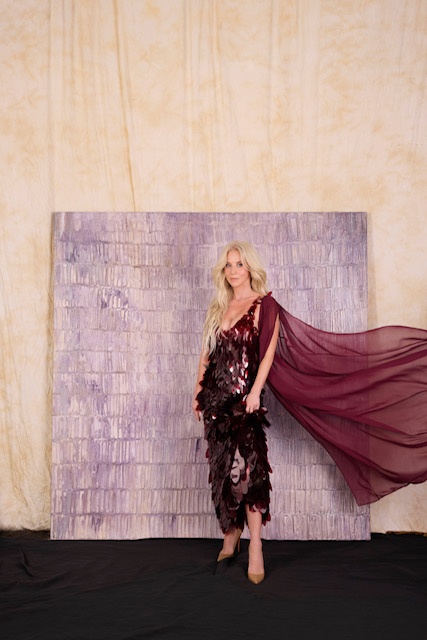
Niki Woehler’s Miami Chapter: The Art of Reinvention, Freedom, and Feeling
After 32 years in Scottsdale, the contemporary artist has chosen Miami as the setting for her next evolution—one defined by creative independence, monumental work, and a renewed vision for the relationship between art, emotion, and community.

At 55, Niki Woehler made a decision that would have felt daunting at almost any age: she left behind the life she had spent more than three decades building and moved across the country to begin again. She arrived in Miami without knowing a single person or even where to find her footing. What she brought with her was an established artistic practice, a devoted community of collectors, and a growing conviction that the next chapter of her life needed to look different from the last.
“I picked up my life and moved across the country to a city where I didn’t know a single person, the name of a single street, or even where to begin, and I did it to build the life that had been living inside of me for decades,” Woehler says. “Because I wanted to.”
It is a sentiment that captures the spirit of her arrival in Miami. For Woehler, the move represents more than a change of geography. It is an act of self-determination—and an invitation to explore the full breadth of her creative identity without the expectations that can accompany an established reputation.
Now, with a new working studio, The Atelier, and a separate gallery and gathering space, The Salon, Woehler is building an environment that reflects the artist she has become and the possibilities she sees ahead.
A City That Makes Room for Reinvention
Woehler’s path to Miami began with a feeling. Originally from Toronto, she describes herself as a city girl who found herself in Scottsdale more than three decades ago, partly through circumstance and partly through the life that unfolded there. What began as an unexpected destination became home. She raised three children, established her studio, cultivated a loyal collector base, and developed relationships that extended well beyond the boundaries of her artistic practice.
But as her children grew up and began choosing cities of their own, Woehler started asking herself a different question: Where did she want to be?
The answer required three things: the electric vibrancy of city life, a deeply rooted art community, and proximity to water.
During a visit to South Florida for her best friend’s wedding, she found herself watching the sunrise from the beach, struck by the openness of the people she encountered and the sense of peace she felt. Miami soon became the answer. Within weeks, she was planning her move; seven months later, she had made it home.
The city offered something she was ready to embrace: an environment where contemporary art, international influences, architecture, design, and individuality intersect. For an artist whose work explores texture, movement, symbolism, and emotion, that creative atmosphere feels less like a departure from her established practice than an invitation to take it further.
“Miami doesn’t ask you to conform,” she says. “It asks you to show up fully, unapologetically, in all of the glory that you are.”
That openness matters to Woehler because success, over time, can create its own set of expectations. After 32 years in one place, she had become known for a particular visual language. There was beauty in that recognition, but also the possibility of being confined by it.
In Miami, she feels freer to experiment, follow instinct, and pursue ideas that might not fit neatly within the work for which collectors already know her. She is not abandoning her past; she is giving herself permission to build on it.
Beyond the Surface
Woehler’s contemporary abstract practice is rooted in the interplay of lines, layers, textures, and surfaces. Her work invites viewers to look beyond immediate visual appeal and consider what lies beneath it: the marks of time, the complexity of memory, and the emotions that emerge when something resonates on a deeply personal level.
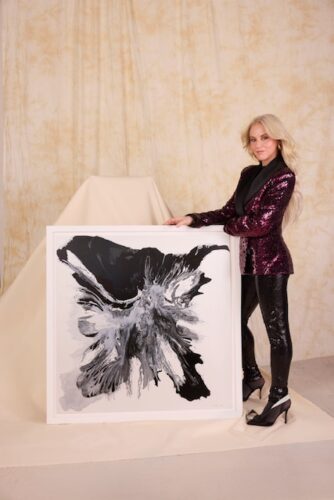
Her approach to materials is equally tactile. Iridescent paints, micaceous iron oxides, and natural stone pigments interact with light, allowing surfaces to shift in appearance throughout the day. Monumental scale amplifies that experience, giving the work a physical presence that can transform the atmosphere of a room.
Light has always been integral to how she thinks about her paintings. Miami, with its distinctive natural brightness and coastal atmosphere, offers a new context in which to explore those qualities.
Rather than suggesting that the city has fundamentally altered her process, Woehler sees it as encouraging her to push further into what has always been there.
“Miami hasn’t asked me to change how I work,” she says. “She’s asking me to push further into what was already there; more light, more scale, more movement, more freedom.”
That distinction is central to this moment in her career. Reinvention does not necessarily require discarding a signature style. Sometimes it means removing the limitations around it.
One of the clearest examples of Woehler’s willingness to challenge expectations is Reverence, a 12-foot rearing stallion layered with imagery from iconic Playboy editions. The work required more than 1,000 hours to complete and prompted questions about the use of imagery that some viewers might consider provocative.
For Woehler, however, the intention was not provocation for its own sake. She saw strength, beauty, and courage in the women depicted, particularly in the historical context of the social consequences associated with revealing their bodies.
The title was deliberate. Reverence was an invitation to reconsider what people see when they look at an image—and how quickly assumptions can obscure its meaning.
It is a sensibility that continues to inform her work today. Woehler is increasingly interested in what happens when art is allowed to exist without prescribing a single interpretation. Rather than telling viewers what to think or feel, she wants to create a space in which they can bring their own histories, memories, and emotional responses.
“I want my work to create an experience where someone can bring their own memories, emotions and history, and find themselves in it,” she says.
For Woehler, the most meaningful encounter with a painting may not be the moment a viewer understands it, but the moment they recognize something of themselves in it.
The Atelier and The Salon: A Different Kind of Art Experience
The physical spaces Woehler is establishing in Miami reflect that philosophy. In Scottsdale, her studio and gallery were combined in a street-facing environment that encouraged spontaneous visits and allowed collectors to watch her work in progress. The accessibility was valuable, both personally and professionally, but her next chapter called for a different balance.
This time, she wanted to protect her creative process while creating more intentional opportunities for connection.
The result is a two-part environment. The Atelier is her dedicated working studio, designed to give her the solitude and uninterrupted time that ambitious work requires. The Salon, a separate gallery space open by appointment and for events, offers a more intimate setting in which collectors and guests can encounter the work.
The separation allows Woehler to preserve the concentration required to create while giving visitors a more considered experience when they enter her world.
It also reflects a broader idea about how art can be experienced. Rather than treating the gallery solely as a place to view and acquire finished work, Woehler envisions her Miami space as a gathering point for conversations, collaborations, and shared discovery.
She plans to host intimate dinners, openings, speaker events, and conversations that bring together collectors, artists, and people from different creative disciplines. The goal is not simply to introduce visitors to her paintings, but to create opportunities for meaningful encounters between people who might not otherwise meet.
“I envisioned a space where people came to feel,” she says. “Feel connection—to me, to the work, and to themselves. To feel emotion. To feel free.”
It is an ambitious vision, but one grounded in her experience. Over the years, many of Woehler’s client relationships have grown into lasting friendships. Commissioned work, in particular, requires a degree of openness that can make the relationship between artist and collector unusually personal.
She estimates that commissions now account for approximately 80 percent of her business. The process begins with practical considerations such as dimensions and color palette, but the conversation ultimately turns toward something less tangible: the emotional experience the client wants the finished work to create.
“What do you want to feel when you look at this painting?” is the question she asks.
That question shifts the focus from decoration to meaning. The work must inhabit a physical space, but it must also speak to the people who live with it.
Woehler recalls receiving messages from collectors years after a painting was installed, describing how they continue to sit in front of it, sometimes with a glass of wine, losing themselves in the experience. Those moments affirm the purpose behind her practice.
For collectors who already have access to beautiful objects, she believes the most compelling acquisition is often not another possession, but an encounter that interrupts the noise of everyday life and restores a sense of wonder.
The Relationships That Make a Practice
Woehler speaks about her years in Scottsdale with gratitude, particularly when reflecting on the community that grew around her work. Her farewell gathering there became a moment of recognition: a room filled with people whose lives had intersected with hers through art, friendship, philanthropy, and shared experiences.
The evening reinforced a lesson she intends to carry into Miami. A creative practice is shaped not only by the work produced, but by the relationships that sustain it.
“Scottsdale taught me so much about love, and about how love gives us wings,” she says.
It also taught her the importance of vulnerability. As she became more willing to share the stories and emotions behind her work, she found that the connection with viewers deepened. The more personal the process became, the more space others seemed to find for their own experiences.
In Miami, she hopes to cultivate that same sense of belonging while discovering an entirely new community. The dinners and events planned for The Salon are part of that intention: to create a setting in which art becomes a catalyst for conversation and the relationships formed around it become as meaningful as the objects themselves.
The approach feels particularly suited to an artist who wants to move beyond the conventional boundaries between studio, gallery, and gathering place. Woehler is interested in what becomes possible when people can encounter the artist, the work, and one another in the same environment.
For her, the experience surrounding a painting is not secondary to the art. It is part of the larger world the art can create.
The Courage to Become Something More
Ask Woehler what she is leaving behind, and her answer is unequivocal: the need to remain recognizable.
For years, she felt a responsibility to continue making the work people expected from her. That familiarity had helped establish her practice, and she remains deeply connected to the work that brought her here. But she no longer wants the expectations attached to her name to determine what she creates next.
“I’m leaving behind the need to protect an identity I’ve already outgrown,” she says.
It is not a rejection of her history, but a recognition that artistic evolution depends on the willingness to move beyond what has already been accomplished. She wants to follow curiosity, pursue the ideas that challenge her, and make work that surprises even her.
Miami provides both the physical and psychological space for that next stage. The new studio accommodates larger ambitions, while the separate gallery creates opportunities to develop a more expansive program of events and collaborations. Together, the spaces offer a framework for a practice that extends beyond the production and presentation of individual artworks.
Over the next five years, Woehler hopes The Atelier and The Salon will become places people remember not simply for what they saw, but for how they felt while they were there. She imagines artists, collectors, thinkers, friends, and strangers gathering in a space that encourages discovery, meaningful conversation, and a renewed sense of connection.
Her ambition is ultimately human in scale, even when the paintings themselves are monumental.
In a culture saturated with messages about identity, expectation, and how people should live, Woehler wants to make room for something less prescriptive. Her work does not need to provide every answer. It needs to invite the viewer to pause long enough to encounter a feeling, a memory, or a possibility they might otherwise have overlooked.
“If five years from now people think of this space as somewhere they felt inspired, welcomed, challenged, moved, or deeply alive, that would mean everything to me,” she says.
Scottsdale was where Woehler built her foundation. Miami is where she intends to explore the full measure of what that foundation makes possible.
At this stage of her career, the move is not a beginning in the conventional sense. It is the continuation of a practice shaped by decades of work, relationships, and discovery—now entering a chapter with fewer expectations and more room to grow.
For Woehler, the most important thing she is creating in Miami may not be a painting or even a studio. It may be the freedom to become, without reservation, the artist she has yet to discover.
Visit Niki Woehler in Miami
The Atelier & The Salon
330 NE 61st Street
Miami, FL 33137
The Atelier is Woehler’s dedicated working studio, while The Salon offers an intimate gallery experience for collectors and guests by appointment and during special events.
Explore her work at nikiwoehler.com.
Latest from Haute Living

Sylvester Stallone Goes Back to Round One for Rocky’s 50th Anniversary
Where LA Actually Drinks Now: 11 Cocktail Bars to Know

Dior Unveils Christian Dior’s Night in Color: An Animated Short Narrated by Robert Pattinson