HAUTE LIVING EXECUTIVE Q&A Work, Live, Thrive: SteelWave’s Blueprint for the Hybrid Age
SteelWave drives the future of commercial real estate with flexible workspaces, sustainability, digital finance, and mixed-use innovation.
1. SteelWave has a reputation for anticipating market shifts. How do you see the balance between traditional office space and flexible, hybrid models evolving over the next decade?
Many people believe that the transition from the traditional office environment to a more flexible office environment, both from a physical standpoint as well as from work from home/work from an office standpoint, was triggered by the pandemic.
We believe that that transition has been evolving for the last 2 decades and that the pandemic only acted as a late stage accelerant.
All of our markets are West Coast technology hubs and the built environments and workforce flexibility nuances are heavily influenced by the large technology companies such as Apple, Meta, Google, Microsoft, Nvidia, Tesla and Amazon.
One size doesn’t fit all and each of these companies tailor their work environments and best practices to their individual brands and their cultures that they’ve worked to build over time.
The aftermath of the pandemic favored a much more flexible workforce schedule. That level of flexibility is reversing back to more ‘work from office’ balance.
Most large companies believe that innovation and productivity require teams of people working together collaboratively and in person. We figured out 20 years ago that if you want people to be happy about coming to work, you need to provide a physical work environment that actually doesn’t feel like a ‘work’ environment.
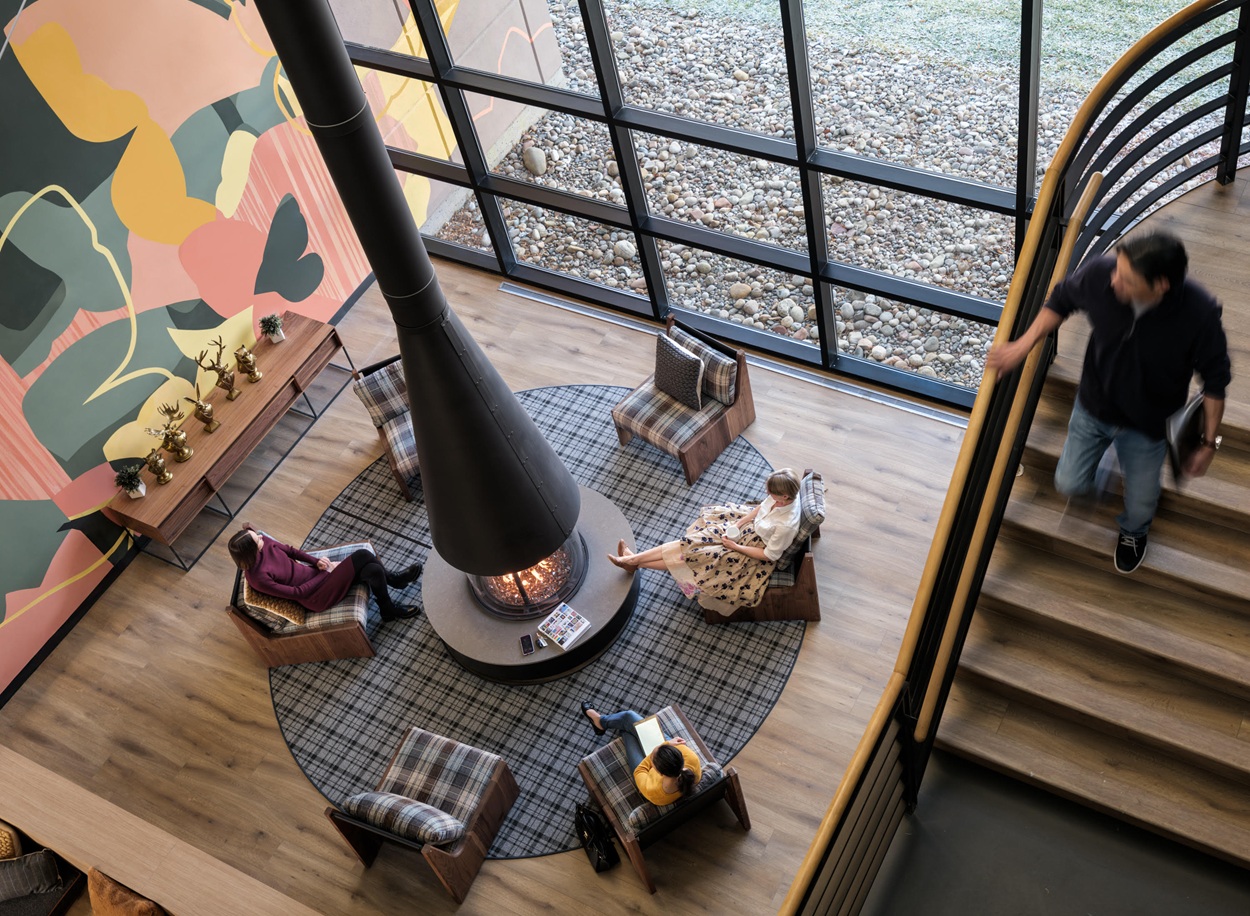
We have been incorporating high end residential and hospitality design elements into our creative office workspaces so that the look, feel and functionality is much more aligned with team collaboration and today’s best practices for fostering innovation.
While it’s not new to Steelwave, the aftermath of the pandemic has kicked off a bit of an arms race to deliver highly amenitized work environments where people are incentivized to come to work.
The only limit going forward is one’s imagination.
You should expect to see high end food and beverage facilities, retail facilities, health and fitness facilities and entertainment venues incorporated in the office work environment over the years to come.
The goal is to get people into the office and keep them there as long as possible.
The founders of Steelwave have been active in Commercial Real Estate for over 40 years. Having witnessed countless evolutions, we know that the only thing we’re sure of is that tomorrow will not look like today.
As such, we have fostered a culture that views change through the lens of opportunity.
2. Sustainability is no longer optional in commercial real estate. What strategies or technologies is SteelWave investing in to future-proof its portfolio against climate risk and regulatory pressures?
There isn’t much we haven’t employed in terms of sustainable technologies, whether it be solar fields on top of parking lots, electrochromic glass, cutting edge mechanical systems, or eco friendly landscaping.
We also utilize third party certifications such as LEED and Energy Star – Our approach is to fit each project with a customized plan that involves multiple technologies and practices to have the biggest impact for any given opportunity.
A less sexy but maybe equally impactful strategy is not to build as often – There is a lifecycle to all buildings and one of the biggest impacts you can have on climate change is getting more out of that cycle.
A well designed and quality built project will be more durable and attract tenancy for longer, minimizing all the embedded energy, resources depletion, and pollution of the building process.
We believe the landmark properties we consistently deliver achieve these goals.
Likewise, we are big believers in adaptive reuse. Adaptive reuse, if properly designed and executed, maintains the desired sense of authenticity and reduces the carbon footprint of creating new ground up structures.
3. Urban centers are transforming rapidly. How is SteelWave identifying or redefining ‘prime’ locations in light of demographic shifts, remote work, and changing lifestyle priorities?
We’re super excited about this segment and the ability to work with cities and other stakeholders to create a modern vision of a city center.
When done well—whether in the US or Europe— they act as a perfect balance of community and commerce.
The walkable streets, layered uses, and a deep sense of place creates a central hub for a community. The key to maximizing value is to fully integrate all of the different uses into a single ecosystem such that each use is a force multiplier for the other uses.
There is a big difference between creating a single product that incorporates multiple uses as opposed to creating multiple projects that are adjacent to one another.
We’ve teamed up with SteerPiont, a leader in retail and mall revitalization, on two major projects in the last year, and are actively pursuing several more. These aren’t just real estate plays, but powerful vehicles to strengthen the community and help them tell their unique story.
4. With interest rates and capital costs fluctuating, how is SteelWave approaching development and acquisitions to maintain resilience and deliver returns in a more volatile financial environment?
The capital market challenges have been very real— but we believe from big dislocations come big opportunities.
The markets have completely repriced themselves. Most, if not all, commercial real estate asset classes are worth less than they were 3 yrs ago. In some cases, that delta is as much as 75%.
Obviously, that’s not good for an existing portfolio; however, that is very good if you are trying to acquire a new portfolio.
The first phase of any recovery is accepting the fact that what you may have paid for an asset prior to a major dislocation is not what the asset is worth today. Acceptance of this simple fact, frees the mind to find other opportunities.
The senior leadership team has been through four market cycles where values crashed. Each time brought some pain and lots of new opportunities.
This time is no different. But if there was one difference this time around, it would be the evolving world of decentralized finance.
‘Web 3’ and the world of digital securities could dramatically change the way Real World Assets (RWA) are bought, sold and held.
The ownership structures that typically hold commercial real estate are very cumbersome and inefficient. If you own commercial real estate, there is a high likelihood that you own a limited partnership interest, a tenant in common interest, a non-traded stock interest or a traded stock interest. These structures are very expensive to form and very inefficient to sell without selling the underlying asset.
Digital securities, ‘de-fi’and the world of Web 3 could revolutionize how real estate is owned and transacted.
We launched Steelwave Digital in 2022 to build a brand in this decentralized world of finance and to play a key role as an early adopter and ambassador in how this ecosystem intersects with the world of commercial real estate.
After years of groundwork, we’re in it. The regulatory world for this space is finally taking shape.
Next comes the rules around compliance and the security layers around custody. We have partnered with the leaders in this space and hope to bring new products to market at the intersection of the world of decentralized finance and commercial real estate over the next 12 months.
This space is no longer a theoretical exercise and has the potential to change the way investors think about owning assets.
5. Looking ahead, what types of mixed-use or experiential developments do you see defining the next generation of commercial real estate—and how is SteelWave positioning itself to lead in that space?
We currently have several mixed-use projects underway and are looking at many more.
There’s a huge appetite for deeper, more grounded experiences—places people can go to live, work and gather, and engage in ways that feel real and organic. That’s the gold standard for experiential real estate – But mixing multiple uses such as residential, retail, office and hospitality creates multiple challenges. And mixing three different uses has twice as many challenges as mixing two uses.
These challenges include sound, smell, sightlines, egress, safety and a multitude of others.
These challenges usually have the effect of chipping away at the quality of the experience unless they are very thoughtfully addressed and designed around on the front end.
These aren’t things that can be dealt with after the fact. This is where our design DNA and multidisciplinary background gives us an edge.
Our process is fluid enough to take the hits that inevitably come through the design, entitlement, and construction process without losing the essence of the project vision.
That’s what we refer to as ‘creating the magic’.
Latest from Haute Living

Nine Espresso Martinis in Miami Worth Staying Up For
Peking Duck and Penfolds Grange by the Glass: Inside Yù & Mì at Mandarin Oriental Downtown, Dubai

Anthony Vaccarello Turns the House Icons to Gold at Paris Fashion Week for the Saint Laurent Summer 2027 Collection