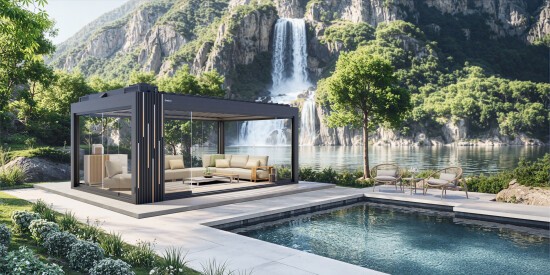
The Brand That Refused to Follow the Market Is Now Leading It. Inside Letright’s Rise
Discover how Letright transformed outdoor living with recyclable materials, the Ombra Smart Pergola, and award winning sustainable innovation.
Photo Credit: Letright Industrial Corp
When the outdoor furniture market chased premium timber finishes in the 2000s, Letright Industrial Corp. made a decision that cost its customers: it walked away from natural wood. At the time, it seemed risky; two decades later, it looks prescient.
Today, Letright operates in more than 70 countries, has earned recognition from Red Dot and Milan Design Week, and introduced the Ombra Smart Pergola, a solar-powered structure generating 15 kilowatt-hours of clean energy per day. The company that rejected the conventional path is now one of its most influential players.
The Harder Path
Most companies in the outdoor living sector followed the same logic: consumers want wood, wood signals premium, so build with wood. Letright read the same data differently, concluding that using virgin wood tied the business to fragile supply chains, high maintenance, and scrutiny. The company chose recyclable alternatives, absorbing customer attrition and research costs.
The friction was real. Early resistance from buyers accustomed to natural timber forced Letright to defend a position not yet validated. The company held its course and, in 2016, invested in heat transfer printing to replicate the look and feel of wood on recyclable materials with superior durability and zero maintenance. What seemed a compromise became a competitive advantage and an industry reference point.
When Sustainability Becomes Performance
The Ombra Smart Pergola, released in 2023, distills two decades of progress into one product. Its patented adjustable louvers integrate solar panels with a 25.6 percent conversion rate, generating enough energy to power air conditioning, misting, lighting, and controls. Built from recyclable materials, it produces rather than consumes energy.
That distinction carries commercial weight. Architects, hotel developers, and premium residential projects across Asia, Europe, the Middle East, and North America have adopted Ombra for year-round usability beyond conventional pergolas. The product earned Red Dot recognition, drew attention at Milan Design Week, and contributed to Letright’s ACES Awards as Responsible Business Leader (2024) and Entrepreneur of the Year (2025).
What the Market Took Two Decades to Learn
Letright’s trajectory makes a sharper argument than product success alone: protecting natural resources and building a strong business are not mutually exclusive, and that logic has proven durable beyond trend-driven sustainability claims.
Competitors who adopted wood-alternative aesthetics only after demand was proven avoided the uncertainty Letright absorbed.
The Ombra’s solar integration arrived as falling photovoltaic costs made high-efficiency solar viable at the product level. Letright was positioned to act because it had built capability in materials science and alternative manufacturing rather than defending a conventional product line.
Its leadership has argued that ethical choices build long-term capabilities competitors struggle to replicate. Developers and buyers who once needed convincing now arrive with specifications built around the Ombra.
The outdoor living sector is catching up to a position Letright staked out before it was advantageous. The company that once lost customers for refusing wood is now studied as the standard for outdoor living after wood.
Latest from Haute Living

Inaugural Taste of West Palm Beach Draws 800 Guests and 30 Restaurants to CityPlace, Raising $300,000 for the Palm Beach County Food Bank
Inside ‘Three Planes,’ Jae Omar’s 11,000-Square-Foot Hidden Hills Estate Inspired by Chumash Cosmology

Haute Insider: Creator Vale Genta’s Guide to Miami