Rolls-Royce Spectre 2026 Review: The Silent Revolution of Ultra-Luxury
Our 2026 Rolls Royce Spectre review explores its 291 mile range, 577 hp performance, sublime ride, luxury interior, and $420,000 price.

The Rolls-Royce Spectre is not simply an electric car wearing a Spirit of Ecstasy. It is the logical conclusion of everything Rolls-Royce has been building toward for 120 years — a motor car so refined that the powertrain finally matches the silence and smoothness the brand has always promised.
Photo Credit: Rolls-Royce
After spending a week with the 2026 Spectre, logging 847 miles across highway, city, and winding canyon roads, here is our comprehensive verdict on the most important Rolls-Royce since the original Silver Ghost.
Design: Presence Without Apology
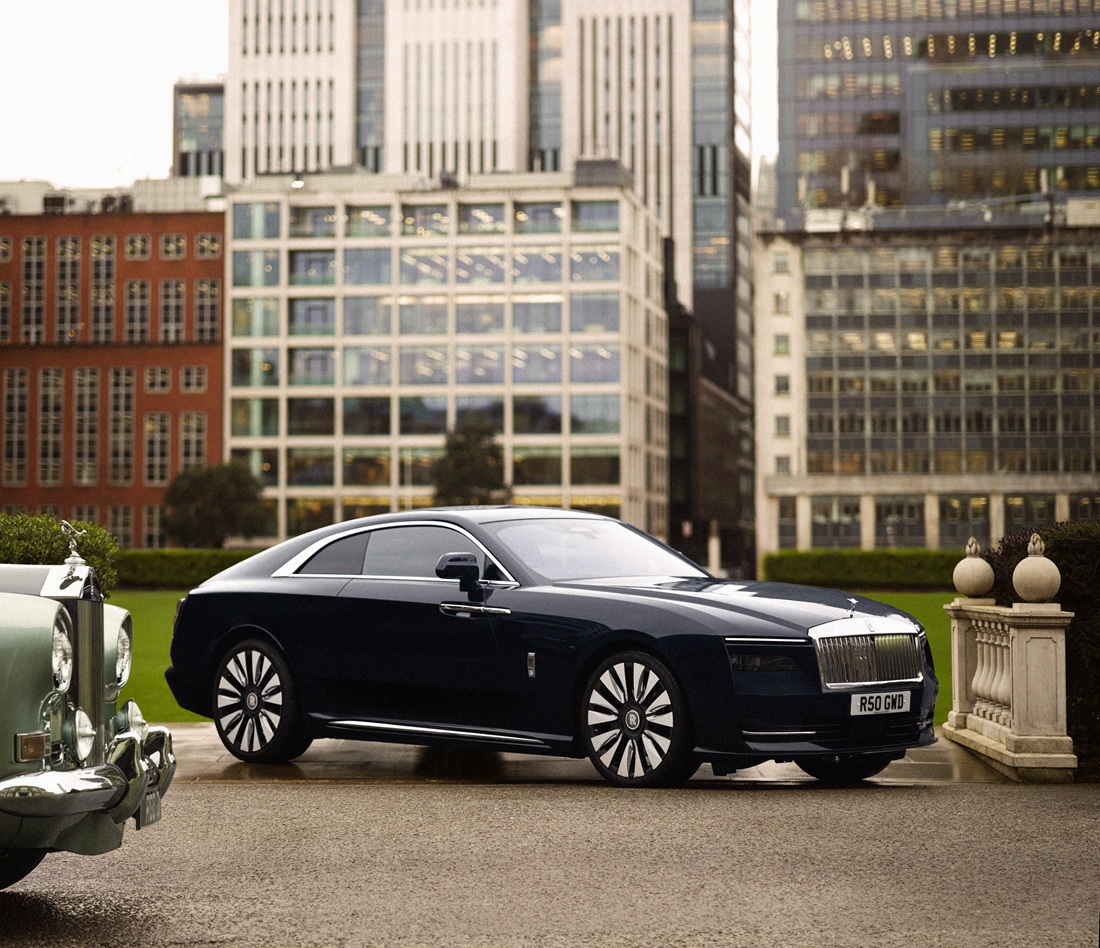
The Spectre is, by any measure, a massive automobile. At 214.7 inches long, 81.9 inches wide, and weighing up to 6,559 pounds, it commands road presence the way an aircraft carrier commands a harbor. Yet somehow, it doesn’t look heavy. The fastback silhouette is the most aerodynamic Rolls-Royce ever made (0.25 Cd), and the split headlights — among the widest ever fitted to a Rolls — give it a gaze that is both futuristic and unmistakably regal.
The illuminated Pantheon grille, now a signature of modern Rolls-Royce design, pulses gently when the car is charging — a subtle reminder that this is not your grandfather’s Roller. Around back, the wide haunches and continuous tail light create a profile that photographs beautifully from every angle.
Key dimensions: 214.7″ L × 81.9″ W × 61.4″ H | Wheelbase: 126.4″ | Curb weight: up to 6,559 lbs
Interior: The Best Place to Be in Any Car
If the exterior makes a statement, the interior makes a case for never leaving. Rolls-Royce poured extraordinary development time into the Spectre’s cabin, and it shows in every surface, every stitch, every material choice.
The Starlight Headliner — over 1,000 hand-woven fiber optic lights arranged in a shooting star pattern — remains one of the most magical features in any automobile. Paired with the illuminated Fascia (a custom-etched glass panel spanning the dashboard), the interior after dark feels like sitting inside a constellation.
The cabin in our test car paired Charles Blue leather over Arctic White, hand-stitched using 22 hides per car, with Tudor Oak trim finished in brushed aluminum. Underfoot, deep-pile lamb’s wool carpet in Serenity Green completes the palette, while the controls are finished in polished stainless steel with a diamond-knurled texture.
Rear seat passengers are treated to individual climate zones, their own Starlight panel, champagne cooler, and enough legroom to stretch out fully. The self-closing “coach” doors (suicide doors, in common parlance) open to a cavernous 41.5 inches — among the widest door openings of any production car.
Performance: Silence Is the New Horsepower
Here is where the Spectre’s electric powertrain transforms the Rolls-Royce experience. The dual-motor setup produces 577 horsepower and 664 lb-ft of torque, propelling this three-ton grand tourer from 0-60 mph in 4.4 seconds. But the acceleration figure misses the point entirely.
What matters is how the Spectre delivers its power. There is no vibration. No gear changes. No engine note rising through the cabin. You press the accelerator and the world outside simply begins moving faster, as if the car were bending physics rather than burning fuel. Rolls-Royce engineers specifically tuned the power delivery to feel “inevitable” rather than aggressive — and they succeeded perfectly.
The Spectre’s dual electric motors, one front and one rear, produce 577 horsepower and 664 lb-ft of torque, enough to send the car from 0-60 mph in 4.4 seconds on the way to an electronically limited top speed of 155 mph. Power comes from a 102 kWh lithium-ion battery rated at up to 291 miles of EPA-estimated range on the standard 22-inch wheels, or 266 miles on the optional 23-inch wheels, and the car supports 195 kW DC fast charging, enough to take it from 10 to 80 percent in about 34 minutes.
The regenerative braking is calibrated so gently that you barely notice it. In “Glide” mode, the car coasts with almost zero deceleration — exactly how a Rolls-Royce should behave. In stronger regeneration modes, you can one-pedal drive through city traffic without ever touching the brake pedal.
Ride Quality: The Magic Carpet Gets an Upgrade
Rolls-Royce has long described its ride quality as a “magic carpet.” With the Spectre, they’ve essentially laid a heavy battery pack beneath the floor, lowering the center of gravity and creating a platform that absorbs road imperfections with supernatural composure.
The Planar suspension system uses GPS data, navigation inputs, and a stereo camera to read the road ahead, pre-conditioning the dampers for what’s coming. It actually works — on roads I know well, I could feel the suspension preparing for bumps I knew were coming, softening fractionally before impact.
At highway speeds, the Spectre is the quietest car I have ever driven. Rolls-Royce built in extensive sound insulation, double-glazed windows, and active noise cancellation — but the real secret is the absence of a combustion engine. Without that fundamental vibration source, the cabin achieves a silence that approaches sensory deprivation.
Technology
The Spectre runs Rolls-Royce’s Spirit operating system, displayed across a 12.3-inch instrument cluster and 13.2-inch central touchscreen. The infotainment is based on BMW’s iDrive 8 platform but reskinned with Rolls-Royce’s own aesthetic — darker colors, refined typography, and none of BMW’s more aggressive design language.
Among the Spectre’s notable tech features are its Planar suspension, which uses predictive, GPS-reading dampers to read the road ahead, and all-wheel steering, with the rear wheels turning up to 4.5 degrees. The Flagbearer system uses stereo cameras to scan the road surface ahead of the car, working alongside an extensive onboard sensor network that monitors vehicle systems in real time. Rounding out the package are a heads-up display with night vision, Level 2+ driver assistance with highway pilot, and over-the-air updates that continue to improve performance and features after purchase.
The EPA-estimated range — 291 miles on 22-inch wheels, 266 miles on the 23-inch wheels fitted to our test car’s optional spec — is adequate for the car’s mission; this is a grand tourer, not a road-trip car. In practice, I averaged 265 miles per charge in mixed driving, and the 195 kW DC fast charging meant that a 20-minute coffee stop at an Electrify America station added significant range.
Who Is This Car For?
The Spectre starts around $395,000 before options. A typically specified car pushes past $500,000 with bespoke commissions. This is not a car for people who compare EPA range figures or calculate cost-per-mile.
The Spectre buyer is someone who has owned Phantoms and Ghosts and Wraiths, and who recognizes that the electric powertrain finally delivers what Rolls-Royce has always aspired to: perfect silence, instant torque, and a driving experience so refined that the journey itself becomes the destination.
It is, without qualification, one of the finest electric cars ever made — and a strong contender for the finest car of any kind currently in production.
Verdict
Rating: 9.5/10
The Rolls-Royce Spectre is not a compromise. It is not an electric car making apologetic concessions to luxury. It is the opposite — a luxury car that found its perfect powertrain. The silence of the electric motors finally matches the silence of the cabin. The instant torque finally matches the effortless character of the brand. The Spectre proves that electric power and Rolls-Royce character were made for each other.
On the plus side, the Spectre is the quietest, smoothest car we’ve ever driven, with interior craftsmanship that justifies every penny, electric torque perfectly suited to Rolls-Royce character, and Planar suspension that sets a new ride quality benchmark.
For more of Haute Living’s automotive coverage, see .
Rolls-Royce previously targeted a fully electric lineup by 2030 under former CEO Torsten Müller-Ötvös. Current CEO Chris Brownridge has since stepped back from that hard deadline, and the Ghost, Phantom, and Cullinan continue to be offered with V12 power for now. The Spectre remains the brand's first and, so far, only series-production all-electric model. On paper, they're close — the Spectre's 577 hp and 664 lb-ft of instant electric torque get it from 0-60 mph in a Rolls-Royce-quoted 4.4 seconds, while independently tested Wraiths have run anywhere from about 4.1 to 4.6 seconds depending on model year and test conditions. In practice, the Spectre's power delivery feels noticeably quicker off the line due to the instant torque characteristic of electric motors. The 2026 Rolls-Royce Spectre starts at approximately $395,000 before options and bespoke commissions. Most buyers spec their cars to $475,000-550,000 with custom paint, interior materials, and personalization.Frequently Asked Questions
Will Rolls-Royce make all electric cars?
Is the Rolls-Royce Spectre faster than the Wraith?
How much does the Rolls-Royce Spectre cost?
Latest from Haute Living

Harbour Club Reinvents Itself in Miami Beach, With Antonio Bachour by Day and a Michelin Alum at Dinner
After Its $150 Million Transformation, the Brooklyn Nets’ Arena Now Has An Art Gallery, A Chef’s Table & More

Gucci’s New GucciCore Campaign Turns the Streets of New York Into a Runway