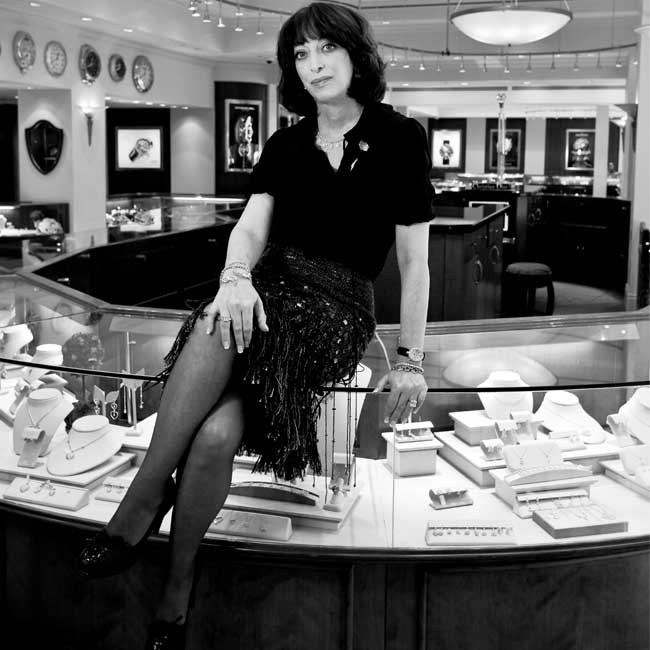
As a retailer catering to the international fashion conscious Miami crowds, our customers are always looking for the most exotic and exclusive designs when it comes to luxury gents watches. Harry Winston, known more for their extravagant jewelry designs than their watch manufacturing, decided to change the name of the game when it comes to high-end multifunction watches. In 2001, they decided to create a very unique concept behind a new product line they called Opus. This project entailed Harry Winston’s own design team working in collaboration with different independent “rock star” horologists operating in Switzerland. Each piece turned out as a distinctive artistic interpretation, intertwined carefully with the technical brilliance required to create some of the most complicated and exquisite wrist watches ever produced.
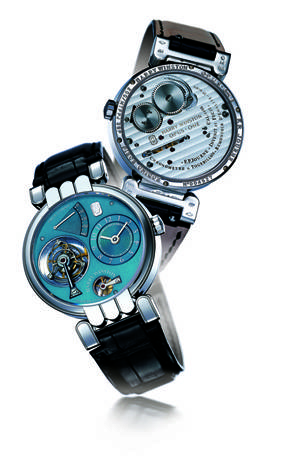
Opus 1
5 Day Automatic: $47,000; limited to 6 pieces
Platinum Tourbillon: $140,000; limited to 6 pieces
Resonance Chronometer: $78,000; limited to 6 pieces
In their first collaboration project, Harry Winston elected to go with the technical prowess of watch designer extraordinaire F.P. Journe. Known for taking a complication and finding different ways to achieve the same or better result, he designed three separate movements, each limited to 6 pieces. Harry Winston added the aesthetic input with a 38mm platinum case and the option of up to 5.2 carats in diamonds.
The first movement consists of a dual time function with a 42-hour power reserve and a resonance chronometer. The innovation is the use of resonance to create a more accurate timepiece. With twin balances working in synchronization, one will speed up while the other will correspondingly slow down until they return to a matching frequency. This helps to absorb the shocks and disturbances that affect the precision of a conventional wristwatch.
The second movement is a one-minute tourbillon that doubles as a seconds indicator and comes with a 40-hour power reserve. What makes this tourbillon special is that it is constructed with a constant-force remontoir which provides the escapement with a direct and constant force every second that is separate from the fluctuating power of the mainspring.
The third available movement is a five day (120-hour) automatic power reserve with grand date. What seems pedestrian by today’s standards in terms of power reserve length was a horological masterpiece at the time of its debut, and represents a landmark in the development of the power reserve function.
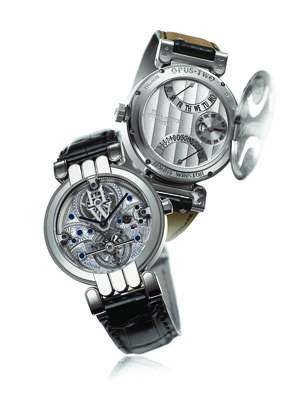
Opus 2
Tourbillon: $195,000; limited to 11 platinum pieces
Tourbillon with Perpetual Calendar: $295,000; limited to 11 platinum pieces
Platinum with 4.4ct diamonds, piece unique for each movement
The Opus 2 was developed in partnership with Antoine Preziuso. His one-minute tourbillon with a remontagemystérieux winding system adorns the front of both Opus 2 movements offered by Harry Winston. The 38mm cases are platinum. The first movement featured is a tourbillon paired with a 110-hour power reserve.
The second movement is a watch that aficionados would kill for. The front of the case appears to be an elegant and simple tourbillion, however, the watch holds a hidden treasure beneath the case back in what is known as a fond secret, or secret cover, which opens to reveal a handsomely appointed patented bi-retrograde perpetual calendar.
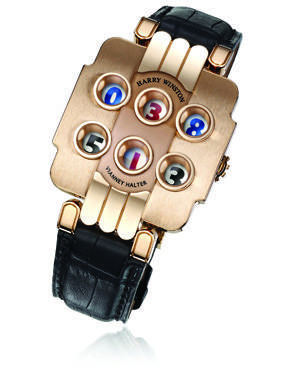
Opus 3
Rose Gold: $ 95,900; limited to 25 pieces
Platinum: $ 111,300; limited to 25 pieces
Platinum with 4.44ct diamonds; limited to 5 pieces
For the Opus 3, Harry Winston teamed up with visionary watchmaker Vianney Halter. Halter took the Opus collection into new waters with a complication the watch making world had never seen before in an entirely unique case and design. Simply put, the Opus 3 provides a new way to read time. The watch is a manually wound movement constructed from German silver and boasts a 40-hour power reserve. In its handmade Art Deco style rectangular case, there are six porthole openings that display a colored number. Blue is representative of hours, black defines the minutes, and red indicates the date. The hour is read horizontally from left to right in the top row numbers, while the minutes are read the same way in the bottom row of numbers. The date is displayed vertically in the second column. Each display relies on the instant jumping of the six indications that work by using 10 discs and 53 different jewels in order to complete a-one-of-a-kind complication that was so seemingly impossible to construct that it took 8 years to deliver.
Opus 4
Platinum: $387,100; limited to 18 pieces
Platinum with baguette diamonds; limited to 2 pieces
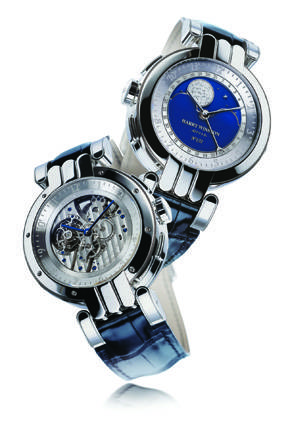
The Opus 4, developed with Christophe Claret, who recently launched his own watch line, is a tale of two watches told in one exceptional time piece. The watch comes in a reversible 44mm diameter case. The watch has a technical face on one side and an elegant face on the other, which looks more suited for evening events. Fitted with a 53-hour power reserve, the technical side of the watch displays a tourbillon, time indication, and a cathedral-type chime minute repeater, Claret’s expertise. On the visually romantic side of the watch are a moon phase, date and time indication against a blue dial matching the leather of the blue crocodile strap. Requiring an unbelievable 423 parts and 40 jewels to assemble, this complex piece is a horological work of art.
Opus V
Rose Gold: $111,300; limited to 45 pieces
Platinum: $143,300; limited to 45 pieces
Platinum with diamonds; limited to 10 pieces
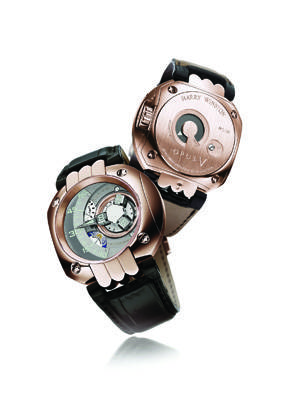
Revisiting their approach with the Opus 3, Harry Winston created another one-of-a-kind complication with watch designer Felix Baumgartner. The Opus V represents an interpretation of telling time that is incredibly creative, yet manages to maintain a distinctively chic and contemporary design that is true to the Harry Winston aesthetic enthusiasts revere. The way that the movement works is by using what is called a “satellite hour” display. On the three small blocks there are four numerals. These blocks rotate in order to indicate the time. The entire wheel to which the blocks are connected rotates as well, creating a three-dimensional display system. The current hour is shown on the block aligned with an arrow pointing to the minute, on one of the largest retrograde minute indicators in the industry, angled at 120 degrees. The Opus V also has a 120-hour power reserve, day/night indicator and a second unique feature known as a service indicator on the back of the watch that graduates from 0 to 5 years to let the owner know when their time piece needs to be taken to Harry Winston for its regular service.
Opus 6
White gold: $479,000; limited to 6 pieces
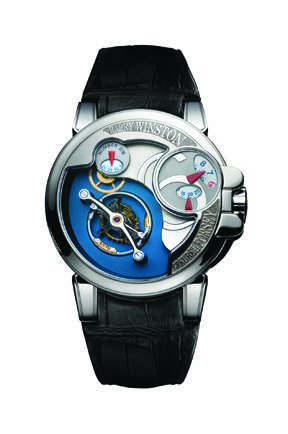
For the Opus 6, Harry Winston decided to dance with GreubelForsey to see what kind of technological marvel they could choreograph together. Having worked on the IWC Grand Complication, Greubel had both the mastery and resume to help write the next chapter in the Opus series. Where in the past the Opus watches were synonymous with complicated and intricate designs, the sixth installment would be more about precision and purity. Greubel used his revolutionary movement called the Emotion 30 to make his double 44mm one-minute tourbillons even more accurate. By angling the movement at 30 degrees, the balance oscillates constantly in all planes, which provides for greater precision in keeping time. What makes this watch appear so clean is that Greubel was able to succeed in hiding the gears by layering them and placing them off center beneath the bridge which covers the right side of the dial. The result allows the angled tourbillons to take center stage. In order to keep with the concept of a pure design, the hours, minutes, and seconds are given in circular displays at 3 and 11 o’clock.
Opus 7
White Gold: $218,700; limited to 50 pieces
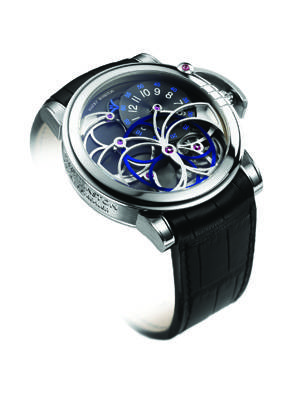
For the Opus 7, Harry Winston and Andreas Strehler put their minds together to explore the philosophy, “It is complicated to be simple.” In this horological pilgrimage, Andreas developed a watch able to display the hours, minutes and power reserve with no hands and only one display disc activated by pressing in the crown. Pressing the crown in once will cause the disc to align the white numbers with the triangular marker located at 10 o’clock. Pressing the crown in a second time causes the disc to match the blue numbers with the marker to indicate the minutes. Pressing the crown in a third time ingeniously reveals how much of the 60 hour power reserve is remaining by the same set of numbers used to identify the minutes. The bridge work on the watch dauntlessly flows across the dial in the shape of a butterfly inspired by the art nouveau movement. The impressive watch comes in a large 45 mm case.
Opus 8
White Gold: $405,500; Limited to 50 pieces
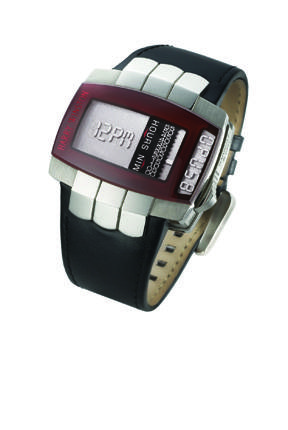
The Opus Collection’s second most expensive watch doesn’t look like a traditional mechanical watch at first glance. With a vision to combine the world of luxury complicated watches with the modern appearance of digital displays, Harry Winston looked to the engineering talents of FrédéricGarinaud, who had always dreamed of creating a hybrid display watch. Using a 1970’s inspired design, Garinaud managed to create a digital display powered by a mechanical movement. When a slide on the side of the watch is activated, it momentarily reveals what appears to be a digital hour and AM/PM display using the same concept as pin art games, which creates 3 dimensional impressions of objects pushed against them. To the right of the hour display is a vertical indicator that changes every five minutes. The back of the watch has disc displays for the hour, AM/PM, minutes and a 48-hour power reserve.
Opus 9
White Gold: $197,300; limited to 100 pieces
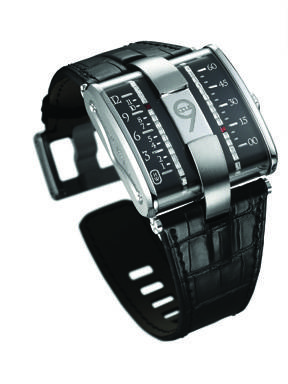
For the first time in the Opus series, Harry Winston invited two outside designers to work on a timepiece together. Grand Prix 2007 Best Watchmaker Designer winner Jean-Marc Wiederrecht came together with designer and architect Eric Giroud to create a piece that embodies the most fundamental elements of a Harry Winston time piece – elegance, class and exceptionalism. The design uses two vertical indicators to display the hour and minutes using the same principle as conveyor belts. The indication intertwines aesthetics with function, using 66 diamonds and six mandarin garnets strategically positioned to mark the time. The way the stones are set is reminiscent of the iconic Harry Winston invisible settings, making the stones to appear as if they are floating in the crystal tubes encasing them. The Opus 9 received the honor of “Best Designed Watch of the Year” for 2009 by the Jury of the Grand Prix d’Horlogerie.
Opus X
White Gold: $230,100; limited to 100 pieces
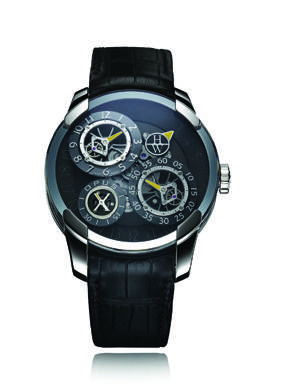
A decade after the debut of the first Opus watches at Baselworld, Harry Winston introduced the Opus X in conjunction with Jean-Francois Mojon. Mojon comes from a family of watchmakers and worked for both IWC and Swatch Group before deciding to open his own business, Chronode SA, dedicated to the research and development of high complication watch movements. The Opus X design was inspired by the pattern of planetary orbit. The hours, minutes and seconds are displayed on discs which rotate in a fluid motion to imitate a planetary gear train. There is also a second timezone driven on a separate frame running along the edge of the dial, which completes a rotation every 24 hours. The watch was designed with no bezel on the 46mm case in order to give it a cleaner look.
Opus Eleven
White Gold: $229,600; limited to 111 pieces
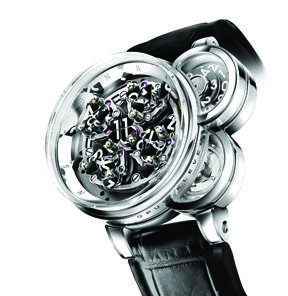
A watch that initially looks very complex and chaotic, The Opus Eleven is actually a very organized and well thought out timepiece. Developed with Denis Giguet, the idea for the watch was “deconstructing time.” In the main dial, a system of gears assembles 24 placards like a puzzle in the center to reveal the hour. Protruding from the right side of the watch are two smaller subdials. The top dial uses a jump-hour system to give the minutes in tens, while the bottom dial is dedicated to displaying the minutes in single units. This watch would truly be a unique grail piece of any connoisseur’s collection. The Opus Eleven took more than 14,400 hours to engineer, with 560 components and a staggering 166 jewels. Pricing is current as of September 13, 2011.
Latest from Haute Living
Gabrielle’s Angel Ball Returns to New York for an Evening of Philanthropy and Glamour
From Seattle to South Florida: A New Wave of Wealth Sets Its Sights on Miami
One of D.C.’s Best Bars Just Launched a Menu Built on Myths, Monsters and Urban Legends — and Yes, There’s Even a Bigfoot Negroni