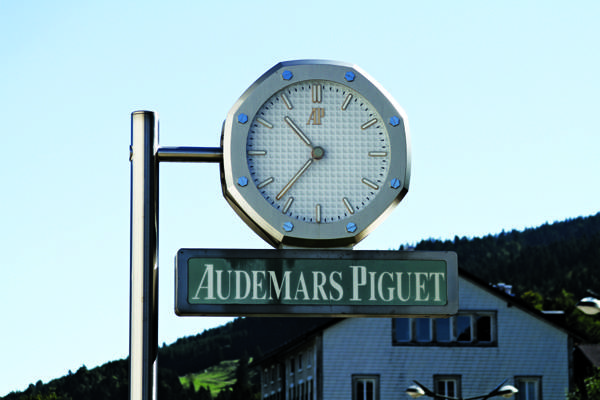
Audemars Piguet
A Close Look into the Celebrated Luxury Swiss Watchmaker
The people responsible for the Audemars Piguet of today are often given rock-star status by fellow luxury watch industry colleagues. This perception is often credited to the beautiful synergy between the visual and technical design arms of the prestigious Swiss watch maker. Traveling to Audemars Piguet’s headquarters and movement manufacture in the La Vallee du Joux region of Switzerland, I discover a few other reasons for the brand’s high status as I take an intimate look into the historic brand that has continually produced watches since the mid-19th century.
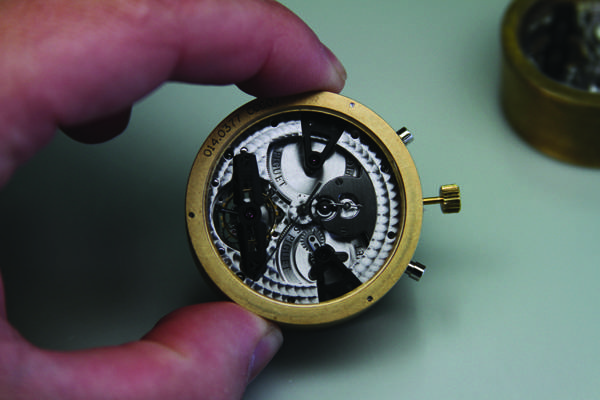
[highlight_text] The sophisticated works shops at APRP (Audemars Piguet Renaud & Papi, the movement making arm and partner of Audemars Piguet) bring powerful industrial tools to traditional watch making in the interest of making tiny parts precise, consistent, and of a very high quality. [/highlight_text]
Audemars Piguet started in Le Brassus—small hamlet in La Valle du Joux typical of Swiss storybook-style villages. The region has a watch making tradition that dates back hundreds of years. Historically an agricultural center, it provided a rich labor source of farmers looking to keep themselves occupied in the cold winter months when growing crops was not possible. The people adopted pocket watch making and in the early spring would travel to Geneva to sell the machines they delicately produced by hand during winter. Like many watch making areas of Switzerland at this time, neighbors often shared techniques and assisted each other to help the community as a whole produce the finest possible work. Good watches were a source of community—not just individual—pride. It was during this time in the 1830s when Audemars Piguet had its origins.
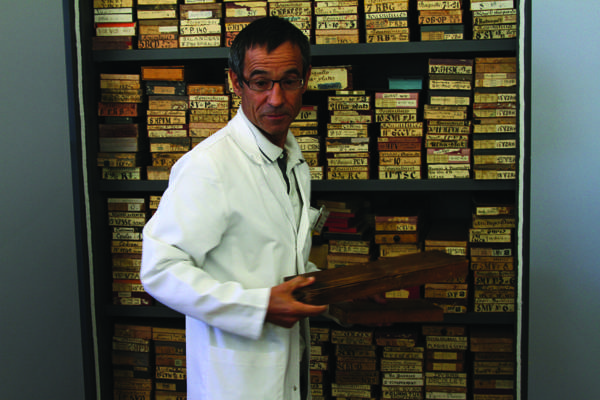
Continually benefitting from the rich tradition and culture of this period, today’s Audemars Piguet isn’t that much different in concept than the brand 100 years ago, or even earlier. The brand has a fantastic restoration shop that not only works on classic Audemars Piguet watches, but also those from other historic brands produced in the La Vallee du Joux region. The workshop contains a rare treasure, a cabinet filled to the brim with spare watch parts from as early as the mid-1800s. This physical knowledge base helps watch makers learn about historic techniques and offers a rubric for parts when old watches come in for restoration. Looking at the extremely well preserved historic watch parts evokes a sense of how modern they feel. The reality in fact is just how traditional modern watch parts of today still are.
Audemars Piguet is quick to share that no new complications or features for watches can be developed. “It has all been done before. Today we just improve upon how they are made and find innovative ways of combining complications.” This sentiment reflects how deeply engrained in tradition the Swiss are, but it is a true statement. Watch makers of the past were extremely resourceful and clever. If something was technically possible, they found a way to do it, and without today’s modern technology.
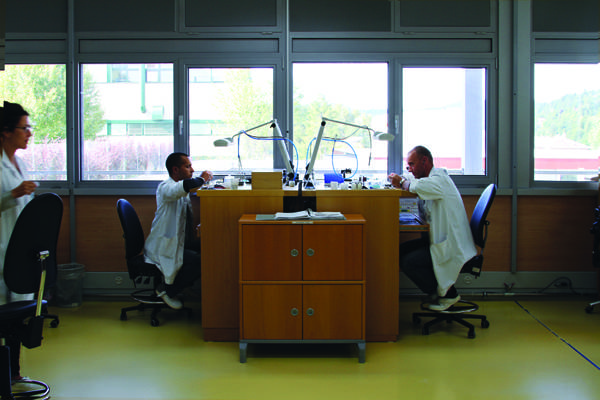
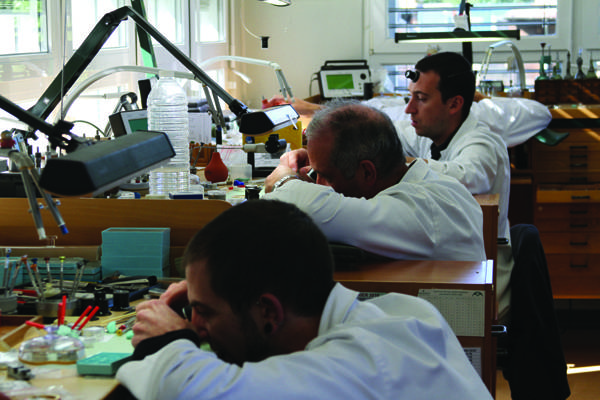
Modern technology has its benefits in today’s Audemars Piguet. While a luxury mechanical watch movement doesn’t need to be modern in design, it can be modern in construction. The sophisticated works shops at APRP (Audemars Piguet Renaud & Papi, the movement making arm and partner of Audemars Piguet) bring powerful industrial tools to traditional watch making in the interest of making tiny parts precise, consistent, and of a very high quality. This allows a brand like Audemars Piguet to make traditional style watches that feature high accuracy and durability, not to mention in a volume that meets their customers’ demands. Audemars Piguet also insists on experimenting with new materials to use in watch making, which is actually one of the most exciting uses of modern technology in the world of mechanical watches. Now famous for its use of “forged carbon,” Audemars Piguet produces an innovative molded and baked carbon thread formula that results in very light, very strong cases and case components. Forged carbon (different than carbon fiber) is making its way into more and more Audemars Piguet watches given the popularity of the innovative material. Audemars Piguet nevertheless asserts its dedication to tradition. The company employs a number of watchmakers who work in the quiet comfort of its facilities. In fact, Audemars Piguet isn’t just one building; it’s spread out among a couple of different campuses that each specialize in an integral role of the watch making process.
Movements and casing (everything in a watch that isn’t the movement) are produced separately and put together during a process called casing. Before casing, the movements must be manufactured starting with the plates and tiny components (a universe of gears, rods, pinions, and wheels). Audemars Piguet sources the base metal in the form of sheets and rods. After that, almost all parts of a movement are produced internally by skilled technicians. Small parts are produced in batches by various high precision machines that are about as sophisticated as they are interesting to view in operation. A number of highly specialized machines are employed to produce the necessary parts.
No part is used in a watch without being carefully inspected under magnification, and often experiences intense hand-applied finishing and decoration. In fact, the “finishing” phase of making watch movement parts is the most time consuming but also extremely important. Luxury watches command the prices that they do because of the level of effort required to make movements, especially those that contain hand decorated and assembled components. In addition to making watch movements more visually attractive, finishing makes movements operate more accurately by reducing friction, and can help movements to last much longer.
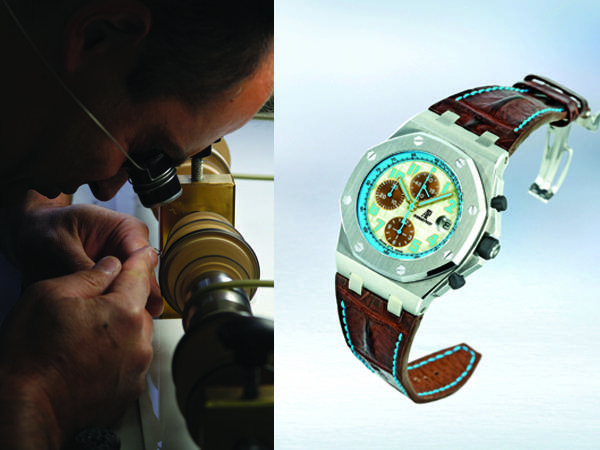
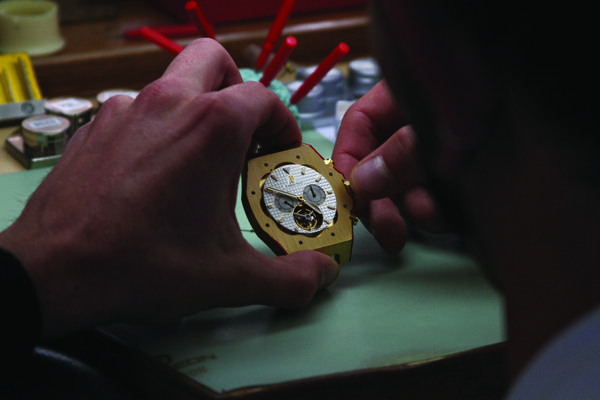
After parts are completed, movements go through various levels of assembly and testing. Movements aren’t only test after they are completed; they undergo constant testing during the assembly process. Certain complications such as a tourbillon require large amounts of adjusting time, providing that watches with a tourbillon escapement require high labor costs, and thus higher premium prices. Assembly and testing can require huge amounts of time, and at Audemars Piguet, entire teams are often involved in the manufacture and assembly of a single watch. There is an incredible level of attention provided to each timepiece when produced in this manner.
Testing also ensures that movements achieve desired levels of accuracy, and that cases provide advertised levels of water resistance. These assurances aren’t provided to merely a single “master watch design”—each individual watch must be tested for accuracy, water resistant, and other measures of quality and durability.
Watch movement making is all well and good, but today’s luxury watches are also valued for their design. Lead of Audemars Piguet product design, Octavio Garcia is a well-spoken American who has been living in Switzerland for almost two decades. Octavio continually smiles when asked about the future direction of Audemars Piguet design and product offering. Restrained by the Swiss preference for secrecy, Octavio still hints at the future direction of product development. He indicates that Audemars Piguet will more than ever focus on a strong core collection, and limited edition offerings will continue to exist but be less prevalent. The message to brand fans seems to be that Audemars Piguet will focus on refining and strengthening the most popular watch designs, but also those that are important to round out the collection, defining the brand now, as well as into the future. Additionally, limited editions will hold a higher value for collectors, being released less often, and with greater selectiveness to preserve their special status for the brand and collectors.
A look at Audemars Piguet products reveals strong luxury sport watches, as well as beautiful, traditionally styled complex timepieces. Such a broad set of competencies assures that Audemars Piguet has no real competitor, making it one of the strongest and most enduring watch brand personalities in the Swiss watch making industry. Audemars Piguet has a rich history that is ardently preserved today, but also pushes the boundaries when it comes to modern design, materials, and technology.
A final message for you is a hint into the motivation of their key technology developing talent. With the advent of the “AP Escapement,” Audemars Piguet wishes to promote the durability and practicality of mechanical timepieces in addition to their luxury status. The AP Escapement (timing regulation system) is extremely fast moving and operates at 43,200 beats per hour, which is about twice that of escapements in other mechanical watches. It is able to do this because it is made from an almost frictionless material called silicium that also benefits from not requiring lubrication. The AP Escapement may be regulated to be as accurate as within 5 seconds a week, a figure that is extremely impressive for a mechanical watch. Audemars Piguet will continue to develop the AP Escapement technology, with a possible goal of placing them in each movement that Audemars Piguet produces. The future for Audemars Piguet sees continually improved, novel designs, with an enthusiastic attention to technology and performance. All within the bounds set by their strict adherence to the tradition and history that put the brand where it is today.
Ariel Adams is the Haute Living Watch Editor and also publishes the luxury watch review site aBlogtoRead.com
Latest from Haute Living

The Best Halloween Events in Miami 2026, From Golden Caves to Venetian Masquerades

The Hotels Art Collectors Actually Book for Art Basel Miami Beach 2026

Inside Real Madrid’s New Louis Vuitton Wardrobe, Designed by Pharrell Williams