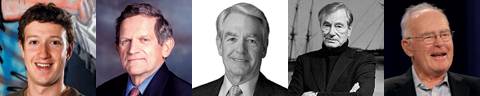
Tech Titans: Mark Zuckerberg, John Morgridge, Charles Schwab, Tom Perkins and more
For our premiere San Francisco edition, it was a natural decision to highlight 25 of the most important and impressive Tech Titans-the men that have shaped the industry.
Silicon Valley is ruled by the tech world. It is the raison d’entre for much of the sustained prosperity that abounds in Northern California. As such, for our premiere San Francisco edition, it was a natural decision to highlight 25 of the most important and impressive Tech Titans-the men that have shaped the industry. And it just so happens that they all call Silicon Valley home.
Mark Zuckerberg
Company: Facebook
Home: Palo Alto
The Web 2.0 wunderkind designed the perfect vessel to make social networking appeal to the increasingly addicted masses; he actually made it useful for everyone, whether young or old, hip or geeky. At 24 years old, Zuckerberg represents tech’s next generation of connected users. It also helps that in 2007, Microsoft bought a stake in the company, valuing it at $15 billion, making Zuckerberg the youngest member of Forbes’ billionaires list, with a personal net worth around $1.5 billion.
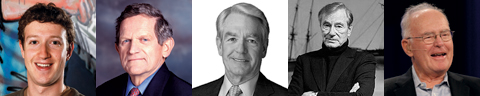
John Morgridge
Company: Cisco
Home: Portola Valley
Cisco Systems was founded in 1984 in attempts to advance the development of IP-the basic language to communicate over the Internet and in private networks. Morgridge joined Cisco Systems, Inc. in 1988 as president and CEO, and grew the company from $5 million in sales to more than $1 billion, and from 34 employees to more than 2,250. In 1990 he took Cisco public, and in 1995 he was appointed chairman. During his tenure, Cisco has become the worldwide leader in networking for the Internet, with more than $25 billion in revenues and some 47,000 employees in 77 countries.
[highlight_text] Today, Charles Schwab & Co. holds close to $1 trillion of client assets. [/highlight_text]
Charles Schwab
Company: Charles Schwab
Home: Atherton
When you think of revolutionaries in the world of personal finance, Schwab is the first name that comes to mind. The man who famously brought Wall Street back to Main Street by undercutting the big brokerage houses in the late 1970s was also one of the first to bring investing online (on CompuServe, well before the ’90s Internet trading frenzy). Today, Charles Schwab & Co. holds close to $1 trillion of client assets (the figure fluctuates as wildly as the market) and a $25 billion bank that stayed clear of the toxic debt that has choke-slammed so many other financial institutions, and Chuck himself is a multibillionaire.
Tom Perkins
Company: Kleiner Perkins Caufield & Byers
Home: Belvedere
One of Silicon Valley’s pioneers, Perkins’ venture capital firm, Kleiner Perkins Caufield & Byers, was an early backer of Genentech, Netscape, and Google. He is now, or has been, a director of the following firms: Acuson, Applied Materials, Compaq, Corning Works, Genentech, Hewlett Packard, Hybritech, LSI Logic, The News Corporation, Philips Electronics NV, Spectra-Physics, Symantec, and Tandem Computers. Not one to slow down, when he turned 70 several years ago, he decided to build the biggest, fastest, most technologically advanced, single-hulled sailing megayacht in the world, the 289-foot Maltese Falcon.
Gordon Moore
Company: Intel
Home: Woodside
In 1965, Moore predicted that the number of components the industry would be able to place on a computer chip would double every year. That phenomenon came to be known as Moore’s Law. Moore co-founded Intel in 1968, and in 1975, he updated his prediction to once every two years. It has become the guiding principle for the semiconductor industry to deliver ever-more-powerful chips while decreasing the cost of electronics. While the San Francisco native is retired from Intel, he is a director of Gilead Sciences Inc., a member of the National Academy of Engineering, and a fellow of the Royal Society of Engineers. Moore also serves on the board of trustees of the California Institute of Technology. He received the National Medal of Technology in 1990 and the Medal of Freedom, the nation’s highest civilian honor, from George W. Bush in 2002.
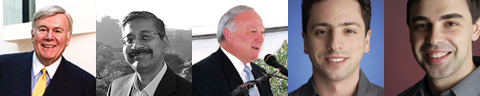
Pat McGovern
Company: IDG
Home: Hillsborough
McGovern is the undisputed heavyweight champion of tech media execs, and he can trace it all back to the world’s first computer magazine, Computers & Animation, where he was an assistant editor. As chairman of International Data Group, he oversees a multi-billion dollar global empire that spans 90 countries and reaches more than 200 million people. Amid the constant churn in tech and publishing, his patient, focused adherence to long-term vision has let IDG grow and adapt through diversification, reader service, and global expansion. Lately he’s been touting the economics of electronic media, and IDG has a new “Internet-first” strategy.
Kavitark Ram Shriram
Company: Sherpalo
Home: Mountain View
He’s called the Sherpa of Google not just because he wrote a six-figure check for its growth, but also because he was involved in the formation of the DNA of the company (he still sits on the board). The self-made billionaire started at Netscape, launched shopping site Junglee (sold to Amazon in ’98), and then founded Sherpalo in 2000. Besides Google, he’s gone on to back Yodlee, Zazzle.com, and currently backs Indian and American outfits like Mevio and 24/7 Customer.
Jerry Sanders III
Company: Advanced Micro Devices
Home: San Francisco
A champion of competition, Sanders, as co-founder and CEO of semiconductor manufacturer AMD, created the only real competitor to Intel. Before he stepped aside in 2002, for three-plus decades, he refused to back down despite odds and market share being stacked against him, allowing AMD to thrive while thousands of firms ended up in the tech graveyard. When IBM decided to not market desktops based on its own processors for Windows, AMD stayed. When Compaq and HP stopped making processors, AMD kept plugging away. While Motorola at times seems unsure in its commitment to desktop and server platforms, it’s never a question for AMD. During the dot-com boom, when Intel suffered from supply problems, AMD grew market share from single digits to almost 20 percent.
Sergey Brin
Company: Google
Home: Palo Alto
Love ‘em or hate ‘em, when Google makes a move, everybody pays attention. Along with Larry Page, whom he met at Stanford, Brin is the co-founder of the Google empire, and he currently operates as the president of technology. After developing the original search engine software, the duo launched the company out of a friend’s garage. Today, he’s one of the wealthiest Americans and has been dubbed the most important person on the Web by many tech publications. Oh, yeah, and he’s only 35.
Larry Page
Company: Google
Home: San Francisco
Page has racked up a multi-billion dollar net worth since launching Google with Brin in 1998. He grew the company to about 200 employees before moving himself to the president of products in 2001. While the recent economic slip has reduced his overall worth by a couple of billion, Google is still the undisputed dominating force in the tech world.
Eric Schmidt
Company: Google
Home: Atherton
Schmidt was brought on board at Google in 2001, and he took the company public in 2004. The Google tri-chief oversees an agenda that continues to wield influence in the tech industry and rake in the dough. It’s moved into new markets (and into more direct competition with Microsoft) with the launch of a mobile phone operating system and an open source web browser. Schmidt’s also been busy integrating recent acquisitions into Google, like YouTube, Postini (security), and DoubleClick (online ads).
Larry Ellison
Company: Oracle
Home: Redwood City
As a young man, while working as a programmer at Ampex, Ellison helped build the first IBM-compatible mainframe system. In 1977, Ellison and two of his Ampex colleagues founded their own company, Software Development Labs. They won a two-year contract to build a relational database management system for the CIA, and they dubbed it Oracle. Upon its success, they began developing the system’s commercial usages and launched a company to sell the application. In 1980, Ellison’s revenues were less than $1 million, but the following year, IBM adopted Oracle for its mainframe systems, and Oracle’s sales doubled every year for the next seven. Today, Ellison is one of the world’s wealthiest individuals. He also has a habit of buying up his professional competitors, with more than 40 acquisitions in the past four years.
Ray Dolby
Company: Dolby Laboratories
Home: San Francisco
While still in high school, Dolby went to work for Ampex Corporation, where he ultimately became responsible for developing the electronics for the first Ampex professional videotape recorder, the precursor of every professional and consumer videotape system today. In 1965, he founded Dolby Laboratories with the initial goal of developing electronic systems for reducing the background noise, such as hiss, introduced by the tape recording process. With the success of those systems and many analog and digital innovations since, the Dolby name has come to be associated worldwide with quality audio from film soundtracks, home theater systems, audio- and videocassettes, DVD, TV audio, and cable and satellite transmissions. He has received countless honors in the field of technology, including the U.S. National Medal of Technology.
Thomas Siebel
Company: Siebel Systems
Home: Woodside
The self-made tech billionaire got his start in the industry as a salesman for Larry Ellison’s Oracle. But when Ellison opted against Siebel’s sales-tracking software, Siebel launched his own company. Siebel Systems became a global leader in application software with more than 8,000 employees in 32 countries, more than 4,500 corporate customers, and annual revenue in excess of $2 billion. The company went public in 1996 and eventually was sold to Oracle in 2005 for the astounding price of $5.9 billion, securing Siebel a personal $500 million.
John Chambers
Company: Cisco Systems
Home: San Jose
One of Chambers’ great assets is that he sees market transitions early and quickly sets the ball in motion. He successfully transitioned Cisco from a disastrous 2001, when it went from being the most highly valued company in the world to a cautionary tale of the excess of bubbles. So he had Cisco prepared for what’s going on now, as the firm has a $26 billion cushion of available cash, two-dozen promising products in the pipeline (each of them targeting a minimum 40 percent market share), and an unprecedented forward-looking strategy to unleash what it’s dubbing a “human network effect” both on and off the Cisco campus.

George Lucas
Company: Lucasfilm
Home: Nicasio
Based on the classic story of a young man’s battle with the forces of evil, Star Wars introduced a modern myth to a new generation. It also revolutionized special effects, forged new frontiers in sound design, and brought audiences to movie theaters in record numbers. In the late ’70s, he established Lucas Films Ltd. in Marin County, a 2,700-acre production center and think tank. Here, at Skywalker Ranch, he presides over a vast entertainment empire (which includes THX, Skywalker Sound, and Industrial Light and Magic) that continuously expands visual and technological possibilities.
L. John Doerr
Company: Kleiner Perkins Caufield & Byers
Home: Woodside
In 1974 John joined small chipmaker Intel just as they invented the legendary 8080 microprocessor. Today, he is a partner at venture capital company Kleiner Perkins Caufield & Byers, where he has backed Larry Page, Sergey Brin, Eric Schmidt from Google, Jeff Bezos of Amazon, Scott Cook and Bill Campbell of Intuit, and others. John joined KPCB in 1980 and soon started Silicon Compilers, a VLSI CAD software company, and @Home, the first broadband cable Internet service. Not only is he a member of the board at Google, Bezos called him the “center of the Internet.” He is adamantly passionate about green technology and is active in the fight against global warming. He is currently backing a slew of green technological measures, including Al Gore’s Alliance for Climate Protection.
Vinod Khosla
Company: Khosla Ventures
Home: Menlo Park
Silicon Valley’s preeminent eco investor-named the No. 1 venture capitalist by both Fortune and Forbes-Khosla invested more than $300 million of his personal fortune into start-up green technologies. Vinod Khosla was formerly a General Partner at Kleiner Perkins and founder of Sun Microsystems. He also co-founded design automation company Daisy Systems early 1980s, and founded venture capital firm Khosla Ventures in 2004 to build businesses for the Internet, and the computing, mobile, and silicon and green technology arenas.
Steven Jobs
Company: Apple
Home: Palo Alto
The figurehead behind the always customer-focused Apple brand, Jobs is arguably a modern Merlin, consistently changing our lives by pulling new tech wizardry out of thin air. From the iPod to the MacBook, he oversees a brand whose ongoing innovation in hardware, software, consumer products, and product design raises the bar for the marketplace. He also revolutionized the way people get their music, thanks to iTunes. The CEO even figured out how to sell applications for the iPhone with the Apps Store, which is fast on its way to becoming a billion-dollar business (and one whose success has inspired a slew of desperate imitators). As a result, the Cupertino company’s shares have risen more than 1,000 percent over the past 10 years. Jobs’ pioneering vision also helped create Pixar.
David Filo
Company: Yahoo!
Home: Palo Alto
Filo co-created the Yahoo! Internet navigational guide in April 1994 with Jerry Yang and co-founded Yahoo! Inc. in April 1995. The venture has minted Filo billions, and Forbes lists him as one of the country’s wealthiest individuals. Today, Filo serves as a key technologist at Yahoo!, directing the technical operations behind the company’s global network of Web properties. He is credited with helping build Yahoo! into one of the Internet’s most recognized brands.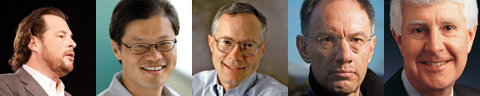
Marc Benioff
Company: Salesforce.com
Home: San Francisco
Benioff is one of the keenest evangelists of software as a service and has continued to drive Salesforce.com, a company he founded in 1999, forward in his own inimitable style. Recent highlights include Salesforce successfully distributing its software-as-a-service platform (Force.com, on which businesses can develop and run their own on-demand applications) and integrating its CRM software (the firm’s bread and butter) with Google Apps. It’s hard to find any article on cloud computing (using computer resources from a location other than your current one) that doesn’t mention him.
Jerry Yang
Company: Yahoo!
Home: Los Altos Hills
Yang co-founded Yahoo! with Filo in 1994. He has been instrumental in the company’s growth, as he focuses on corporate strategy, technology, strategic partnerships, joint ventures, and talent recruitment. He was appointed as the company’s CEO in 2007, in hopes of establishing Yahoo! as a real competitor for Google. Unfortunately, amidst a failed, unsolicited buyout attempt by Microsoft, and a deal with Google that was challenged by the government’s antitrust laws, Yang and Yahoo! endured a series of hardships. Yang announced he would step down from his role as CEO as soon as a suitable replacement is found. Yang also serves on the board of Yahoo! Japan, Cisco Systems, and Alibaba.com Corporation, and he is currently on a leave of absence from Stanford’s electrical engineering Ph.D. program.
Scott Cook
Company: Intuit, Inc.
Home: Woodside
Scott Cook co-founded Intuit Inc. in 1983 and now serves as the chairman of the Executive Committee. Before founding Intuit, he managed consulting assignments in banking and technology for Bain & Company, a corporate strategy consulting firm. He previously worked for household products giant Procter & Gamble in various marketing positions, including brand manager, for four years. Cook is a member of the board of directors of eBay; Procter & Gamble; the Asia Foundation; the Harvard Business School Dean’s Advisory Board; the Center for Brand and Product Management at the University of Wisconsin; and the Intuit Scholarship Foundation.
Michael Moritz
Company: Sequoia Capital
Home San Francisco
Welsh-born, Wharton-educated Moritz has arguably been the top tech dealmaker on the planet since the Internet took off. He joined Sequoia Capital (The Entrepreneurs Behind the Entrepreneurs) in 1986; prior to that, he worked in a variety of positions at Time Warner and was a founder of Technologic Partners. He was the leader behind Sequoia’s prescient 1995 stake in Yahoo! Four years later, the investment was in Google. He became a board member and stayed until 2007, a span that saw Google explode from a startup into a multi-billion dollar behemoth.
David Duffield
Company: Workday
Home: Alamo
Duffield rose to prominence (and an annual spot on Forbes’ wealthiest list) building PeopleSoft into a software juggernaut, via its rare combination of killer competitive edge, customer service, and congenial office culture. As he promoted core values that never strayed from people, innovation, integrity, and fun, PeopleSoft grew into the second-largest application software firm. In the past several years he’s been priming his new company, Workday, to challenge Oracle and SAP AG with on-demand software that allows customers to manage biz tasks online, instead of installing pricey programs on company computers.
Latest from Haute Living

L’AGENCE Debuts Spring 2027 Dream Collection at The Ritz Paris
Inside the Zero Bond Dinner Where Orlando Bloom & Porsche Design Revealed Their Most Ambitious Concept Yet

The Atlanta Steakhouses Where the Real Deals Get Done