





 Photo Credit: Shutterstock
By Sanjana Challa, Charlotte Thomas, & Dr. Samuel Lin, MD, FACS
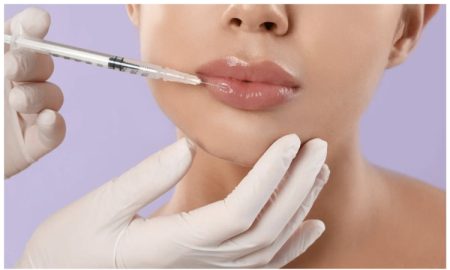
Fat grafting (removing fat from other parts of your body) is a less invasive procedure that first requires liposuction of another area. This fat is then injected into your breasts to provide minor augmentation and contouring support. Similarly, dermal fillers, such as hyaluronic acid-based fillers, may be used to improve the shape, size, and contour of the breast. This is a minimally invasive office-based procedure.
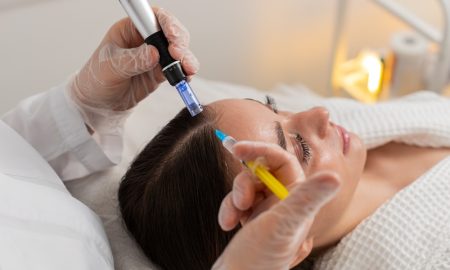
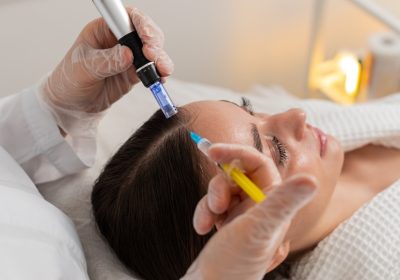
A procedure known as a platelet-rich-plasma (PRP) breast lift, or “vampire breast lift,” involves a provider using a sample of your blood, separating the plasma by spinning at high speed, and injecting it into the breasts. This procedure can improve the skin texture and provide minor augmentation. Some surgeons offer temporary saline injections, sometimes known as “vacation breasts,” which offer temporary (24-48 hour) breast augmentation, after which the saline is absorbed back into the body; however, this procedure lacks evidence to support its longevity and side effects.
Lasers may be used to improve the skin quality of the area, as used elsewhere on the body. While lasers have been promoted as an option for breast lift, these claims are not supported by evidence. For an immediate, non-permanent enhancement, bras with thicker cups can lift and gather the breasts, providing a fuller appearance without actual tissue growth.
While dermal fillers and fat grafting can correct small contour defects and provide minor volume boost to targeted areas, they do not offer larger volume changes that are capable with breast augmentation. Options like the vampire breast lift and lasering may provide improvements to the skin of this area, which augmentation alone will not provide. However, there is limited evidence to support the longevity of these effects.
Regarding reversal, dermal fillers can be dissolved in the office, whereas a breast augmentation would require a secondary operation to remove implants. Small areas of the breast can be treated with liposuction to remove fat from targeted areas. Benefits of fat grafting include modest volume enhancement and high patient satisfaction. At one year, the reported fat retention rate is 36-40%.
Benefits of injectable fillers include the minimally invasive, outpatient nature of the procedure, which allows for fast results with immediate volume enhancement. The benefits of vampire breast lift and temporary saline injections include an immediate effect. The benefits of lasers include high patient satisfaction; however, studies reporting favorable outcomes for breast lift procedures show commercial bias. Although rare, the main risks of fat grafting are fat necrosis, cyst formation, and infection. Additionally, fat grafting may lead to radiological artifacts that may complicate future breast imaging.
Risks of injectable filler include infection, foreign body reaction, including granuloma formation, and migration and mass formation that can lead to contour deformities. The lack of efficacy of lasers for breast lift is a major concern and limitation despite many providers offering this treatment. Risk for a vampire breast lift includes bruising, swelling, tenderness, calcification, and hematoma. Temporary saline injections may cause skin pain and stretching. For patients who do not want to undergo surgery, these other options are available. However, the outcomes from these procedures are modest compared to breast augmentation, with limited evidence on long-term outcomes.
Patients who are ideal for these procedures are generally healthy, non-smokers with no open wounds on their breasts who are looking for a small to modest increase in breast volume. Patients should talk to their board-certified plastic surgeons about the best option for them.
Resources
- Krastev TK, Alshaikh GAH, Hommes J, Piatkowski A, van der Hulst RRWJ. Efficacy of autologous fat transfer for the correction of contour deformities in the breast: A systematic review and meta-analysis. J Plast Reconstr Aesthet Surg. 2018 Oct;71(10):1392-1409. PMID: 30061004. Available at: https://pubmed.ncbi.nlm.nih.gov/30061004/
- Swanson E. A systematic review of radiofrequency and helium plasma radiofrequency alternatives to mastopexy. Aesthetic Plast Surg. (Online ahead of print) 2025. PMID: 41053477. Available at: https://pubmed.ncbi.nlm.nih.gov/41053477/
- Hu S, Xu H. Volume retention rate after breast autogenous fat grafting and related influencing factors: A systematic review and meta-analysis. J Plast Reconstr Aesthet Surg. 2024 Feb;89:105-116. PMID: 38160589. Available at: https://pubmed.ncbi.nlm.nih.gov/38160589/
- Seth I, Bulloch G, Gibson D, et al. Autologous fat grafting in breast augmentation: A systematic review highlighting the need for clinical caution. Plast Reconstr Surg. 2024 Mar;153(3):527e-538e. PMID: 37166041. Available at: https://pubmed.ncbi.nlm.nih.gov/37166041/
- Schlenz I, Kaider A. The Brava external tissue expander: is breast enlargement without surgery a reality? Plast Reconstr Surg. 2007 Nov;120(6):1680-1689. PMID: 18040206. Available at: https://pubmed.ncbi.nlm.nih.gov/18040206/
- Khouri RK, Jr, Khouri RK, et al. Nonsurgical breast enlargement using an external soft-tissue expansion system. Plast Reconstr Surg. 2000;107(2):622-628. PMID: 10845308. Available at: https://pubmed.ncbi.nlm.nih.gov/10845308/
- Spear SL, Pittman T. A prospective study on lipoaugmentation of the breast. Aesthet Surg J. 2014 Mar;34(3):400-408. PMID: 24604785. Available at: https://pubmed.ncbi.nlm.nih.gov/24604785/
- “Vampire Breast Lift: What You Should Know.” Cleveland Clinic. Available at: https://my.clevelandclinic.org/health/treatments/21862-vampire-breast-lift
For more information, visit Dr. Samuel Lin's social media:

Doctor's Talk
November 20, 2025From Anti-Aging to Authentic Beauty: How Dr. Steven Cohen Is