Top 10 Architects: Zaha Hadid, Santiago Calatrava, Tadao Ando, Cesar Pelli and more
Shaping the World's Urban Density.
Zaha Hadid
Text by Ayesha Khan
The first woman ever to win the coveted Pritzker Prize (architecture’s version of the Nobel Prize), Zaha Hadid is a force to reckon with in an industry dominated by men. Architecture was always a dream for the Iraqi-born virtuoso who asserts she knew she was certain of her future career path since she was 11 years old. Although she has garnered many titles typically reserved for men, including Commander of the British Empire and Fellow of the American Institute of Architects, Hadid still admits it is hard for a woman in her industry. “Working on an architecture project means perseverance,” she asserts. “But no matter how much progress has been made, there is still a world that, for women, is taboo.” Hadid’s educational endeavors took her from Beirut to London, and she later held several professorships at Yale, Harvard, and the University of Applied Arts in Vienna. Hadid’s pioneering deconstructive architectural style turned heads ever since she worked with the likes of Rem Koolhaas and Elia Zenghelis in the Office for Metropolitan Architecture. Her unmistakable mark can be seen in the Chanel Mobile Art exhibit, the BMW Central Building in Leipzig, Germany, and the Bridge Pavilion in Zaragoza, Spain. Future projects include the London Olympic Aquatic Centre, which will be completed in 2012, and a performing arts center on Saadiyat Island, United Arab Emirates.
Santiago Calatrava
Text by Ayesha Khan
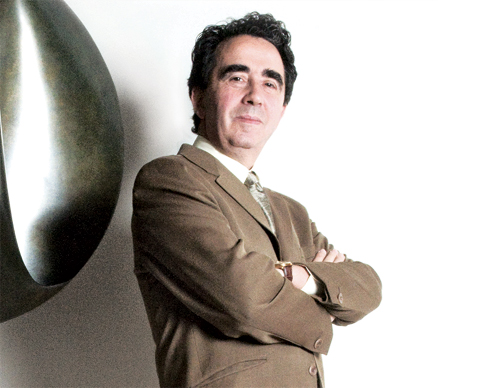
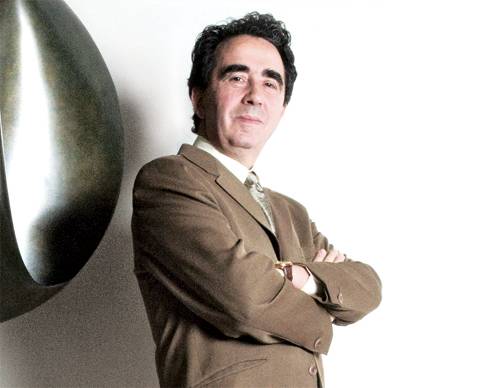
Following in the footsteps of the likes of Gaudi, Dali, and Picasso, Spanish architect Santiago Calatrava harbors the creative spirit of a true artist. His buildings come alive with a vibrancy and dynamism that comes from the dichotomy between engineering and sculpture. Born and raised in Valencia (where he would later create one of his most iconic buildings, La Ciudad de las Artes y de las Ciencias), Calatrava trained in the arts and went on to obtain a doctorate in civil engineering. It was his early work with bridges, most notably the Puente del Alamillo in Seville, Spain, that put him on the international map as a truly gifted architect. But Calatrava will always be the first to point out that no architect is successful without a true understanding of art. “I like to think of an architect as an artist. There is certainly a renaissance of architecture towards art. Architecture is not only something that we can enjoy, but it’s also a heritage that we are delivering to the next generation, as witnesses to our epoch,” he says. Operating out of Paris, Zurich, New York, and his native city of Valencia, Calatrava is, at one time, working on a host of international projects from Liège, Belgium, to Chicago and New York. “The Ground Zero [World Trade Center Transportation Hub] project is very important, and I think it’s a prudent time to do such enormous work in 10 years,” he says. The transportation hub will house 14 subway lines, a massive pedestrian link to the World Financial Center and Hudson River Ferries, and is expected to accommodate 250,000 visitors daily. “It’s a challenging project because it’s an enormous complex, and it’s technically very challenging,” he adds. He feels the Chicago Spire project is “an important achievement for the city of Chicago and its whole skyline.” When completed, the Chicago Spire will project from Chicago’s lakeside skyline at a stunning 150 floors, making it one of the world’s tallest freestanding buildings.
Tadao Ando
Text by Sean Ballent
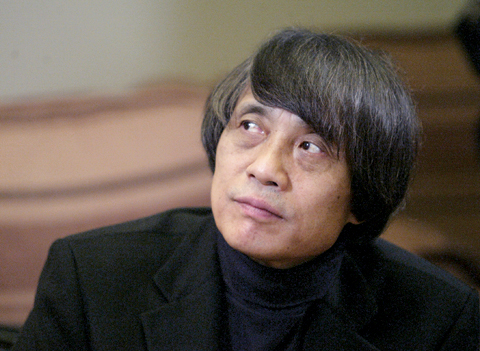
As Japan recovered from the war, Tadao Ando spent most of his time outdoors, in the streets of Osaka. When he was 14 years old, he helped a crew of carpenters do an extension on his family’s house. It was then that one of the most renowned contemporary Japanese architects fell in love with the craft, building countless models of airplanes and ships. As a young child, he watched how trees grew and sunlight altered the qualities of the lumber. After visiting temples and shrines in Kyoto and Nara and studying traditional Japanese architecture, he came to understand the absolute balance between form and the material from which it is made. “I was never a good student. I always preferred learning things on my own outside of class,” Tadao explains. Traveling to Europe and the U.S., he analyzed the Western world’s greatest buildings by keeping a detailed sketchbook, storing his ideas and possibly his future works. It was here that he began to form his own ideas about architectural design, before founding Tadao Ando Architect & Associates in Osaka in 1969. Some of his significant works include his Row House in Sumiyoshi, a small two-story, cast-in-place concrete house, and his housing complex at Rokko, just outside Kobe, a complex warren of terraces, balconies, atriums, and shafts. Ando’s creative works have not only gained him every major Japanese architecture award but also the world-renowned Pritzker Architecture Prize, which he won due to his artistic and intellectual sensitivity and his ability to produce buildings large and small that both serve and inspire. “I hope that my architecture dialogues with those who experience it can renew their sense of values. I always try to create an architecture where people can discover something new,” he explains.
Cesar Pelli
Text by Sean Ballent
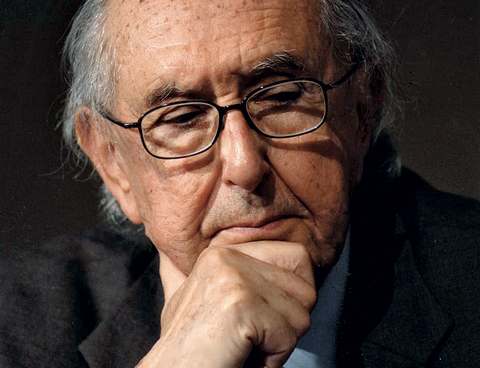
Argentinean-born architect Cesar Pelli boasts new innovative design strategies that are rich in detail, while maintaining extremely humane elements. His award-winning technique has earned him prestigious accolades throughout his long career, including the American Institute of Architects Gold Medal and a 1991 distinction as one of the 10 most influential living American architects. He began to leave his mark all across the American landscape in 1952 when he immigrated here to study at the School of Architecture at the University of Illinois at Urbana-Champaign. From there, he started his career in the New Haven offices of renowned architect Euro Saarinen as project designer for several buildings, including the TWA Terminal at JFK Airport in New York and Stiles and Morse Colleges at Yale University. He was then appointed as director of Design at DMJM and later a partner for design at Gruen Associates. These years yielded many architectural awards, including some for his designs of the Pacific Design Center in Los Angeles and the U.S. Embassy in Tokyo. As the former dean of the Yale University School of Architecture and the author of extensive works in well-respected journals, books, and digests, his list of acknowledgements and awards is as detailed as his projects. His architectural proficiency reached soaring heights in Malaysia in 2004 when he received the Aga Khan Award for Architecture for his striking Petronas Twin Towers office complex, which looms 1,483 feet over the city. Pelli’s renderings can be admired around the globe and have received international critical acclaim.
Frank Gehry
Text by Ayesha Khan
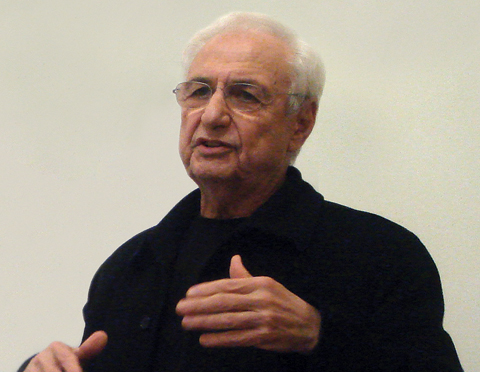
Many would be surprised to learn that Frank Gehry flunked his first architecture class. But, convinced of his love for art and design, he gave it a second try. Dozens of iconic commissions, a Pritzker Prize, and a Sydney Pollack documentary later, the world is grateful that he did. “My grandmother played with me on the floor with blocks when I was eight years old in Canada, and she got cuttings for her wood stove from the shop,” says Gehry of his initial introduction to architecture. “They were like band saw and jigsaw cuttings, and they were odd shapes, and we used to play, make fantasy cities.” His mother introduced him to his love for music and museums that would later be the subject of most of his commissions. His most famous projects include the Guggenheim Bilbao, the Disney Concert Hall in Los Angeles, and the IAC building in New York City. Whether they be clad in titanium or majestically lit glass, a theme of dynamic movement always resonates throughout Gehry’s buildings. “I have been interested in the sense of movement in architecture,” he says. “Maybe it comes from the fast society, the fast world around me, that I’m trying to make some kind of connection to. “Gehry is currently taking his architectural mastery around the world, from Miami Beach, where he is developing the iconic New World Symphony, to Abu Dhabi in the United Arab Emirates, where he is working on another Guggenheim project.
Herzog & de Meuron
Text by Sean Ballent
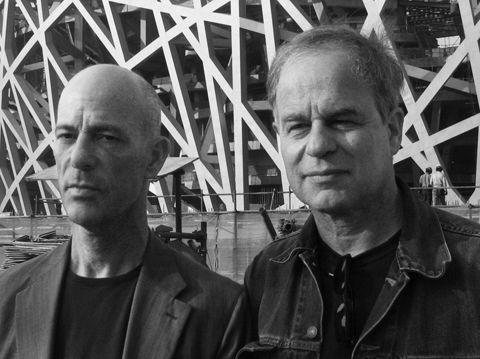
A plethora of brilliant minds and products have come out of Basel, Switzerland, earning it top nods among luxury-lovers as one of the most elite international cities when it comes to art and culture. In 2001, two new names were added to the accomplished list that Basel produced when Jacques Herzog and Pierre de Meuron, Basel natives born in 1950, earned the Pritzker Architecture Prize. Upon completing their studies at the Swiss Federal Institute of Technology in Zurich, the pair partnered up in 1978, created Herzog & de Meuron, and immediately went to work, constructing a reputation as solid as their designs. They have been hailed for their work in converting the abandoned Bankside power station on the Thames River into the renowned Gallery of Modern Art for the Tate Museum, as well as for their work with silkscreened glass and concrete for the library at the Technical University in Eberswalde, Germany. The team’s early works are often described as reductivist pieces of modernity, but more recently their claims to architectural fame at the Barcelona Forum Building, Prada Tokyo, and the Beijing National Stadium (which debuted with all the eyes of the world upon it at the 2008 Olympic Games) indicate the dynamic duo may be leaning towards a reorganized and restructured architectural philosophy, further exemplified by their designs for New York’s 56 Leonard.
Lord Norman Foster
Text by Ayesha Khan
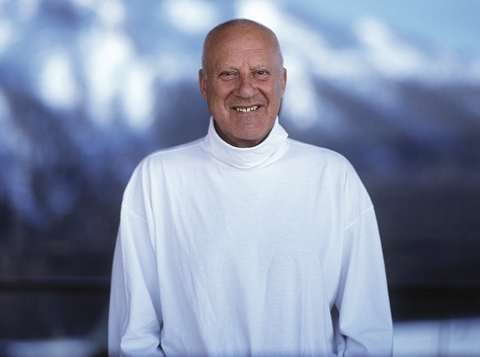
Perhaps the most celebrated name in British architecture, Lord Norman Foster commands a monster design firm, valued at more than 500 million pounds. Based in London, the design house has imparted groundbreaking technologies in building design. He and his firm have always been ahead of the curve with “green” design, which, in Foster’s own words is, “not about fashion, it’s about survival.” Foster + Partners has created such pioneering buildings as Hong Kong’s HSBC headquarters, which is mostly lit by natural daylight, and London’s 30 St Mary Axe which employs a series of energy-saving elements that allow it to use only half the energy expected from a tower of its size. Lord Foster was knighted in 1990 and created a life peer as Baron Foster of Thames Bank, Reddish. Most recently, the world took note when his massive Beijing Airport project was unveiled in time for the Olympics. “It’s so big that in certain lights you can’t see one end of building from the other,” says Foster. His firm is also developing Tower 2 of the World Trade Center site, which, when completed, will be the second tallest building in New York City after Freedom Tower. “As an architect you design for the present, with an awareness of the past, for a future which is essentially unknown,” asserts Foster. However uncertain the future may be, Foster’s name is sure to be a key part of the architecture world’s future for years to come.
Renzo Piano
Text by Sean Ballent
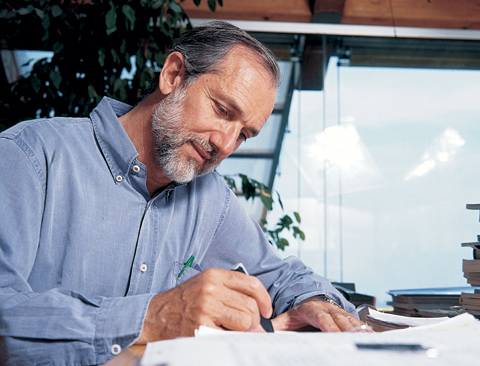
Renzo Piano’s work is a rare blending of art, architecture and engineering with a touch of intellectuality, toped and garnished with classical Italian philosophy and tradition. The 1998 Laureate of the Pritzker Architecture Prize, the highest in the field of architecture, is a craftsman of another world. Piano was born into a family of builders in Genoa, Italy, in 1937. His grandfather, his father, four uncles, and brothers were all contractors who were against the idea of his choosing architecture as a career. Against those odds, Piano completed his graduation from the Milan Polytechnic Architecture School and started business in his father’s construction company after marrying the girl he had known since his school days. Inspired by 15th-century idol Brunelleschi, co-worker Jean Prouve of France, and Z.S. Makowsky, Piano set off to perfect his craft. His first important commission took shape in 1969 when he designed the Italian Industry Pavilion at Expo ’70 in Osaka. The Expo attracted much favorable attention, including that of another young English architect named Richard Rogers. The two had a great deal in common and worked together to win the international competition for the Centre Georges Pompidou in Paris. Renzo Piano’s collection of work includes a wide variety of more than 40 world-famous projects that span the globe. One of his most famous is The Menil Collection, a museum in Houston, Texas, which stands as an architectural masterpiece, due to its simplicity, flexibility, open spaces, and illumination of natural light through Piano’s signature “roof of leaves.”
I.M. Pei
Text by Michael Calderone
Photography Stephen Ladner
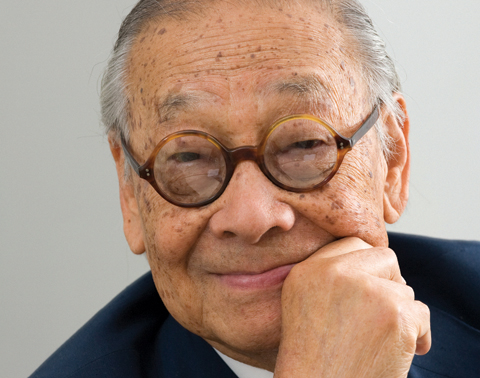
Of course, I.M. Pei, who recently turned 91 years old, is a living legend in the field of architecture, with numerous accomplishments, including the National Gallery of Art-East Wing in Washington, DC; the Bank of China Tower in Hong Kong; the Four Seasons Hotel in New York; The Rock and Roll Hall of Fame in Cleveland; and the Louvre’s famed glass pyramid in Paris. When his reputation was only growing, Jacqueline Kennedy hand selected him to design the Kennedy Library, following a competition that included far more well known names in the field, such as Louis Kahn, Mies van der Rohe, Gordon Bunshaft, and Philip Johnson. Pei’s storied career throughout the second half of the 20th century (and beyond!) is as fascinating as his creative mind. Hailing from a family of means, Ieoh Ming Pei was born in Canton, China, in 1917, as the son of an executive at the Bank of China. Pei had the opportunity to study abroad and at 17 years old left for the United States. Here, he received a bachelor’s degree in architecture at MIT, and proceeded to Harvard for graduate school, studying under Bauhaus founder Walter Gropius. In 1948, I.M. began working for legendary William Zeckendorf as the director of architecture for his real estate development company. The following decade, he formed I.M. Pei & Associates (later I.M. Pei & Partners) and would go on to design impressive structures throughout the world. Over the years, the Pritzker Architecture Prize-winning architect designed schools, hospitals, museums, and skyscrapers. Later, with his son, Li Chung “Sandi,” he designed the stunning Bank of China Tower in Hong Kong. Although retired from the firm he founded since 1990, I.M. Pei remains quite active and is listed as the design principal of the Museum of Islamic Art, in addition to keeping it in the family by working with Pei Partnership Architects on the Macao Science Center.
Robert A.M. Stern
Text by Michael Calderone
Photography by Naila Ruechel
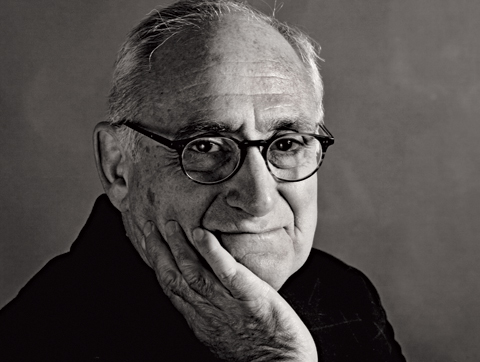
In his late 60s, the renowned Robert Stern shows no signs of slowing down. That’s not surprising, considering the many hats he wears: overseeing a highly successful, 300-person firm in Manhattan, serving as the dean of the Yale School of Architecture, writing books, giving lectures, visiting work sites, and simply sketching his newest ideas. Academically, the young architect was a standout, receiving degrees from both Columbia University and Yale, the latter where he was mentored by the renowned Vincent Scully. Then, graduating in 1965, one of Stern’s first jobs was as a junior designer in the studio of another up-and-coming architect: Richard Meier. Since branching out on his own 38 years ago, Stern has embarked on one of the most prolific-and varied-careers in contemporary architecture. His firm’s projects have included a Federal Courthouse in Virginia, buildings at Harvard and University of Virginia, and numerous luxury condominiums, such as 10 Rittenhouse Square, overlooking historic Philadelphia. Whether designing a penthouse in the sky for a high-powered CEO or an academic building, Stern’s process is remarkably similar to decade’s earlier-making preliminary sketches and sculpting clay. “I don’t even know how to use a word processor,” says Stern, “or what do you call that, a laptop!” Of course, he understands the computer’s power in today’s architecture world, and his remarkable team is well versed in the latest technology. Nevertheless, if there’s one piece of advice that the celebrated architect still hopes to offer the next generation of architects, its that they do “not lose contact with making things with their hands, looking with their eyes. My mantra as an educator is that while you must always go forward and take advantage of new situations that come to us as architects; we don’t need to cast away what we have already learned,” said Stern. “The past must teach us.”
Latest from Haute Living
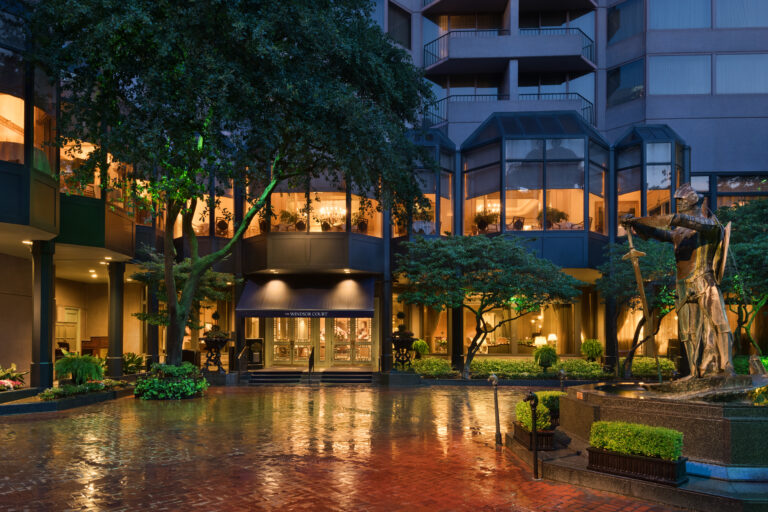
New Orleans, Reconsidered: Why the Crescent City Is One of America’s Great Luxury Destinations

HAUTE LIVING – Rashawn Smith on the Art of Time, Style and Modern Watch Collecting

From Tiffany to Cartier: The Best Diamond Tennis Necklaces Worth the Investment