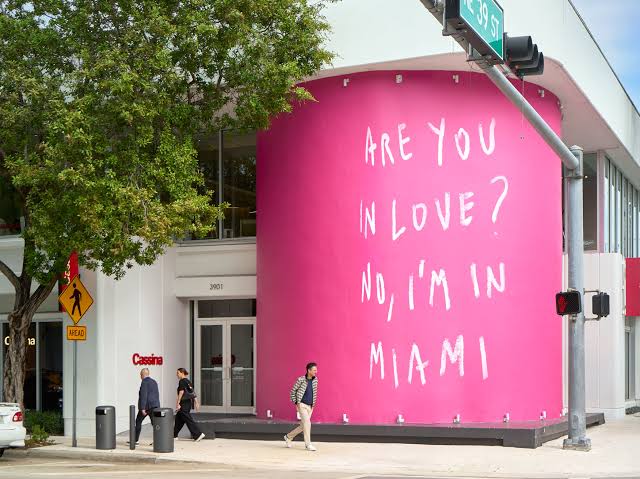
Maybe You Are In Love, But You’re Still In Miami

If you live in Miami, you know exactly who posted this sign on her Instagram story. It was the person who is actively, currently, at this very moment, in a situationship. She posted it hoping he would like the story, connect the dots, and finally have the personal growth moment she has been manifesting for him for six months. Six words on a furniture store in the Design District: Are You in Love? No, I’m in Miami.
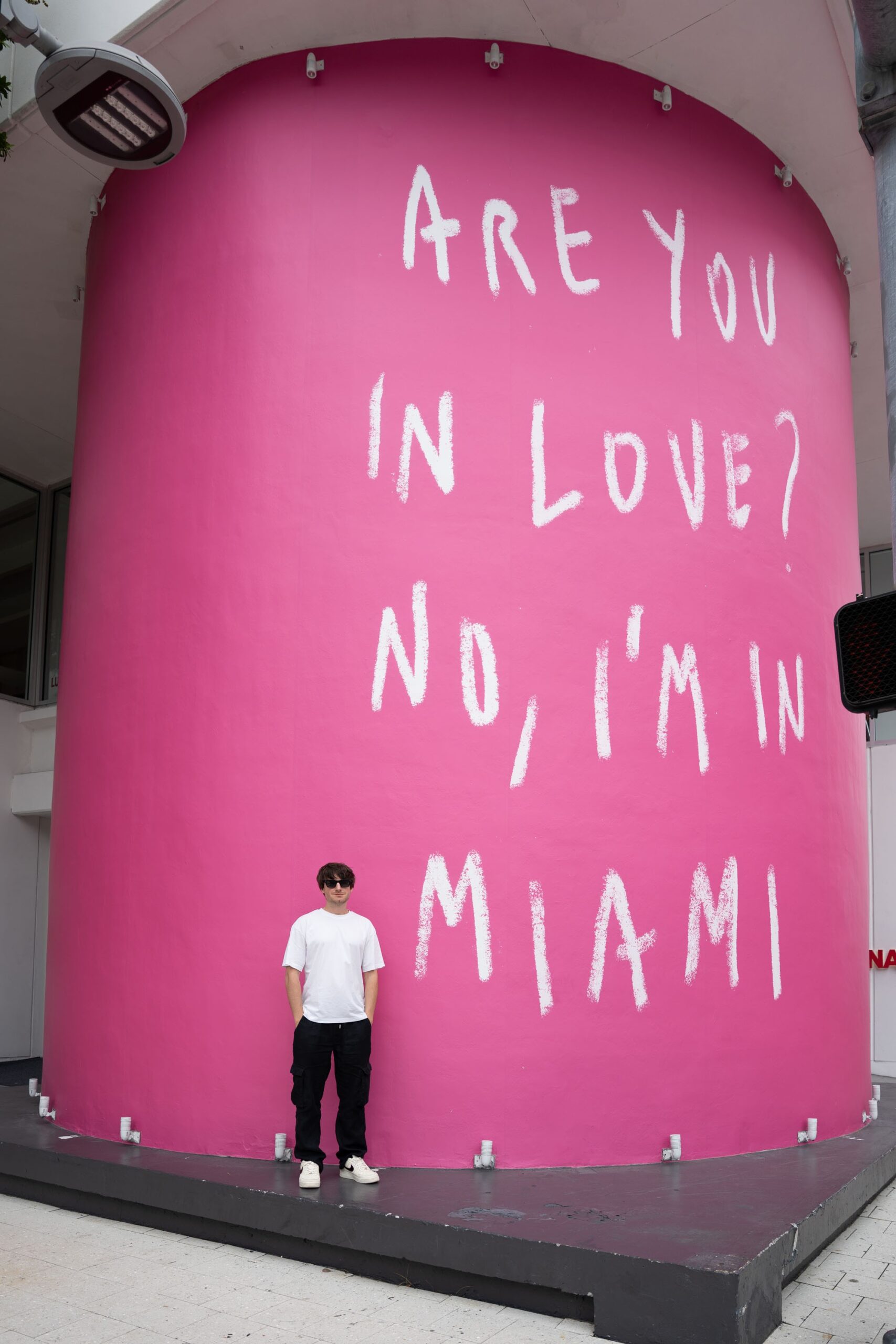
Photo Credit: Courtesy of Miami Design District
After it’s debut during Art Basel 2025, the sign went viral almost immediately. It ended up on thousands of TikToks, in hundreds of Instagram captions, and on the lips of people who had never set foot in a gallery in their lives but somehow felt the joke landed somewhere deep and personal. Because it is a joke. And like all the best jokes, it is also completely, uncomfortably true.
Italian artist Pietro Terzini created the piece as what he described as an ironic provocation, a commentary on how emotional depth and genuine human connection are increasingly replaced by place and status. He chose Miami deliberately. And Miami, in its self-awareness, laughed and posted it, which is exactly what the sign was talking about.
It was not the first time Miami’s complicated relationship with intimacy had been put into words. In the summer of 2024, Camila Cabello, Miami native and one of the city’s most devoted musical ambassadors, released C,XOXO, a kaleidoscopic tribute to her hometown that circled the same territory from a different angle. She described the Miami she loves as a bottle-blonde fantasy with dark roots breaking through its platinum gloss: beautiful on the surface, complicated underneath, and honest about exactly neither. The album did not solve the riddle of this city’s emotional life. It made it sound so good that nobody minded. Terzini’s sign, arriving a year later, simply said the quiet part out loud.
Miami has always had a complicated relationship with intimacy. It is a city purpose-built for surface, for beauty, for spectacle, and for the performance of a life well-lived. This is not a character flaw unique to Miami. It is an intensification of something present in every major city, the substitution of experience for emotion, of presence for connection. But Miami does it with more style than anywhere else, and with a version of charm that makes the whole city feel like it’s letting you in on something. The result is a dating culture that is simultaneously electric and exhausting, full of extraordinary moments and remarkably fewer extraordinary relationships.
The city attracts people in transition. Founders who just exited. Divorcees who just relocated. Models in town for the season. Finance guys who came for the tax structure and stayed for everything else. Everyone is arriving from somewhere and headed somewhere else, which creates an energy that is intoxicating and an emotional availability that is, to put it charitably, variable. And the Miami natives are the most emotionally unavailable people you will ever meet in your life. They did not become this way by accident. This city raised them.
Miami did not invent the situationship, but it has certainly perfected it. The combination of physical beauty, social abundance, and a cultural ethos that treats commitment as the enemy of spontaneity, produces a relational landscape where almost everyone is available and almost no one is ready.
What makes Terzini’s phrase so resonant is not the cynicism. It is the accuracy. Being in Miami really does produce a feeling. It is warm and luminous and faintly euphoric and it makes you feel, on certain evenings, like anything is possible. That feeling is real. It is simply not the same as being in love, and the sign is honest enough to say so.
In a city where so much energy goes into the performance of abundance: the right table, the right outfit, the right circle, the right zip code, genuine emotional vulnerability is a countercultural act. To want something real in here, is to swim against a very strong current. Most people float. A few people swim. And the ones who find each other swimming tend to hold on very tightly, because they know how rare it is.
Miami has a way of sorting people. The ones who are here for the fantasy tend to move on when the fantasy gets complicated. The ones who stay tend to be more interesting. More layered, more self-aware, more willing to trade the performance for something quieter and more true.
Pietro Terzini put six words on a building and inadvertently wrote the most honest thing anyone has said about Miami’s interior life in years. The city laughed, shared it, turned it into content, and kept going, which is also, arguably, the most Miami response possible.
But somewhere in the viral loop, between the reposts and the captions, a few people read it and felt something more than amusement. They felt recognized. They felt, for a moment, less alone in the specific loneliness of loving a city that is better at delivering beauty than authentic romance.
And if you are one of those people, there is something worth knowing: the sign is on the outside of a furniture store that sells objects designed to make a house feel like a home. Terzini knew exactly what he was doing.
Maybe that feeling you have is real. Maybe it is warm and luminous and faintly euphoric and it makes you feel, on certain evenings, like anything is possible. Maybe you are even in love. But you are still in Miami, and he still has his location off.
Latest from Haute Living
Giorgio Armani & Kith Unveil Dreams of the Dune—Their Third Collaboration—in the Marrakech Desert
Straker’s Arrives in New York: Inside the London Chef’s First Restaurant Outside the U.K.

Haute List: The October Must-Haves for Haute Living Editors