
Afrojack & Elettra Lamborghini Reveal the Surprising Secret Behind Their Love Story
Afrojack and Elettra Lamborghini open up about marriage, fame, puzzles, private life, and the unexpected secret to their relationship.


SUIT & SHIRT: Louis Vuitton
SNEAKERS: Vans
ELETTRA IS WEARING:
DRESS: Michael Kors Collection
SUNGLASSES: Cubitts
Photo Credit: Alberto Gonzalez
AFROJACK IS ONE OF THE BIGGEST DJS IN THE WORLD. ELETTRA LAMBORGHINI IS ABOUT TO HOST EUROVISION. NEITHER OF THEM CARES ABOUT ANY OF IT AS MUCH AS THEY CARE ABOUT EACH OTHER.
BY LAURA SCHREFFLER
PHOTOGRAPHY ALBERTO GONZALEZ
STYLING CHARLIE RINCON
GROOMING & MAKEUP CESAR FERRETTE
HAIR KESHIA TABARAN
PHOTOGRAPHY ASSISTANT NICO PANCORVO
STYLING ASSISTANT RAY STEIN
SHOT ON LOCATION AT DUA MIAMI
One of the coolest couples I’ve ever interviewed is on a Zoom call showing me puzzles and laughing about it like teenagers in love. I’m not here to judge — I’m here to take notes.
Let me set the scene properly, because it matters.
Elettra Lamborghini is in Italy. She’s been in rehearsals for Eurovision — she’s hosting for RAI, Italy’s national broadcaster, which means she is days away from standing in front of one of the largest live television audiences on earth — and she is tired in the specific, slightly luminous way of someone who is running on adrenaline and choosing to be charming anyway. She looks beautiful. She also looks like she would very much like to be horizontal. Afrojack is in Miami, sitting behind a DJ setup in the apartment the two of them have quietly fallen in love with, wearing the easy energy of a man who has nowhere to be and is genuinely fine with that. He looks comfortable in a way that feels almost conspicuous for someone whose name is currently on festival lineups across three continents.
They are on different continents. They are also, unmistakably, together.
Not metaphorical puzzles. Actual puzzles — thousands of pieces, landscapes and abstract patterns and intricate illustrations, spread across tables in Miami and Italy. Elettra lifts one toward the camera, laughing, a little proud, explaining she has become, her words, “a little bit nerd” about them lately. Afrojack nods in a way that suggests this is simply a fact about his life that he has fully accepted and possibly enjoys. They’ve been working through entire stacks together over the last several weeks. They FaceTime while assembling them. Sometimes they talk. Sometimes they don’t. Sometimes her phone falls over mid-call and he spends twenty minutes staring at the ceiling before she notices. Nobody, apparently, finds this alarming.
It’s intimate in a way that feels almost intrusive to witness — not because they’re performing closeness, but because they so clearly aren’t. There’s no PR gloss on any of it. No careful pivots back to the music, the television deal, the upcoming projects. When I ask what life looks like when nobody is watching, the conversation doesn’t drift toward the résumés. It drifts toward Miami walks and sleep schedules and Ben & Jerry’s and an alpaca named Claude who lives in Belgium. (There are also peacocks, named Ableton and FruityLoops. Because of course there are.)

FULL LOOK: Hermès
ELETTRA IS WEARING
FULL LOOK: CHRISTIAN DIOR
Photo Credit: Alberto Gonzalez
Afrojack — born Nick van de Wall, Grammy winner, one of the architects of the EDM era that redefined popular music for a decade, the man who produced “Titanium” and wrote “Take Over Control” and has been headlining festivals across the globe for 15-plus years — could be anywhere tonight. He has a Las Vegas residency at the Wynn that has run 14 years. He has 20 million monthly Spotify listeners. He just performed in front of 50,000 people at Ultra Miami, where he debuted his reunion with David Guetta and Sia live on the main stage — their first collaboration since “Titanium” — and crashed Swedish House Mafia’s set on the same weekend, because why not. He played Coachella. He played the Desert Nights After Party with Green Velvet. He has a Kapuchon alias pushing deep into underground house that has absolutely nothing to prove and sounds like it. The man is, by any reasonable measure, everywhere.
But where he seems happy to be, right now, is at home in Miami, looking at his wife, explaining his puzzle system.
Elettra Lamborghini — granddaughter of Ferruccio Lamborghini, host of The Voice Italy, Italia’s Got Talent, and now Eurovision itself, a reggaeton-pop force with a fanbase stretching from Europe to Latin America, and a personality so singular she’s made the world’s most famous surname feel incidental to her own story — is similarly situated. She could be anywhere. She could be doing anything, too.
And yet, here she is, holding a puzzle up to a screen and laughing about it with her husband.
And neither of them — this is the crucial part — seems even slightly confused about which option they prefer.
They’ve been together since 2019, married since September 2020 at Lake Como, six years of two extremely famous people very quietly deciding that what they actually want is to go home early. To text each other pictures of puzzle progress. To walk 10,000 steps through Miami Beach in the morning before anyone recognizes them, past the places they’ve made their own — favorite cafés, familiar routes, the humid early light off the water — building a version of ordinary life inside one of the world’s most performatively extraordinary cities.
“We like home,” Elettra says simply. “We like to do fun things together.”
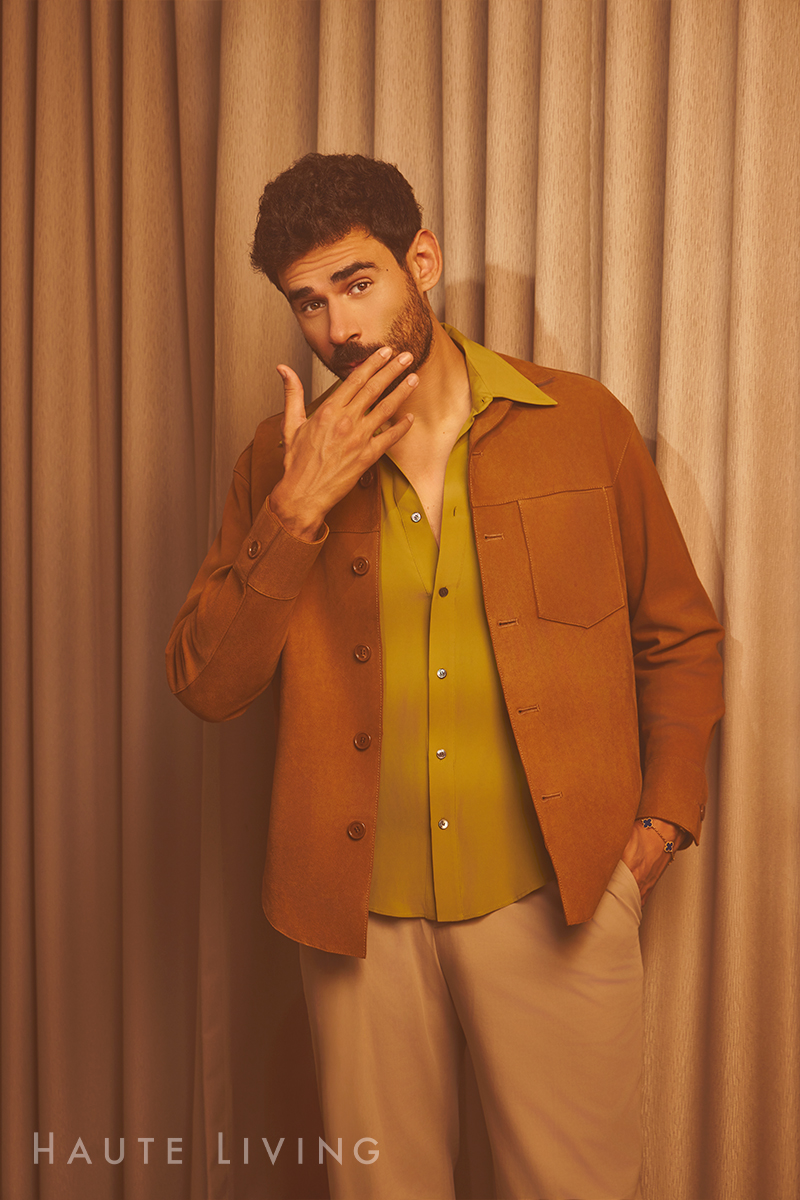
FULL LOOK: Ami Paris
Photo Credit: Alberto Gonzalez
The fun things, to be clear, are not the fun things you’d expect.
Miami is an interesting choice for a refuge. It’s loud, humid, neon-soaked — a city built on the premise that the night is always just beginning. It is exactly the kind of city that people like Afrojack and Elettra Lamborghini are supposed to belong to — and they do, professionally. His name is on the lineups. Her face is on the billboards. The nightlife belongs to them.
But here’s what Miami actually gives them: the beach at 7 a.m., before it belongs to anyone else. The walk home after dinner when the air is still warm and the city is just starting to get loud and they are already leaving. The strange, specific pleasure of building a routine inside a place that doesn’t believe in routines. “What I love about Miami,” Afrojack says, “is that everything exists together.” Luxury and chaos. Beauty and unpredictability. The performance and the quiet just behind it.
They leave events early. They go to bed. “If there’s a DJ I really want to see,” Afrojack tells me — a DJ he wants to see, himself, a man who is one of the most famous DJs alive — “I’ll arrive at 12:45, watch for fifteen minutes, then by 1:30 I’m in bed.”
Elettra laughs because it’s true.
They’ve done the other version. The parties. The clubs. The after-hours dinners that stretch until the sky goes pale. The endless socializing that comes with careers at this level, the sense that being seen is part of the job and the job is never really over. They’ve seen what it looks like from the inside. Which is probably why neither of them romanticizes it anymore.
“What is very sexy now,” Elettra says, completely unprompted, “is calm.”
Not excess. Not spectacle. Not the mythology of the industry that created both of them.
Calm.
“Eating healthy,” she continues. “Going to sleep kind of early. Resting. Training. Those types of things. Because our jobs take a lot of energy mentally and physically.”
She means it — and then Afrojack immediately undermines the wellness aesthetic with genuine enthusiasm for Ben & Jerry’s and Shake Shack. They are simultaneously glamorous and deeply unserious, teasing each other constantly — interrupting, correcting each other’s timelines, laughing before the other finishes speaking. At one point he starts answering a question and stops, waiting for her reaction before he commits to the punchline. She doesn’t disappoint.
Afrojack has lost around 55 pounds in recent years through better habits and lifestyle changes. It’s the kind of detail that usually gets attributed to a new trainer, a nutritionist, some regimented program designed by someone in Calabasas. His explanation is simpler and considerably more devastating. “Before I met her,” he says, “if I turned 70 or 100, I didn’t care so much.” He pauses. “Now I want to be very old and healthy.”
He says it simply, the way he says most things — direct, unadorned, Dutch in the bone. Because underneath the matter-of-fact delivery is something close to: she gave me a reason to want more time. And he said it like it was obvious. Like it was just a fact about his life now.
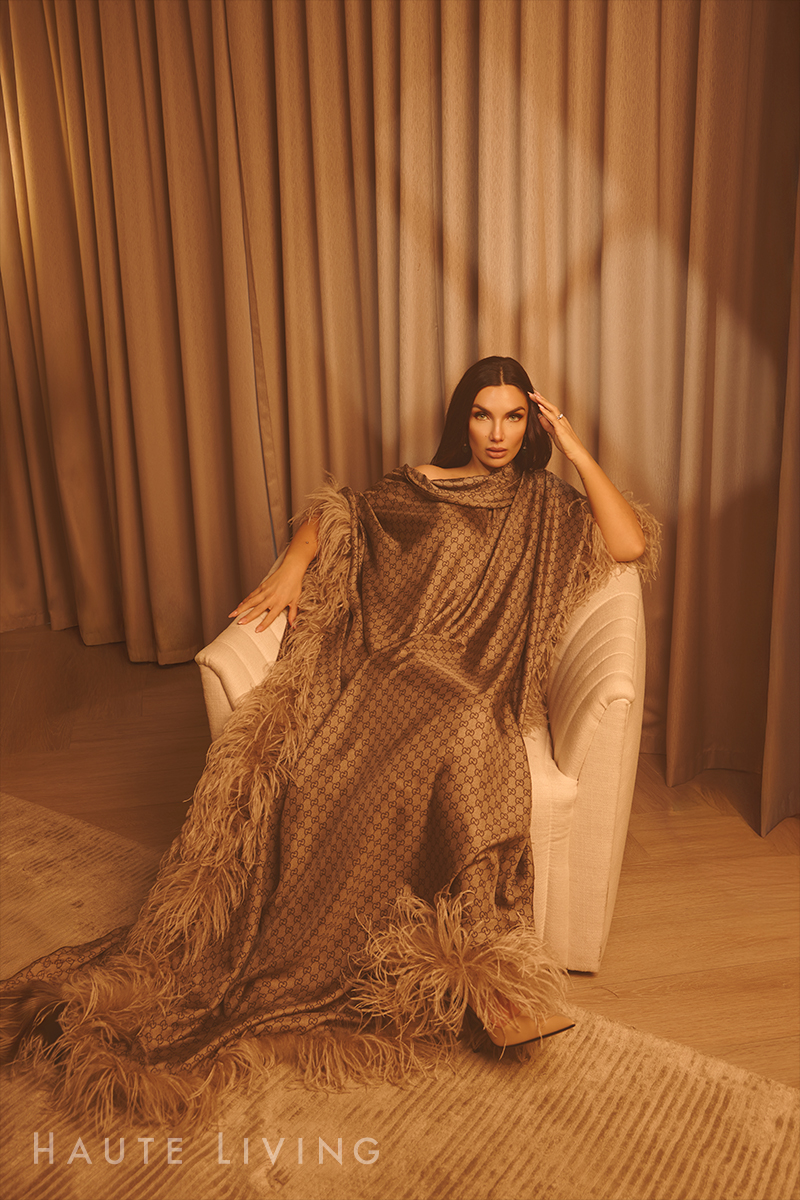
FULL LOOK: Gucci
Photo Credit: Alberto Gonzalez
This is what they’re like: constantly undercutting their own sincerity with practicality, then accidentally revealing something devastating before you’ve had time to prepare for it. He describes himself as emotionally cold in the specifically Dutch sense — direct, calm, unsentimental. She is emotional, dramatic, poetic, Italian in the fullest sense. “He’s my rock,” she says. “His brain is cold.” Beat. “I’m an ice cube,” he replies. “But I melt for her.” Somewhere between joke and confession, with no apparent interest in clarifying which.
She mocks the proposal — he did it inside her childhood bedroom in Bologna, sister filming nearby, no fireworks, very sincere, very Dutch, and Elettra had clearly anticipated a different production value. He admits this cheerfully. He also admits, in the same breath, that he never wanted to get married before meeting her at all. “I thought everyone that got married was stupid,” he says, with the serene confidence of someone who has since updated his priors. Then he met her. Then he proposed in a bedroom. She wanted more fire. He finds this funny. She also finds this funny, which is maybe the whole relationship in miniature.
The romantic details they actually volunteer are almost aggressively small. The night she wandered onto a Miami beach while jet-lagged and traced “I love you” in giant letters with her feet so he’d see it from above the next morning. The stick-figure drawing she left on a bathroom wall in Belgium before a work trip — something he loved so much he framed it and left it there permanently. The lipstick message on a mirror that still hasn’t been cleaned off. The FaceTime calls where they sit together for hours without speaking because sharing space matters more than filling it.
The longest they’ve been apart was about 30 days during the Covid-19 pandemic. Anything beyond 12 days now feels excessive. “If it’s twelve days,” he says, “then I need like a week with her before I can go again.” He says it practically, the way you’d describe a logistical requirement. Which, for him, it apparently is.
Elettra has one moment that lands even harder.
While discussing their relationship almost jokingly, she suddenly goes quiet and says: “I always tell him I want to die first.” Then she explains. “If something happened to him, I’m going to be single for the rest of my life.”
The honesty of it hangs in the air before she immediately tries to lighten the mood. “Okay,” she laughs nervously. “We did too much. Let’s talk about something else.” But you can’t unhear it. She wasn’t performing vulnerability. She was just telling the truth.
Professionally, both are operating at a level that should make any of this logistically impossible, and yet.
Afrojack’s 2026 alone would constitute a full career year for most artists: ‘Control’ with Lucas & Steve in March; ‘Awake Tonight’ with Guetta and Sia debuted live at Ultra to 50,000 people in April; and the Kapuchon alias going deeper underground with ‘Hot Sauce’ alongside Miss Monique and GLZ on AETERNA Records in May.
The range — from festival main stages to intimate club runs to credentialed underground releases — only makes sense if you understand that he genuinely doesn’t experience these as different versions of a brand. They’re just music. Different rooms, same obsession.
But here’s the thing: when you ask about any of it — the accolades, the milestones, the headline moments — the conversation slides almost immediately back toward each other. Toward Miami. Toward walking. Toward sleep. Toward ice cream. Toward the alpaca. The careers are significant. They’re also clearly not the point.
When Afrojack describes how he makes decisions now — bookings, business, which rooms to say yes to — the filter isn’t the deal. It’s simpler than that. “When I make business decisions,” he says, “I think: when do I see Elettra? When do we spend time together?” For a man who spent years building one of the most demanding careers in electronic music, that reordering is not small. It is, in fact, everything.

SUIT & SHIRT: Louis Vuitton
SNEAKERS: Vans
ELETTRA IS WEARING:
DRESS: Michael Kors Collection
SUNGLASSES: Cubitts
Photo Credit: Alberto Gonzalez
At one point, pushed on what luxury actually means to them now — after the residencies, the private jets, the red carpets, the kind of access most people spend their whole lives imagining — they both land in exactly the same place without comparing notes.
“You cannot buy someone that truly loves you,” Elettra says quietly. “You cannot buy family.”
Afrojack is quiet for a moment. “I used to fly private a lot,” he says. “But now? I’d rather fly commercial to a loving home than fly private with no purpose.”
He pauses after saying it, like he’s hearing it for the first time himself. Like the sentence arrived before he had a chance to edit it into something more guarded. And then he just lets it stand.
They are not retired. They are not stepping back. Afrojack is having one of the more creatively restless years of a career built on creative restlessness. Elettra is about to stand in front of the Eurovision audience and make it look effortless. This is not a story about slowing down.
It’s a story about two people who figured out, earlier than most, what the careers are actually for.
He mentions almost in passing that when he travels somewhere beautiful without Elettra, he doesn’t fully let himself experience it. He saves it. He’ll look at whatever view is in front of him — some coastline, some city at golden hour, some corner of the world most people would consider a destination in itself — and he’ll think: I’ll come back with her. Waits to go back when they can see it together. For someone who has spent fifteen years seeing the entire world, that is a profound and quietly radical thing to choose.
Somewhere in Miami, there’s a half-finished puzzle on a table. Somewhere in Italy, there’s another one. The pieces are different but the point is the same: something to work on together, something to return to, something that requires patience and pays off slowly and doesn’t care how many people were in the crowd last weekend.
At some point tonight, two phones will connect across an ocean. Two people who could be anywhere—who should be anywhere—will sit together in the dark, looking for edge pieces on screens they’ve positioned just right. Neither of them will think it’s strange.
That’s the thing about real love: it doesn’t need an audience to make sense. It doesn’t need a stage. It just needs patience, and a puzzle, and someone across the world who’s willing to wait for you to find the pieces that fit.
FULL LOOK: Hermès
ELETTRA IS WEARING
FULL LOOK: CHRISTIAN DIOR
Photo Credit: Alberto Gonzalez
Latest from Haute Living

Victoria Beckham Designed a Gap Collection & It’s Dropping This Week
Louis Vuitton Brings Seven Years of Artycapucines to Art Basel Paris

A Shattered Collarbone, a Bangkok Shophouse and a Love Story: The Couple Behind LenLen, NYC’s Most Unapologetic Thai Restaurant