Who Is Dr. Raghu Athré and Why Is the 4D Facelift™ at the Center of His Practice?
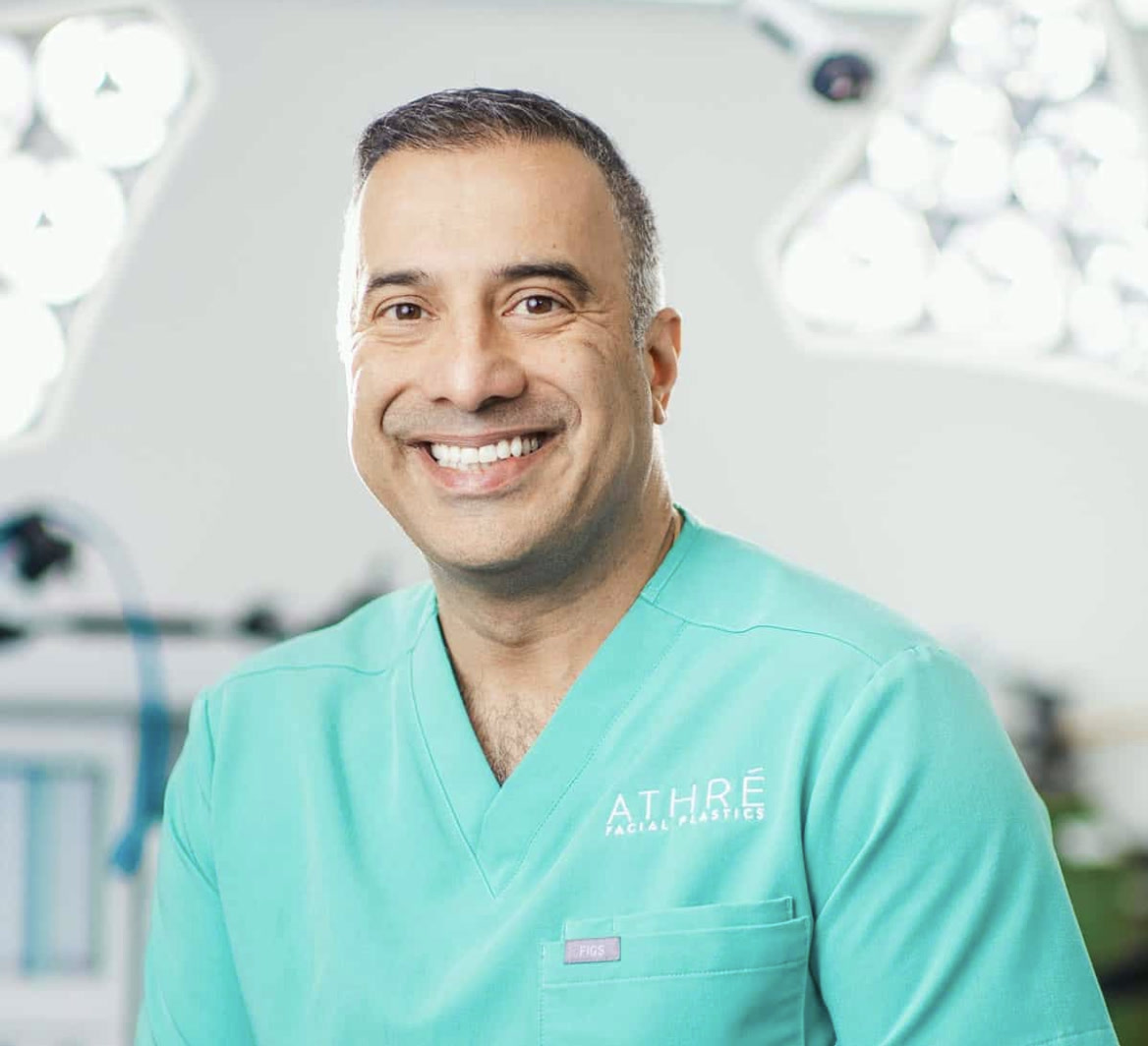
Houston facial plastic surgeon Dr. Raghu Athré explains the 4D Facelift™, his signature deep plane technique performed under local anesthesia, and the training behind it.
Patients researching a facelift in Houston quickly learn that the operation behind the same name can differ widely from one surgeon to the next. Dr. Raghu Athré, founder of Athré Facial Plastics, performs facelift surgery far more often than any other service he offers, and the procedure that defines his practice is the 4D Facelift™, a technique unique to his practice. Understanding what the 4D Facelift™ is, how it is performed, and the training behind it helps patients judge whether this approach fits their goals.
Dr. Athré is a double board-certified facial plastic surgeon with a background that is unusual in his field. He graduated with honors in Chemical Engineering from the University of Texas at Austin, through the Engineering Honors Program with a specialization in Biomedical Engineering. He has described plastic surgery as closely related to engineering, because both demand careful analysis, close attention to detail, and a precise plan before any work begins. That mindset shapes how he approaches a facelift: as a structured plan built around the layers of the face rather than a simple tightening of skin.
What Is the 4D Facelift™ and How Does It Work?
The 4D Facelift™ is Dr. Athré's signature technique for rejuvenating the face and neck. Athré Facial Plastics has described the procedure as designed to restore natural volume and contour, with the goal of results that look refreshed rather than pulled or overdone. The approach combines two established surgical concepts in a single, tailored operation.
The first is the deep plane technique, which lifts the deeper facial tissues under the SMAS. SMAS stands for the superficial musculoaponeurotic system, the supportive layer beneath the skin that gives the face its structure. Lifting this layer, rather than pulling on the skin alone, allows the surgeon to reposition tissue in a way that holds up better over time and avoids the tight, windswept look associated with skin-only lifts. The second is the neck. Again, the neck is addressed in a deep neck lift fashion under the platysma muscle for the same reasons of lifting and adjusting deeper layers. Third, volume loss is addressed with autologous fat grafting to replenish lost volume; and fourth, the skin texture is addressed with a skin resurfacing procedure. Together, this combination approach comprehensively addresses areas where aging is most visible, including the cheeks, the jowls, and the line that separates the face from the neck.
Because the procedure is planned around each patient's anatomy, the 4D Facelift™ is not a one-size-fits-all operation. Dr. Athré evaluates facial structure, tissue quality, and the specific areas of concern before deciding how each layer will be treated. This is where his engineering mindset and his surgical training come together.
Why Is the 4D Facelift™ Performed Under Local Anesthesia?
One of the most distinctive features of the 4D Facelift™ is how patients experience it. At Athré Facial Plastics, 98 percent of procedures are performed with local anesthesia and oral sedation, which allows patients to remain awake during surgery. Dr. Athré has explained that this method minimizes bruising and swelling compared with general anesthesia, which helps speed recovery and allows patients to return to their routines sooner.
For many patients, avoiding general anesthesia is a major factor in choosing a facelift surgeon. General anesthesia carries its own risks and can add to the overall recovery burden, including grogginess and nausea in the days that follow. A local anesthesia approach offers a gentler path for patients who are otherwise healthy and want to reduce those variables. As with any surgery, whether this approach is appropriate depends on the individual, and Dr. Athré reviews each patient's health history and preferences during consultation.
How Does Dr. Athré Support Patients Before and After a Facelift?
Dr. Athré has emphasized that facelift surgery is not only about what happens in the operating room. His practice places weight on preparing patients before surgery and supporting them afterward, with the goal of delivering the best possible result and the smoothest possible recovery. He has also been pioneering the use of peptide therapy to optimize biochemical and metabolic pathways as part of this broader approach.
For patients, this means the 4D Facelift™ is delivered as a complete care experience rather than a single event. Planning, surgery, and aftercare are treated as connected steps, and Dr. Athré personally performs every procedure at the practice rather than delegating any portion of a patient's care to associates.
What Medical Training Prepared Dr. Athré to Perform Advanced Facelift Surgery?
After UT Austin, Dr. Athré earned his medical degree at the University of Texas Southwestern Medical School, graduating in the top 10 percent of his class. He received the Hudson-Penn Award, given to the top surgical senior medical student, and was inducted into Alpha Omega Alpha, the national medical honor society that recognizes academic achievement alongside professionalism and leadership.
He then completed his residency in Otolaryngology and Head and Neck Surgery at UT Southwestern. Otolaryngology treats the head and neck as an interconnected system, and that foundation matters in facelift surgery, where the facial nerves, muscles, and deeper tissue layers must be understood in relation to one another. A surgeon lifting the SMAS or working in the deep plane needs a detailed command of this anatomy.
Following residency, Dr. Athré was awarded one of fewer than 40 fellowship positions available nationwide each year in Facial Plastic and Reconstructive Surgery. He completed that fellowship in Atlanta, Georgia at the Premier Image Cosmetic and Laser Surgery Center, training directly under Dr. William Silver. Fellowship training focuses exclusively on advanced facial aesthetic and reconstructive techniques, and it is the stage of his education that most directly informs the facelift work he performs today.
How Does Reconstructive Experience Influence the 4D Facelift™?
Dr. Athré has been direct about how his reconstructive background shapes his cosmetic work. In his view, aesthetic surgery makes more sense once a surgeon has seen reconstruction and trauma, because that experience allows one surgeon to address all of these problems comprehensively. A surgeon who has managed facial trauma, cancer reconstruction, and complex functional repairs brings a broader frame of reference to an elective facelift.
This matters most for patients with more complex needs. Those considering revision surgery, or those with altered anatomy from prior procedures or injury, benefit from a surgeon whose training spans reconstructive and cosmetic work. The same layered anatomy a reconstructive surgeon works with after trauma or tumor removal is the anatomy that the 4D Facelift™ is built around.
What Else Sets Athré Facial Plastics Apart?
While the 4D Facelift™ is the focus of the practice, Dr. Athré also offers a small number of other procedures, including rhinoplasty and non-surgical treatments. One of these is OcuRX, a proprietary technique he developed for under-eye filler application. The under-eye area is among the most technically demanding regions of the face to treat with injectables, and OcuRX reflects the same precision-driven thinking that runs through his facelift work. It is a useful option for patients seeking non-surgical rejuvenation, though facelift surgery remains the procedure he performs most and the one he most wants to be known for.
Dr. Athré has also built a research record that is uncommon among local practices. He has authored numerous articles and several book chapters, and he has lectured internationally. His published work covers rhinoplasty tip dynamics, facial filler agents, and reconstructive techniques, appearing in journals including the Archives of Facial Plastic Surgery, the Laryngoscope, and Otolaryngology-Head and Neck Surgery. He has also served as a guest editor of Operative Techniques in Otolaryngology Head and Neck Surgery. For a prospective facelift patient, this record signals a surgeon who stays engaged with the science behind the procedures he performs.
What Recognition Has Dr. Athré Received, and Where Does He Practice?
In 2026, Dr. Athré was named a Castle Connolly Top Doctor and was also recognized among Castle Connolly's Top AAPI Doctors. The Top Doctor recognition is based on a peer nomination and review process. He has additionally been recognized by H Magazine and named among RealSelf's Top 500 Docs, a list drawn from one of the most widely used patient review platforms in aesthetic medicine.
Dr. Athré practices at Athré Facial Plastics, located at 2414 Ella Boulevard in Houston Heights. The practice draws facelift patients from throughout the greater Houston area, including Katy, Pearland, Sugar Land, and Clear Lake, as well as patients traveling from other states and internationally for his combination of reconstructive depth and facelift specialization.
Frequently Asked Questions
What is the 4D Facelift™?
The 4D Facelift™ is Dr. Athré's signature facelift technique, unique to Athré Facial Plastics. It combines the high SMAS technique to lift deeper facial tissues with deep plane methods to rejuvenate the mid-face and jawline, with the goal of restoring natural volume and contour.
Is the 4D Facelift™ performed under general anesthesia?
At Athré Facial Plastics, 98 percent of procedures are performed with local anesthesia and oral sedation, so patients remain awake. Dr. Athré has explained that this approach minimizes bruising and swelling and supports a faster return to routine activities.
Is Dr. Raghu Athré board certified?
Yes. Dr. Athré holds double board certification, from the American Board of Otolaryngology in Head and Neck Surgery and from the American Board of Facial Plastic and Reconstructive Surgery, placing him among a small number of facial plastic surgeons in Houston with certification in both fields.
Where did Dr. Athré complete his fellowship training?
He completed his Facial Plastic and Reconstructive Surgery fellowship at the Premier Image Cosmetic and Laser Surgery Center in Atlanta, Georgia, under Dr. William Silver, in one of fewer than 40 fellowship positions available nationally.
Does Dr. Athré perform both reconstructive and cosmetic procedures?
Yes. His training spans both reconstructive and aesthetic facial plastic surgery, and he has spoken about how experience with reconstruction and trauma informs a more comprehensive approach to cosmetic cases, including the 4D Facelift™.
What areas does Athré Facial Plastics serve?
The practice is based in Houston Heights and serves patients throughout Houston, Katy, Pearland, Sugar Land, and Clear Lake, along with patients traveling from other states and internationally.
What is OcuRX?
OcuRX is Dr. Athré's proprietary technique for under-eye filler application, offered alongside his facelift work.
This article is for general informational purposes only and is not medical advice. Individual results vary, and any surgical or non-surgical procedure carries risk. Prospective patients should consult directly with Dr. Athré or another qualified physician to determine what approach, if any, is appropriate for their individual circumstances.