
Donovan Mitchell Didn’t Expect Love to Change His Game. Then Coco Jones Did Exactly That
Newly married and entering his 10th season, Cavaliers star Donovan Mitchell opens up about chasing a ring, The Office and real luxury.

At 30, newly married, and entering his tenth NBA season, the Cleveland Cavaliers superstar has learned that ambition is not about getting everything immediately. It is about trusting the route—and staying ready when the moment finally arrives.
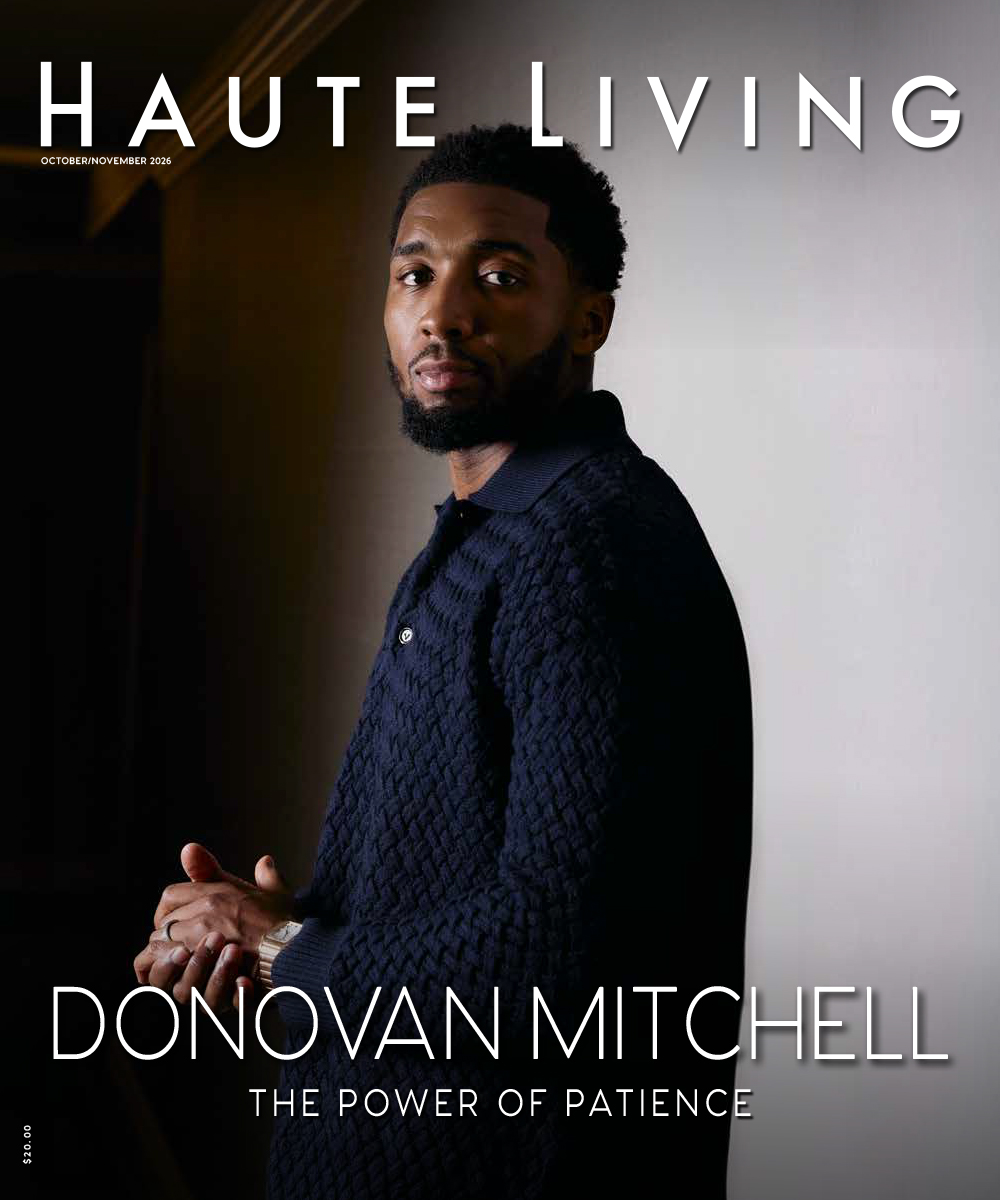
Photo Credit: Ben Draper
BY LAURA SCHREFFLER
PHOTOGRAPHY BEN DRAPER
STYLING ASHLEY NORTH
SHOT ON LOCATION AT THE RITZ-CARLTON, CLEVELAND
His Own Race
Somewhere around the two-hour mark of their first date, Donovan Mitchell and Grammy-winning singer and actress Coco Jones discovered they could both quote The Office from memory. That was it. That was the whole ballgame. Today, the Cleveland Cavaliers superstar is 30, married to Jones, and heading into his tenth NBA season with exactly one thing left on his wish list.
“I was like, all right—unless you mess this up, unless you start acting completely weird—I know what I like,” he says, laughing. “I know what I want.”
Knowing what he wants has never been Mitchell’s problem. Getting it on his own schedule is another matter. He’d clocked Jones years earlier, tried to shoot his shot, and missed. (Reader, he married her anyway.) The other ring, the one he is actually paid to chase, has followed a similar script: nine seasons, seven All-Star selections, a first trip to the Eastern Conference Finals last season, a loss to the Knicks, and a $273 million bet that Cleveland is where the story ends differently.
“Young Donovan was like, ‘I want it. I’m going to get it right now,’” he says. “Some guys have made it to the Finals in their second year, their third year. Your route is your route.”
These days, he has finally made peace with that route. The show, for the record, is still always on—playing in the background at home, running as he falls asleep, even keeping him company on the way to meet me. And when he tries to explain what goes on inside his head, naturally, that is where he turns: the fire-drill episode.
If you know the scene, you can see it: smoke pouring beneath a door; Michael Scott screaming; Oscar in the ceiling; Angela’s cat in freefall; Dwight standing amid the havoc, satisfied that his point has been made. It is one of the series’ most gloriously unhinged sequences, and for Mitchell, it is also unexpectedly familiar terrain.
“I don’t know if that represents me the best, but I think it’s just the chaos of it all,” he says. “That’s how my mind is. I’m just always everywhere.”
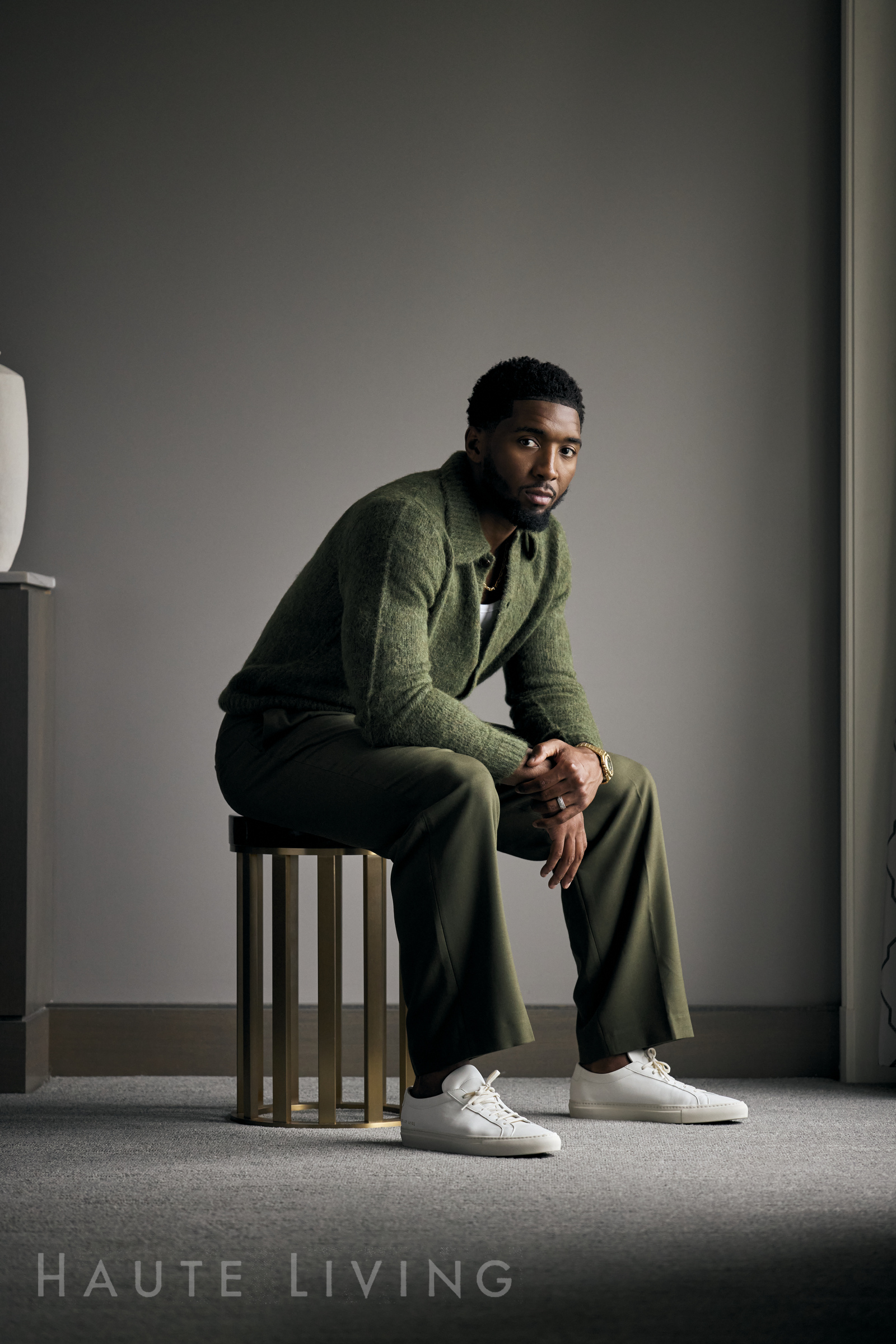
PANTS: Simkhai
SHOES: Common Projects
JEWELRY: David Yurman
WATCH: Audemars Piguet
Photo Credit: Ben Draper
He might be driving when something he forgot two weeks ago flashes back into his head. He loses track of text messages because his brain has already skipped ahead to the next game, the next responsibility, the next move. Jones teases him about the way his eyes dart back and forth while he tries to keep pace with everything happening inside. From the outside, the seven-time NBA All-Star can appear preternaturally composed. Inside, Oscar is in the ceiling and the cat is coming down.
Learning to operate within that chaos—and to stop demanding that every ambition be realized immediately—may be the defining evolution of Mitchell’s first decade in the league.
Mitchell did not enter the NBA with the luxury of a slow introduction. Selected 13th overall in the 2017 draft and traded to the Utah Jazz, the Connecticut native detonated every modest expectation attached to him. He set a Jazz rookie scoring record, became the first rookie since Blake Griffin in 2011 to record multiple 40-point games in a season, and, at 21, became the fastest rookie in league history to reach 150 three-pointers, doing so in 63 games. He won the 2018 Slam Dunk Contest, was unanimously named to the NBA All-Rookie First Team, and collected both the Best Breakthrough Athlete ESPY and the players’ own Leader of the School award. The league also got to know him by the nickname that had followed him since childhood: Spida, bestowed by a teammate’s father because of Mitchell’s long arms and uncanny ability to generate steals. For a man whose mind is also, by his own account, always everywhere, the moniker fits a little too well.
He had entered the league hoping simply to make the roster and contribute. Instead, almost instantly, he became the face of a franchise.
“My first year and a half in the league, it was like the 2K MyCareer,” he says. “There’s no way I go from two years of high school where I finally started taking basketball seriously, two years of college, and the next thing you know I’m the face of the Utah Jazz.”
The precocity created its own illusion. Utah won a playoff series in his first season, and Mitchell, still learning the scale of the league, assumed this might simply be how his career would proceed. But the NBA has a way of stretching time. Progress is rarely linear. A postseason breakthrough can be followed by a painful exit; an individual leap does not guarantee a collective one. The player who initially wanted everything right away began to understand that success exists within each step, not only at the end of the road.
“I’m equally as hungry every year,” he says, “but I understand that it’s a long process. Run your own race. Stay in your lane. No matter what else is going on around you, it’s what you have going on in your lane.”
That lane eventually led to Cleveland. Traded to the Cavaliers in 2022, Mitchell needed only a few months to produce the kind of performance that converts statistics into folklore: a franchise-record 71 points in a single game on January 2, 2023. That same season, he made his first All-Star start and earned All-NBA Second Team honors. He continued to build, extending his All-Star streak to seven seasons and earning 2025 All-NBA First Team honors, the highest All-NBA recognition of his career.

PANTS: Fear of God
Photo Credit: Ben Draper
Then came the 2025–26 season, perhaps his most complete yet. Mitchell averaged a career-high 29.1 points, along with 5.8 assists, 4.7 rebounds, and 1.46 steals per game. He scored 30 or more points 25 times, eclipsed 40 on five occasions, and led the Eastern Conference with 173 made three-pointers—a campaign that earned him his second All-NBA Second Team selection. Cleveland reached its first Eastern Conference Finals since 2018. It was Mitchell’s first trip that deep into the postseason, and yet still not deep enough.
The Cavaliers lost to the New York Knicks, leaving Mitchell with the particular ache of having moved closer than ever without arriving. His response was not retreat. He signed a four-year, $273 million maximum contract extension, an emphatic commitment to Cleveland and to the unfinished work ahead.
At this level, criticism never disappears; it merely advances to the next available target. Mitchell understands the mechanism now. First, skeptics wondered whether he could develop his game or elevate the players around him. Once those questions receded, another took their place: Can he win a ring?
“When that happens, the next conversation is, ‘Can he win two?’” he says. “There’s always going to be something. It’s a privilege to be in this spot where now it’s the ring. I started here; now we’re here. That’s what you’ve got to do.”
Proving Himself Right

JEWELRY: David Yurman
WATCH: Patek Philippe
Photo Credit: Ben Draper
Mitchell once drew energy from disproving everyone else. Doubt was fuel, and negativity could be metabolized into work. But a career eventually reaches a point when the old source of motivation no longer serves. The résumé fills up: All-Star selections, All-NBA honors, scoring records, financial security. At some point, the argument with the outside world has already been won.
“Now it’s about proving myself right,” he says, “and being the champion that I know I can be.”
Positive affirmation came to him relatively late. For years, he regarded voicing confidence aloud as something that might sound cocky or, within the unforgiving culture of elite sports, soft. He has since come to believe that what a person repeatedly feeds the mind matters—particularly when the world is eager to fill it with doubt.
His central affirmation is disarmingly simple: “I’m Donovan Mitchell.”
It carries more than one meaning. It represents the player whose name sits atop the scouting report, the seven-time All-Star who has reached the conference finals and competed at basketball’s highest levels. But it also represents the son of a family that sacrificed for him; the brother whose sister graduated from Columbia and now works alongside him; the child who can provide a house, a car, and retirement for his mother; the husband building a life with his wife; and the businessman whose enterprise would have been unimaginable a decade ago.
“It’s not cockiness. It’s not overconfidence,” he says. “It’s affirmation. This is what you do. This is how you do it. This is who you are. And you’re going to keep doing it to the standard that you hold yourself to.”
The standard has evolved as well. Becoming better is no longer primarily about adding a shot or polishing a move. Mitchell focuses on whether he is conserving energy on the court, whether he can push through the moments when any player would naturally take a breath, and whether his behavior consistently models what he demands of his teammates. For him, self-improvement and leadership have become inseparable.
That leadership comes with a cost far harder to quantify than a box score.
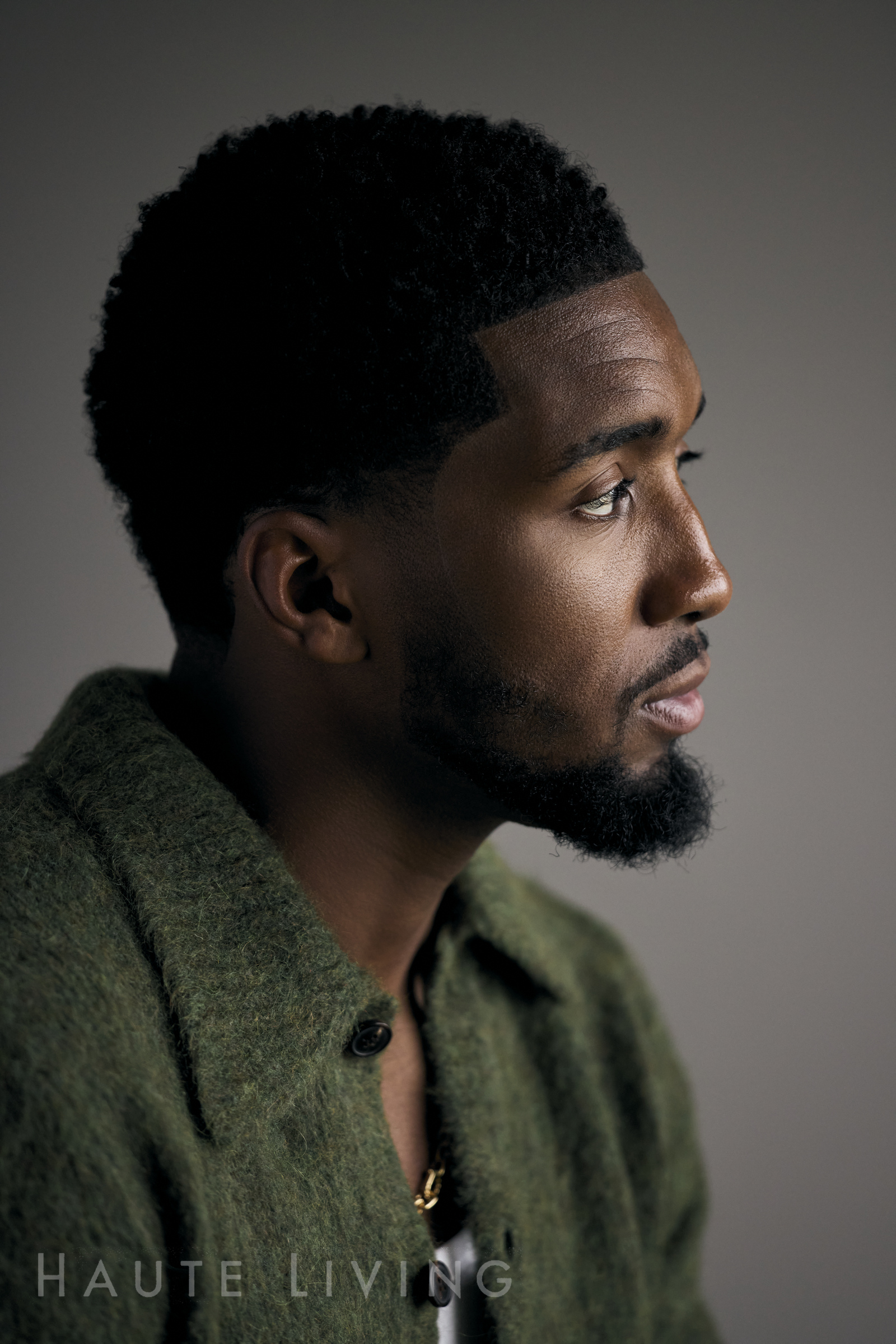
Photo Credit: Ben Draper
“It’s probably one of the loneliest positions in sports,” Mitchell says. “What you do affects an entire organization, an entire city, an entire fan base.”
When a team wins, its leader distributes the credit. When it fails, blame is far less democratic. It lands squarely at the star’s door, regardless of how responsibility might reasonably be divided. The role requires accepting that strangers will form rigid opinions from a distance, and that most will never fully grasp the mental space occupied by the person expected to answer for everyone.
Mitchell does not present this as a grievance. “It’s the job I asked for,” he says. He is mindful of the contract, the privilege, and the childhood dream made real. The kid who wrote about these moments in elementary school would have embraced the pressure without hesitation. Every great leader Mitchell admired endured scrutiny; he cannot seek the position while rejecting its terms.
“You have to be okay with being alone, ridiculed, looked at in a certain way,” he says. “People are going to have opinions of you—good, bad, or indifferent—and not everybody is going to understand you. You can’t worry about making everybody happy.”
For much of his career, Mitchell carried every mistake home. A missed box-out, a poor shooting night, a tough loss—each could replay until the next tip-off, keeping him awake and tightening his body around the fear of repetition. Experience taught him to review a mistake without dwelling inside it. Marriage taught him something more fundamental: there must be a life to return to when he leaves the arena.
Mitchell describes meeting Jones as a blessing because loving her disrupted the total dominance basketball once held over his identity. At first, that disruption unsettled him. He had never loved anything outside his family the way he loved the game. When he found himself having as much fun watching a movie or going on a date as he did playing basketball, he wondered—only half-joking—whether something was wrong.
Instead, the relationship elevated him. Jones is a star in her own right, navigating pressures and obligations that mirror his own. They can trade stories about work, empathize with the isolation that accompanies being the center of attention, and offer each other perspective from parallel worlds. At home, they can set their public personas aside.
“I’ve got to go be Donovan Mitchell every single day,” he says. “She gets to be Coco Jones and do her job in the studio or act or whatever she’s doing. And then she can come home and just be Courtney.”
Mitchell calls her his happy place, not his good-luck charm. Luck is fleeting; what they are building is meant to endure. The distinction matters. She does not eliminate the grind, the scrutiny, or the distance their careers sometimes demand. Rather, she provides a sanctuary where those pressures no longer define him.
“I get to go home and be at peace,” he says. “Even during the highs and the lows, I don’t have to bring work home. Your shoulders relax a little bit. You can just be in the moment.”
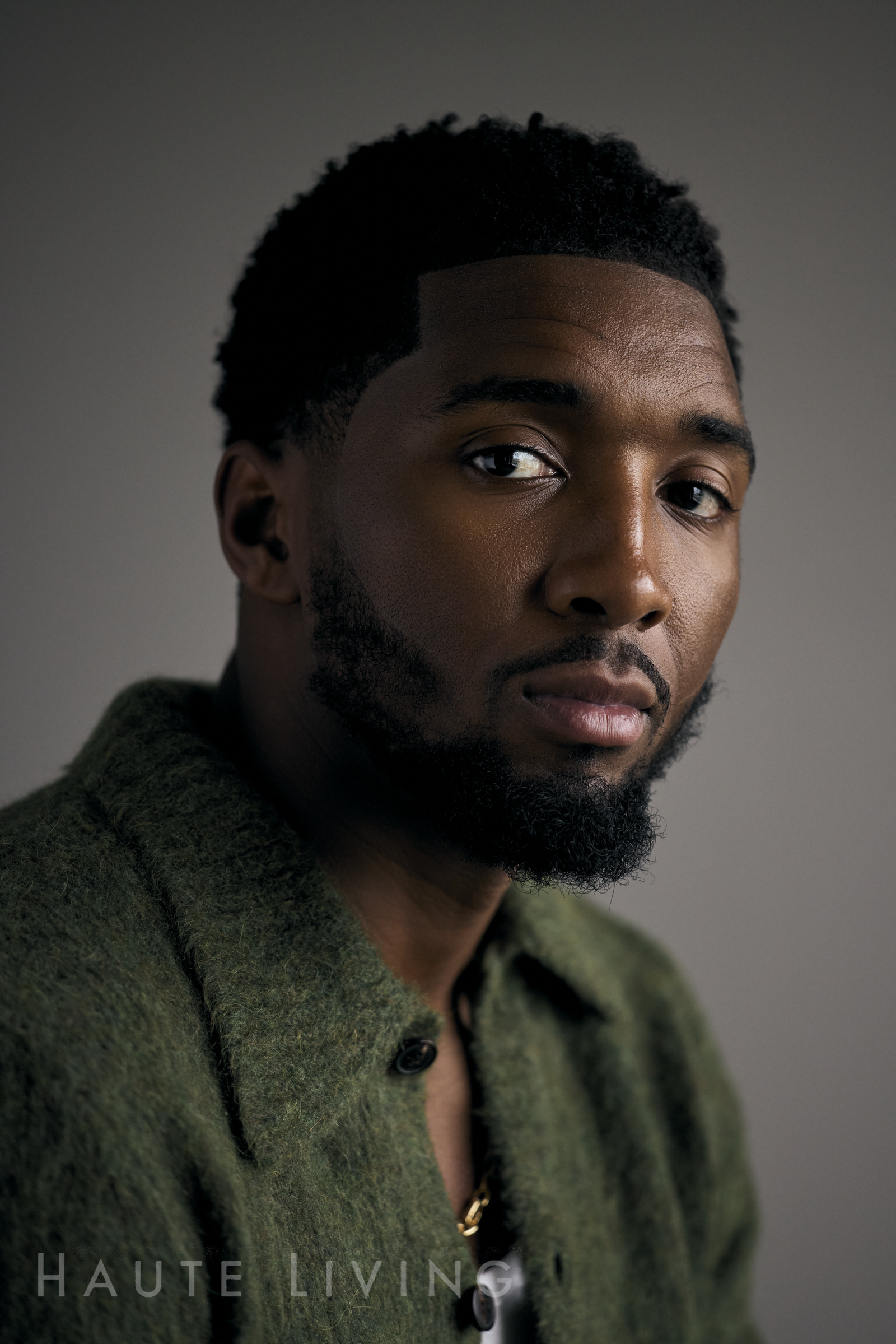
Photo Credit: Ben Draper
He sees no coincidence in the fact that the three years of their relationship have coincided with the three best basketball seasons of his career. The labor remains his—he is careful to note—but peace has allowed that work to resonate differently. He returns to the floor with a clearer mind, renewed energy, and a greater capacity to lead.
Their relationship also reflects his broader education in timing. Mitchell first became aware of Jones years before they met, when an Adidas collaboration linked his signature shoe to the series Bel-Air, in which she starred. He remembers thinking she was “fire” and trying, unsuccessfully, to shoot his shot. Years later, they reconnected; now they are married. In Mitchell’s Office cosmology, they are Dwight and Angela—not for the secrecy or chaos of that fictional romance, he quickly clarifies, but for the long interval between initial recognition and the ending everyone saw coming.
“I knew who she was all those years ago,” he says. “And here we are seven years later, finally married.”
Keeping basketball in perspective does not mean Mitchell discounts its impact. He likes to reduce the sport to its most elemental truth—“putting an orange thing into an orange thing”—because that simplicity preserves his joy. Social media, sports wagering, money, and constant public scrutiny can easily distort the game. Remembering the asphalt courts of his youth helps him stay grounded.
Yet the reach of his platform has never ended at the baseline. Education, in particular, is central to Mitchell’s sense of duty. His mother, Nicole, was a schoolteacher in Greenwich, Connecticut, and the values of the classroom shaped the Mitchell household long before professional basketball changed their circumstances.
Through SPIDACARES (named for his enduring moniker), Mitchell has channeled those values into charitable contributions, refurbished technology labs, academic scholarships, community basketball courts, and other resources designed to expand opportunity in the places that molded him: Greenwich, Cleveland, and Panama. The foundation received the NBA Cares Community Assist Award for its 2021 offseason initiatives. To honor his Panamanian roots and his late grandmother, Blossom, the Mitchell family partnered with Adidas to renovate a court in Panama.
In 2024, Greenwich Country Day School opened the D.O.N. Mitchell Family Athletic Center at his alma mater. D.O.N. stands for Determination Over Negativity—and, not coincidentally, nods to Don. The facility’s full-size NCAA court can be divided into two high-school courts, creating not merely a monument to an alumnus’s success, but lasting infrastructure for the students coming up behind him.
These efforts further enrich the meaning of his name. “I’m Donovan Mitchell” is not just an expression of self-belief; it is an acknowledgment of the communities and heritage embedded in that identity—and of his power to broaden opportunities for others.
He admits that, while in the thick of his playing career, he rarely pauses to contemplate the hope a marquee athlete represents to fans. That reflection can wait. For now, looking too far outward risks pulling his focus from the task directly ahead. He keeps his sights dialed in: the next possession, the next film session, the next season.
And this upcoming season feels different.
Asked to name his current era, Mitchell chooses one word: “Grown.”
Not finished. Not fulfilled. Grown.
At 30, newly married, and entering his tenth NBA campaign, he carries both the deepest postseason run of his life behind him and the championship he covets still ahead. Maturity has not diluted his ambition; it has taught him how to sustain it. He will pour every ounce of sweat, blood, and focus into reaching the Finals. If Cleveland falls short, he insists, he will return and do it again, recognizing that 30 franchises vie for an outcome only one can claim.
He also realizes that growth now unfolds in spaces where no crowd cheers: in honest communication with his wife, in learning how to show up as a partner, and perhaps even in making the bed—a routine Jones views as essential to starting the day and Mitchell considers optional whenever she is traveling.

JEWELRY: David Yurman
WATCH: Patek Philippe
Photo Credit: Ben Draper
The humor matters. So does honoring the kid who once dreamed of playing baseball, who never took the NBA for granted, who still unwinds on Xbox, and who remembers when simply making a roster felt like a miracle. Mitchell works to keep that wonder alive because gratitude is the best safeguard against entitlement. The challenges he faces today, he notes, are ones his younger self would have embraced in a heartbeat for the opportunity to live this life.
That is why, when asked to define life’s greatest luxury, Mitchell does not point to a possession, an exotic destination, or any emblem of wealth.
“Life,” he says. “Life in general, but also the life that I have. I wouldn’t trade any of this for the world.”
Every year, even through adversity, feels richer than the last. A single misstep, an untimely injury, or one altered circumstance could have derailed the journey entirely. Instead, he plays for a franchise he watched growing up, backed by a city that has embraced him, married to the woman he noticed years before the timing aligned, and standing closer to a championship than ever before.
His mind may still occasionally resemble a Dunder Mifflin fire drill—a whirl of competing thoughts and perpetual motion. But beneath the commotion lies a steady, quiet conviction. Mitchell knows who he is. He knows what the journey demands. And he no longer mistakes anyone else’s pace for his own direction.
The young Donovan wanted everything right away. The veteran entering year ten understands the deeper truth: the life, the love, and the legacy worth having are built possession by possession, season by season, in a race whose clock belongs to him alone.

PANTS: Jil Sander
SHOES: Common Projects
WATCH: Cartier
JEWELRY: David Yurman
Photo Credit: Ben Draper
Read More
More from Haute Living’s NBA cover stars: Josh Hart on the Knicks, the Finals and his love of wine, and Kawhi Leonard on family, philanthropy and life beyond basketball.
Frequently Asked Questions
Who is Donovan Mitchell married to?
Donovan Mitchell is married to Coco Jones, the Grammy-winning singer and actress known for the series Bel-Air. The couple married during the 2026 NBA offseason.
How did Donovan Mitchell and Coco Jones meet?
Mitchell first noticed Jones years earlier, when an Adidas collaboration linked his signature shoe to Bel-Air, and tried unsuccessfully to “shoot his shot.” They reconnected years later, and on their first date discovered they could both quote The Office from memory.
Why is Donovan Mitchell called Spida?
The nickname Spida was given to Mitchell as a child by a teammate’s father, because of his long arms and knack for generating steals.
Latest from Haute Living

Barcelona’s Most Famous Bar Just Landed on the Strip. Here’s What to Order

Where to Drink Now in Chicago

Mouton Rothschild’s 100th Anniversary Sotheby’s Auction Includes Warhol Magnums and a Barrel of the 2025