The moments after a rear-end collision are a chaotic blur of adrenaline and confusion. But what you do right here, right now, lays the entire foundation for a successful rear end collision lawsuit. It’s not just about procedure; it’s about starting your evidence-gathering from the second the impact happens.
Critical First Steps After a Rear End Collision
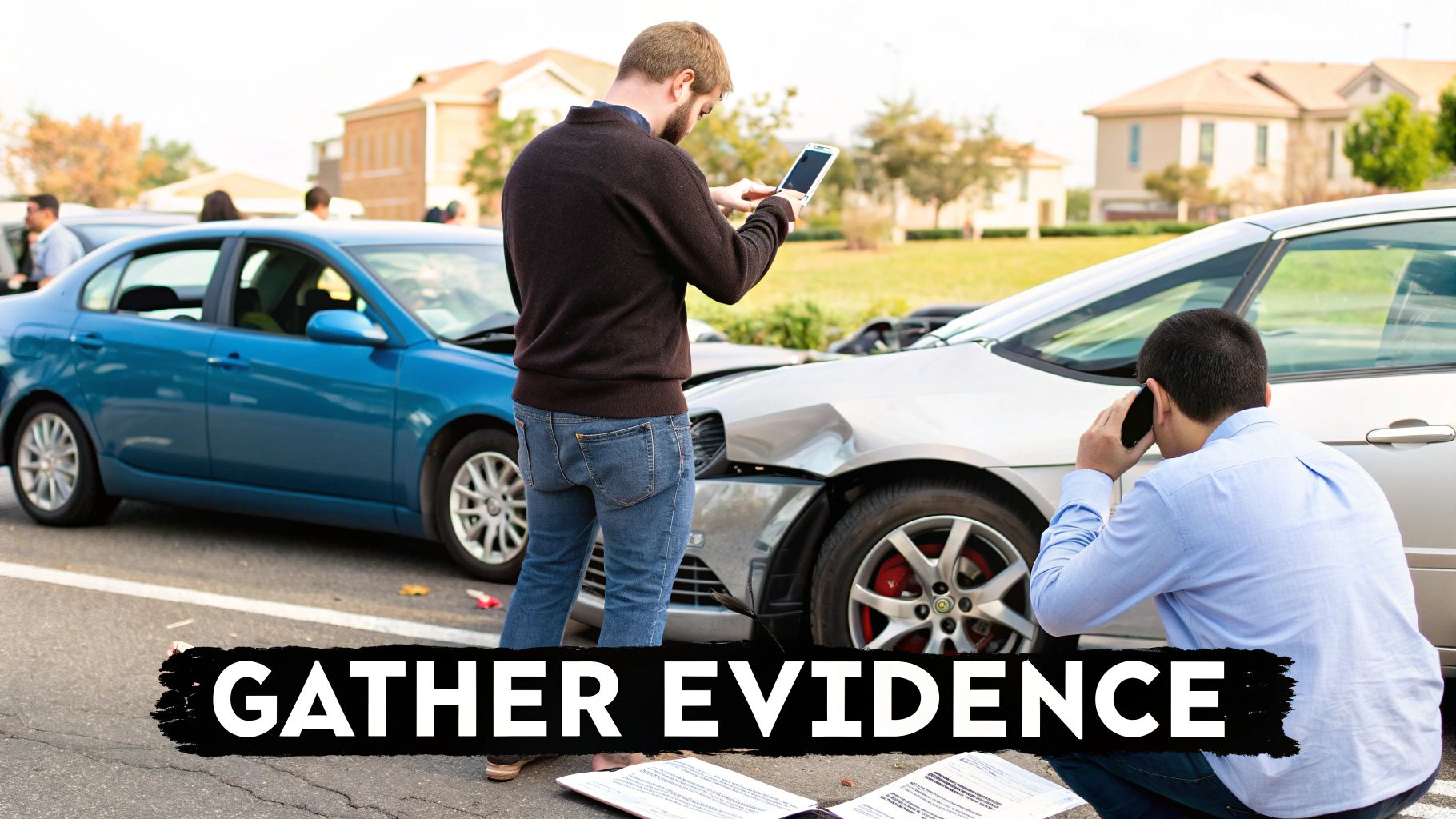
It’s tough to think straight when your heart is pounding after a crash. That’s completely normal. However, taking a few deliberate steps at the scene is absolutely essential for protecting your health and your legal rights down the road. Every action helps build a stronger case.
Your first priority is always safety. If you can, move the cars out of the flow of traffic to prevent another accident. Flip on your hazard lights and go check on the other driver and anyone else involved.
Document Everything Immediately
Once you’ve confirmed everyone is safe, your mission shifts to documentation. The evidence you gather in these first few minutes is the bedrock of your entire claim.
- Take Extensive Photos: Your smartphone is your best friend here. Snap pictures of everything—the damage to both cars from every angle, the license plates, how the vehicles are positioned, and the wider scene. Get shots of any traffic signs, stoplights, or skid marks on the road.
- Exchange Information: Get the other driver’s full name, address, phone number, driver’s license number, and their insurance policy details. This is not the time to discuss who was at fault. Just stick to gathering the facts.
- Speak with Witnesses: If anyone saw what happened, get their name and phone number. A neutral, third-party account of the collision can be incredibly powerful in proving your case.
Prioritize Official and Medical Reports
Beyond what you can gather yourself, official reports are non-negotiable. These documents provide the objective, third-party validation that insurance adjusters and lawyers rely on. The steps you take here can dramatically change what happens after a car crash.
Calling the police isn’t just a formality—it’s a critical step. The responding officer will create an official accident report, which becomes a neutral account of the collision. This report is a key piece of evidence your legal team will use.
Getting medical attention is equally vital. Even if you feel perfectly fine, injuries like whiplash or concussions often don’t show symptoms for hours, sometimes even days. Seeing a doctor right away creates a direct, documented link between your injuries and the accident.
If you wait, the other driver’s insurance company will jump at the chance to argue that your injuries must have come from something else.
To make it simple, here’s a quick checklist of what to do.
Post-Accident Action Checklist
| Action Item | Why It Is Crucial for Your Lawsuit |
|---|---|
| Ensure Safety | Your well-being is paramount. It also demonstrates responsible conduct. |
| Call 911 | Creates an official police report—a vital piece of neutral evidence. |
| Take Photos & Videos | Captures unbiased evidence of vehicle damage, positions, and road conditions. |
| Exchange Information | Gathers the necessary details for filing claims and legal documents. |
| Talk to Witnesses | Independent accounts can corroborate your version of events and are highly credible. |
| Seek Medical Attention | Officially documents your injuries and links them directly to the accident. |
| Do Not Admit Fault | Avoid making statements that could be used against you by the insurance company. |
| Contact a Lawyer | An attorney can protect your rights and guide you from the very beginning. |
By following these steps, you are actively protecting your claim from the moment the collision occurs, setting yourself up for a much stronger position later on.
Who Is Really at Fault in a Rear End Crash?

There’s a powerful, widely held belief that in any rear-end collision, the driver in the back is always to blame. While that’s often the case, the law is far more nuanced than this simple assumption suggests. Successfully navigating a rear-end collision lawsuit means understanding the legal idea of negligence and how fault is truly determined.
In most accidents, the legal system starts with a “presumption of fault” against the trailing driver. Think of it as the default setting. This presumption exists because every driver has a fundamental duty to maintain a safe following distance and be ready to stop if the vehicle ahead brakes suddenly.
This is exactly why tailgating, distracted driving, or speeding are common reasons the rear driver is found negligent. In fact, rear-end collisions are painfully common, accounting for about 29% of all traffic accidents that result in serious injury—often because the trailing driver simply didn’t have enough time to react. You can learn more about these common accident statistics.
When the Lead Driver Shares the Blame
However, this presumption is not absolute. The lead driver also has a duty to operate their vehicle safely and predictably. There are several situations where the driver in front can be found partially, or even entirely, at fault for causing a rear-end crash.
Here are a few clear examples:
- Sudden Reversing: If the front driver unexpectedly throws their car in reverse, the rear driver may have no chance to avoid the collision.
- Broken Brake Lights: Taillights are a critical safety feature. If they aren’t working, the trailing driver gets no warning that the vehicle ahead is slowing or stopping.
- Aggressive Driving: Intentionally “brake-checking” another vehicle is a reckless act that can directly cause a crash.
- Unsafe Lane Changes: Suddenly cutting in front of another vehicle without enough space can make a collision unavoidable.
In these scenarios, the actions of the lead driver directly contributed to the accident, breaking the chain of fault that would normally fall on the trailing driver.
Understanding Comparative Negligence
Most states use a legal principle called comparative negligence. This doctrine acknowledges that sometimes, both drivers share responsibility for an accident. Fault is assigned as a percentage, and any compensation you receive is reduced by your share of the blame.
For example, if a court determines the rear driver was 80% at fault for following too closely, but the front driver was 20% at fault for having a broken taillight, the front driver’s total compensation award would be reduced by 20%.
This concept is a favorite tool of insurance adjusters, who will look for any reason to shift a percentage of fault onto you to reduce their payout. This is why having clear evidence and strong legal representation is so important in a rear-end collision lawsuit. Knowing these exceptions to the standard fault rule prepares you for the arguments the other side will likely use and strengthens your overall claim.
Calculating the Full Value of Your Claim
A fair settlement after a rear-end collision isn’t just about covering the repair bill for your bumper. Far from it. True compensation accounts for every single loss you’ve suffered, from the obvious financial hits to the deep, personal impacts.
Think of your claim like an iceberg. The crumpled metal and broken taillights are just the tip—what everyone can see. The real weight of the claim, the part that can truly sink your financial and emotional well-being, lies hidden beneath the surface. To get what you’re owed, you have to account for the entire iceberg.
Economic Damages: The Measurable Costs
First, let’s talk about the straightforward part. These are the losses that come with a paper trail. Economic damages cover every calculable, out-of-pocket expense that piled up because of the accident. They form the concrete foundation of your claim because they are backed by hard evidence—bills, invoices, and pay stubs.
These are the black-and-white numbers, and they typically include:
- Medical Bills: This is everything from the ambulance ride and ER visit to ongoing physical therapy, surgeries, and prescriptions. Every single medical expense counts.
- Lost Wages: If you can’t work because of your injuries, you are owed that lost income. This also extends to future lost earning capacity if the accident permanently affects your ability to do your job.
- Property Damage: This is the most obvious one—the cost to either repair your car or replace it if it was totaled.
- Other Out-of-Pocket Expenses: Did you have to pay for Ubers to get to doctor’s appointments? Hire someone to mow your lawn or clean your house? Those costs add up and are part of the calculation.
Non-Economic Damages: The Human Cost
This next category is where things get more personal, but it’s just as critical. Non-economic damages are designed to compensate you for the profound, non-financial toll the crash has taken on your life. There’s no receipt for pain or a bill for trauma, but these losses are very real.
These damages cover the physical pain, the sleepless nights, the emotional distress, and the simple fact that your life isn’t what it used to be. You could be compensated for the chronic back pain that now prevents you from picking up your kids, or for the fresh wave of anxiety that hits you every time you get behind the wheel.
Assigning a dollar figure to this kind of suffering is where a skilled attorney becomes invaluable. They can help quantify these impacts, often by using a multiplier based on the severity of your injuries and the total of your economic damages. This is exactly where people often underestimate what their claim is truly worth, leaving significant money on the table by overlooking the hidden costs of personal injury.
In particularly egregious cases—say, the other driver was drunk or texting—a court may award a third type of damages. Punitive damages aren’t about making you whole. They are meant to punish the at-fault driver for their extreme recklessness and to send a clear message that such behavior won’t be tolerated.
Navigating the Lawsuit Process from Start to Finish
The idea of filing a lawsuit can feel overwhelming, but it’s a structured journey—not a chaotic free-for-all. It’s a process with a clear roadmap that rarely starts in a courtroom. Instead, the whole system is built to establish the facts and push for a fair resolution long before a trial ever becomes necessary.
Nearly every rear end collision lawsuit starts in what we call the pre-lawsuit phase. Once your attorney has gathered all the critical evidence—police reports, medical records, proof of lost income—they’ll put together a formal demand letter. This is much more than a simple request for payment; it’s a detailed legal argument that lays out the facts, proves the other driver was at fault, and calculates the full value of your damages.
That letter gets sent directly to the at-fault driver’s insurance company, which officially kicks off settlement talks. The insurer will almost certainly come back with a lowball counteroffer. This back-and-forth negotiation is a completely normal part of the process, and it’s where your attorney fights to close the gap and secure a fair deal. In fact, a huge number of cases get resolved right here.
The Formal Lawsuit Stages
But what happens if the insurance company refuses to make a fair offer? That’s when your attorney will file a formal complaint with the court. This is the step that officially starts the lawsuit and moves your case into the “discovery” phase.
Think of discovery as a mandatory, structured exchange of information. Both sides are legally required to share all the evidence they have about the case. The entire point is to avoid any “gotcha” moments or courtroom surprises, making sure everyone understands the strengths and weaknesses of each side’s argument.
Key parts of discovery include:
- Interrogatories: These are written questions one side sends to the other, which must be answered in writing and under oath.
- Requests for Production: This is a formal demand for documents. It could be a request for the other vehicle’s maintenance records or, if a commercial truck was involved, internal company reports.
- Depositions: This is sworn testimony given out of court. Lawyers get to question witnesses—including you and the other driver—face-to-face. A court reporter transcribes every word, creating an official record that can be used at trial.
Before a case ever makes it in front of a jury, the court will almost always order the two sides to try mediation. A neutral, third-party mediator is brought in to facilitate a settlement discussion between you, your lawyer, the insurance adjuster, and their legal team. The mediator doesn’t have the power to force a decision, but they are skilled at finding common ground and helping both parties reach an agreement.
The infographic below breaks down the different types of damages that your attorney will be fighting for throughout this entire process.
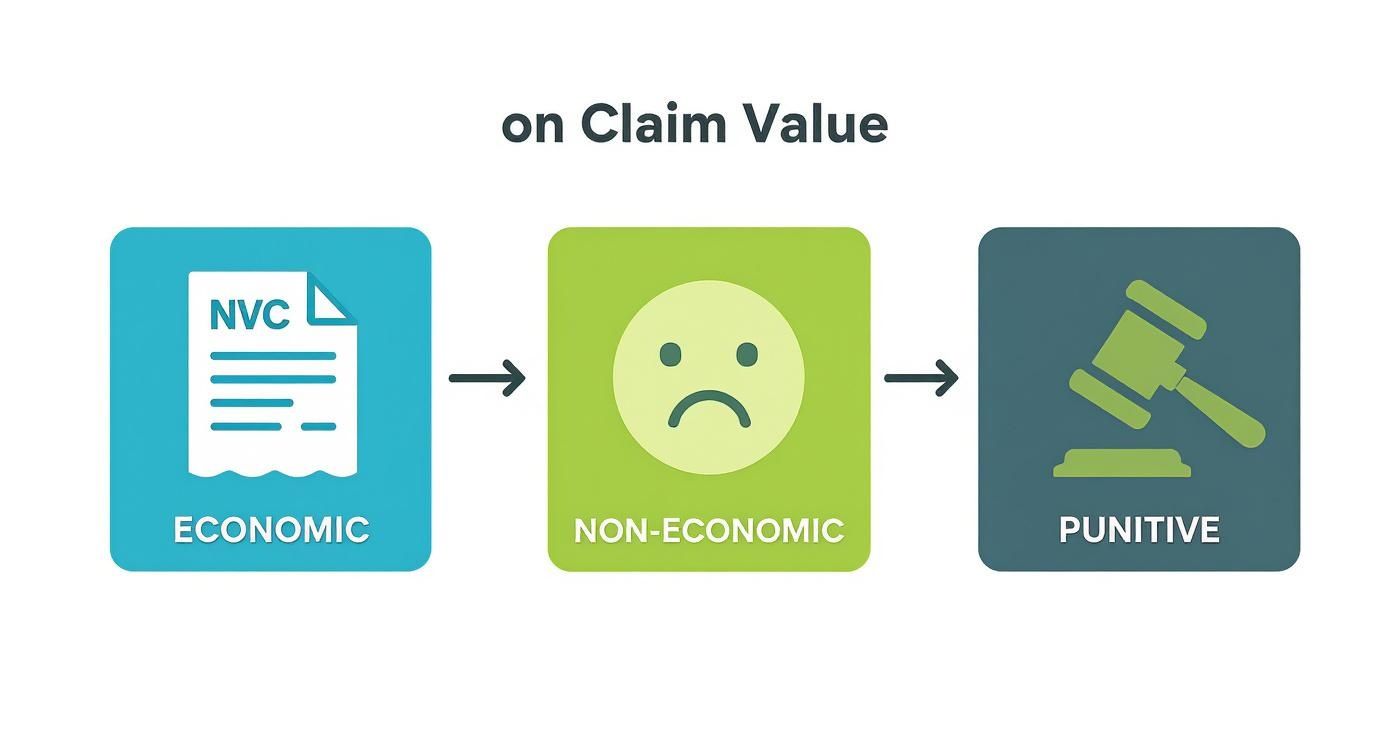
As you can see, your claim is built on more than just medical bills. It includes the tangible economic costs, the very real human toll of non-economic damages, and in rare situations, punitive damages meant to punish extreme negligence.
Why an Experienced Attorney Makes a Difference

Trying to manage a rear end collision lawsuit alone is like walking into a professional negotiation unarmed. The insurance adjusters on the other side are highly trained—their entire job is to protect their company’s profits by paying you as little as possible. An experienced attorney doesn’t just know the rules of the game; they completely level the playing field.
From day one, they take over all communications, shielding you from the pressure and lowball offers that insurers are notorious for. This frees you to focus on your recovery while a dedicated professional fights for your interests. But their most critical role is knowing exactly where to find the evidence that can make or break your case.
Uncovering Hidden and Complex Evidence
A sharp lawyer goes far beyond a simple police report. They dig deep to construct a powerful, evidence-backed claim. This becomes absolutely essential when a commercial vehicle is involved, as these cases are often packed with layers of corporate complexity.
Your attorney can legally compel companies to turn over crucial information you would likely never see on your own, including:
- The commercial driver’s logbook to spot hours-of-service violations.
- The vehicle’s maintenance and inspection records, which can reveal a pattern of neglect.
- The driver’s full employment history and driving record.
Evidence like this can prove systemic negligence, dramatically strengthening your negotiating position. These details are often what lead to major verdicts—one landmark rear-end collision case resulted in a $101 million award after it came to light the at-fault driver was impaired and had a history of prior violations.
An attorney’s true value lies in their ability to accurately calculate the full, long-term cost of your injuries. They work with medical and financial experts to project future medical needs, lost earning capacity, and the ongoing impact of pain and suffering.
This comprehensive approach ensures the settlement you receive covers not just today’s bills, but the challenges you’ll face for years to come. Ultimately, hiring an attorney is an investment in securing a just and complete financial recovery. If you’re not sure how to begin your search, our guide on how to find a personal injury lawyer is a great place to start.
Common Questions About Rear End Collision Lawsuits
After the shock of a car accident wears off, the questions start flooding in. When you’re considering a rear end collision lawsuit, the uncertainty can be overwhelming. Getting clear, straightforward answers is the first step toward regaining control.
This section tackles the most pressing questions people have, breaking down critical deadlines, insurance company tactics, and the realities of legal costs. Think of it as your initial roadmap for the path ahead.
How Long Do I Have to File a Rear End Collision Lawsuit?
This is one of the most critical questions, and the answer is governed by a strict legal deadline known as the statute of limitations. It’s different in every state.
For most personal injury cases, including car accidents, this window is typically two to three years from the date of the collision. But this isn’t a universal rule. Some states have shorter timelines, and specific details of your case can alter the deadline.
CRITICAL WARNING: If you miss this deadline, your right to file a lawsuit and seek compensation is permanently lost. It doesn’t matter how strong your case is; the door is closed forever.
The clock starts ticking the moment the crash happens. That’s why it’s so important to speak with an attorney immediately. They can confirm the exact statute of limitations for your situation and ensure every piece of paperwork is filed on time, protecting your rights.
Should I Accept a Quick Settlement from the Insurance Company?
Be extremely cautious when the at-fault driver’s insurance company comes to you with a quick settlement offer. It might seem like a lifeline when medical bills are piling up, but it’s almost always a lowball tactic.
Insurance adjusters are professional negotiators. Their job is to resolve your claim for the lowest amount possible. They often make these fast offers before you even know the full extent of your injuries or what your future medical needs will truly cost.
Once you sign their release, your case is finished for good. You can’t go back and ask for more money later, even if you find out you need surgery or long-term therapy. Never accept any offer without having an experienced attorney review it first.
Can I Still Sue If I Was Partially at Fault?
Yes, in most states, you absolutely can. Even if you share some responsibility for the accident, you can still recover damages under a legal concept called comparative negligence.
Here’s how it works: the court assigns a percentage of fault to everyone involved in the crash. Your total compensation is then simply reduced by your percentage of fault.
- Example: Let’s say a jury decides your total damages are $100,000. If they also determine you were 10% at fault—maybe for having a broken taillight—your final award would be cut by that 10%, leaving you with $90,000.
A skilled attorney is crucial here. They will fight back against any unfair attempts to shift blame onto you and explain precisely how your state’s laws apply to your case.
How Much Does It Cost to Hire a Car Accident Lawyer?
The fear of high legal fees should never prevent you from getting expert help. The vast majority of personal injury lawyers handle car accident cases on a contingency fee basis.
This payment structure is simple: you pay absolutely nothing upfront. Your lawyer’s fee is just a pre-agreed percentage of the settlement or verdict they ultimately win for you.
Bottom line: If you don’t get paid, your lawyer doesn’t get paid. This system levels the playing field, ensuring that anyone, regardless of their financial situation, can afford elite legal representation to fight for the compensation they deserve.
Finding the right legal professional is the most important step in protecting your rights after an accident. The Haute Lawyer Network connects you with a curated list of the nation’s most respected attorneys, selected for their professional excellence. Elevate your search and find the elite-level representation you need by visiting us at https://hauteliving.com/lawyernetwork.