
So, what really separates a run-of-the-mill lawyer from a truly great one? It’s not just a fancy degree hanging on the wall or the ability to deliver a dramatic courtroom speech you’d see on TV. The truth is, it’s a powerful combination of sharp analytical thinking, compelling communication, genuine empathy for clients, and an unbreakable ethical code. These are the pillars that hold up a truly exceptional legal practice.
Beyond the Degree: Core Qualities of a Good Lawyer
When you strip away all the legalese and courtroom procedure, you find that the most effective lawyers are built on a specific set of interlocking qualities. These aren’t just skills you cram for in a classroom; they’re traits that are honed over years of experience, discipline, and a deep-seated commitment to their clients and the principles of justice.
Think of it like this: a lawyer’s technical knowledge of the law is the engine in a high-performance car. It’s absolutely essential, but without a skilled driver who can navigate tricky roads, communicate with their team, and make split-second judgments, that powerful engine won’t get you to your destination safely. The best lawyers masterfully combine their legal knowledge with a whole suite of personal and professional qualities that actually drive success.
The Four Pillars of Legal Excellence
To really get to the heart of what makes a good lawyer, we can break down their abilities into four fundamental pillars. Each one supports the others, creating a well-rounded and effective advocate who can handle just about anything thrown their way.
This infographic provides a great visual breakdown of how these core qualities branch out to form the foundation of a great lawyer.
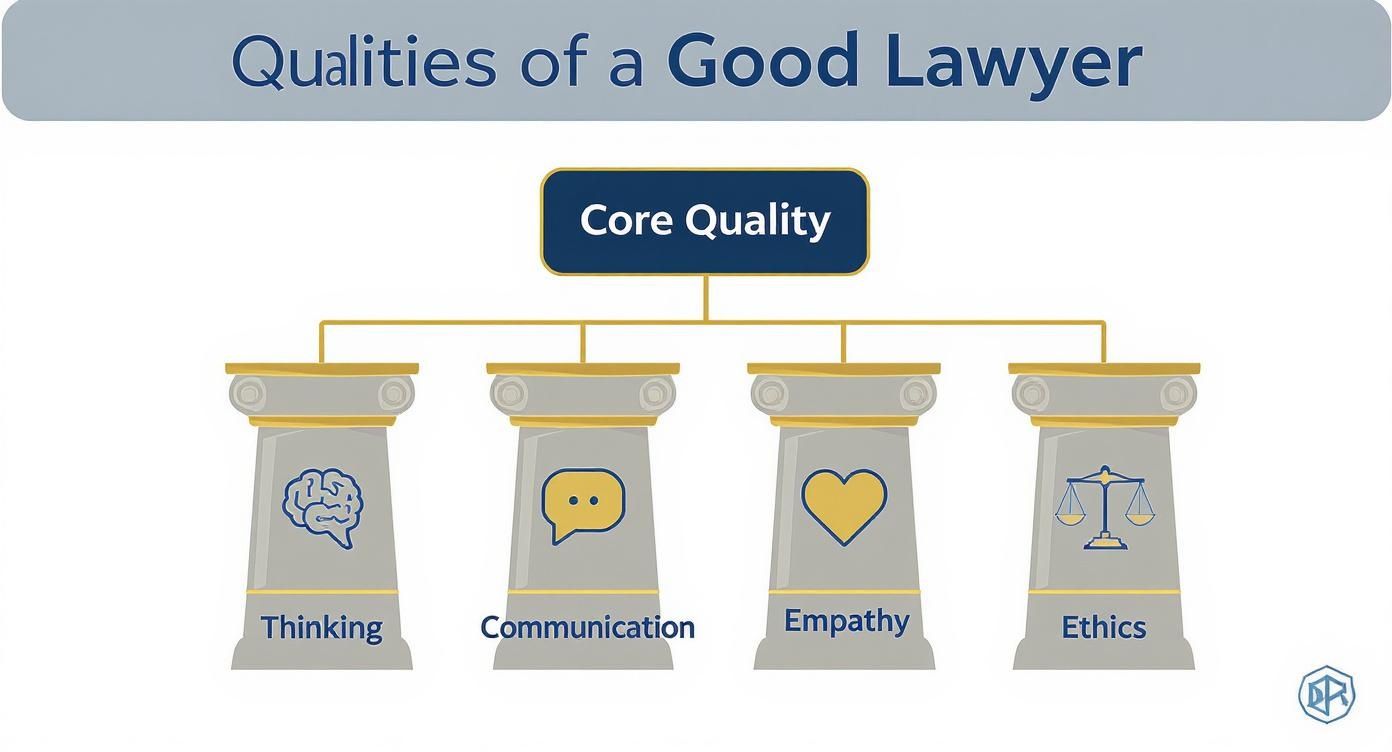
As you can see, these four distinct areas—Intellectual Skill, Communication, Empathy, and Ethics—are all woven together. It’s proof that legal excellence isn’t just one thing; it’s a multifaceted skill set.
The most impactful lawyers don’t just know the law; they understand people. They combine intellectual rigor with human insight to solve complex problems and guide clients through challenging times.
These pillars aren’t just abstract ideas; they are practical tools a lawyer uses every single day.
To give you a clearer picture, let’s briefly summarize what each pillar represents. The table below lays out these core components, showing not just what they are, but why they’re so critical in the real world.
The Four Pillars of Legal Excellence
| Pillar | Description | Why It Matters |
|---|---|---|
| Intellectual Toolkit | The ability to think critically, conduct meticulous research, and build logical, persuasive arguments from a mountain of complex facts. | This is the foundation of any legal strategy. Without it, a case has no structure, no direction, and little chance of success. |
| The Art of Persuasion | This covers everything from powerful public speaking and crisp legal writing to skillful negotiation and, just as importantly, strategic listening. | A brilliant legal argument is useless if it can’t be communicated effectively to a judge, jury, or opposing counsel. |
| Client Trust & Empathy | This is the human element—the capacity to understand a client’s fears and goals, communicate with compassion, and build a relationship based on trust. | Clients need to feel heard and understood. Trust is the currency of the lawyer-client relationship, and it’s earned through genuine empathy. |
| Unwavering Ethical Compass | This is about rock-solid integrity, professional responsibility, and a deep-seated commitment to upholding the law with honor and honesty. | The legal system is built on trust and fairness. A lawyer’s ethical compass ensures they protect their client’s interests and the integrity of the profession. |
In short, these four pillars are the non-negotiables. They work in tandem to transform a knowledgeable professional into a trusted advocate who can achieve the best possible outcomes for their clients.
The Intellectual Toolkit of Top Attorneys
Beyond personality and ethics, you’ll find the engine room of legal practice—the intellectual machinery that powers every successful case. A great lawyer is, at their core, a master problem-solver. Think of a detective or an engineer. They don’t just see a jumble of facts; they see a complex system of interconnected parts.
Their job is to spot the patterns, anticipate the weak points, and build a logical bridge from where their client is to where they need to be. This intellectual toolkit is what turns raw legal knowledge into a winning strategy.
At the heart of it all is analytical reasoning. This has very little to do with memorizing dusty law books and everything to do with dissecting information. Imagine someone hands you a thousand-piece puzzle with no picture on the box. A lawyer has to examine each piece, understand its shape and color, and figure out how it fits into the larger, unseen picture.
You see this skill in action everywhere. When reviewing a contract, they aren’t just reading words; they are stress-testing every clause, hunting for potential loopholes or ambiguities. When listening to a witness, they’re constantly cross-referencing that story against known evidence, searching for the one inconsistency that could unravel an entire argument.
Mastering the Ocean of Information
Of course, analytical skills are only as good as the information you feed them. This is where meticulous research skills become absolutely essential. Years ago, this meant being buried in stacks of law books for days on end. Today, it’s about navigating a vast digital ocean of case law, statutes, and legal precedents.
A top-tier attorney knows their way around sophisticated legal databases and research tools. They can unearth that one obscure case from decades ago that turns an entire argument on its head. It’s not about finding an answer; it’s about finding the best answer, backed by the strongest possible proof.
What makes a good lawyer truly formidable is their ability to find the needle in the haystack—and then use that needle to sew together an airtight case. This skill is less about knowing everything and more about knowing exactly how to find anything.
The Power of Strategic Thinking
The final piece of this intellectual puzzle is strategic thinking. This is what elevates a lawyer from a mere technician to a master strategist. It’s the ability to think several moves ahead, just like a grandmaster in a chess match.
This involves a few key things:
- Anticipating Opponent’s Moves: A sharp lawyer doesn’t just build their own case. They’re already working to deconstruct their opponent’s potential arguments and preparing counter-moves well in advance.
- Assessing Risk and Reward: They constantly weigh the potential outcomes of every single decision, giving clients clear-eyed advice on whether to push for a trial, accept a settlement, or find another way forward.
- Creative Problem-Solving: Sometimes the best solution isn’t the most obvious one. Top attorneys find novel solutions to complex legal challenges that others might miss entirely.
For example, instead of getting bogged down in a costly court battle over a business dispute, a strategic lawyer might design a unique negotiation framework. One that not only achieves the client’s financial goals but also preserves the business relationship for the future. This blend of analysis, research, and forward-thinking is what truly defines the intellectual horsepower of an exceptional attorney.
The Art of Persuasion and Advocacy

A brilliant legal argument, backed by flawless research, is completely worthless if it can’t be communicated effectively. This is where being a great lawyer transitions from a science into a true art form.
The best attorneys are master storytellers. They have an almost uncanny ability to transform a pile of dry facts, dates, and statutes into a compelling narrative that resonates with a judge, a jury, or even opposing counsel. It’s about connecting on a human level, making complex legal ideas understandable and, most importantly, relatable.
This skill isn’t just about public speaking. It’s about crafting a story with a clear beginning, a tense middle, and a persuasive conclusion. They don’t just present evidence; they weave it into a narrative that leads the listener to the one logical—and desired—outcome.
Writing as a Weapon
Long before an attorney ever steps into a courtroom, the battle of persuasion has already begun on paper. A legal brief isn’t just a summary of the facts; it’s a meticulously crafted argument designed to convince a judge before anyone even opens their mouth.
A poorly written brief can torpedo an otherwise solid case, while a truly powerful one can win it outright. This is where clarity and conciseness become lethal weapons. A good lawyer knows how to slice through dense legal jargon and present their case with surgical precision. They structure their arguments to guide the reader, step-by-step, making their conclusion feel utterly inevitable.
If you really want to get into the weeds on this, we’ve put together a guide on how to draft a legal brief that wins.
The goal of persuasive legal writing is not just to be understood, but to make it impossible to be misunderstood. Every sentence serves a purpose, building momentum and dismantling the opposition’s stance.
This level of skill is what separates the good from the great, especially in a field this crowded.
Beyond the Courtroom: The Art of Negotiation
Persuasion isn’t just for formal settings. In fact, the vast majority of legal disputes are settled outside of court through negotiation. This is a different kind of advocacy—one that demands tactical precision, psychological insight, and a profound understanding of leverage.
Here, the key components of persuasion shift dramatically:
- Strategic Listening: Top negotiators spend far more time listening than they do talking. They’re absorbing information, identifying the other side’s motivations and weaknesses, and just waiting for the perfect moment to press their advantage.
- Audience Awareness: They know who is sitting across the table. A conversation with a seasoned corporate counsel is going to be worlds apart from one with an emotional plaintiff, and they tailor their approach accordingly.
- Controlled Communication: Every word, every pause, every gesture is intentional. They project confidence and control, expertly guiding the negotiation toward a favorable settlement for their client.
This ability to persuade is non-negotiable for success. In the United States alone, there are over 1.3 million active lawyers. States like New York and California are home to a quarter of them. To thrive in a market that saturated, an attorney absolutely must master these communication skills to deliver the kind of results clients demand.
Building Trust and Empathy with Clients

Technical skill might win cases, but it’s empathy and trust that build a career. While a sharp intellect and persuasive arguments are the engine of a legal practice, the ability to connect with clients on a human level is the steering wheel. What truly separates the good lawyers from the great ones is their capacity to be a trusted guide during what is often a client’s most stressful and uncertain time.
Clients aren’t just looking for a walking, talking legal encyclopedia; they’re looking for an ally. They need someone who can cut through the dense legal jargon, offering clear, actionable advice, and who genuinely gets what they’re going through. This is where empathy stops being a “soft skill” and becomes a powerful strategic tool.
Acting as a Trusted Guide
Think of a lawyer as a guide leading someone through treacherous territory. The terrain is unfamiliar, the stakes are high, and the path forward is anything but clear. A great guide doesn’t just know the map; they know how to reassure their charge, manage their fears, and build the confidence needed to see the journey through.
This takes a specific set of client management skills:
- Setting Clear Expectations: Right from the start, a good lawyer lays out the potential outcomes, timelines, and costs. No sugarcoating. This kind of transparency prevents misunderstandings down the line and builds a solid foundation of honesty.
- Maintaining Open Communication: Keeping clients in the loop, even when there’s nothing new to report, is crucial. A quick “no updates, but I’m on it” shows their case is a priority and they haven’t been forgotten.
- Demonstrating Genuine Care: This goes way beyond simple politeness. It’s about active listening, remembering the key details of their situation, and showing them that you see a person, not just a case number.
A client who trusts their lawyer is more likely to be open and honest, providing the critical information needed to build the strongest possible case. Trust isn’t a byproduct of good legal work; it’s an essential ingredient.
This human connection is indispensable for getting the best results.
The Growing Importance of Diverse Perspectives
Building this kind of trust also means understanding and reflecting the diverse world we live in. A lawyer who can relate to clients from all walks of life is simply better equipped to serve them effectively. It’s why diversity and inclusion are increasingly seen as key components of what makes a good lawyer.
The industry trends back this up. For instance, between 2014 and 2024, the percentage of lawyers of color in the U.S. jumped from 12% to 23%. This significant shift highlights the growing recognition that a diverse legal workforce is essential for meeting client needs and fostering a more equitable justice system. You can explore more lawyer statistics to get a fuller picture of these trends.
Navigating the Ethical Compass of Law

In the high-stakes arena of law, an attorney’s most valuable asset isn’t their win-loss record—it’s their reputation for integrity. It’s a quality that goes far beyond just knowing the rules. This is about an unwavering commitment to fairness and honesty that shapes an entire career, guiding every decision from the courtroom to the boardroom.
What separates a truly great lawyer from the rest is their ability to navigate the complex, often murky ethical waters of the profession. They don’t just ask, “Is this legal?” They ask, “Is this right?” It’s this mindset that builds the deep-seated trust that clients, judges, and even opposing counsel rely on.
The Foundation of Trust and Confidentiality
At the very heart of legal ethics lies the sacred duty of client confidentiality. Think of it as the bedrock of the entire attorney-client relationship. It creates a secure space where clients feel safe sharing their most sensitive information, knowing it will go no further. This promise is what allows a lawyer to build the strongest possible case.
But a lawyer’s ethical duties stretch far beyond this one principle. They must be constantly vigilant about potential conflicts of interest, ensuring their loyalty to one client is never compromised by obligations to another. This demands a level of professional discipline that is a hallmark of the best legal minds.
A lawyer’s reputation is built on a thousand small, ethical decisions. One lapse in judgment can undo years of hard work, proving that integrity isn’t just a virtue—it’s a critical component of a successful legal practice.
Real-World Ethical Challenges
The true test of a lawyer’s character doesn’t come from a textbook scenario. It happens in high-pressure situations where the ethical path isn’t immediately clear. These are real-world dilemmas that require sound judgment and a strong moral core.
A few of these tough calls include:
- Handling Difficult Clients: An attorney has a duty to advocate zealously, but never at the cost of misleading the court or stooping to dishonest tactics.
- Billing Practices: Upholding transparent and fair billing is non-negotiable. It’s a direct reflection of an attorney’s respect for their client’s trust and resources.
- Professional Courtesy: A great lawyer treats opposing counsel with respect. They understand the legal system functions best when civility and professionalism are maintained by all parties.
These challenges are a constant in the legal field. For a more in-depth look, you can explore a practical guide to mastering legal ethical issues to see how these principles apply in practice.
Ultimately, an unwavering ethical standard ensures a lawyer’s legacy is defined not just by their wins, but by how they played the game.
Adapting to the Future of Law
The legal profession isn’t a static field, and what defines a great lawyer today is a far cry from what it was a generation ago. The attorneys who will truly lead the pack are those who see change not as a threat, but as an opportunity to deliver smarter, more efficient service to their clients. Standing still simply isn’t an option anymore.
One of the biggest shifts? The non-negotiable demand for sharp business acumen. A modern law firm is a business, and the best lawyers get this on an intuitive level. They’re not just advising on the law; they’re making shrewd financial decisions, thinking strategically about growth, and truly understanding the economic pressures their clients are up against. This business-first mindset is what allows them to give advice that isn’t just legally sound, but commercially brilliant.
Embracing Technological Fluency
Right alongside business sense is a deep-seated comfort with technology. And no, this doesn’t just mean knowing your way around email. Today’s top-tier lawyers are fluent in the tools that are reshaping the entire industry. We’re talking about complex e-discovery platforms that can sift through millions of documents in hours, not months, and sophisticated cybersecurity protocols that are essential for protecting sensitive client data.
This tech-savviness isn’t about being flashy; it’s about being effective. Lawyers who master these tools deliver better results, faster, giving their clients a serious competitive edge. Understanding how artificial intelligence is revolutionizing legal practice is no longer a “nice-to-have”—it’s a core competency.
The lawyer of the future isn’t a robot, but they will certainly use them. The ability to weave technology into human skill is what will separate the good from the truly great.
This demand for forward-thinking lawyers is reflected in the profession’s healthy growth. Projections show employment for lawyers is expected to grow by 5% between 2023 and 2033, and the average wage was recently reported at $176,470. This points to a robust market for legal experts who can stay ahead of the curve. To discover more insights about lawyer employment projections, the latest official reports offer a detailed look.
Ultimately, the lawyers who thrive will be the ones who masterfully blend timeless legal principles with these modern, adaptive skills.
Answering Your Questions About Finding a Great Lawyer
Even with a solid grasp of what makes a lawyer effective, you’re bound to have some practical questions. Let’s tackle a few of the most common things people wonder about when they’re hiring an attorney or even thinking about becoming one.
How Can I Spot a Good Lawyer During a Consultation?
Pay close attention to the dynamic. A great lawyer isn’t there to give you a speech; they’re there to listen.
They should be actively engaged with your story, asking smart, clarifying questions that show they’re thinking several steps ahead. You’ll also notice they make an effort to translate dense legal jargon into plain English you can actually understand.
The goal of a first meeting shouldn’t feel like a sales pitch. It’s about honestly managing your expectations. If they show genuine empathy, are upfront about potential costs, and lay out a logical path forward for your case, you’re likely in very good hands.
Is a Lawyer’s Win-Loss Record the Only Thing That Matters?
Not at all. While an impressive track record is certainly a good sign, it rarely tells the full story. In fact, some of the most masterful legal work happens outside the courtroom.
Many of the best outcomes are settlements shrewdly negotiated behind the scenes, which don’t get tallied as a public “win.”
A lawyer’s experience with cases like yours, their communication style, and their proposed strategy are far more telling. The right fit is an attorney who makes you feel confident in their approach, not just one who brags about courtroom victories.
An attorney’s talent for avoiding a costly, drawn-out trial through sharp negotiation is often more valuable than any high-profile verdict.
Elevate your brand and connect with an elite clientele. At Haute Lawyer Network, we don’t just list you; we showcase your excellence through the powerful Haute Living media ecosystem. Learn more about joining our curated network of top attorneys.