
Let’s be honest, the term “thought leadership” gets thrown around a lot. It’s become a buzzword, often mistaken for just another form of content marketing. But for attorneys, understanding the difference isn’t just semantics—it’s the key to building a practice that attracts, rather than chases, high-value clients.
Defining Thought Leadership Beyond the Buzzword
So, what is it, really? Thought leadership isn’t about shouting from the rooftops that you’re an expert. It’s about proving it, quietly and consistently, by sharing your unique insights, forward-thinking perspectives, and genuine expertise.
It’s the difference between being another lawyer in the directory and becoming the go-to authority clients actively seek out when the stakes are high.

Think of it this way: traditional marketing tells people you’re a great lawyer. Thought leadership shows them by offering valuable guidance and sharp analysis before they ever sign a retainer. It’s not about listing credentials; it’s about demonstrating your legal mind in action.
A glossy law firm brochure is a static advertisement. A thought-leadership article analyzing a recent Supreme Court decision’s impact on your clients’ industry is a generous consultation. One sells a service; the other solves a problem and builds unshakable trust.
This table breaks down the core differences:
Thought Leadership vs Traditional Marketing
| Attribute | Thought Leadership | Traditional Marketing |
|---|---|---|
| Primary Goal | Educate and build trust | Promote and sell services |
| Approach | Pull marketing (attracts clients) | Push marketing (interrupts prospects) |
| Focus | Audience’s problems and questions | Firm’s accomplishments and offerings |
| Core Message | “Here is how to think about this.” | “Here is what we do.” |
| Perceived Value | High-value, insightful guidance | Commercial, self-promotional |
| Client Relationship | Builds a long-term advisory role | Creates a short-term transaction |
Ultimately, traditional marketing can get your name out there, but thought leadership is what makes that name synonymous with authority and expertise.
The Foundation of Trust
At its core, thought leadership is a mechanism for building profound trust. When you consistently offer a unique perspective on a recent court ruling, predict how new legislation will impact a specific industry, or outline a novel strategy for a common legal challenge, you prove your value upfront.
This educational approach fundamentally changes the client-attorney dynamic. Instead of chasing leads, you attract sophisticated clients who are already convinced of your capabilities because you’ve already helped them understand their situation. This is where demonstrating the traits of a good lawyer through your insights becomes so powerful.
Genuine thought leadership is about educating and empowering your audience, not just promoting your services. It transforms your reputation from a practitioner into an indispensable advisor.
This isn’t just a theory; it has a measurable impact. Research shows that 73% of decision-makers say a firm’s thought leadership is a more trustworthy way to assess its capabilities than its marketing materials. By committing to this strategy, you’re not just marketing—you’re investing in a reputation that commands respect and attracts premium opportunities.
Why Modern Attorneys Must Embrace Thought Leadership
In today’s legal market, a law license and a solid reputation are just the price of entry. For elite attorneys, the game has changed. Building a powerful thought leadership presence is what separates the recognized experts from the rest of the pack.
It’s the shift from being just another service provider to becoming an indispensable advisor whose opinion is actively sought out.
The business case is impossible to ignore. High-net-worth individuals and corporate decision-makers are now using an attorney’s public insights as a primary vetting tool. They don’t just want to see your credentials on a website; they want to see your mind at work through your articles, interviews, and analyses. It’s a living portfolio of your strategic thinking.
This demonstration of expertise builds a deep, preemptive layer of trust. Before a potential client ever picks up the phone, they’ve already sampled your knowledge and feel a connection to your approach. This dramatically shortens the client acquisition cycle and makes conversations about premium fees far simpler—you’ve already proven your value.
From Expert to Authority
Being a known expert in your field does more than just bring in clients; it completely reshapes your professional trajectory. It’s the difference between chasing opportunities and having them come directly to you.
Think about the tangible outcomes this kind of authority generates:
- Attracting Ideal Clients: You stop competing for every case and start attracting the specific clients who are a perfect match for your expertise and fee structure.
- Justifying Premium Fees: When you are the recognized authority, clients expect to pay for top-tier insight. The downward pressure on your rates simply vanishes.
- Unlocking New Opportunities: Media outlets seek you out for commentary. Conference organizers invite you to speak. Top-tier referral networks put you at the top of their list.
This shift doesn’t happen by accident. It’s the direct result of consistently sharing your unique perspective and demonstrating an undeniable command of your legal niche.
When your insights consistently solve problems for your target audience, you’re no longer just marketing your practice. You are building an undeniable reputation that functions as your most powerful business development tool.
The Bottom Line Impact of Insight
The link between thought leadership and business growth isn’t just a theory; it’s backed by hard data. Decision-makers now rely heavily on expert content to guide their choices, making it a critical part of their due diligence.
Recent data shows that 75% of executives have explored services they weren’t previously considering after engaging with compelling thought leadership. More directly, 53% of buyers confirm that an expert’s insights have directly influenced a purchasing decision.
But there’s a crucial catch: quality is everything. A staggering 73% of decision-makers warn that poor content can actively damage a firm’s reputation. You can explore how buyers use this content in their decision-making process.
For attorneys, the message is clear. Publishing insightful, high-quality analysis is a direct path to influencing high-value clients and cementing your status as a true leader in your field.
The Four Pillars of Legal Thought Leadership
Building a reputation that magnets high-value clients and career-defining opportunities isn’t luck—it’s a deliberate process. True legal thought leadership is built on four distinct, interconnected pillars. When you master each one, you transform your legal expertise from a service you sell into a powerful personal brand that works for you.
Think of this framework as a practical roadmap. It breaks down the ambitious goal of becoming a recognized authority into clear, actionable steps, making the entire journey feel far more achievable.
Pillar 1 Niche Mastery
This is the bedrock. You simply cannot be a thought leader on “the law” in general. You have to own a specific, well-defined corner of the legal world.
This means going deeper than general practice and staking your claim as the go-to expert in a niche like cryptocurrency regulation, medical device litigation, or international estate planning for high-net-worth families. Niche mastery isn’t just about what you know; it’s about clearly defining the sandbox you intend to dominate. It gives your audience a compelling reason to listen to you over the thousands of other attorneys out there.
Pillar 2 Original Insight
Once your niche is established, you need to offer a unique point of view. This is arguably the most critical pillar, separating genuine thought leaders from mere commentators who just repeat the news. Original insight isn’t about summarizing a new statute; it’s about delivering a fresh, valuable perspective no one else is offering.
This could mean:
- Analyzing a recent court ruling and predicting its downstream effects on a specific industry.
- Presenting a counter-intuitive strategy for a common legal problem that your peers have overlooked.
- Spotting an emerging legal trend before it hits the mainstream and clearly explaining its implications.
This pillar is about connecting the dots for your audience in a way they haven’t seen before. It’s the “aha” moment you provide that builds unshakable credibility.
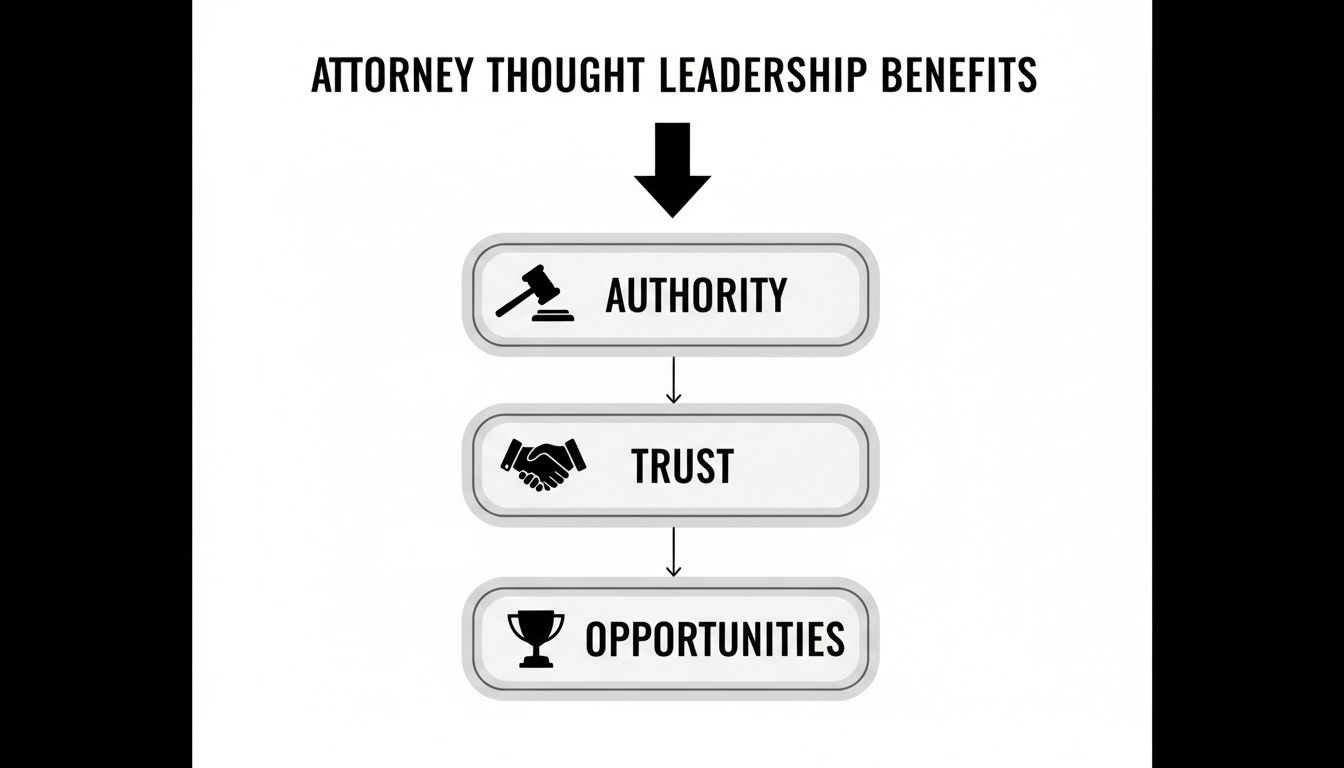
As this shows, establishing real authority naturally builds client trust, which in turn unlocks the kind of premium opportunities that define a successful career.
Pillar 3 Consistent Communication
Your brilliant ideas are worthless if they never leave your head. The third pillar is the disciplined, consistent sharing of your insights on the channels where your ideal clients actually spend their time. This isn’t about shouting into the void on every platform; it’s about choosing one or two and showing up reliably.
Consistency signals commitment and dependability. Whether it’s a monthly deep-dive article, a bi-weekly newsletter, or a weekly video brief, a regular cadence keeps you top-of-mind and builds an audience that actively looks forward to what you have to say next.
Pillar 4 Audience Engagement
Finally, thought leadership isn’t a monologue—it’s a conversation. The fourth pillar is about actively engaging with the community that grows around your work. That means responding to comments on your articles, answering questions on social media, and joining the discussions happening in your niche.
Engagement turns a passive audience into a loyal community. It proves you aren’t just broadcasting from an ivory tower but are an accessible expert who is genuinely willing to help.
By nurturing this community, you build real relationships and create brand advocates who will gladly amplify your message for you. Each pillar builds on the last, creating a powerful cycle that cements your status as a leader in your field.
Building Your Thought Leadership Platform Step by Step
Knowing you need to build a thought leadership platform is one thing. Actually doing it is another beast entirely, especially when you’re managing a demanding legal practice. The whole idea can feel overwhelming.
Let’s demystify the process and break it down into a practical framework. We’ll follow a real-world example to make it tangible: an intellectual property (IP) lawyer who specializes in advising tech startups.
Step 1: Define Your Niche and Ideal Client
First things first: get laser-focused. You can’t be the go-to expert for everyone, and trying to be is a recipe for failure. Generalists get ignored; specialists get paid.
Instead of targeting “businesses,” our IP lawyer gets specific and targets “early-stage SaaS founders in the fintech sector.” That narrow focus isn’t a limitation—it’s a superpower.
Suddenly, every piece of content she creates is intensely relevant. She knows this audience’s exact pain points: securing software patents, navigating messy data privacy laws, and protecting their brand’s trademark. This clarity becomes the foundation for everything that follows.
Step 2: Develop Your Core Message
Once you know who you’re talking to, you need to figure out what you’re going to say that no one else is. This isn’t just a tagline; it’s the central, memorable idea that cuts through the noise and runs through all your content.
For our IP lawyer, the core message might be: “Proactive IP strategy isn’t a cost center for startups; it’s their most valuable competitive advantage.”
This message is sharp, a little contrarian, and directly challenges a common misconception among founders. It instantly positions her not as just another lawyer, but as a strategic business partner who understands their world.
A strong core message acts as a filter for all your content. It ensures consistency and reinforces the unique value you bring to your specific niche, making your thought leadership instantly recognizable.
Step 3: Choose Your Primary Channels
You don’t need to be on every platform. In fact, you shouldn’t be. The key is to pick one or two places where your ideal clients—in this case, fintech SaaS founders—are already spending their time.
- Articles on LinkedIn: Perfect for reaching a professional audience with deep-dive analysis on recent patent litigation or new privacy regulations.
- Guest appearances on tech/startup podcasts: An incredibly effective way to reach founders directly, in a format they already trust and consume.
- A monthly newsletter: Ideal for building a direct relationship with an audience that has already raised its hand and shown interest in your expertise.
Our lawyer decides to focus her energy on publishing one in-depth article on LinkedIn per month and actively pitching herself as a guest on two popular startup podcasts each quarter. This is a focused, sustainable approach. Remember, your content marketing strategy for your law firm should always prioritize quality and consistency over sheer volume.
The demand for this kind of sharp, authoritative guidance is surging. A 2023 study found that 60% of senior executives felt a greater need for thought leadership compared to the year before. And what did they value most? Not fluff, but action-oriented insight (35%) and fresh thinking (28%). This proves that practical, forward-looking analysis is exactly what potential clients are looking for.
Common Mistakes That Undermine Attorney Credibility
Building a reputation as a thought leader is a deliberate process, but it’s surprisingly easy to derail even the best-laid plans. Certain common mistakes don’t just waste your time; they can actively chip away at the credibility and trust you’ve worked so hard to build.
Knowing what these pitfalls are is the first step toward creating a strategy that actually strengthens your professional standing, rather than undermining it.

Many attorneys fall into the trap of creating content that feels more like an advertisement than genuine expert guidance. This is a critical error that repels the exact audience you hope to attract.
Being Overly Self-Promotional
The fastest way to lose your audience is to make your content all about you or your firm. True thought leadership puts the audience’s needs first, offering real value and education without expectation. Constant self-promotion shatters that trust.
- What Not to Do: Publishing articles titled “Why Our Firm Is the Best Choice for Your Case” or ending every paragraph with a push to book a consultation.
- What to Do Instead: Focus on solving a real problem for your ideal client. An article like “Three Overlooked Liabilities for Tech Startups in Their First Year” provides immense value and naturally showcases your expertise without a hard sell.
Your content should feel like a generous consultation, not a sales pitch. When you educate effectively, the right clients will seek you out—no aggressive promotion needed.
Publishing Inconsistently
Another all-too-common mistake is treating thought leadership like a hobby. Publishing a few insightful articles and then going silent for months sends a clear signal of unreliability. Consistency is everything when it comes to building an audience that trusts and anticipates your insights.
Establish a regular cadence—whether it’s weekly or monthly—to demonstrate your commitment and keep your name top-of-mind. It’s far better to publish one high-quality piece per month, every single month, than to release five articles in January and nothing for the rest of the year.
Regurgitating Known Information
Genuine thought leadership demands a unique point of view. Many attorneys simply summarize recent legal news or restate well-known facts. This adds zero new value and positions you as a reporter, not an expert analyst.
Your audience doesn’t need another summary of a new statute; they need your interpretation of what it means for their business or their family. Always ask yourself: what unique insight or forward-looking prediction can I offer that nobody else is talking about? That’s the core of what separates true thought leaders from the crowd.
Amplifying Your Voice with the Haute Lawyer Network
Putting in the work to create exceptional thought leadership is a huge first step. But even the most brilliant legal analysis is useless if it never reaches the right people. This is where strategic amplification comes in—it’s the engine that turns your expertise into real-world influence and, ultimately, new business.
Without a powerful distribution channel, your articles and videos are like a message in a bottle tossed into the ocean. You need a platform that not only broadcasts your message but also lends it instant credibility and prestige.
This is exactly why partnering with a curated network is such a powerful move. Instead of spending years trying to build a high-caliber audience from scratch, you tap directly into an established, trusted ecosystem.
Elevating Your Expertise with a Premier Platform
The Haute Lawyer Network was built to solve the single biggest challenge in legal thought leadership: getting your content seen by high-net-worth individuals and key decision-makers. It’s not just a publisher; it’s a premier amplification partner designed to connect elite attorneys with the exclusive audience they want to reach.
When you join, you align your personal brand with Haute Living, a luxury media powerhouse that has earned the trust of an affluent readership for over two decades. That association immediately elevates your content, giving it a level of authority that’s almost impossible to achieve on your own. Your insights are no longer just expert opinions—they become featured commentary on a platform synonymous with excellence.
Being a thought leader means more than just having great ideas; it means having your great ideas heard by the people who matter most. Amplification through a trusted network is the bridge between expertise and influence.
The benefits go far beyond simple visibility. Content published through the network gains significant SEO authority, helping you rank higher in search results for the clients you actually want. You gain immediate access to a pre-qualified audience of business leaders, entrepreneurs, and potential clients who already trust the Haute Living brand.
This completely changes the game, turning your content efforts from a slow burn into a targeted, effective strategy for building a high-value practice. You can learn more about becoming a member to see how this network can directly support your goals.
Answering the Tough Questions on Thought Leadership
Even the most seasoned attorneys have practical questions when it comes to building a thought leadership platform. Let’s get straight to the most common concerns so you can move forward with confidence.
How Much Time Do I Really Need to Commit Each Week?
Let’s be realistic—you have a demanding practice. The good news is you don’t need to add another full-time job to your plate. A focused 2-4 hours per week is more than enough to gain serious traction.
The secret isn’t logging more hours; it’s about being strategic with the time you have.
- Batch your efforts: Set aside one block of time each month to outline several articles or record a few short videos. This is far more efficient than trying to create content on the fly.
- Create once, share everywhere: A single, well-researched article can be the foundation for a dozen social media posts, a quick video script, or even a webinar presentation.
This isn’t about choosing between practicing law and building your brand. It’s about making them work together.
How Do I Actually Measure the ROI on This?
Forget vanity metrics like ‘likes’ and ‘views.’ The real return on your investment shows up in tangible business opportunities. Your goal is to track the outcomes that directly lead to growth.
Keep an eye on these key performance indicators:
- Inbound calls and emails from potential clients who specifically mention your content.
- Media requests from journalists looking for an expert quote on a trending legal issue in your niche.
- Speaking invitations for industry conferences, podcasts, or webinars.
- A noticeable climb in search rankings for the keywords that matter most to your practice.
When you start seeing these results, you’ll know your efforts are not just being seen—they’re attracting high-value opportunities.
What If I’m a Great Lawyer but Not a Great Writer?
That’s perfectly fine. Your expertise is what matters, not your prose. Writing is just one tool in the toolbox, and for many successful attorneys, it’s not even their primary one.
If staring at a blank page feels like a chore, shift your focus to formats that play to your natural strengths:
- Host a webinar breaking down a complex new regulation for your clients.
- Jump on a popular industry podcast as a guest expert.
- Record short, direct-to-camera video explainers for LinkedIn or other social platforms.
You can also partner with a platform that has a professional editorial team. They can take your brilliant ideas and shape them into powerful, polished content. Success comes from the quality of your insights, not the medium you choose to deliver them.
Elevate your expertise and connect with a high-net-worth audience. The Haute Lawyer Network provides the premier platform to amplify your voice and solidify your status as a leader in your field. Discover how to transform your insights into influence at https://hauteliving.com/lawyernetwork.