
Forget the dramatic, last-minute confessions you see in courtroom dramas. At its core, litigation is simply the formal process of using the court system to settle a conflict. It’s the structured, rule-bound path parties take when they can’t resolve a serious disagreement on their own.
Understanding Litigation and Its Key Players
When a dispute gets to a point where handshakes and negotiations have failed, litigation provides the official framework to find a resolution. This isn’t a single event; it’s a journey governed by strict legal procedures, non-negotiable deadlines, and formal rules about what evidence is allowed.
Think of it as a carefully guided expedition through a complex legal landscape. Each step is deliberate, designed to ensure both sides get a fair hearing. To really grasp what a lawsuit entails, you first have to understand who the main players are. Their interactions drive the entire case forward, from the first filing to the final judgment.
Who Is Involved in a Lawsuit?
Every civil lawsuit revolves around two central figures: the plaintiff and the defendant. Their conflict is what the entire legal action is about.
- Plaintiff: This is the person, group, or company that starts the lawsuit. They are the ones claiming they have been harmed or wronged in some way and are asking the court for a remedy—usually financial compensation or an order for the other party to do (or stop doing) something.
- Defendant: This is the party being sued. The defendant is accused of causing the harm and is legally required to respond to the plaintiff’s claims and defend their position in court.
- Judge: The judge acts as the impartial referee. They preside over the case, interpret the law, rule on disputes between the lawyers, and—if there’s no jury—decide the final outcome.
Litigation isn’t about who shouts the loudest; it’s a structured forum for resolving disputes based on evidence and established law. It gives both sides an equal chance to present their case in a fair and orderly way.
Of course, the plaintiff, defendant, and judge aren’t the only ones in the room. A handful of other key roles are essential to how a lawsuit unfolds.
Key Players in the Litigation Process
This table gives a quick overview of the primary roles you’ll encounter in most lawsuits and what each person does.
| Role | Description |
|---|---|
| Plaintiff | The party who files the lawsuit, claiming a legal wrong was committed. |
| Defendant | The party who is being sued and must defend against the plaintiff’s claims. |
| Judge | The neutral arbiter who oversees the legal process and makes final rulings. |
| Jury | A group of citizens who listen to the evidence and determine the facts of the case. |
Understanding these roles is the first step in demystifying the litigation process. Each player has a distinct job, and their coordinated (and sometimes conflicting) actions are what move a case toward resolution.
The Complete Journey Through the Stages of a Lawsuit
A lawsuit isn’t a single, dramatic courtroom showdown like you see in movies. It’s a methodical progression through several distinct phases. Understanding these stages demystifies the whole affair, turning a confusing legal maze into a logical, step-by-step journey.
Each phase serves a specific purpose, building on the one before it to push the dispute toward a final resolution. The visual below shows the core relationship between the plaintiff (who initiates the case), the defendant (who responds), and the judge who oversees it all.
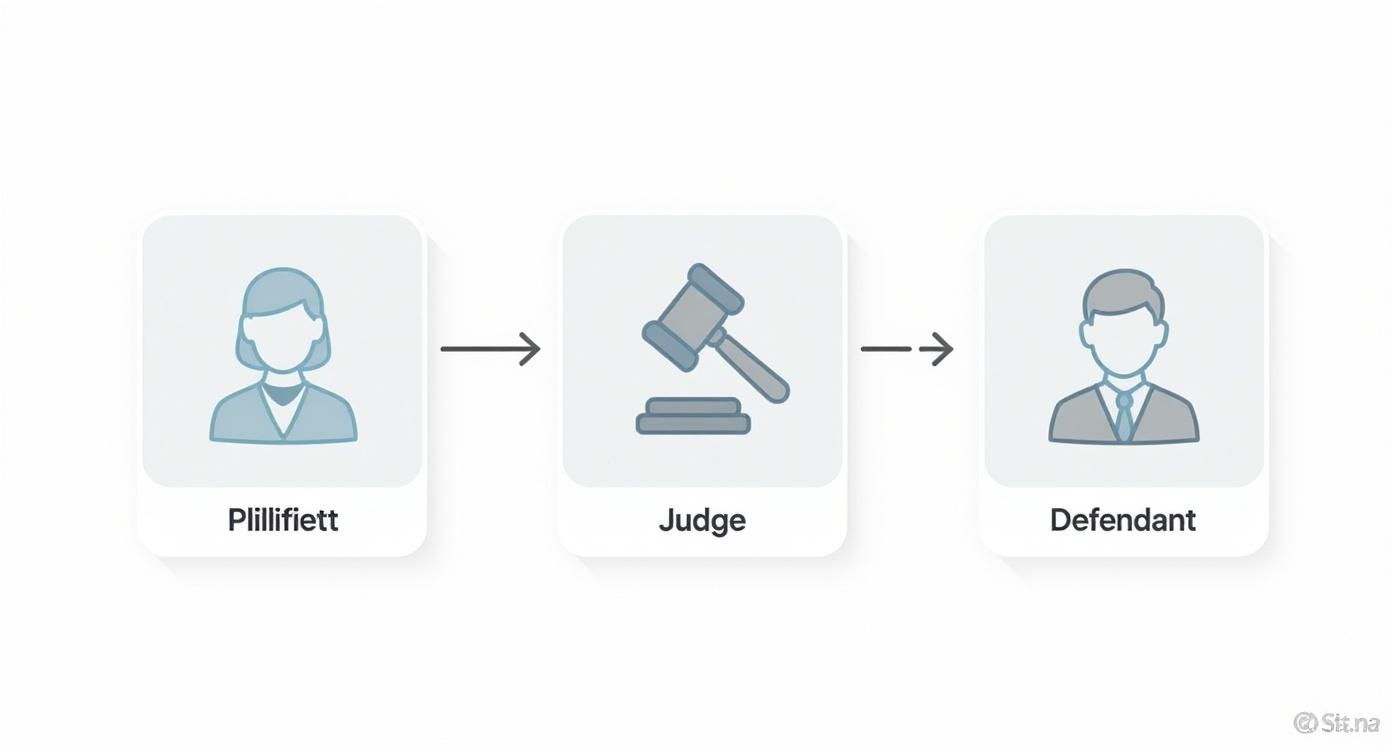
This illustrates the fundamental structure of a lawsuit, where opposing parties present their cases to a neutral authority for a binding decision.
The Pre-Litigation Phase
Long before any court documents get filed, a crucial investigation period unfolds. This is the pre-litigation stage, where a potential plaintiff and their attorney size up the strength of a claim. They gather initial evidence, send formal demand letters, and might even try to negotiate a settlement before ever involving the courts.
Think of it as a reconnaissance mission. The goal is to figure out if there’s a solid legal basis for a lawsuit and if filing one is the smartest strategic move. Getting this right can prevent a costly, time-consuming court battle if a resolution can be found early on.
The Pleadings Stage
If early negotiations fail, the lawsuit officially kicks off with the Pleadings stage. This is where the formal legal arguments are laid out for the court for the very first time.
- Complaint: The plaintiff’s attorney files a formal document called a “complaint.” This document outlines the facts, explains how the defendant allegedly caused harm, and specifies what the plaintiff is asking for—be it money, a court order, or something else.
- Summons: The court then issues a “summons,” a formal notice delivered to the defendant. It informs them they are being sued and gives them a strict deadline to respond.
- Answer: The defendant files an “answer” to the complaint. In it, they respond to each of the plaintiff’s allegations—admitting, denying, or stating they don’t have enough information. The answer might also include their own counterclaims against the plaintiff.
This formal back-and-forth establishes the legal and factual battleground the court will eventually have to navigate.
The Discovery Phase
Once the initial lines are drawn, the Discovery phase begins. This is often the longest and most labor-intensive part of any lawsuit. During discovery, both sides are required to exchange all information and evidence relevant to the case. The idea is to make sure there are no surprises at trial.
Discovery is like both sides laying all their cards on the table. It forces transparency and allows each party to see the full strength and weakness of the other’s case, which often encourages settlement.
Common discovery tools include:
- Interrogatories: Written questions sent to the other side, which they must answer under oath.
- Depositions: Out-of-court testimony where lawyers question witnesses under oath. A court reporter transcribes every word.
- Requests for Production: Formal requests for documents, emails, and any other physical or digital evidence.
Pre-Trial Motions and Resolution Attempts
As discovery wraps up, the case moves into the Pre-Trial phase. Here, attorneys file motions asking the court to resolve specific issues before a trial even starts. For instance, a “motion for summary judgment” asks the judge to rule immediately, arguing the undisputed facts are so one-sided that one party should win without a full trial.
This stage is also the last big push for a settlement. With all the evidence out in the open, both sides have a much clearer picture of their odds of winning. It’s no surprise that over 90% of civil lawsuits are resolved here through negotiation or mediation, avoiding the risk and expense of a trial.
This trend is only growing. A recent survey found that nearly 50% of organizations expect a rise in lawsuits and regulatory actions. You can explore more about these litigation trends and what drives them.
The Trial and Post-Trial Stages
If all settlement talks fail, the case proceeds to Trial. This is the formal courtroom proceeding where both sides present their evidence and arguments to a judge or jury. The trial follows a highly structured process, from opening statements and witness testimony to cross-examination and closing arguments.
But even after a verdict is read, the journey might not be over. The Post-Trial phase can include a few more steps:
- Filing an Appeal: The losing party can appeal to a higher court, arguing that the trial judge made a legal mistake that skewed the outcome.
- Collecting the Judgment: If the plaintiff wins a monetary award, they still have to actually collect it from the defendant—a process that can sometimes become a challenge in itself.
When Is Litigation the Right Path to Take?
Let’s be clear: not every disagreement belongs in a courtroom. Deciding to file a lawsuit is a serious move, one that’s usually made only after every other attempt to find a resolution has failed. Litigation is almost always the last resort, not the first play.
Think of it as the ultimate escalation. When conversations, negotiations, or even formal mediation don’t produce a fair result, the structured power of the court system is the only path left to enforce your rights or get compensation for a wrong. It’s the route you take when the other side simply won’t cooperate or the damage is too great to just walk away from.
Before you go down this road, you have to weigh the potential rewards against the very real costs in time, money, and stress.
Common Triggers for Filing a Lawsuit
Some situations just have a way of ending up in court because the stakes are too high for an informal handshake to fix things. Knowing these common triggers helps clarify when a lawsuit isn’t just an option—it’s a necessity.
Here are a few classic scenarios where people turn to the courts:
- Breach of Contract: When a partner, vendor, or client doesn’t hold up their end of a binding agreement, a lawsuit is often the only way to recover the financial damage. Digging into business and commercial litigation can offer a deeper look at how these disputes play out.
- Personal Injury Claims: If someone gets hurt because of another person’s carelessness—think a car crash or a slip-and-fall—litigation is the standard process for getting money to cover medical bills, lost income, and the physical and emotional toll.
- Property Disputes: Arguments over property lines, who owns what, or landlord-tenant conflicts often need a judge to step in and make a final, legally binding call.
What do all these have in common? One party has been tangibly harmed, and the other is either unable or unwilling to make it right without being compelled by a formal legal order.
Why Litigation Becomes the Only Viable Option
Ultimately, the decision to litigate boils down to one word: necessity. It’s for those times when a legal precedent has to be set, a major financial wrong needs to be righted, or someone’s fundamental rights have been violated. Without the court’s authority, the wronged party is often left with no recourse at all.
Litigation isn’t just about winning an argument; it’s about seeking a just and enforceable resolution when all other attempts at fairness have failed. It provides a final, authoritative answer to an otherwise unsolvable problem.
For example, a small business trying to collect a massive unpaid invoice from a huge corporation has almost no leverage in a simple negotiation. A lawsuit instantly levels that playing field, forcing the corporation to answer for its non-payment in a formal setting.
Likewise, someone permanently disabled by a faulty product can’t just rely on the manufacturer’s goodwill. Litigation becomes the only tool powerful enough to hold that company accountable and secure the resources needed for a lifetime of care. In cases like these, it’s not just the right path—it’s the only one.
How Modern Trends Are Shaping Legal Disputes
The core principles of litigation might be timeless, but the battleground itself is anything but static. Today’s legal disputes are increasingly tangled up in global issues, technological leaps, and evolving societal expectations. This means that the answer to “what is litigation” is constantly expanding to include challenges that didn’t exist a decade ago.

Think about it: international politics can inject massive complexity into what might otherwise be a simple business conflict. A straightforward contract dispute can suddenly become ensnared in trade sanctions, international regulations, or diplomatic tensions, dramatically raising the stakes.
The Rise of Collective and Cross-Border Lawsuits
One of the most powerful shifts we’re seeing is the explosion of collective action lawsuits. Instead of one person taking on a massive corporation, hundreds or even thousands of people who have been similarly harmed can join forces in a single, powerful legal action. This is becoming the go-to strategy for widespread issues like data privacy breaches or environmental damage.
And this isn’t just a domestic trend; it’s a global one. The legal world is grappling with a surge in both the volume and complexity of these cases. A perfect example is the dramatic spike in class actions filed across Europe. In 2023 alone, 133 class actions were initiated, a clear signal that the appetite for collective redress is growing stronger. If you’re interested in the details, you can discover more about these global litigation trends at Chambers and Partners.
Litigation is a mirror reflecting society’s most pressing concerns. As our world becomes more interconnected and technologically dependent, the lawsuits that arise will inevitably address the new and unique conflicts that come with it.
Technology and Data as the New Battlegrounds
Modern litigation is also being fundamentally reshaped by the sheer volume of digital information. Cases that once hinged on a “smoking gun” document found in a filing cabinet now involve wading through terabytes of data. It’s a whole new world.
Here’s how technology is changing the game:
- Electronic Discovery (e-discovery): Forget paper trails. Attorneys now have to be masters of navigating vast digital evidence—emails, internal chat logs, text messages, social media posts—to build a winning case.
- Cybersecurity and Privacy Claims: Data breaches are no longer a rare event. As a result, litigation over the mishandling of personal and corporate information is one of the fastest-growing fields in law.
- Intellectual Property Disputes: As innovation accelerates, so do the conflicts over who owns what. Disputes over patents, trademarks, and copyrights in the digital space have become incredibly complex and high-stakes.
These modern dynamics prove that litigation is far from a rigid, dusty process. It’s a living, breathing field that adapts to reflect the complexities of our hyper-connected world, ensuring it remains a vital tool for resolving the most critical disputes of our time.
Exploring Alternatives to a Court Battle
Heading to court isn’t always the only path forward when a serious conflict arises. While the formal structure of litigation offers a definitive process, it can be notoriously slow, expensive, and public. Fortunately, a powerful set of tools known as Alternative Dispute Resolution (ADR) provides more flexible and private ways to settle disagreements.

Think of ADR as a series of off-ramps on the highway to the courthouse. These alternatives are designed to put more control in the hands of the parties involved, cut down on time and legal fees, and keep sensitive matters out of the public record.
Mediation: The Facilitated Conversation
Mediation is a collaborative process where a neutral third party—the mediator—helps everyone involved find a solution they can all agree on. The mediator doesn’t issue rulings or force a decision. Their role is to open lines of communication, find common ground, and guide the conversation toward a voluntary settlement.
It’s like bringing in a skilled negotiator whose only goal is to help both sides build a bridge over their disagreement. This approach works particularly well when preserving a relationship is a priority, like in business partnerships or family law cases. The differences between these two paths can be stark; our guide on divorce mediation vs litigation offers a closer look at how this plays out in a specific context.
Arbitration: The Private Trial
Arbitration is a more structured process than mediation, often feeling like a streamlined, private version of a trial. Both sides agree to present their case to a neutral arbitrator (or a panel of them) who acts as a private judge. After hearing the arguments and reviewing the evidence, the arbitrator makes a decision, known as an “award,” which is almost always legally binding.
Unlike a judge in a public courtroom, the arbitrator is often an expert in the specific industry related to the dispute, which can lead to a more informed outcome. The process is also typically much faster and less formal than traditional court proceedings.
Alternative Dispute Resolution empowers parties to craft their own solutions. Whether through the collaborative spirit of mediation or the decisive finality of arbitration, ADR offers a strategic alternative to the high stakes of a public court battle.
Negotiation: The Direct Approach
Negotiation is the most fundamental form of dispute resolution. It’s simply the process of the parties—and their attorneys—communicating directly to try and reach a settlement on their own terms. This can happen at any time, whether it’s before a lawsuit is even filed or on the courthouse steps just before trial.
Successful negotiation hinges entirely on the willingness of both sides to find a middle ground and compromise.
Litigation vs. Alternative Dispute Resolution (ADR)
Choosing the right path forward depends entirely on your specific goals for cost, speed, privacy, and control. When weighing a formal lawsuit against ADR, it’s critical to understand the trade-offs.
This table breaks down the key differences.
| Feature | Litigation | Arbitration | Mediation |
|---|---|---|---|
| Decision-Maker | Judge or Jury | Arbitrator(s) | The Parties Themselves |
| Process | Formal and Public | Private and Simplified | Informal and Collaborative |
| Cost | Highest | Moderate | Lowest |
| Speed | Slowest | Faster | Fastest |
| Outcome | Legally Binding Verdict | Legally Binding Award | Non-Binding Settlement |
| Privacy | Public Record | Confidential | Confidential |
Ultimately, understanding these distinctions allows you to make a more strategic decision that aligns with your desired outcome, timeline, and budget.
Common Questions About the Litigation Process
To bring the world of litigation into sharper focus, let’s unpack some of the most practical questions people have when facing a legal dispute.
How Long Does a Lawsuit Actually Take?
There’s no magic number here—the timeline can be wildly different from one case to the next. A straightforward dispute that settles quickly could be over in just a few months.
But a complex, high-stakes case? That can easily stretch from one to three years, sometimes even longer if it goes all the way to a trial and then gets appealed. The timeline really depends on the complexity of the case, how many people are involved, and frankly, how cooperative the other side decides to be.
What Is the Difference Between Civil and Criminal Litigation?
While they both play out in a courtroom, the purpose and rules for civil and criminal litigation are fundamentally different. Think of it this way:
- Civil Litigation is about disputes between private parties—people or businesses. The goal isn’t jail time; it’s about making someone whole again, usually with a monetary award. Think breach of contract or personal injury cases. The burden of proof is “a preponderance of the evidence,” which just means it’s more likely than not that one side’s claim is true.
- Criminal Litigation is when the government prosecutes someone for a crime. Here, the goal is punishment (fines or prison) and protecting the public. The stakes are much higher, so the standard of proof is “beyond a reasonable doubt.”
The real distinction is the objective: civil cases aim to compensate a victim, while criminal cases aim to punish an offender for breaking a law.
Can a Case Settle at Any Point?
Absolutely. In fact, most of them do. A lawsuit can settle at almost any time, from before a single document is filed with the court to the moments right before a jury reads its verdict.
It’s a stunning statistic, but more than 90% of civil cases are resolved through a settlement, not a dramatic trial. As each side gathers more evidence during discovery, the true strengths and weaknesses of their arguments become clear. That clarity often pushes both parties to the negotiating table to avoid the cost, risk, and sheer uncertainty of leaving the decision in a judge’s or jury’s hands.
How Much Does Litigation Really Cost?
This is a huge consideration, and the answer can range from a few thousand dollars to well into the millions. The final bill is a mix of attorney’s fees, court filing costs, fees for expert witnesses, and how long the case drags on.
Clear communication with your attorney is everything. It’s also critical to understand your rights, like the confidentiality that protects your conversations. You can learn more about how to safeguard those vital discussions by understanding what is attorney-client privilege.
When facing a high-stakes legal matter, having a distinguished attorney is essential. The Haute Lawyer Network by Haute Living is a curated directory of the nation’s top legal professionals, selected for their expertise and excellence. Elevate your legal strategy by connecting with a leader in your field. Visit the Haute Lawyer Network to find the right representation today.