
Legal malpractice is more than just losing a case or disagreeing with your attorney’s strategy. It’s a profound betrayal of trust—a situation where an attorney’s professional negligence directly causes significant financial harm to their client. Think of it like a skilled surgeon making a preventable mistake during a critical operation. In the legal world, the consequences can be just as devastating.
A Clear Look at Legal Malpractice

When you retain an attorney, you’re not just hiring a service; you’re entering a professional relationship built on a fundamental promise. This promise, known legally as the standard of care, represents the baseline level of competence, knowledge, and diligence that any reasonably skilled lawyer would provide in a similar situation. Legal malpractice occurs when an attorney’s actions—or inactions—fall disastrously below this professional benchmark.
It’s crucial to understand this isn’t simply about being unhappy with the outcome. Losing a high-stakes lawsuit doesn’t automatically mean malpractice occurred. The real question is whether the attorney’s error, and not the inherent weaknesses of the case, was the direct cause of your financial loss. For high-net-worth individuals and businesses, the fallout from such a breach can be catastrophic. A missed deadline in a nine-figure deal or a poorly drafted estate plan can wipe out generational wealth in an instant.
The Four Elements of a Malpractice Claim
To successfully bring a legal malpractice claim, you don’t just need to feel wronged—you need to prove four specific elements. Think of these as the four legs of a table; if even one is missing, the entire claim collapses. These are often referred to as the “case-within-a-case,” because you essentially have to prove you would have won your original matter but for your lawyer’s negligence.
The four required elements are:
- Duty: You must first prove that an attorney-client relationship existed, which established the lawyer’s professional duty to you.
- Breach: Next, you must show that the attorney breached that duty by acting negligently—meaning their conduct fell below the accepted standard of professional care.
- Causation: This is often the hardest part. You have to prove that the attorney’s specific error was the direct and proximate cause of your financial injury.
- Damages: Finally, you must demonstrate the exact monetary damages you suffered as a result of the malpractice.
To make this clearer, here’s a simplified breakdown of these core components.
Core Components of a Legal Malpractice Claim at a Glance
This table provides a simplified overview of the four fundamental elements a client must prove to establish a successful legal malpractice claim.
| Element | Simple Explanation |
|---|---|
| Duty | An official attorney-client relationship existed. |
| Breach | The attorney made an error a competent lawyer would not have made. |
| Causation | The attorney’s error directly caused you to lose money. |
| Damages | You can prove the specific amount of money you lost. |
Understanding these four pillars is the first step in assessing whether you have a viable claim. Without clear evidence for each, even the most egregious-seeming error won’t hold up in court.
The Four Pillars of a Successful Malpractice Claim

Winning a legal malpractice claim is far more demanding than just being unhappy with how your case turned out. The entire lawsuit stands on four essential legal elements, and much like pillars holding up a roof, if even one is missing, the whole claim collapses.
To succeed, you must prove all four of these components:
- Duty: The attorney owed you a professional duty of care.
- Breach: They violated that duty through negligence or error.
- Causation: Their mistake directly caused you financial harm.
- Damages: You suffered real, measurable financial losses.
Let’s break down each of these foundational pillars. It’s the only way to truly understand the high bar you must clear when bringing a malpractice action.
Pillar 1: Duty of Care
First, you have to establish that a formal attorney-client relationship existed. This relationship is the bedrock that creates the lawyer’s professional duty to act in your best interests.
This is usually straightforward, proven with a signed retainer agreement or engagement letter. But a formal contract isn’t the only way. Courts can find that a relationship existed if an attorney gave you legal advice and you reasonably acted on it.
Without this proven duty, there are no grounds for a malpractice claim. An attorney simply doesn’t owe a professional obligation to a non-client.
Pillar 2: Breach of the Standard of Care
With the duty established, you must now prove the attorney breached it. This means showing your lawyer failed to use the ordinary skill and care that a reasonably competent attorney would have under similar circumstances. This is known as the “standard of care.”
A breach isn’t a strategic disagreement or a judgment call that didn’t pan out. It’s a clear error.
Think of things like:
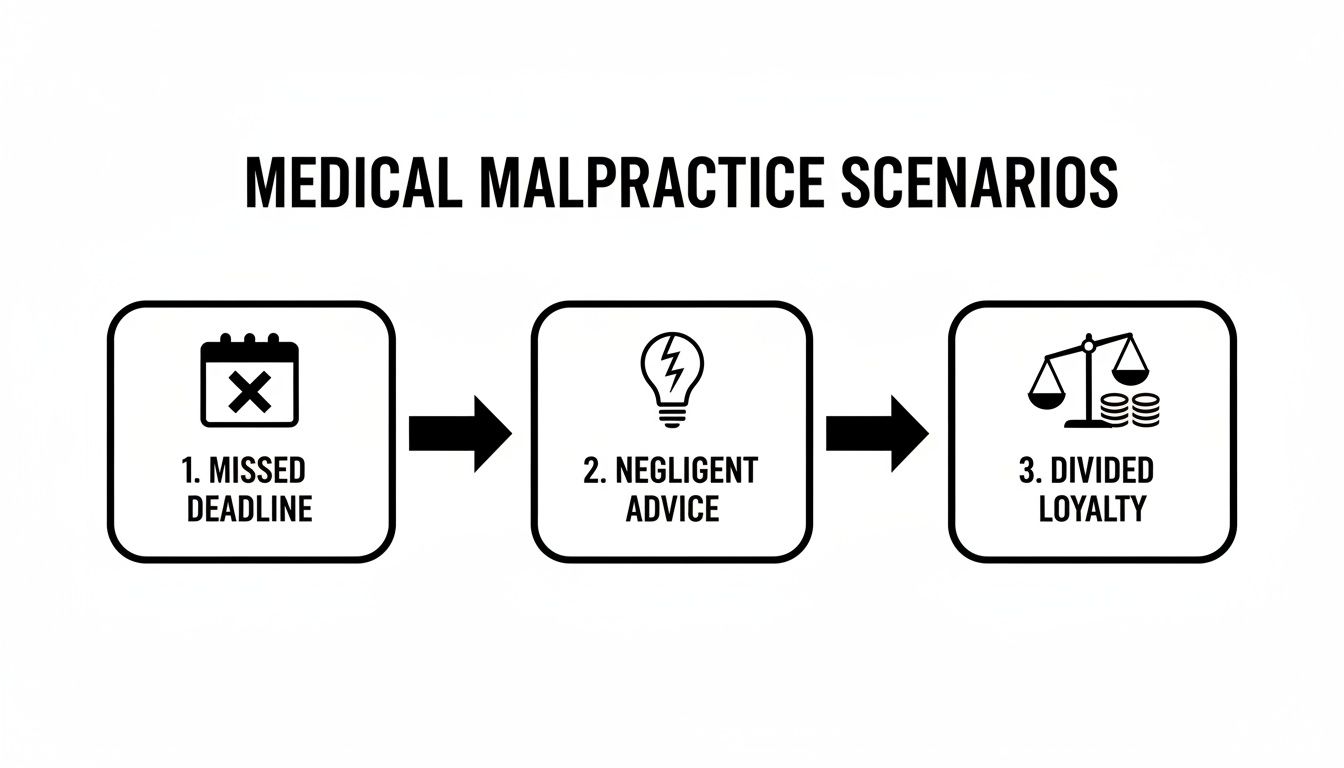
- Missing a critical deadline, like the statute of limitations.
- Failing to conduct basic due diligence in a corporate transaction.
- Giving objectively incorrect legal advice.
- Operating with an undisclosed conflict of interest.
Proving a breach almost always requires expert testimony. You need a qualified legal expert to explain to the court what a competent attorney should have done and precisely how your former lawyer’s conduct fell short.
This is where professional responsibility and basic competence intersect. The rules governing lawyers set a baseline for acceptable conduct, and as discussed in this modern lawyer’s guide to legal ethics issues, violating these principles is often a direct path to proving a breach.
Pillar 3: Causation and the “But-For” Test
Proving causation is frequently the most difficult hurdle in a malpractice case. You have to demonstrate that “but for” your lawyer’s negligence, your financial loss would not have occurred. It’s about drawing a direct, unbroken line between the error and the harm.
This creates what’s known as the “case-within-a-case” challenge. For example, if your lawyer missed the deadline to file your lawsuit, it’s not enough to show they made a mistake. You also have to prove you would have won the original lawsuit if it had been filed correctly. You essentially have to win two cases at once.
If your underlying case was weak and you were going to lose anyway, then the lawyer’s mistake didn’t actually cause your financial damages. The link must be undeniable.
Pillar 4: Quantifiable Damages
Finally, you must prove you suffered actual, measurable financial damages. Being frustrated, angry, or emotionally distressed is not enough. The loss has to be tangible and calculable in dollars and cents.
Clear examples of provable damages include:
- The value of a lost settlement or court judgment.
- Money lost in a badly negotiated business deal.
- Legal fees paid to the negligent attorney for their failed work.
- The cost of hiring a new lawyer to fix the original mess.
You need to present concrete evidence of your monetary loss. Without proof of specific financial harm, there is no recovery—even if the other three pillars are rock-solid.
Recognizing Malpractice in High-Stakes Scenarios
The legal theory is one thing, but seeing attorney negligence play out in the real world is another. While malpractice can happen in any case, the consequences explode in high-stakes corporate deals, complex litigation, and sophisticated estate planning. Here, a single error can wipe out a fortune.
Understanding these common fact patterns is key to spotting red flags when millions are on the line. These aren’t just minor oversights; they are catastrophic failures that shatter the foundation of the attorney-client relationship.
Missing the Statute of Limitations
Imagine you have a solid breach of contract claim against a business partner, easily worth $10 million. Your lawyer assures you the case is a slam dunk. But they miscalculate the statute of limitations—the absolute deadline to file a lawsuit—and submit your claim one day late.
Just like that, your $10 million claim is gone forever, dismissed by the court on a technicality. This is one of the most painfully clear-cut examples of legal malpractice. A simple administrative blunder with devastating financial results. The strength of your case becomes completely irrelevant because your attorney missed a fundamental deadline.
Negligent Due Diligence in Business Deals
Picture your company acquiring another business for $50 million. You’re counting on your legal team to conduct meticulous due diligence, digging into the target company’s finances, contracts, and any hidden liabilities.
Instead, your attorney rushes the job. They fail to uncover a massive pending lawsuit that could cripple the target company. The deal closes. Six months later, your new subsidiary is slammed with a $20 million judgment. This disaster, which should have been caught and handled during negotiations, is now your problem. The attorney’s sloppy work led directly to a multimillion-dollar loss.
In a high-value transaction, an attorney’s primary duty is to be the guardian of their client’s interests. When they fail to find critical risks that any competent lawyer would have spotted, they breach that duty, leaving the client holding the bag.
Critical Drafting Errors in Estate Planning
Drafting errors are another all-too-common source of high-stakes malpractice. A high-net-worth individual hires an attorney to create a sophisticated family trust, designed to protect assets and minimize taxes for generations to come.
The attorney, however, makes a critical mistake in the document, using ambiguous language that fails to structure the trust correctly under tax law. Years later, when the individual passes away, the error surfaces. Instead of a smooth transfer of wealth, the estate gets hit with millions in unexpected taxes, and the family is dragged into expensive litigation to try and clean up the lawyer’s mess.
The Pervasive Threat of Conflicts of Interest
A conflict of interest exists when a lawyer’s loyalty is split. This could be between two clients—like representing both the buyer and seller in a deal—or between their client and their own personal interests, such as advising a startup while secretly owning a stake in a competitor.
This divided loyalty is a breeding ground for malpractice. A lawyer simply cannot serve two masters. When they try, one client’s interests are almost always sacrificed. These situations are especially dangerous because the damage often isn’t obvious until it’s far too late.
These examples show why spotting potential malpractice is so critical when the financial stakes are this high. Recent trends show that claims related to business transactions and estate planning are surging. Data covering 80% of Am Law 100 firms revealed that while the number of claims held steady, the severity of the losses skyrocketed, with some insurers paying out over $300 million on a single claim. This trend, as explored in recent industry analyses, highlights the escalating risk in complex legal work. You can learn more about these legal malpractice trends to better understand the current landscape.
Your Roadmap for Pursuing a Malpractice Claim
Realizing your attorney may have bungled your case is a uniquely stressful and disorienting experience. It’s critical to move past the initial shock and take methodical, deliberate steps to protect your rights. This isn’t about emotion; it’s about building a solid, evidence-backed foundation for a potential claim.
Think of the following as your immediate action plan. Each step is designed to preserve your options and position you for the best possible outcome.
Step 1: Assemble All Documentation
Your first move is to become the archivist of your own case. Gather every single piece of paper, every email, and every document related to your relationship with the attorney in question. No detail is too small or insignificant at this stage.
Your file should be comprehensive and include:
- The signed retainer agreement or engagement letter that officially kicked off the relationship.
- All email correspondence between you, your attorney, and their staff.
- Court documents, including all motions, pleadings, and orders filed on your behalf.
- Billing statements and proof of payment for every dollar spent on fees and costs.
- Any other written materials—think letters, internal memos, or even your own notes from phone calls.
Having this information organized and ready is absolutely crucial before you can move on to the next step.
Step 2: Understand the Statute of Limitations
This is where many valid malpractice claims die before they even begin. A statute of limitations is a non-negotiable legal deadline for filing a lawsuit. If you miss this window, your claim is gone forever, no matter how strong the evidence of malpractice is.
A statute of limitations is a ticking clock on your right to sue. Once that time runs out, the courthouse doors are permanently closed to you. Procrastination is the single biggest reason legitimate claims fail.
These deadlines vary dramatically from one state to the next. Some jurisdictions use a “discovery rule,” meaning the clock starts ticking not when the mistake happened, but when you discovered it (or reasonably should have discovered it). Because this is a make-or-break issue, you must understand the specific rules for your state. You can find a helpful overview of the statute of limitations by state to get a general sense of these timelines.
Step 3: Consult a Specialized Malpractice Attorney
This is, without question, the single most important action you will take. You need to find and consult with a new attorney who specializes in legal malpractice. Do not try to handle this yourself. This is a highly complex field, and you need a lawyer who specifically focuses on suing other lawyers to give you an objective, expert assessment.
This new expert will review your meticulously organized file and listen to your side of the story. They are looking for the four essential pillars of a malpractice claim: duty, breach, causation, and damages.
Crucially, they will also walk you through the “case within a case” doctrine. This means you won’t just have to prove your first lawyer was negligent; you’ll have to prove you would have won your original case if not for their mistakes. This initial consultation is your chance to get a clear-eyed, unbiased opinion on whether you have a legitimate path forward.
Distinguishing a Bad Outcome from Actual Negligence
Losing a high-stakes legal battle is crushing. It’s only natural to wonder if your lawyer dropped the ball. But one of the hardest truths in pursuing a claim is learning the difference between a disappointing result and genuine professional negligence.
The legal system is full of risk, and an unfavorable verdict doesn’t automatically mean your attorney failed you. Lawyers are strategists, not fortune tellers, and they can’t guarantee a win. Sometimes, even with perfect execution, the facts or the judge just don’t go your way.
The Judgmental Error Rule
One of the first lines of defense a lawyer will raise is the judgmental error rule. This doctrine is crucial. It protects attorneys from being sued over good-faith strategic calls that simply didn’t pan out.
Think of a trial lawyer deciding whether to put a specific witness on the stand. That witness might have great things to say, but they could also get destroyed on cross-examination. The lawyer has to weigh the risks and make a call. If they decide against it and the case is lost, you can’t sue them just because, in hindsight, it looks like the wrong move.
The legal system can’t function if every strategic choice is second-guessed after the fact. An attorney’s strategy isn’t negligent just because it failed; it must be a decision that no reasonably competent lawyer would have made under the circumstances.
Proving Causation Is Not Easy
Even when you can point to a clear mistake, the fight isn’t over. The defense will almost certainly attack the element of causation. Their argument? Your original case was a loser anyway, so the error didn’t actually cause your financial loss.
For example, say your lawyer missed a deadline to submit a key piece of evidence. It’s a clear error. But if the defense can prove that evidence was weak and wouldn’t have swayed the judge, they’ll argue the mistake was harmless. This forces you into a “case-within-a-case,” where you have to prove all over again that you should have won the original lawsuit.
To make these critical differences crystal clear, let’s look at a few common scenarios.
Bad Outcome vs. Legal Malpractice: Understanding the Difference
This table contrasts situations that are merely disappointing legal outcomes with those that may constitute actual attorney negligence, helping clients assess their situation.
| Situation (The Bad Outcome) | When It Might Be Malpractice | When It Likely Is Not Malpractice |
|---|---|---|
| You lost your lawsuit at trial. | Your attorney failed to file key motions or missed the statute of limitations, resulting in a dismissal. | The judge or jury simply found the opposing side’s evidence more credible, despite your attorney’s competent work. |
| Your settlement was smaller than you hoped for. | Your attorney failed to conduct proper discovery, missing crucial assets or facts that would have increased the settlement value. | Your attorney provided a realistic assessment of the case’s weaknesses and negotiated the best possible deal under the circumstances. |
| Your business deal fell through. | Your lawyer made a critical error in the contract draft that made the deal legally unenforceable, causing the other party to back out. | The other party withdrew due to changing market conditions or financial issues entirely unrelated to your lawyer’s legal work. |
Internalizing these distinctions is the first step toward realistically evaluating whether your bad experience crosses the line from a simple loss into actionable negligence.
How to Proactively Mitigate Your Legal Risk
After diving into the complexities of legal malpractice claims, one truth becomes crystal clear: the best strategy is simply to avoid one in the first place. Preventing a problem is always superior to fixing one—especially when your business or financial future is on the line.
Without a doubt, the single most powerful step you can take to mitigate this risk is exercising extreme diligence when selecting your legal counsel from day one. This isn’t just about finding a lawyer with a good reputation. It’s about shifting your mindset from reactive problem-solving to proactive risk management. For anyone with significant assets or complex business interests, choosing the right attorney isn’t a simple hire—it’s one of the most critical financial decisions you will ever make.
Vetting Counsel Is Your Best Defense
Partnering with elite, thoroughly vetted attorneys dramatically shrinks your exposure to the kinds of devastating errors that blossom into malpractice lawsuits. When you select lawyers based on their proven excellence and integrity, the likelihood of sloppy work, missed deadlines, or ethical conflicts simply plummets.
Think about the common pitfalls we’ve already covered:
- Procedural Errors: Top-tier law firms operate with robust internal systems built to track deadlines and manage case files. This professional infrastructure minimizes the chance of a catastrophic mistake, like a missed statute of limitations.
- Substandard Work: Elite professionals build their careers on meticulous due diligence and flawless legal drafting. Their work is specifically designed to withstand intense scrutiny.
- Ethical Conflicts: The best attorneys are acutely aware of their ethical duties and prioritize transparent communication to avoid even the appearance of a conflict of interest.
Choosing the right lawyer isn’t just an expense; it’s an investment in security. By prioritizing proven expertise and ethical rigor, you are actively safeguarding your assets against the preventable errors that define legal malpractice.
This is precisely why curated legal networks are so valuable for high-stakes matters. They offer a pre-vetted pool of professionals whose careers are defined by excellence. Instead of rolling the dice and hoping you’ve found the right expert, you can choose from a roster of attorneys who have already met an exceptionally high bar for inclusion.
This initial due diligence on your part is the ultimate form of protection. For a deeper look, our guide on how to choose a lawyer for high-stakes legal matters provides a comprehensive framework for making this vital decision.
Ultimately, your best defense against legal malpractice is a powerful offense—a meticulous and informed selection process that ensures you are represented by the very best from the start.
Your Top Legal Malpractice Questions Answered
When you suspect your lawyer made a critical error, the path forward can feel incredibly confusing and overwhelming. Let’s cut through the noise and address the most pressing questions people have when they believe their attorney has let them down.
I Think My Lawyer Messed Up. What’s My First Move?
Stop what you’re doing and find an attorney who focuses specifically on legal malpractice claims. This is not the time to wait and see. Every state has strict deadlines, known as statutes of limitations, for filing these cases, and missing that window means you lose your rights for good.
Your new lawyer will give you an objective, unvarnished look at what happened. To make that first meeting as productive as possible, pull together every piece of paper related to your case.
This file should absolutely include:
- The fee agreement or engagement letter you signed.
- Every email and letter you exchanged with your former lawyer.
- All court filings, discovery documents, and official records.
Can I Sue Just Because I Lost My Case?
Absolutely not. This is probably the biggest misconception out there. Losing a case, even a case you felt strongly about, is not automatic grounds for malpractice. The legal system has winners and losers, and sometimes, the facts or the law just aren’t on your side.
To have a real claim, you have to prove two very specific things. First, that your lawyer’s work fell below the professional standard of care—the level of skill and diligence that a reasonably competent attorney would provide. Second, you must prove that this specific failure, and not some other weakness in your case, is the direct reason you lost money.
A bad outcome from a reasonable strategic choice isn’t malpractice. An attorney missing a non-negotiable filing deadline that gets your case dismissed? That’s a different story entirely.
What Does It Cost to Hire a Malpractice Attorney?
Most lawyers who handle these specialized cases work on a contingency fee basis. This structure is a lifesaver for clients, giving them access to top legal talent without needing a pile of cash upfront.
With a contingency agreement, you pay zero out-of-pocket attorney fees. Your lawyer only gets paid if they win money for you, either through a settlement or a trial verdict. Their fee is a pre-agreed-upon percentage of that recovery, usually somewhere between 30% and 40%.
If you don’t win, you owe no attorney fees. Period. But always be sure to ask whether you might still be on the hook for other litigation costs, like court filing fees or the high cost of hiring expert witnesses.
How Is the Payout Calculated in a Malpractice Case?
The goal of a malpractice award is to make you whole. The law tries to put you in the exact financial position you would have been in if your first lawyer hadn’t made the mistake. To do this, you essentially have to prove a “case within a case.”
For example, if your lawyer’s mistake cost you a personal injury claim that was clearly worth $500,000, then your damages in the malpractice suit would be that $500,000. You can also recover other direct losses, like the fees you paid the negligent attorney or the money you had to spend hiring a second lawyer to clean up the mess.
The surest way to sidestep malpractice is to start with elite, rigorously vetted counsel. The Haute Lawyer Network offers curated access to the country’s most respected legal minds, ensuring your critical matters are handled by proven experts from day one. Learn more and connect with a trusted advocate at https://hauteliving.com/lawyernetwork.