
When a high-stakes dispute arises, the courtroom isn’t the only option. In fact, for sophisticated individuals and businesses, it’s often the last resort. A settlement agreement is the preferred alternative—a powerful, legally binding contract that resolves a conflict privately, efficiently, and on your own terms.
Think of it as a negotiated peace treaty. Instead of surrendering control to a judge or jury, you dictate the outcome, maintain complete confidentiality, and sidestep the staggering costs and public exposure of a trial.
Understanding the Purpose of a Settlement Agreement

At its heart, a settlement agreement is a strategic risk management instrument. Why leave your fate in the hands of the court when you can architect the resolution yourself? This is especially critical when your reputation, business operations, or significant personal assets are hanging in the balance.
Entering into a settlement is not an admission of guilt. In fact, nearly every well-drafted agreement contains a “no admission of liability” clause. It’s a calculated business decision to protect your interests, conserve resources, and move forward with certainty.
To give you a clearer picture, here’s a quick breakdown of what a settlement agreement typically involves.
Settlement Agreement at a Glance
| Characteristic | Description |
|---|---|
| Nature of Document | A private, legally enforceable contract between disputing parties. |
| Primary Goal | To resolve a conflict without court intervention and with finality. |
| Confidentiality | Terms are kept private, protecting personal and professional reputations. |
| Control | Parties collaboratively define the resolution, unlike a judge-imposed verdict. |
| Cost-Effectiveness | Avoids the unpredictable and often exorbitant expenses of a full-blown trial. |
| Liability | Typically includes a clause stating that the settlement is not an admission of fault. |
This table underscores why a settlement is often the most pragmatic and intelligent path forward for resolving disputes.
Key Benefits of Settling a Dispute
Opting for a settlement provides several decisive advantages over a protracted legal war. These agreements are engineered to deliver certainty where a trial can only offer a gamble.
The primary benefits are clear:
- Cost Control: Litigation costs—attorney fees, court filings, expert witnesses—can spiral out of control. A settlement establishes a fixed, predictable cost to end the matter for good.
- Confidentiality: Court proceedings are a matter of public record. Settlements are almost always bound by strict confidentiality clauses, ensuring the dispute remains private and your reputation stays intact.
- Finality and Control: You and the other party, not a judge, decide the final terms. This allows for customized solutions a court could never order, bringing a definitive end to the conflict.
A settlement is the definitive alternative to protracted legal proceedings. It swaps the uncertainty and public exposure of the courtroom for a confidential, controlled, and conclusive resolution tailored to your specific needs.
Ultimately, understanding what is litigation and its inherent risks clarifies why over 95% of civil cases are resolved through settlement. By choosing this path, you are opting for strategic resolution over indefinite conflict, preserving both your financial resources and your peace of mind.
Where Settlement Agreements Make the Most Impact
Settlement agreements aren’t just a one-trick pony; they are sophisticated legal tools designed to resolve high-stakes disputes across a variety of sectors. Think of them as a strategic off-ramp from the costly, public, and often damaging highway of litigation. Understanding where they’re most effective reveals their true value.
Whether it’s a boardroom fallout or the end of a marriage, these agreements provide a structured and private path to finality. Let’s look at four arenas where settlements are absolutely essential.
Executive Departures and Severance Negotiations
In the corporate world, the exit of a high-level executive is a delicate operation. A settlement agreement, usually structured as a severance package, is critical for ensuring a clean break. This is about more than just a final paycheck; it’s a strategic move to protect the company’s reputation and trade secrets while giving the departing executive a dignified exit.
For instance, when a Chief Financial Officer leaves a major corporation, the agreement will likely include:
- A strict confidentiality clause to prevent any discussion about why they left.
- A non-disparagement provision that keeps both sides from making negative public statements.
- A full release of claims, meaning the executive forfeits the right to sue for things like wrongful termination.
This is a calculated business decision. It insulates both the company and the individual from future legal headaches and allows everyone to move forward without looking back.
Civil and Personal Injury Claims
Civil litigation, especially personal injury cases, is another field dominated by settlements. The reality of a drawn-out, emotionally taxing, and unpredictable trial is enough to bring both sides to the negotiating table. A settlement delivers certainty, while a jury verdict is always a gamble.
Take a complicated multi-vehicle accident claim. Instead of dragging everyone through years of court battles, the injured party and the insurance company can negotiate a settlement. The agreement locks in a specific dollar amount for medical bills, lost income, and pain and suffering, closing the book on the matter efficiently. It sidesteps the risk of a jury awarding a far larger—or disappointingly smaller—sum.
Divorce and High-Net-Worth Family Disputes
When a marriage dissolves, particularly one involving substantial or complex assets, a settlement agreement is indispensable. Often called a marital settlement agreement, this document is the blueprint for unwinding a shared life. It goes far beyond just splitting up the furniture, addressing highly sensitive issues with precision.
A well-structured divorce settlement is the difference between a bitter, public fight and a private, mutually agreed-upon plan. It transforms disputes over businesses, investments, and custody into a clear roadmap for the future.
This legally binding contract details everything from dividing real estate and investment portfolios to setting the terms for spousal support and child custody. It gives the couple control over their own financial destinies, rather than leaving those deeply personal choices in the hands of a judge.
Commercial and Business Conflicts
Disputes are a cost of doing business. But in this context, what is a settlement agreement? It’s a strategic tool for resolving breach of contract claims, partnership disagreements, or intellectual property disputes without blowing up business operations. A public lawsuit can destroy a brand’s reputation and send investors running for the hills.
For example, two tech companies locked in a patent dispute can use a settlement to create a licensing deal, agree on a payment, and even preserve their professional relationship. It’s a pragmatic approach that saves an immense amount of time and legal fees, letting both companies get back to focusing on what they do best.
Anatomy of a Watertight Settlement Agreement
A well-crafted settlement agreement isn’t just paperwork; it’s a fortress designed to shield your interests with absolute precision. While your attorney handles the legal minutiae, understanding its core components empowers you to ensure the final contract is truly impenetrable. Let’s break down the key clauses that form the backbone of any strong settlement.
These agreements are not cobbled together from generic templates. They are meticulously structured legal instruments where each clause serves a specific, vital purpose. Together, they create a final, binding resolution designed to prevent the same dispute from ever haunting you again.
The Release of Claims
The single most critical component is the release of claims. Think of this as a permanently locked door on the dispute. By signing, both parties agree to give up their right to sue each other over the issues involved—not just now, but forever.
This clause has to be drafted with surgical clarity. It must specify whether the release is mutual and precisely outline which claims (both known and unknown) are being waived. A vaguely worded release can leave you exposed, defeating the very purpose of settling in the first place.
A watertight release of claims delivers complete finality. It ensures that once the ink is dry, the matter is permanently concluded, giving you the peace of mind to move forward without the threat of the same conflict resurfacing.
The following flowchart illustrates the most common legal arenas where these detailed agreements are essential.
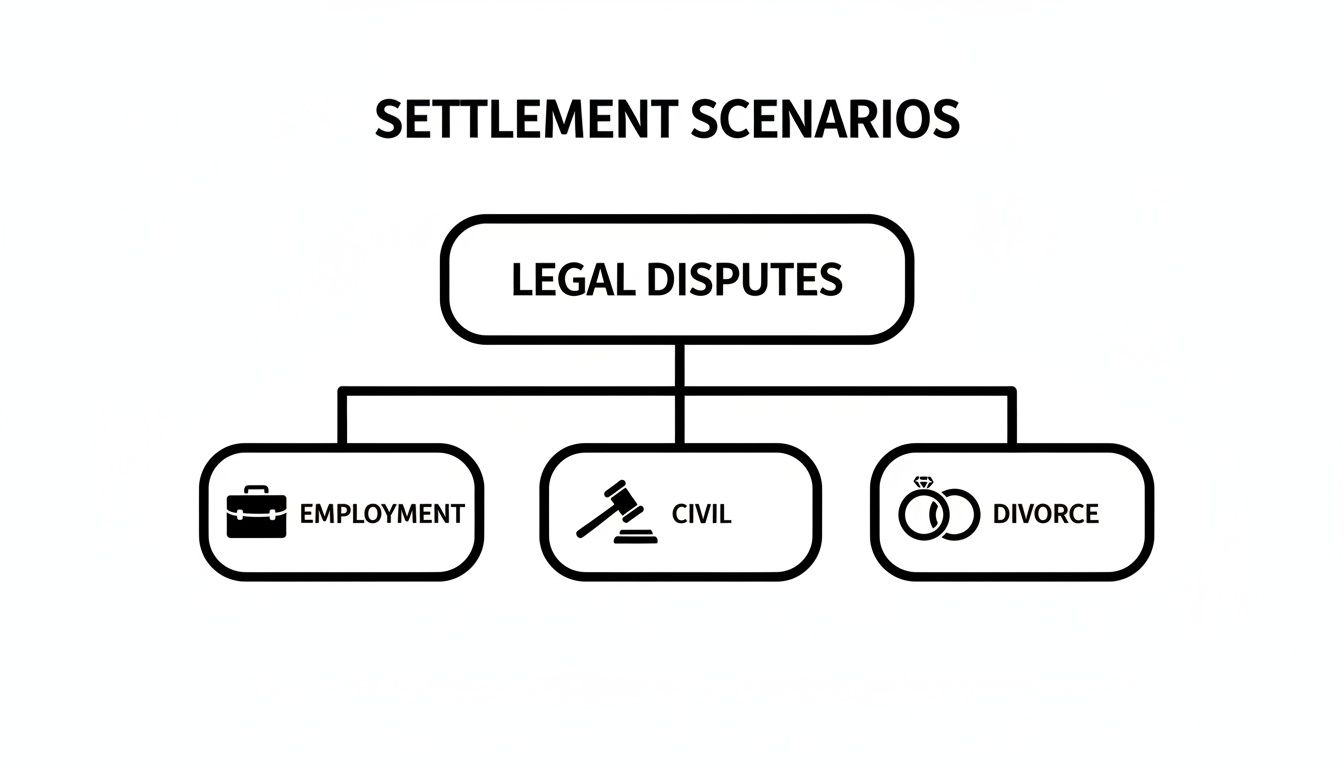
This visual highlights how settlement agreements are customized to address the unique challenges of employment, civil, and divorce law, each demanding specific clauses to be effective.
Confidentiality and Non-Disparagement
For high-profile individuals and businesses, reputation is an invaluable asset. This is where confidentiality and non-disparagement clauses become absolutely crucial. These provisions legally bar either party from discussing the settlement’s terms or making negative statements about the other.
A confidentiality clause ensures the entire dispute stays private. A non-disparagement clause takes it a step further, preventing public attacks that could tarnish your personal or professional standing long after the conflict is over. For preserving your brand and legacy, these are non-negotiable.
Consideration and Payment Terms
Every legally binding contract requires consideration—the value exchanged between the parties. While this is often a monetary payment, it can also include actions like returning property or issuing a public retraction.
This section must meticulously detail the payment terms, leaving zero room for interpretation:
- The Exact Amount: Specify the total sum to be paid in no uncertain terms.
- Payment Schedule: Outline whether it’s a lump sum or installments, including precise due dates.
- Method of Payment: Define how funds will be transferred, such as by wire or certified check.
The value of settling high-stakes disputes is increasingly evident on a global scale. According to a UNCTAD analysis, treaty-based investor-state dispute settlement (ISDS) cases more than doubled in the last decade, reaching 1,332 known disputes. Tellingly, 21% of these cases concluded through settlement, a testament to its power in resolving multimillion-dollar claims and preserving assets amid geopolitical risk. You can explore more data on these trends in the full UNCTAD report.
How Global Legal Systems Impact Settlements
The success of a settlement isn’t just about the facts of your case. It often hinges on something far more fundamental: where the dispute is being resolved. The legal world is largely split between two major traditions—common law and civil law—and for anyone navigating international business or personal matters, knowing the difference is a strategic necessity.
Think of it this way: a common law system, like those in the United States and the United Kingdom, is intensely adversarial. It’s like a high-stakes boxing match where both sides spend months gathering evidence, deposing witnesses, and sizing each other up in a process called discovery. This pre-trial battle often reveals the true strengths and weaknesses of each case, creating powerful incentives to settle before stepping into the expensive and unpredictable courtroom ring.
Common Law vs. Civil Law Systems
In stark contrast, civil law systems, found in countries like France and Germany, are more inquisitorial. Here, a judge takes an active role in investigating the facts, almost like a referee and detective rolled into one. The pre-trial discovery process is far more limited, meaning the parties often have less insight into their opponent’s hand. This structure often leads them to see the legal process through to a final judgment rather than striking a deal beforehand.
This core difference dramatically impacts outcomes. A revealing study in the Journal of Legal Analysis found that common law countries like the U.S., U.K., and Australia saw settlement rates hover between 50-67%. Meanwhile, civil law nations such as France and Belgium reported rates below a mere 15%. You can read the full research about global settlement trends to see just how deeply legal traditions shape dispute resolution.
For a clearer picture, let’s look at the numbers side-by-side.
Global Settlement Rate Comparison
This table illustrates the significant difference in pre-trial settlement rates between major common law and civil law jurisdictions, underscoring how the legal framework itself can predict the likelihood of a negotiated outcome.
| Country/System | Typical Pre-Trial Settlement Rate |
|---|---|
| Common Law Jurisdictions | |
| United States | ~65-70% |
| United Kingdom | ~55-60% |
| Australia | ~50-55% |
| Civil Law Jurisdictions | |
| France | <15% |
| Germany | <15% |
| Belgium | <15% |
As the data shows, the legal system you’re operating in doesn’t just influence the rules—it fundamentally changes the game.
Strategic Implications for Global Disputes
This isn’t just an academic exercise; it has profound, real-world consequences. For an entrepreneur with a commercial dispute spanning multiple countries, or a family navigating a complex international divorce, the choice of where to file suit is a critical strategic move.
Understanding the legal environment is as vital as understanding the merits of your case. Choosing where to file a lawsuit can dramatically influence your negotiating leverage and the likelihood of achieving a favorable settlement agreement.
Knowing these dynamics allows you to anticipate how a dispute is likely to play out. In a common law country, the staggering costs and procedural demands of discovery often force both sides toward the negotiating table. In a civil law nation, you have to be prepared for a more judge-driven process where settlement is far from a given. This kind of foresight is absolutely essential to protecting your interests on a global scale.
Key Strategies for Negotiating a Favorable Outcome

Walking into settlement negotiations unprepared is a surefire way to leave value on the table. Securing a strong outcome isn’t about being the loudest voice in the room; it’s about meticulous preparation, strategic positioning, and knowing precisely when to hold firm.
The groundwork you lay before talks even begin is your greatest asset. This means defining what you truly want and, critically, what you will do if the deal falls through. This is your Best Alternative to a Negotiated Agreement (BATNA), and it’s the ultimate source of your leverage. A well-defined BATNA gives you the power to walk away from a bad offer.
Defining Your Position and Making the First Move
Once your BATNA is clear, you can establish your ideal settlement terms, your target number, and your absolute bottom line. With these goalposts in place, making the first offer can provide a significant tactical advantage.
A well-reasoned opening offer acts as an “anchor,” framing the entire negotiation around your terms. It should be ambitious but credible, grounded in the facts of your case. This move forces the other party to react to your position instead of letting them control the narrative from the start.
Your negotiation strategy should be built on a foundation of thorough preparation. Knowing your objectives, your limits, and your BATNA empowers you to control the dialogue and steer it toward a resolution that protects your interests.
Many disputes are ultimately resolved through formal processes like mediation. To learn more about navigating this structured environment, our guide explains how to prepare for mediation in detail.
Maintaining Objectivity and Recognizing Red Flags
Negotiations can be emotionally charged, but your greatest strength is objectivity. Decisions made out of frustration or ego are rarely the right ones. Stick to the facts, trust the strategy you built beforehand, and let your legal counsel handle the direct back-and-forth.
It’s just as important to spot when the other party isn’t negotiating in good faith. Stay alert for warning signs that the process is becoming unproductive.
Negotiation Red Flags to Watch For:
- High-Pressure Tactics: Any attempt to rush you into a decision without proper time for review is a major red flag.
- Vague or Ambiguous Terms: If the other side avoids clear definitions, they could be building intentional loopholes into the agreement.
- Constant Delays or Evasiveness: Repeatedly postponing calls or dodging direct questions is often a tactic to wear you down.
- Refusal to Justify Their Position: A party unable or unwilling to explain the logic behind their offer is likely not negotiating seriously.
Knowing when to walk away is just as crucial as knowing how to negotiate. If these red flags appear and offers don’t meet your walk-away point, exercising your BATNA is the most powerful move you have.
Why Elite Legal Counsel Is Non-Negotiable
Knowing the basics of a settlement agreement is one thing; successfully executing one in a high-stakes dispute is another game entirely. This is precisely where elite legal counsel becomes your most critical asset. Top-tier attorneys aren’t just drafting documents—they’re strategic advisors who see the board from every angle, understanding the intricate financial and reputational risks on the line.
They anticipate the opposition’s next move, navigate treacherous negotiations, and build agreements designed not just to end a dispute, but to protect your wealth and legacy for decades to come.
The Strategic Advantage of Expert Counsel
When significant assets or international jurisdictions are involved, the right lawyer isn’t an expense. It’s an investment in finality. Their value is most obvious in the complex legal arenas where a settlement is almost always the endgame.
Consider this: a staggering 96% of U.S. tort cases are resolved through settlement. The numbers don’t lie. A full-blown trial can easily cost over $100,000, while a well-negotiated settlement might be closer to $20,000. An expert attorney uses this reality to your strategic advantage from day one. You can discover more insights about caseload statistics to see just how prevalent this is.
Choosing elite counsel is about more than just legal representation; it’s about retaining a strategic partner dedicated to achieving finality and protecting what you’ve built.
For members of the Haute Lawyer Network, this means having direct access to a curated roster of attorneys who specialize in transforming complex, high-value disputes into definitive, favorable outcomes. They ensure your interests are not just represented, but aggressively defended until the ink is dry.
Frequently Asked Questions
Even after you’ve grasped the basics of a settlement agreement, the real-world questions start to pop up. Let’s tackle some of the most common concerns people have as they head into the final stages of a dispute.
Does Signing a Settlement Mean I Admit Guilt?
Absolutely not. In fact, one of the most critical parts of nearly every settlement agreement is the “no admission of liability” clause. Think of it as a mandatory feature.
This language makes it crystal clear that your agreement to settle is a business decision to end the conflict, not an admission of fault. It’s a powerful tool that lets both sides walk away without the legal or reputational damage that a formal admission of guilt would cause.
What Happens If Someone Violates the Agreement?
A settlement agreement isn’t just a handshake deal; it’s a legally binding contract. If one person breaks the terms—maybe they miss a payment or leak confidential information—the other party has the power to enforce it.
This usually means heading back to court, but this time for a straightforward breach of contract claim. A well-constructed agreement won’t just leave this to chance; it will spell out the exact penalties for a violation, whether that’s forcing the other party to comply or suing them for damages caused by the breach.
A settlement agreement transforms a dispute into a binding contractual obligation. Its strength lies not just in the terms agreed upon, but in the legal power to enforce those terms if they are broken, ensuring the resolution is final.
Are Settlement Payments Considered Taxable Income?
This is where things get tricky, and the answer is rarely simple. The tax treatment of your settlement money depends entirely on what the original legal claim was about. The IRS has very specific rules for this.
For example, money received for a physical injury is often non-taxable. But compensation for lost wages, emotional distress, or punitive damages? That’s almost always considered taxable income. To get a better handle on these distinctions, our guide on if workers’ comp settlements are taxable provides essential IRS insights. Because the financial stakes are so high, you should always speak with both your attorney and a tax professional before you sign anything.
Can I Negotiate a Settlement Without a Lawyer?
Legally, yes. Practically? It’s an incredibly risky move. This is especially true when significant money or complex legal rights are on the line. When you sign a settlement, you are permanently giving up your right to sue over that issue, and the language used in these documents is deliberately precise and powerful.
An experienced attorney knows the game. They understand the legal nuances, the negotiation tactics, and the hidden loopholes that can make or break a deal. To truly protect your interests and ensure the agreement is airtight, bringing in expert legal counsel isn’t just a good idea—it’s essential.
For high-stakes legal matters, connecting with the right legal expert is paramount. The Haute Lawyer Network is a curated directory of the nation’s most distinguished attorneys, providing direct access to elite counsel ready to protect your interests. Find your expert attorney on the Haute Lawyer Network.