
Ever been handed a document that feels like it’s holding your career hostage? That’s often what a non-compete agreement feels like. It’s a legal contract where you promise not to jump ship to a competitor or launch a rival business for a set amount of time after you leave your job.
The whole point is to protect a company’s legitimate business interests—things like their secret sauce, valuable client lists, or the specialized training they’ve invested in you. Think of it as a promise from a star player not to immediately join the opposing team and share the playbook the moment their contract is up.
Decoding Your Non-Compete Agreement

At its heart, a non-compete is all about protecting a company’s competitive edge. When an employer shares confidential information, provides one-of-a-kind training, or introduces you to key clients, they’re making a huge investment. They want to make sure that investment doesn’t walk out the door and straight into a competitor’s office.
Imagine a software company spends months training a developer on its proprietary code. Without a non-compete, that developer could quit on Friday and start working for the company’s biggest rival on Monday, taking all that valuable, internal knowledge with them. The non-compete is designed to create a buffer, giving the original employer time to protect its assets.
The Purpose Behind the Paperwork
The core idea is supposed to be fairness. Employers argue these agreements are essential for protecting their intellectual property and holding their ground in the market. But let’s be honest—these contracts are a major point of contention because they can seriously limit your ability to earn a living in your chosen field.
This fundamental tension is why courts look at non-competes so carefully. An agreement that’s overly broad or just designed to crush competition probably won’t hold up. Instead, it has to be narrowly tailored to protect specific, provable business interests. These usually include:
- Trade Secrets: Protecting confidential info like formulas, internal processes, or business strategies that give the company a real advantage.
- Customer Relationships: Preventing a former employee from immediately poaching clients they built relationships with on the company’s dime.
- Specialized Training: Shielding the significant investment a company makes in training an employee with unique, hard-to-find skills.
A valid non-compete isn’t about stopping someone from working; it’s about preventing them from unfairly using the former employer’s own resources against them for a reasonable amount of time.
The Widespread Impact of Non-Competes
These agreements are far more common than most people think. In the United States, non-competes bind roughly 30 million workers—that’s nearly one in five American employees.
The Federal Trade Commission (FTC) has even explored a near-total ban, estimating that getting rid of them could boost new business formation by 2.7% annually. That’s over 8,500 new startups every single year. You can get more details on the FTC’s position on non-competes and their economic impact directly on their site. This just shows how much these contracts shape career mobility and the economy. Before you sign anything, it’s critical to understand the key parts that give it power.
The Three Pillars of an Enforceable Agreement
Not all non-compete agreements are created equal. Just because you signed a document doesn’t mean a court will actually enforce it if your former employer comes knocking. For a non-compete to hold up, it can’t be an overreaching attempt to keep you from ever working again. It must be a reasonable, narrowly tailored tool to protect a company’s legitimate business interests.

Courts generally test this “reasonableness” by looking at three core components. Think of them as the pillars holding the entire agreement up. If any one of them is weak or overly restrictive, the whole structure can come crumbling down.
Pillar 1: Geographic Scope
The geographic scope defines the physical area where you’re not allowed to compete. This restriction has to be directly tied to the area where the employer actually does business and where your role made an impact. A blanket ban on working anywhere in the United States is almost never going to fly.
It’s all about context. A 25-mile radius might be perfectly reasonable for a local bakery trying to stop its head baker from opening a shop across the street. The bakery’s customer base is local, so this protects its direct market.
But that same 25-mile radius makes zero sense for a remote software engineer whose clients are scattered across the globe. For a remote worker, a more appropriate restriction might focus on specific, named competitors rather than a geographical line in the sand.
Pillar 2: Time Duration
This pillar is all about the clock—how long the non-compete lasts after you leave the company. The timeframe must be just long enough to protect the employer’s interests, but not so long that it permanently hobbles your ability to find work in your field.
Most courts find durations of six months to one year to be reasonable. A two-year restriction might get a pass for high-level executives with access to critical, long-term strategy, but anything beyond that faces serious scrutiny. A five-year ban is almost universally viewed as an unfair restraint on your right to work.
Here’s a practical look at how courts often see it:
- 3-6 Months: Generally considered reasonable for most roles.
- 1 Year: Often the maximum acceptable duration for many employees.
- 2+ Years: Usually reserved for senior execs or business owners and requires a very strong justification.
The core question a court asks is simple: How long does the employer really need to protect its confidential information or client lists before they become outdated?
Pillar 3: Scope of Restricted Activities
The final pillar is arguably the most complex. It gets into the weeds of what you can’t do and where you can’t do it. An enforceable clause will be narrowly defined, preventing you from performing a similar role for a direct competitor.
An overly broad scope, for instance, would try to ban you from working in an entire industry in any capacity. A non-compete preventing a marketing manager at a tech company from taking any job—even in accounting or HR—at any other tech company would almost certainly be struck down by a judge.
The restriction must be linked to your actual job duties. If you were a salesperson, the agreement should restrict you from taking on sales roles at direct competitors, not from working as a product developer for a non-competing firm in a totally different market. The language here is critical; it must clearly define what “competing” actually means in the context of your specific role and the company’s business. Understanding these three pillars is the first step in analyzing what is a non compete agreement and whether yours is fair.
How Non-Competes Affect Wages and Innovation
A non-compete agreement doesn’t just limit your next career move; its effects ripple across entire industries and regional economies. These contracts do far more than manage an individual’s transition between jobs—they fundamentally shape wage growth, market competition, and even the pace of technological progress.
Think of it this way: when talented people are locked into their roles, the natural flow of ideas, skills, and expertise slows from a river to a trickle. A vibrant tech hub, for example, thrives when engineers and executives move between companies, cross-pollinating concepts and challenging old ways of doing business. Widespread non-competes build walls around each company, effectively shutting down that engine of innovation.
The Connection Between Job Mobility and Paychecks
When you can’t freely entertain offers from other companies, you lose your most powerful negotiation tool. A non-compete strips you of the leverage to pursue a higher salary, because if an employer knows you can’t walk across the street to a competitor for a 15% pay raise, their incentive to offer you one disappears.
This isn’t just a theory; the data backs it up. In industries and states where non-competes are common, wage growth is consistently slower. While this suppression hits hardest for workers without highly specialized skills, it ultimately creates a less competitive labor market for everyone. When companies don’t have to fight for top talent, salaries stagnate.
A restricted labor market acts like a salary cap. Even if your individual performance is stellar, the lack of outside options can place an artificial ceiling on your earning potential, benefiting the employer at your expense.
Stifling the Engine of Innovation
Breakthroughs rarely happen in a vacuum. Innovation is fueled by collaboration and the movement of smart people who build on each other’s work. By trapping institutional knowledge within a single company, a non-compete can bring that entire process to a halt. A brilliant software architect with a game-changing idea, for instance, might be blocked from joining a startup with the capital and vision to actually build it.
This lockdown on talent has measurable consequences. A pivotal study from the University of New Hampshire found that regions with stricter non-compete enforcement saw a staggering 32.5% reduction in the market value of new patents. The data makes a compelling case: when employees can’t move freely, launch their own ventures, or join rival firms, the creation of valuable intellectual property slows dramatically.
This chilling effect discourages entrepreneurship and can even lead to a “brain drain,” as top talent flees states with restrictive laws for more employee-friendly environments like California. While businesses often use these contracts to safeguard their assets, they must also understand how to protect intellectual property through more direct and less economically damaging methods.
Ultimately, the debate over non-competes is about finding the right balance. Companies have a legitimate need to protect trade secrets. But a dynamic, prosperous economy depends on the free movement of labor, fair wage competition, and the unhindered flow of new ideas. Overly restrictive non-competes threaten to tip that balance, creating a less vibrant economic future for everyone.
Navigating State Laws on Non Competes
When it comes to a non-compete agreement, your zip code matters more than you might think. There’s no single, nationwide rule for these contracts. Instead, you’re dealing with a confusing patchwork of state laws, where an agreement that’s perfectly legal in one state could be completely worthless just a few miles across the border.
This creates a high-stakes legal minefield for everyone involved. A company with offices in multiple states has to navigate each location’s unique rules, while an employee weighing a new job offer needs to understand exactly how their rights and obligations could shift. This is precisely why there’s so much debate and uncertainty around non-competes.
The Spectrum of State Enforcement
States generally fall into one of three camps on non-competes, ranging from extremely permissive to completely prohibitive. At one end, you have states like Florida, which are famously employer-friendly and give strong legal backing to enforcing these agreements.
On the opposite end is California, which has a long-standing, near-total ban on non-competes for employees. This policy is often credited with fueling Silicon Valley’s dynamic culture, allowing engineers and executives to move freely between companies, spreading ideas and launching new ventures. Several other states, like Oklahoma and North Dakota, have followed suit, passing laws that make most non-competes unenforceable.
This infographic shows just how much these agreements can impact both individual wealth and broader economic innovation.
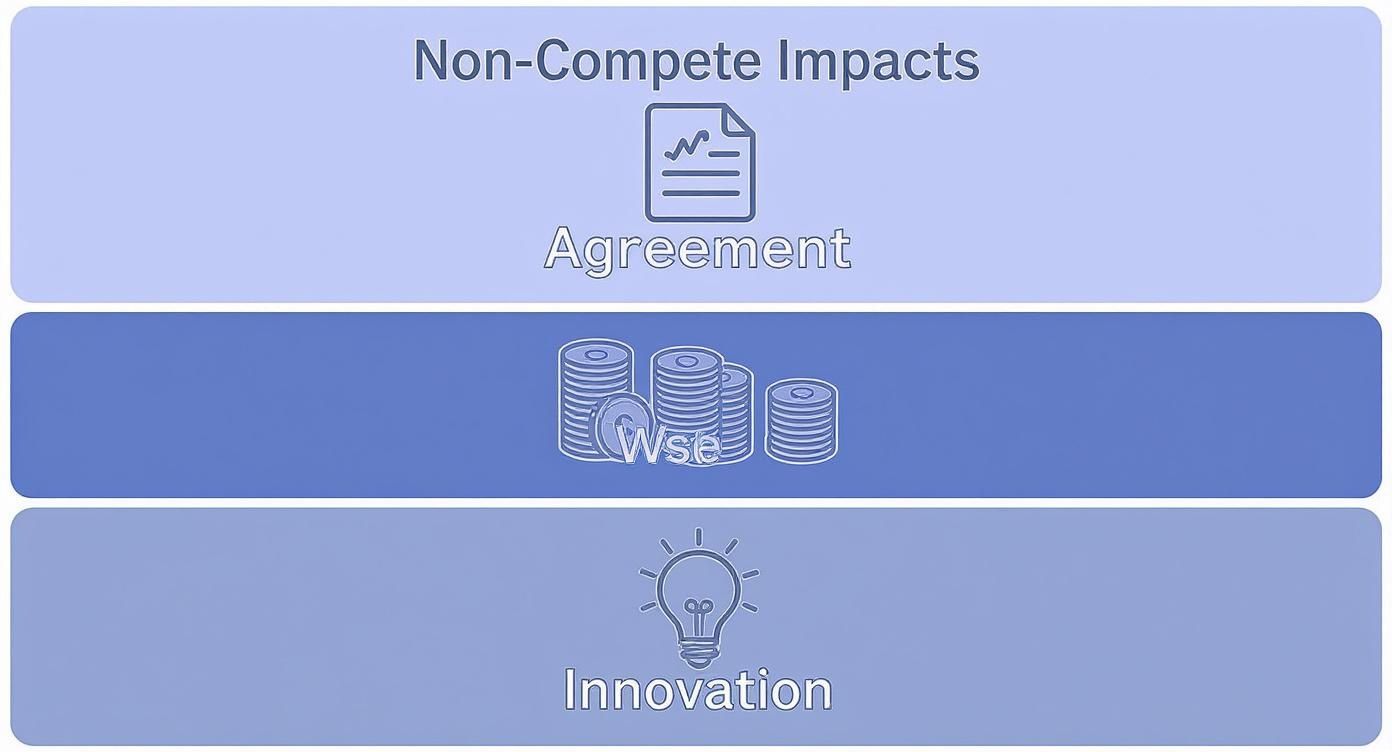
The visualization makes it clear: there’s a direct line connecting restrictive agreements, suppressed wages, and slowed innovation, highlighting the very real consequences of these contracts.
Salary Thresholds and Other Protections
Many states have found a middle ground. They aim to protect lower-wage workers while still letting companies use non-competes for higher-paid employees who have access to sensitive information. Their solution? Salary thresholds.
Put simply, if an employee earns less than a certain annual income, a non-compete is automatically void. States like Washington, Colorado, and Illinois have laws on the books that make these agreements unenforceable for workers who fall below specific wage levels, which are often adjusted for inflation.
The logic is straightforward: an employee earning a modest salary is less likely to possess true trade secrets and would suffer far greater hardship from being blocked out of the job market.
This isn’t just a trend in the United States. Many developed countries have adopted similar protections. In fact, several OECD nations, including Denmark and the Netherlands, have restricted non-competes to apply almost exclusively to high-level executives or those in specialized, knowledge-based roles.
Because this legal landscape is constantly shifting, companies must stay vigilant to remain compliant. Staying current on these rules is a critical part of how to master employment law for employers and avoid drafting unenforceable contracts. For employees, knowing your state’s rules—especially any salary thresholds—is your first and best line of defense. It empowers you to know if the document you’re signing has any legal teeth at all.
Comparison of Non Compete Laws in Key US States
The table below offers a quick look at how different states approach non-compete enforceability, highlighting key differences that employees and employers need to be aware of.
| State | General Stance on Non Competes | Key Restrictions (e.g., Salary Threshold) |
|---|---|---|
| California | Unenforceable | Near-total ban on non-competes for employees; considers them a restraint of trade. |
| Florida | Enforceable | Generally employer-friendly; courts will often modify an overly broad agreement to make it enforceable. |
| Texas | Enforceable (with conditions) | Must be part of another valid agreement and reasonable in scope, time, and geography. |
| Illinois | Enforceable (with thresholds) | Banned for employees earning $75,000 or less per year. |
| Colorado | Enforceable (with thresholds) | Banned for employees earning less than the state’s highly-compensated worker threshold (approx. $112,500 in 2023). |
| New York | Mixed | Generally enforceable if reasonable, but legislation to ban them is frequently considered. Not allowed for broadcasters. |
As you can see, where you work fundamentally changes the game. A non-compete that would be thrown out of court in California might be actively enforced just a state or two over, making it essential to understand the local legal environment.
Smarter Alternatives to Non-Compete Clauses
Too many employers reach for a non-compete agreement like it’s a sledgehammer—a blunt instrument for a delicate job. But in the world of high-stakes employment contracts, precision is everything. Smarter, more targeted agreements are almost always the better choice. They’re not only fairer to you, but they’re also viewed more favorably by the courts, which makes them far more likely to hold up if challenged.
Think of these alternatives as surgical tools. Instead of a blanket ban on your future, they’re designed to protect a company’s legitimate business interests—like its proprietary data or crucial client relationships—without sidelining your entire career. Knowing these options exist gives you immense leverage in any negotiation.
Protecting Information with Non-Disclosure Agreements (NDAs)
The most common and widely accepted alternative is the Non-Disclosure Agreement (NDA), sometimes called a confidentiality agreement. An NDA doesn’t stop you from working for a competitor. What it does do is create a legally binding promise that you won’t share, use, or profit from your former employer’s confidential information.
This is the perfect tool when a company’s main concern is protecting its “secret sauce.” That could be anything from:
- Proprietary software code or internal development processes.
- Customer lists and sensitive pricing data.
- Future product roadmaps and confidential marketing strategies.
- Manufacturing techniques or unique chemical formulas.
By focusing on the information itself, an NDA directly addresses the employer’s core concern without needlessly handcuffing your career. It protects their playbook without benching you for the entire season.
Guarding Relationships with Non-Solicitation Agreements
Another powerful and far less restrictive tool is the Non-Solicitation Agreement. This clause solves a completely different problem: it stops former employees from poaching clients or raiding their old team for talent.
A non-solicitation agreement typically has two distinct parts:
- Non-Solicitation of Customers: This prevents you from actively pursuing clients you worked with at your old job for a set period. You can still work in the same industry—you just can’t use your insider access to steal their established business.
- Non-Solicitation of Employees: This provision stops a departing employee from gutting their old department. It’s a stability measure, preventing a competitor from hiring away an entire team all at once.
A non-solicitation agreement essentially tells an employee, “You’re free to join a competitor, but you can’t use the relationships you built on our dime to dismantle our business or poach our team.” Courts often see this as a reasonable middle ground.
Bringing these alternatives up during a contract negotiation can shift the entire tone of the conversation. It shows you understand the company’s need to protect its assets while also advocating for your own career mobility. Proposing an NDA or a non-solicitation clause signals that you’re a reasonable partner looking for a fair solution, not just an employee trying to get out of a contract.
When You Should Talk to an Employment Lawyer
Trying to decipher a non-compete agreement can feel like navigating a legal maze blindfolded. Knowing when to bring in an expert isn’t an admission of defeat; it’s a smart, strategic move to safeguard your career and your financial stability.
Think of it this way: a proactive legal review is a small investment that can save you from enormous stress and catastrophic expense down the road. An employment lawyer can translate the dense legalese, pinpoint unfair or unenforceable clauses, and explain the real-world impact of the contract you’re being asked to sign.
Key Moments to Seek Legal Counsel
Certain situations should immediately raise a red flag, signaling that it’s time for professional advice. If you find yourself in any of the following scenarios, consulting an attorney who lives and breathes employment law is non-negotiable.
Here are the specific moments when you absolutely should make that call:
- Before You Sign Anything: The single best time to get advice is before your signature hits the paper. A lawyer can evaluate whether the agreement is even enforceable in your state and help you negotiate for more reasonable terms.
- The Agreement Seems Overly Broad: If the restrictions on geography, time, or scope of work feel excessive, they very well might be. An attorney can give you an honest assessment of whether a court would likely uphold such far-reaching terms.
- Your Role Involves Sensitive Information: For anyone working with trade secrets, proprietary software, or high-value client lists, the stakes are exponentially higher. Legal counsel is critical to fully grasp your obligations and potential liabilities.
- You Receive a Cease-and-Desist Letter: If a former employer sends a threatening letter after you’ve already started a new job, do not ignore it. Getting a lawyer involved immediately is crucial for crafting the right response and protecting yourself.
Viewing legal counsel as a strategic partner rather than a last resort can completely change the outcome. A small investment in a consultation upfront can prevent a costly and career-damaging legal battle later.
Knowing the right questions to ask a lawyer during a consultation will help you maximize the value of the meeting and ensure you find the right advocate to protect your interests.
Common Questions About Non-Competes
Even with a clear understanding of the basics, real-world situations often bring up tricky questions. Let’s break down some of the most common scenarios employees find themselves in when presented with a non-compete.
Can My Employer Make Me Sign a Non-Compete After I’ve Already Started Working?
This is a classic “gotcha” moment for many employees. An employer can ask you to sign a non-compete at any point, but whether it’s actually enforceable is another story. For any contract to hold up, both parties need to get something of value—a legal principle known as “consideration.”
When a non-compete is part of your initial offer letter, the job itself is the consideration. Simple enough. But if you’re already on the payroll, many states demand that your employer provide new consideration to make it valid. This can’t just be the promise of keeping the job you already have. It has to be something more, such as:
- A promotion or a meaningful raise
- A one-time cash bonus
- New stock options or equity grants
- Access to sensitive company trade secrets you didn’t have before
In states with this requirement, if your employer just slides a non-compete across your desk without offering anything new in return, a court could easily rule it unenforceable. The specific rules vary by state, so this is one area where local laws really matter.
What Really Happens If I Break the Agreement?
Violating a non-compete can have serious fallout, but it’s rarely an automatic penalty. What happens next depends heavily on your specific contract and whether your former employer decides to take legal action—a costly and time-consuming process for them.
The first move is almost always a cease-and-desist letter from their lawyer. This is a formal demand that you immediately resign from your new position. If that doesn’t work, the company might file a lawsuit. In court, they typically ask for two things:
- An Injunction: This is a court order forcing you to stop working for the competitor. It’s the most immediate and disruptive threat.
- Damages: They can also sue you for any money they claim to have lost because you breached the contract.
The injunction is the real weapon here, as it can pull the rug out from under you and force you out of a new job. That said, litigation is incredibly expensive, and many companies simply use the threat of a lawsuit as a scare tactic, hoping you’ll back down without them ever having to step inside a courtroom.
Is a Non-Compete Still Valid If I Was Laid Off or Fired?
This is where things get interesting, and again, state laws are key. Many judges are reluctant to enforce a non-compete against someone who was terminated without cause, like in a mass layoff. The logic is straightforward: it’s fundamentally unfair for a company to prevent you from working in your field after they’re the one who chose to end your employment.
However, if you were fired for cause—say, for poor performance, misconduct, or violating company policy—a court is much more likely to side with the employer and uphold the agreement. The contract itself might also have a clause specifying what happens in different termination scenarios. Some agreements state the non-compete applies no matter why you leave, but a judge still has the final say on whether that’s a reasonable restriction under the circumstances.
When facing complex legal challenges like a non-compete agreement, having an expert on your side is essential. The Haute Lawyer Network is a curated directory of the nation’s top attorneys, selected for their professional excellence. Find elite legal representation to protect your career and advocate for your rights.
Connect with a premier attorney on Haute Living’s Haute Lawyer Network today.