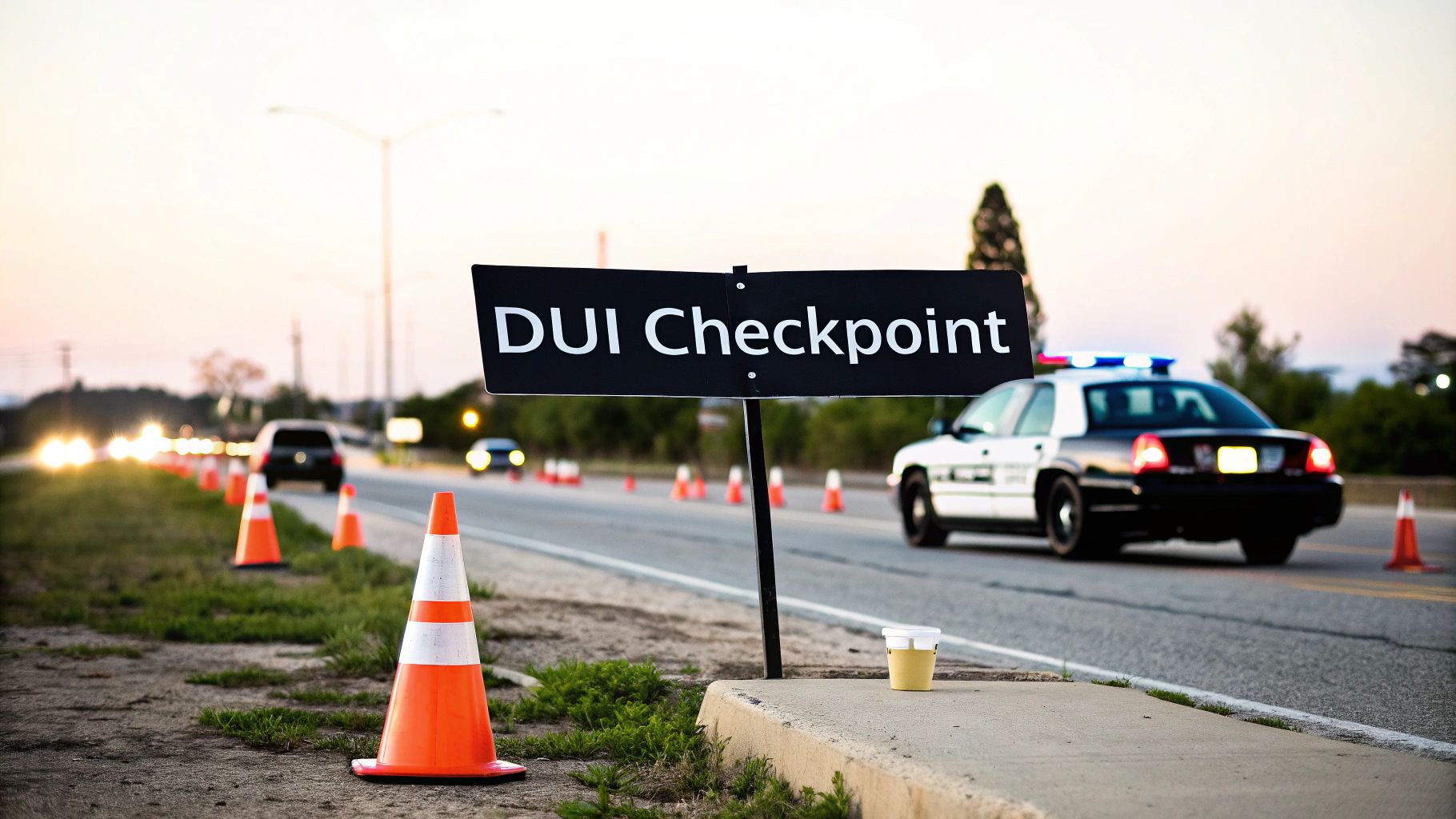
A DUI checkpoint, often called a sobriety checkpoint, is a temporary police roadblock where officers can briefly stop drivers to check for signs of alcohol or drug impairment. You can think of it as a quick, preventative safety screening on the road, aimed at deterring people from getting behind the wheel after drinking. The primary goal is to spot and remove potentially dangerous drivers before a tragedy occurs.
Understanding the DUI Checkpoint Process
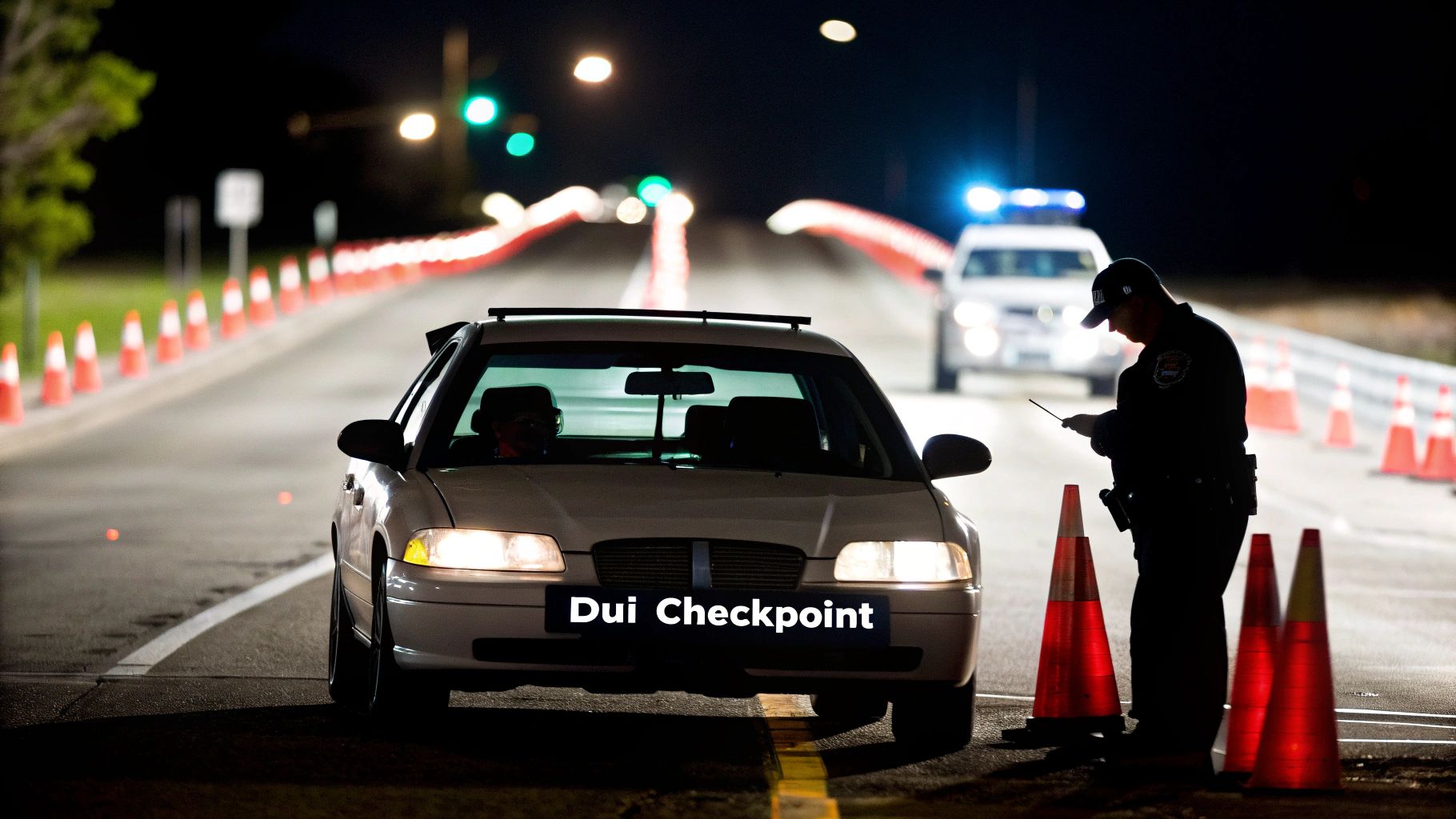
Imagine you’re driving late on a Saturday night and see a line of orange cones and flashing blue lights ahead. This is the classic setup. Unlike a typical traffic stop that requires an officer to have a specific reason—like speeding or a broken taillight—to pull you over, checkpoints operate differently. Here, police stop vehicles based on a predetermined, neutral pattern, like stopping every third or fifth car that comes through.
This approach is a highly targeted enforcement strategy. These temporary roadblocks became a key law enforcement tool after the Supreme Court’s landmark 1990 decision in Michigan Department of State Police v. Sitz. The ruling found them constitutional as long as they are conducted under specific guidelines that protect drivers’ rights. You can find more details on these official guidelines at NHTSA.gov.
To give you a clearer picture, let’s break down the essential components of a DUI checkpoint.
Key Elements of a DUI Checkpoint at a Glance
| Element | Purpose |
|---|---|
| Public Notification | Advance notice is often required to inform the public and maximize deterrence. |
| Visible Signage | Clearly marked signs and police presence to ensure safety and transparency. |
| Neutral Stopping Formula | A non-discriminatory method for selecting vehicles (e.g., every third car). |
| Brief Initial Contact | The initial interaction is kept short to minimize intrusion for sober drivers. |
| Safe Screening Area | A designated, well-lit area for any further investigation or sobriety tests. |
| Supervisory Oversight | Conducted under a pre-approved plan with a supervisor on-site. |
This structure ensures the checkpoint operates within legal boundaries while serving its public safety mission.
The Initial Stop and Screening
When you’re waved to a stop, an officer will approach your window for a very brief interaction. This is essentially a quick screening. As they ask for your license and registration, they are trained to look for tell-tale signs of impairment.
These signs include:
- The distinct smell of alcohol or marijuana.
- Slurred speech or difficulty answering simple questions.
- Bloodshot, watery eyes.
- Fumbling to get your license and registration.
- Any visible open containers of alcohol in the car.
The entire encounter is designed to be minimal. If the officer sees no red flags, you’ll likely be on your way in a minute or two. The point isn’t to inconvenience sober drivers; it’s to keep the roads safe.
The core purpose of a DUI checkpoint is deterrence. By publicizing these operations, law enforcement hopes to discourage people from driving after drinking in the first place, making the roads safer for everyone.
When Further Investigation Is Needed
If that initial contact raises suspicion, the officer will ask you to pull your car into a designated secondary screening area, away from the flow of traffic. Here, the investigation becomes more thorough.
This is the point where an officer might ask you to step out of the vehicle to perform Standardized Field Sobriety Tests (SFSTs). It’s also where questions about police authority often come up, such as when can a police officer search your car. This secondary evaluation is what determines whether the officer has probable cause to make a DUI arrest.
The Legal Framework for Sobriety Checkpoints
On its face, a DUI checkpoint seems to fly in the face of a core American right. The Fourth Amendment is clear: it protects us from “unreasonable searches and seizures.” Usually, that means police need a specific reason—probable cause—to believe you’ve broken the law before they can pull you over. So how can they stop every car in a line without any suspicion at all?
That very question is at the heart of the legal tightrope police walk when they set up a checkpoint. The answer comes from a landmark 1990 U.S. Supreme Court case, Michigan Dept. of State Police v. Sitz. In its decision, the Court had to balance two competing interests: the government’s duty to stop drunk driving and the minor inconvenience a brief stop causes to motorists.
The Court ultimately decided that the immense public safety benefit of getting impaired drivers off the road outweighed the slight intrusion on sober drivers. With that, sobriety checkpoints were ruled constitutional. But this approval wasn’t a blank check. It came with a critical condition: every checkpoint must follow strict, standardized guidelines to be legal.
The Constitutional Guardrails of a Checkpoint
A sobriety checkpoint can’t be a random, free-for-all operation. To pass legal muster, law enforcement agencies have to follow specific procedures designed to limit the discretion of individual officers and protect drivers’ rights. These aren’t just suggestions; they are constitutional mandates.
If police don’t follow the rules, any evidence they collect—including a DUI arrest—can be challenged and potentially thrown out of court. A sharp defense attorney will dissect every detail of the checkpoint’s operation, looking for procedural flaws.
Key requirements for a constitutional DUI checkpoint include:
- Advance Public Notice: Many states mandate that law enforcement announce checkpoints ahead of time. You’ll often see these announcements in press releases or on social media, detailing the general area and date to maximize the checkpoint’s deterrent effect.
- A Neutral Stopping Formula: Officers can’t just pick and choose cars based on a hunch or the type of vehicle. They must stick to a pre-approved, non-discriminatory pattern, like stopping every third car or every vehicle for a set period.
- Minimally Intrusive Stops: The initial stop has to be quick. The officer’s interaction should be brief and focused solely on spotting signs of impairment, allowing sober drivers to move on with minimal delay.
- Clear and Visible Signage: The checkpoint area must be clearly marked with signs, lights, and uniformed officers. This is crucial for driver safety and transparency, ensuring motorists aren’t confused or unnecessarily alarmed.
These rules create a framework that balances the need for public safety with our individual liberties, keeping checkpoints from becoming a tool for baseless searches.
The Role of Supervisory Oversight
Here’s another critical piece: the entire checkpoint must be planned and approved by supervisory personnel, not just the officers on the road. This formal plan has to lay out the location, time, duration, and the exact neutral formula for stopping cars.
The presence of a clear, pre-approved operational plan is non-negotiable. It ensures the checkpoint is conducted systematically and fairly, preventing it from becoming an unconstitutional free-for-all where officers can stop anyone they choose.
This top-down planning is essential for the checkpoint’s legitimacy if it’s ever challenged in court. Without it, the whole operation could be deemed illegal. And as laws and interpretations shift, staying current on things like the new DUI laws of 2025 is crucial for understanding how these frameworks might evolve. In the end, every single detail matters—from the first public announcement to the last car waved through.
Navigating Your Rights During a Checkpoint Stop
When you see the flashing lights of a DUI checkpoint, knowing your rights is your single greatest asset. It’s an intimidating situation for anyone, but staying calm and informed is the key to protecting yourself without making things worse. This isn’t about being difficult; it’s about understanding the legal lines that both you and the police are required to follow.
The initial conversation with an officer is meant to be quick. You are required by law to provide your driver’s license, vehicle registration, and proof of insurance. Hand them over without any fuss. After that, your obligation to talk generally ends.
Keep in mind, officers are trained to ask seemingly innocent questions to get you talking. “Where are you headed?” or “Have you had a couple of drinks tonight?” aren’t just casual conversation—they’re investigative questions. Answering them can hand the prosecution the exact evidence they need.
Your Right to Remain Silent
Your Fifth Amendment right against self-incrimination is just as valid at a DUI checkpoint as it is anywhere else. You have a right to remain silent, and it’s a right you should use.
A clear, respectful statement is all you need. Something like, “Officer, I am choosing to remain silent and would like to speak with an attorney,” is a powerful legal move. It invokes your constitutional protections and should end the questioning. You don’t need to explain yourself, argue, or get defensive. Just state it and stay quiet.
While you must hand over your documents, you are under no obligation to answer questions about where you’ve been or what you’ve been doing. Politely declining to answer is not an admission of guilt—it’s a constitutional right.
This is a critical boundary to maintain. A surprising number of DUI cases are built almost entirely on the driver’s own statements. By staying silent, you take away one of the prosecution’s most valuable tools.
Field Sobriety Tests Are Voluntary
If an officer suspects you’ve been drinking, they’ll likely ask you to get out of the car for Standardized Field Sobriety Tests (SFSTs). These are the roadside balance and coordination tests everyone’s seen on TV—walking a line, standing on one leg, and following a penlight with your eyes.
Here’s the most important thing to know: in the vast majority of states, these roadside tests are completely voluntary. You have the right to politely refuse them.
Why would you refuse?
- They’re subjective. The officer’s opinion is what counts, and factors like nerves, physical limitations, or just a lack of coordination can easily be misinterpreted as impairment.
- They’re designed to be failed. These tests are incredibly difficult for even a perfectly sober person to perform under ideal conditions, let alone on the side of a dark road with traffic flying by.
- You’re giving them evidence. Performing these tests is like participating in an investigation against yourself. Every stumble or misstep will be noted and used against you.
You can simply say, “I politely decline to perform any field sobriety tests.” Refusing doesn’t mean you won’t be arrested—an officer might still make an arrest based on other observations. However, your refusal to perform these unreliable tests cannot be used to suspend your license, and it leaves the prosecution with a much weaker case.
The Critical Difference: Implied Consent
This is where things get tricky, and the distinction is absolutely vital. Refusing a pre-arrest field sobriety test is very different from refusing a post-arrest chemical test. Every state has “implied consent” laws.
By accepting a driver’s license, you have automatically given your consent to a chemical test (like a breathalyzer, blood, or urine test) after you have been lawfully arrested for a DUI.
Let’s break it down:
| Action | When It Happens | Legal Consequence of Refusal |
|---|---|---|
| Refuse Field Sobriety Tests | Before a lawful arrest is made. | Generally no direct penalty, like license suspension. |
| Refuse Chemical Test | After a lawful arrest. | Immediate and severe penalties, including automatic license suspension. |
Refusing a chemical test after you’re in custody triggers serious consequences. Most states will automatically suspend your license for a year or more, and this happens whether or not you’re ever convicted of the DUI. It’s a separate administrative penalty that runs parallel to the criminal case.
While you can physically refuse the test, the fallout from that refusal is often worse than a first-time DUI conviction. Understanding this difference is crucial for making the right call in a high-stakes moment.
How Checkpoint Laws Vary Across the Country
While the Supreme Court has given DUI checkpoints a federal thumbs-up, that’s not the end of the story. The reality on the ground is a complex patchwork of state laws, reflecting a deep divide on how to balance public safety with your individual rights.
What’s perfectly legal for police in one state could be an unconstitutional overreach just a few miles across the border. A dozen states have essentially told the federal government, “Thanks, but no thanks,” deciding that their own state constitutions offer stronger protections against unreasonable searches. This is where knowing your local laws becomes critical.
The Checkpoint Divide: Where They’re Allowed vs. Where They’re Forbidden
The map of DUI enforcement is anything but uniform. Here’s the breakdown: 38 states and the District of Columbia currently permit law enforcement to conduct sobriety checkpoints, following the federal precedent.
But in 12 states, these roadblocks are a non-starter. Their legislatures or state supreme courts have decided that stopping drivers without any specific suspicion of wrongdoing goes a step too far.
To make this crystal clear, here’s a quick overview of which states allow checkpoints and which have put a stop to them.
DUI Checkpoint Legality by State
| State Status | List of States |
|---|---|
| Permitted | Alabama, Arizona, Arkansas, California, Colorado, Connecticut, Delaware, Florida, Georgia, Hawaii, Illinois, Indiana, Kansas, Kentucky, Louisiana, Maine, Maryland, Massachusetts, Mississippi, Missouri, Nebraska, Nevada, New Hampshire, New Jersey, New Mexico, New York, North Carolina, North Dakota, Ohio, Oklahoma, Pennsylvania, South Carolina, South Dakota, Tennessee, Utah, Vermont, Virginia, West Virginia |
| Prohibited | Alaska, Idaho, Iowa, Michigan, Minnesota, Montana, Oregon, Rhode Island, Texas, Washington, Wisconsin, Wyoming |
If you’re in one of the 12 states on the “prohibited” list, you won’t run into a pre-planned sobriety roadblock. That doesn’t mean you’re off the hook, though. Police are still on the lookout for signs of impairment—like swerving or erratic speeding—and can pull you over based on that reasonable suspicion.
Why Some States Rely Heavily on Checkpoints
So why do some states embrace checkpoints so enthusiastically? It often comes down to staggering statistics and a belief that these operations are an indispensable public safety tool, especially during high-risk holidays.
Nationally, alcohol is a tragic factor in 32% of all traffic fatalities. But some states see even grimmer numbers. Texas, for instance, leads the nation with 42% of its traffic deaths being alcohol-related, totaling 1,869 deaths. California isn’t far behind at 33% (1,479 deaths), followed by Florida at 27% (940 deaths).
These aren’t just numbers; they represent lives lost and families destroyed. This is why you see intensified campaigns like California’s “Drive Sober or Get Pulled Over,” especially around deadly periods. In December 2023 alone, there were 1,038 drunk driving deaths nationwide. If you want to dig deeper, you can review the full study on drunk driving in the U.S. to understand the data driving these enforcement decisions.
Knowing your rights is your best defense. This graphic breaks down the essentials.
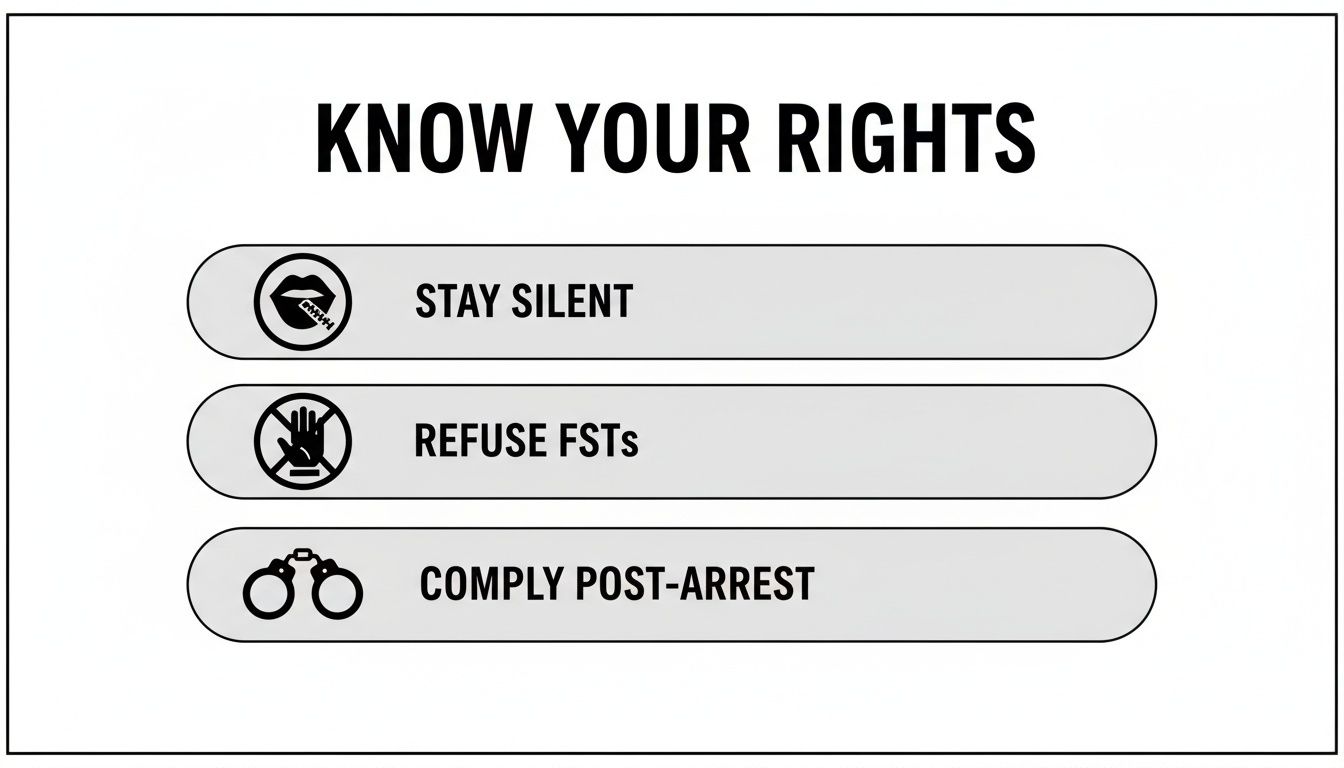
It’s a simple visual guide that shows the crucial difference between your rights before an arrest (like refusing field sobriety tests) and your obligations after an arrest under implied consent laws.
The core takeaway is this: Checkpoint legality is determined at the state, not federal, level. The dramatic differences in state laws mean drivers must be aware of the specific rules that apply wherever they are driving.
This regional variation is exactly why understanding “what is a DUI checkpoint” is about more than just the procedure—it’s about knowing the law where your tires meet the road. The debate over their effectiveness versus their intrusiveness isn’t going away anytime soon, ensuring this legal divide will likely be a feature of American roadways for years to come.
The Immediate Aftermath of a Checkpoint Arrest
Being arrested at a DUI checkpoint throws you into an immediate and confusing legal battle. It’s not one fight, but two, fought on separate fronts at the same time. The moment you’re taken into custody, both a criminal case and an administrative process kick off, and you have to deal with both.
The first stop is the police station for booking. They’ll take your fingerprints and mugshot and formally record the charges. This is also when the officer will demand you take a chemical test—usually breath or blood—as required by your state’s implied consent laws.
This is that critical moment we talked about earlier. Refusing this post-arrest test triggers harsh and immediate administrative penalties, no matter what happens with the DUI charge later.
The Two-Front Legal Battle You Face
What trips most people up is that the Department of Motor Vehicles (DMV) and the criminal court are two completely separate worlds. They don’t talk to each other, and you have to fight them both simultaneously.
- The Administrative Case (DMV): This is your most immediate problem. The DMV’s case moves lightning-fast and is focused on one thing only: your driver’s license. If you refused the chemical test or your BAC was over the limit, you’re facing an automatic driver’s license suspension. You typically have just a handful of days to request a hearing to fight it.
- The Criminal Case (Court System): This is the formal DUI charge that will wind its way through the courts. It involves hearings, motions, and maybe even a trial. The goal here is to avoid a criminal conviction, which comes with penalties like fines, jail time, mandatory alcohol education, and a permanent criminal record.
The DMV can suspend your license long before your criminal case ever sees the inside of a courtroom. If you miss the deadline to request that DMV hearing, you lose your license—even if you’re eventually found not guilty of the DUI.
This dual-track system means you have to act fast. You can’t afford to wait for your court date to think about your license, because by then it will be too late.
Your First Court Appearance
Your first time in front of a judge is called an arraignment. It’s a very brief hearing where the prosecutor will formally state the charges against you, and you’ll be asked to enter a plea. Your options are usually “guilty,” “not guilty,” or “no contest,” and pleading “not guilty” is almost always the right move at this point.
This isn’t a trial; it’s just the procedural starting gun. The judge will also set your conditions for release, which might involve posting bail or simply promising to show up for your next court date. Having an attorney with you, even at this early stage, is critical.
A lawyer can enter the plea for you, make sure your rights are being protected, and start demanding evidence from the prosecution. Most importantly, they will immediately get to work managing the tight deadlines for both your DMV hearing and the criminal case. The decisions you make in the first 24 to 48 hours after a checkpoint arrest are absolutely crucial and can shape the entire outcome of your case.
Why an Experienced DUI Attorney Is Essential

If you’re facing a DUI charge from a sobriety checkpoint, this isn’t a battle you should fight alone. The legal maze is intricate, and one wrong turn can haunt you for years. An experienced DUI attorney is your most critical asset, ready to turn defense into a powerful offense.
Going it alone is a high-stakes gamble. A skilled lawyer knows the legal terrain inside and out, spotting weaknesses in the prosecution’s case that you would never see. Their job is to dismantle the entire arrest, piece by piece.
Often, their first target is the checkpoint itself. Was it even legal? They’ll scrutinize every detail, from whether the public was properly notified to whether the officers followed the required neutral formula for stopping cars. Any misstep here could invalidate the entire stop.
Challenging the Evidence and Procedures
Beyond the checkpoint’s legality, a sharp DUI lawyer meticulously examines the arresting officer’s conduct. They’ll comb through the police report and bodycam footage, ensuring every protocol was followed to the letter. Did the officer truly have reasonable suspicion to pull you aside for a full investigation?
This deep dive extends to the evidence itself. Field sobriety tests are notoriously unreliable and can be challenged for countless reasons, from bad weather to a person’s underlying medical conditions. And those chemical tests? They aren’t as foolproof as they seem.
A top attorney will immediately question:
- Breathalyzer Accuracy: Was the machine properly calibrated and maintained? Was the test administered correctly by the officer?
- Blood Test Integrity: Was the chain of custody for the blood sample flawless? Any break in that chain could mean contamination and an invalid result.
A DUI attorney’s role isn’t just to argue your innocence. It’s to hold the entire system accountable and ensure your constitutional rights were upheld at every single step.
Protecting Your Career and Future
For professionals, the stakes of a DUI conviction are amplified. Licensing boards can launch investigations, putting your career and reputation on the line. An attorney’s work extends far beyond the courtroom, as they strategically work to minimize these professional repercussions and protect your livelihood. We detail many of these long-term consequences in our comprehensive DUI first offense guide.
By uncovering procedural mistakes and challenging flimsy evidence, a lawyer can often get charges significantly reduced or dismissed altogether. Think of their expertise not as an expense, but as a critical investment in protecting your freedom, your license, and your future.
Answering Your Top Questions About DUI Checkpoints
When you see those flashing lights and a line of cars ahead, a lot of questions can race through your mind. Let’s clear up some of the most common uncertainties drivers have about sobriety checkpoints.
Do Police Have to Announce DUI Checkpoints Beforehand?
Yes, in almost every state where checkpoints are legal, advance publicity is a constitutional requirement. This might seem counterintuitive, but the stated goal of these stops is to deter drunk driving, not just to rack up arrests. You’ll often see law enforcement agencies put out press releases or post on their social media channels about the general time and area of a checkpoint, though they won’t give away the exact street corner.
Can I Legally Turn Around to Avoid a Checkpoint?
You absolutely can, but there’s a major catch: you must obey every single traffic law while doing so. You can’t pull an illegal U-turn, speed away, or cut across a median.
Be aware that officers are specifically positioned to watch for cars that abruptly turn off the road. A sudden, suspicious-looking maneuver or any traffic violation gives an officer reasonable suspicion to pull you over, completely separate from the checkpoint itself.
What’s the Difference Between Refusing a Field Sobriety Test and a Chemical Test?
This is probably one of the most critical distinctions to understand, and getting it wrong has serious consequences.
Refusing a pre-arrest field sobriety test—like the walk-and-turn or one-leg stand—is your right in most states. Declining to perform these tests typically carries no direct legal penalty, though the officer will certainly note your refusal.
Refusing a chemical test (breath or blood) after you’ve been lawfully arrested is an entirely different story. Every state has “implied consent” laws, which mean that by having a driver’s license, you’ve already agreed to submit to this test if lawfully arrested for DUI. A refusal triggers an immediate and often lengthy suspension of your driver’s license. This administrative penalty happens regardless of what happens in your criminal DUI case and can be more severe than the penalties from the case itself.
If you’re an attorney specializing in DUI defense, your expertise deserves a platform that reaches the right audience. The Haute Lawyer Network connects elite legal professionals with high-net-worth individuals actively seeking top-tier representation. Elevate your brand and visibility by joining our curated network. Learn more and apply at Haute Living’s Lawyernetwork.