
When your business crosses a border, so does your legal risk. Suddenly, you’re not just dealing with one set of rules—you’re playing a complex game where the laws, regulations, and even cultural norms change with every new jurisdiction. This is where an international lawyer becomes your most critical asset.
They are the specialists who understand the intricate connections between different countries’ legal systems, guiding businesses and individuals through the maze of cross-border transactions, global trade, and international disputes. Their job is to ensure your ventures succeed without getting tangled in foreign legal red tape.
Your Expert Guide in a Globalized World
Think of it like this: expanding internationally is like trying to navigate a foreign city where all the road signs are in a language you don’t speak, traffic laws are completely different, and you’re expected to drive on the opposite side of the road. An international lawyer is the local expert in your passenger seat, translating the rules and charting the safest, most efficient route forward.
Their expertise isn’t in some mythical, one-size-fits-all “international law.” Instead, their real value lies in understanding how the distinct laws of multiple nations interact and often conflict. They help you anticipate problems, seize opportunities, and resolve conflicts that are an inevitable part of operating on a global scale. It’s a role that demands a rare mix of legal precision, cultural fluency, and high-level strategic thinking.
At a Glance: What International Lawyers Do
To make it concrete, here’s a quick look at how an international lawyer’s work directly impacts their clients’ success.
| Core Function | What It Means for You | Example |
|---|---|---|
| Advisory & Strategy | Proactive guidance to prevent legal headaches before they happen. | Structuring a new investment in Europe to comply with both EU and local tax laws, saving you from future penalties. |
| Transactional Work | Facilitating deals that cross borders, like mergers, acquisitions, or financing. | Drafting and negotiating a merger agreement between a U.S. tech firm and a German manufacturer that is legally binding and enforceable in both countries. |
| Dispute Resolution | Representing your interests when conflicts arise with a foreign partner, customer, or government. | Managing an international arbitration case to resolve a supply chain dispute privately, avoiding a lengthy and public court battle in a foreign country. |
Their role is far more than just legal advice; it’s about building a stable bridge between different legal and commercial worlds, allowing your business to move forward with confidence.
So, what does that look like day-to-day? Their work generally falls into three key areas:
- Proactive Counsel: They’re the ones you call before you sign the deal. They help structure international investments, ensure a new product meets foreign safety standards, or advise on data privacy laws like GDPR before you launch a website in Europe.
- Cross-Border Deals: When you’re buying a foreign company or entering a joint venture, they’re in the trenches. They draft and negotiate complex contracts designed to hold up in multiple legal systems, protecting your interests no matter where a problem might arise.
- Conflict Resolution: If a dispute occurs, they are your champion. This often means turning to international arbitration—a neutral, private forum to settle disagreements without being subject to the whims of a single country’s court system.
In short, an international lawyer is the strategic partner who translates global legal complexity into a clear, actionable plan, ensuring your international ambitions are built on a solid legal foundation.
The Core Practice Areas of a Global Lawyer
The term “international law” is a bit of a misnomer. It’s not a single, giant rulebook for the world. Instead, think of it as a collection of highly specialized fields, much like a doctor might focus on cardiology or neurology. An international lawyer operates at the intersection of these fields, where global and local laws collide.
Understanding their core practice areas is the best way to see what these legal experts actually do day-to-day. At its heart, their job is to guide clients through overwhelming complexity to get a specific result. They are the architects who build a secure legal bridge, allowing people, capital, and ideas to move confidently between different countries and legal systems.
This flowchart breaks down their primary functions: managing risks, seizing opportunities, and solving problems across borders.
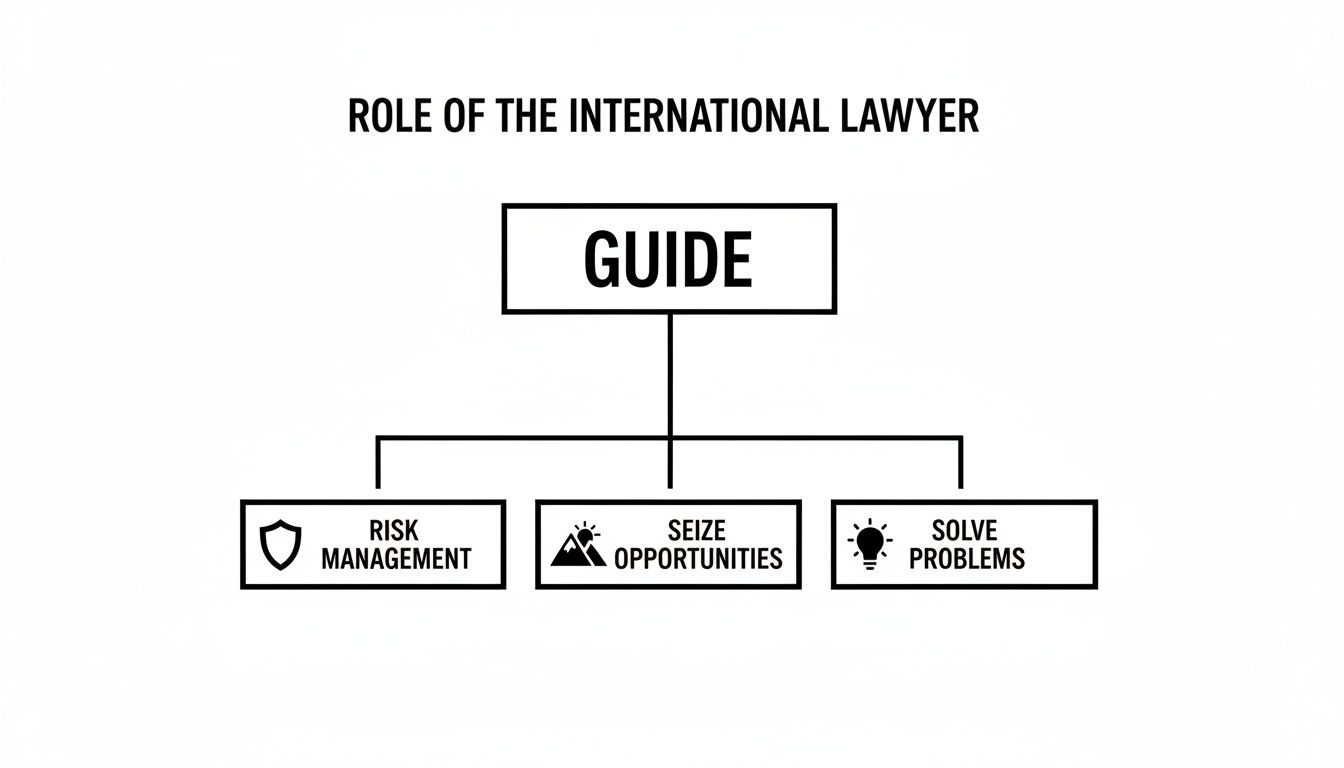
Let’s dive into the most common specialties.
Navigating Cross-Border Transactions and M&A
One of the most high-stakes arenas for any global lawyer is cross-border mergers and acquisitions (M&A). Imagine a U.S. tech company wants to buy a promising German engineering firm. This isn’t just a simple purchase; it’s a minefield of competing legal systems. You’re suddenly dealing with German labor laws, EU competition regulations, and U.S. securities requirements all at once.
The international lawyer is the architect of the entire deal. Their team conducts due diligence to uncover any hidden liabilities in the German company, structures the acquisition to be tax-efficient in both nations, and drafts a sale agreement that’s actually enforceable under both German and American law. They ensure the transaction is not just profitable but legally bulletproof from start to finish.
Mastering International Trade Law
International trade is the lifeblood of the global economy, but it’s governed by a tangled web of treaties, tariffs, and obscure regulations. A lawyer specializing in trade law helps businesses move their goods across borders without getting snagged in red tape.
Say a U.S. company wants to export agricultural products to Asia. They’re immediately hit with a barrage of questions:
- What are the import duties and taxes in each destination country?
- Do our products meet local health and safety standards?
- Is there a trade agreement we can use for preferential treatment?
A trade lawyer provides the answers. They ensure compliance with bodies like the World Trade Organization (WTO) and help clients navigate trade barriers that could otherwise cripple their expansion plans. For any company with a global supply chain, they are indispensable.
The global legal services market is on track to hit $1,052.27 billion by 2029, growing at a 5.5% annual clip. This surge is fueled by the exact complexities we’re talking about—geopolitical risks and shifting regulations are making expert legal guidance more critical than ever before.
Ensuring Global Compliance and Risk Management
For any multinational corporation, operating in dozens of countries means juggling dozens of different legal regimes. This is where a specialist in global compliance comes in. Their job is to create and enforce internal policies that meet the legal standards everywhere the company does business.
Anti-corruption law is a perfect example. A compliance lawyer ensures a company’s sales practices in Brazil don’t run afoul of the U.S. Foreign Corrupt Practices Act (FCPA) or the UK Bribery Act. This isn’t just about writing a memo; it involves training employees, monitoring transactions, and investigating potential issues to head off massive fines and reputational ruin.
Resolving Disputes with International Arbitration
When a contract breaks down between companies from two different nations, whose court gets to decide the case? To sidestep this messy and unpredictable problem, businesses increasingly rely on international arbitration. It’s a private, neutral forum for resolving disputes outside of traditional court systems.
For example, if a Japanese construction firm and a Brazilian energy company have a dispute over a project in a third country, an international arbitration lawyer will represent one side in a neutral location like London or Singapore. The final decision is legally binding and, thanks to international treaties, is often far easier to enforce across borders than a typical court judgment. On a related note, while the scope is different, some lawyers apply similar cross-border expertise to individuals moving between countries. For more on that, you might be interested in our look at the work of an immigration lawyer.
A Day in the Life of an International Lawyer
Knowing the practice areas is one thing, but what does an international lawyer actually do all day? Forget dusty law books and quiet offices. The reality is a fast-paced mix of high-stakes strategy, crisis management, and intense communication, all while juggling a half-dozen time zones.
No two days ever look the same, but they all share one common thread: managing the friction that inevitably arises when different laws, cultures, and business practices collide.

The day often starts before the sun is up with a video call to Tokyo. The agenda? Finalizing a critical due diligence report with local counsel for a nine-figure corporate acquisition. Being an international lawyer means your clock is the world’s clock; early mornings and late nights are just part of the job.
Bridging Legal and Cultural Divides
A huge part of what an international lawyer does is act as a translator—not just of language, but of entire legal philosophies. They might spend half the morning drafting a single contract clause that needs to be ironclad under both New York’s common law and France’s civil code. These aren’t just different rulebooks; they’re fundamentally different ways of thinking about law.
The precision required is immense. They have to predict how a judge in Paris and another in New York might interpret the exact same phrase, ensuring their client is protected no matter where a dispute lands.
From there, the focus might pivot to a global compliance issue. A multinational client needs to align its data privacy practices with both the EU’s GDPR and California’s CCPA. This isn’t a simple memo. It means they’ll be:
- Auditing internal policies to spot the gaps between what the company does and what the law demands.
- Drafting new privacy notices tailored for different regional websites.
- Working directly with IT departments to make sure the right technical safeguards are actually in place.
An international lawyer is the central hub of a global network. They don’t just know the law; they manage critical relationships with specialized local experts in dozens of countries, delivering seamless advice on the ground.
From High-Stakes Negotiation to Crisis Management
The afternoon could be consumed by preparations for an international arbitration hearing. This is where the real battle lines are drawn. It involves drafting pages of intricate legal arguments, sifting through thousands of documents for that one piece of killer evidence, and coaching the client on negotiation tactics. These aren’t small claims—they’re often multimillion-dollar disputes that can make or break a company.
Then, the phone rings. It’s an emergency. A client’s shipment is stuck at a foreign port, impounded by customs because of a new trade regulation that wasn’t even announced. The lawyer has to drop everything, get their local contacts on the line, decipher the new rule, and map out the fastest way to get the goods moving.
This is the reactive, problem-solving side of the job that requires a cool head under extreme pressure. The day usually winds down by catching up on emails from European colleagues, already preparing for tomorrow’s set of cross-border challenges.
Skills That Define an Elite International Lawyer
Technical legal knowledge is just the ticket to the game. What separates a competent international lawyer from a truly elite one is a far more nuanced skill set, honed over years of navigating high-stakes global environments.
The best in this field are more than just legal technicians; they are strategists, diplomats, and cultural interpreters rolled into one. They have to seamlessly pivot between these roles to protect their client’s interests when millions, or even billions, are on the line.
Beyond the Law Books: Core Competencies
The most critical skills for an international lawyer are rarely found in a textbook. They’re forged in the fire of complex cross-border negotiations and disputes.
These core competencies include:
- Exceptional Cross-Cultural Communication: This is much deeper than just language fluency. It’s knowing that the way you close a deal in Tokyo is completely different from how you do it in Texas. A failure to grasp these subtle cultural cues can kill a deal faster than any legal mistake.
- Sharp Negotiation and Diplomacy: When parties from different legal systems and cultures come to the table, an aggressive, head-on negotiation style often backfires. Elite lawyers know how to build consensus and find common ground, acting as a diplomatic bridge between clashing commercial worlds.
- Geopolitical and Economic Acumen: Top-tier international lawyers don’t operate in a legal vacuum. They are students of shifting political alliances, trade tensions, and global economic trends. This allows them to give proactive advice that anticipates risks and opportunities before they materialize.
These foundational abilities are just the start. For a deeper dive into the qualities that make any lawyer stand out from the pack, see our guide on the traits of top legal minds.
Advanced Qualifications and Modern Adaptability
Many of the world’s most respected international lawyers hold advanced degrees, like an LL.M. in International Law, which offers specialized training in areas like international arbitration or trade. These credentials signal a serious commitment to the craft and a sophisticated grasp of global legal frameworks.
But the ground is shifting. Technology and AI are fundamentally reshaping how legal services are delivered, automating routine work and putting a massive premium on high-level strategic counsel.
A recent KPMG analysis predicts that lawyers will soon be a minority on legal teams, working alongside data scientists and operations specialists. With 54% of attorneys believing a talent shortage will impact their firms, those who blend deep legal expertise with tech fluency will own the future.
This evolution means the most valuable international lawyers are those who can provide specialized, strategic guidance that technology simply can’t replicate.
How to Hire the Right International Lawyer
Picking a legal partner for your global ambitions isn’t just another item on a checklist—it’s one of the most critical decisions you’ll make. The right international lawyer is your shield against hidden liabilities and your guide through unfamiliar legal territory. This isn’t about a quick Google search; it’s about finding a true strategic partner.

You’re not just hiring someone with a law degree. You need an expert whose experience, network, and communication style are a perfect match for your specific goals—someone who gets both the law and the unique commercial and cultural realities of your situation.
Vetting Potential Candidates
Once you have a shortlist, it’s time to dig in. This is where you separate the talkers from the doers by asking pointed, specific questions designed to reveal their real-world experience handling cross-border matters.
Start by zeroing in on their direct experience in the countries that matter to your case. For instance, if you’re launching in Brazil, you need to hear about their recent work there, not just their general international practice.
Your questions need to cover a few key areas:
- Jurisdictional Experience: “Tell me about a recent case you handled involving [Country X]. What were the key legal hurdles, and how did you navigate them?”
- Foreign Counsel Network: “How do you choose and manage local lawyers in other countries? Describe your relationship with your contacts in [Region Y].”
- Cross-Border Case Management: “Walk me through your process for managing an international dispute. How do you keep clients in the loop across different time zones?”
A great international lawyer won’t just say they have a global network; they’ll show you how they use it. They should speak with confidence about specific firms or individual lawyers on the ground, proving they have a well-established and trusted web of contacts.
Listen carefully to their answers. Vague responses are a major red flag and suggest a lack of hands-on experience.
Understanding Fee Structures and Value
Of course, cost matters. But in the world of international law, the goal is to find real value, not just the lowest price. Hiring a cheaper, less experienced lawyer can easily backfire, costing you far more in the long run when mistakes happen.
Interestingly, recent legal market reports show that while the biggest global firms now bill well past the $1,000 per hour mark, many companies are finding comparable talent at specialized midsize firms for closer to $600 per hour. The takeaway? Savvy clients are prioritizing proven efficiency and direct expertise over a big firm name, especially for routine or mid-level international work.
Common Red Flags to Watch For
Knowing what to avoid is just as important as knowing what to look for. Certain warning signs can tell you a lawyer isn’t equipped to handle the complexities of your international needs.
Be on high alert for these red flags:
- Lack of Direct Experience: They speak in generalities about “international law” but can’t point to specific, relevant cases in the country or region you’re dealing with.
- Poor Communication: They’re slow to respond, hide behind dense legal jargon, or seem disorganized. In a fast-moving global case, clear and timely communication is everything.
- A “One-Person Show” Mentality: They lack a clear network of foreign counsel and imply they can handle it all themselves. This is a classic sign of inexperience—all good international work relies on collaboration with local experts.
Finding the right legal partner is a crucial first step. If you’re looking for more general advice on what makes a great attorney, you might find our guide on how to choose a good lawyer helpful.
Common Questions About International Law
Even with a clear picture of their role, people often have lingering questions about what an international lawyer actually does. The profession is frequently misunderstood, thanks in no small part to its portrayal in film and media as a world of high-stakes diplomacy.
Let’s cut through the confusion and address some of the most common questions with direct, practical answers. Getting these details right is critical when you’re deciding if you need this kind of specialized legal expertise for your business.
Do International Lawyers Argue Cases at The Hague?
This is probably the biggest misconception out there. While a small, elite group of public international lawyers do argue cases involving war crimes or disputes between nations at courts like the International Court of Justice (ICJ) in The Hague, that’s not the reality for the vast majority of the profession.
Most international lawyers work in the private sector. Their “courtroom” is far more likely to be a corporate boardroom, a negotiating table in Singapore, or a neutral arbitration center in London. They’re handling commercial disputes, cross-border M&A, and trade regulations—not conflicts between sovereign states. The Hague is a powerful symbol of international justice, but it’s not where most international lawyers build their careers.
What Is the Difference Between International and Immigration Law?
It’s easy to see why these get confused, but their focus is fundamentally different.
Here’s a simple way to think about it:
- An Immigration Lawyer is a deep specialist in one country’s laws. Their entire world revolves around helping people and businesses navigate the rules for visas, residency, and citizenship within that single nation. They’re experts on U.S. immigration law, for instance, but not necessarily Canadian or German law.
- An International Lawyer deals with the legal issues that arise between at least two countries. Their job is to manage the interaction—and often, the friction—between different legal systems. An international lawyer might oversee a project to hire foreign workers by coordinating with local immigration specialists in several countries, but their primary role is handling the overarching corporate, tax, and contractual challenges.
While there can be overlap, especially with global mobility for large companies, immigration law is about getting into one country. International law is about the legal dynamics between two or more.
An international lawyer’s true domain is the “in-between”—the legal space where the laws of different nations meet, overlap, and sometimes conflict. They are the experts who build a secure bridge across that gap.
How Much Does Hiring an International Lawyer Cost?
There’s no single price tag. The cost hinges on the lawyer’s experience, the firm’s prestige, and the sheer complexity of the work. At the world’s largest global law firms, senior partners can command rates exceeding $1,000 per hour.
However, many exceptional international lawyers at boutique or midsize firms offer more competitive rates. It’s also become common to see alternative fee arrangements that give clients more cost certainty. These often include:
- Flat Fees for well-defined projects, like drafting a standard international distribution agreement.
- Retainers for ongoing advisory work, giving you consistent access to counsel for a set monthly fee.
Do I Need One for Business in Just One Other Country?
Yes, absolutely. The second your business crosses even one border, you’ve stepped into the world of international law. Suddenly, you’re dealing with two different sets of rules—your home country’s and the foreign one’s—plus any treaties that exist between them.
A simple sales contract can become a legal minefield. Which country’s law will govern the agreement? Where will disputes be resolved? How will you enforce a judgment if your new partner doesn’t pay? An international lawyer is essential for structuring your operations to manage these risks from day one.
Are you an attorney looking to elevate your brand and connect with an elite clientele? The Haute Lawyer Network is the premier platform for top legal professionals to gain visibility and authority. Join our curated network to be featured across Haute Living’s powerful media ecosystem and position yourself as a leader in your field. Find out more at https://hauteliving.com/lawyernetwork.