Got a traffic ticket? We’ve all been there. But before you just pay the fine, it’s worth understanding an option that could save your driving record: a traffic ticket deferral.
Think of it as a second chance from the court. It’s a formal agreement that basically puts your ticket on pause. If you keep your nose clean for a set amount of time, the court just dismisses the whole thing. It never hits your public driving record, and your insurance company never even knows it happened.
What a Traffic Ticket Deferral Really Means

This isn’t about fighting the ticket or arguing you weren’t speeding. A deferral is for drivers who are willing to admit their mistake and prove they can be more careful behind the wheel. You’re making a deal with the court: you follow their rules, and they agree to wipe the violation from your record.
It’s kind of like getting a bad grade on a pop quiz. A normal ticket goes on your permanent record, plain and simple. But a traffic ticket deferral is like the teacher offering you an extra credit assignment. Nail the assignment, and that bad grade vanishes like it was never there.
Of course, this is a formal legal process. It involves paying administrative fees—which can sometimes be even more than the original fine—and entering a probationary period.
The Heart of the Deal
The number one rule of almost every deferral is simple: don’t get another ticket. You have to maintain a spotless driving record for a specific timeframe, usually six months to one year. No new moving violations. That’s it.
If you can successfully get through this period, the court dismisses your original ticket.
By completing the deferral period without any new tickets, you keep points off your license. This is huge, because too many points can lead to a suspended license and send your insurance rates through the roof.
It’s a proactive way to handle a minor mistake, focusing on responsible driving instead of just punishment. But make no mistake—failing to hold up your end of the bargain comes with serious consequences.
Traffic Deferral at a Glance
To clear things up, here’s a quick breakdown of what a deferral program typically involves.
| Component | Description | Typical Outcome |
|---|---|---|
| Probationary Period | A set timeframe (e.g., 6-12 months) where you must avoid new traffic violations. | Ticket is dismissed if you maintain a clean record. |
| Administrative Fees | You pay a non-refundable fee to the court, which can be higher than the ticket fine. | This fee is paid upfront and is not returned. |
| Eligibility | You must have a relatively clean driving record and the violation must be minor. | Serious offenses like DUIs are almost never eligible. |
| Record Impact | The ticket is kept off your public driving record and is not reported to insurers. | Prevents insurance premium increases and license points. |
This table shows how a deferral offers a structured path to protect your driving record, provided you follow the rules.
What a Deferral Isn’t
It’s just as important to know what you’re not getting with a deferral. This isn’t some magic loophole.
- It’s Not an Instant Dismissal: The ticket only gets dismissed after you’ve successfully completed the probation period.
- It’s Not Free: You’re still on the hook for court costs and a non-refundable administrative fee.
- It’s Not a Court Battle: You aren’t pleading “not guilty” or arguing your case. You’re accepting a deal.
Think of it as a conditional pardon. The court is giving you a chance to prove yourself. Do that, and the ticket is forgiven and forgotten, at least as far as your insurance company and the public are concerned.
Who Qualifies for a Ticket Deferral?

Let’s get one thing straight: not everyone who gets a ticket can just ask for a deferral. Courts view this as a privilege for otherwise responsible drivers who just made a small mistake—it’s not a get-out-of-jail-free card for someone who collects tickets like stamps.
The eligibility rules are intentionally strict. Think of it as applying for a highly selective program. The court is going to look at your “application”—your driving history and the ticket itself—to decide if you’re a low-risk candidate. If your record is littered with recent violations, they’re not going to trust you to hold up your end of the bargain.
Your Driving Record Matters Most
The single biggest factor is your recent driving history. Period. Most courts will want to see a relatively clean slate for a specific amount of time right before you got this latest ticket.
For instance, many jurisdictions require that you haven’t had another moving violation in the past 12 to 24 months. A driver with a spotless five-year record is a dream candidate. But someone with two tickets in the last year? They’ll almost certainly be shown the door.
A deferral is a one-time break for a good driver who had a bad moment. It was never designed to be a rinse-and-repeat solution for consistently poor driving.
This simple requirement keeps the system honest and ensures it’s used for its intended purpose: giving a deserved second chance.
The Type of Violation Is Critical
The severity of your ticket plays a massive role here. Deferral programs are almost always reserved for minor, non-criminal moving violations. We’re talking about the small stuff.
Commonly eligible violations include:
- Minor Speeding: Usually something in the 1-15 mph over-the-limit range.
- Improper Lane Change: A simple mistake, not an aggressive, road-rage-fueled maneuver.
- Failure to Obey a Traffic Sign: Like rolling through a stop sign when no one was around and no accident happened.
On the other hand, serious infractions are a non-starter. You can pretty much forget about a deferral if your ticket was for:
- Reckless Driving
- Driving Under the Influence (DUI/DWI)
- Speeding in a school or construction zone
- Passing a stopped school bus
These offenses are in a completely different league because they put the public at serious risk, and courts simply won’t offer any leniency.
License Type and Other Restrictions
Your driver’s license type can also be a dealbreaker. If you hold a Commercial Driver’s License (CDL), you are almost always ineligible for a deferral. Federal regulations are incredibly strict and demand that every conviction for a professional driver gets reported. The standards are just plain higher.
Beyond that, you’ll find that local programs have their own unique quirks. For example, the Infraction Deferral Program in Floyd County, Indiana, requires that a driver has zero tickets from any U.S. state in the last two years, no criminal record, and doesn’t hold a CDL. This is a perfect example of how specific and strict local rules can be, so you have to know what your particular court demands.
How to Request a Traffic Ticket Deferral
So, you’ve checked the rules and think a traffic ticket deferral might be an option for you. Great. Now it’s time to move on it. The process can feel a little tangled in red tape, but breaking it down makes it completely manageable. The most important thing? Act fast. Those deadlines on the citation aren’t suggestions, and missing one could slam the door on your deferral option before you even start.
Your first call should be to the court listed on your ticket, which is typically the county or municipal court clerk’s office. Think of the clerk as your navigator through the courthouse maze—they can confirm if you’re eligible, walk you through their specific local process, and hand you the right forms.
Starting the Official Process
Most courts have caught up with the times and offer a few different ways to get your request in. You can usually pick the one that works best for you:
- Online Portal: Many court websites now have a traffic section where you can fill out a deferral request and submit it right then and there.
- By Mail: The old-school approach still works. You can mail in the required forms, a copy of your ticket, and anything else they ask for.
- In Person: If you prefer face-to-face interaction, walking into the courthouse lets you talk directly with a clerk and make sure your paperwork is perfect before you submit it.
No matter which route you choose, you’ll need your citation number, driver’s license, and a way to pay the administrative fees. These fees usually run between $100 to $250 and are almost always non-refundable, even if you mess up and violate the deferral agreement later.
This infographic gives you a quick visual of the basic journey from getting the ticket to getting a hearing on the books.
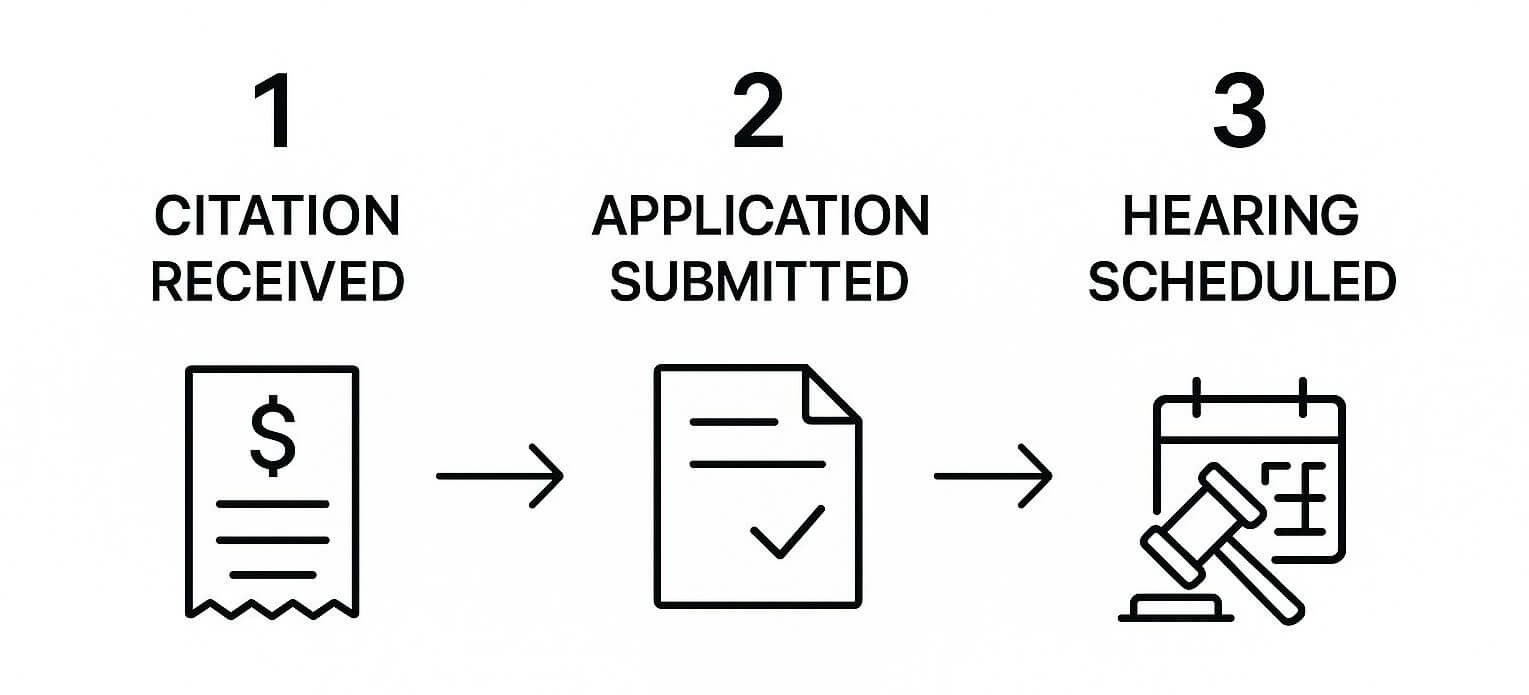
As you can see, filing your application is that critical middle piece connecting the initial citation to the final court decision.
Completing Your Application and Paying Fees
When you sit down to fill out the deferral application, precision is key. Triple-check every detail—your personal info, the citation number, and the date of the offense. A simple typo could cause a delay or, even worse, get your request tossed out. You’re making a formal agreement with the court, so treat it seriously.
A deferral request is essentially a legal petition. By signing it, you are typically waiving your right to contest the ticket in court and agreeing to the program’s conditions.
Once the forms are done, you’ll need to pay the administrative fee. This isn’t a fine; it’s a fee that covers the court’s cost of keeping your case open during the probation period. Expect to pay this upfront when you file.
It’s also worth noting that things can get a lot more complicated if the ticket was part of a bigger incident. To get a better sense of the legal steps involved in those situations, it helps to understand what happens after a car crash and how to protect yourself.
After your request is processed, the court will give you a formal deferral agreement. This document will spell out exactly what you need to do (and not do) and for how long.
What Happens After You Get a Deferral?

Getting a judge to approve your traffic ticket deferral isn’t the end of the road. It’s the starting line.
Think of it like a probationary contract you’ve just signed with the court. You’ve been given a golden opportunity to prove you’re a safe driver, and now it’s on you to hold up your end of the bargain by following the rules to the letter.
The absolute cornerstone of any deferral is keeping your driving record spotless for a specific period, which is typically between six and twelve months. During this time, you can’t get any new moving violations. That’s the deal. A single new ticket is all it takes to void the agreement and throw away this second chance.
Knowing Your Obligations Inside and Out
While staying ticket-free is the main goal, your deferral agreement will have other strings attached. You have to meet every single one of these conditions to get that original ticket officially wiped from your record.
Common requirements often include:
- Paying All Fees on Time: Court costs and administrative fees aren’t optional. They must be paid by the deadline.
- Completing a Driving Course: Many courts will mandate that you complete an approved defensive driving or traffic safety class.
- No Other Violations: This often goes beyond traffic tickets. Some agreements specify you can’t have any new criminal violations, either.
It is absolutely critical that you read and understand every word of your deferral agreement. If anything is unclear, call the court clerk and ask for clarification right away. Claiming you didn’t know the rules won’t fly as an excuse.
The Consequences of Messing Up
Failing to meet your deferral conditions brings swift and serious consequences. The court isn’t going to give you another shot. If you break the rules, the deal is off the table, effective immediately.
Violating your deferral agreement means the original ticket is reactivated, and you’ll be found “committed” or “guilty.” The violation then gets reported to the department of licensing, adding points to your record and almost certainly triggering a jump in your insurance rates.
For instance, many courts have a zero-tolerance policy. In King County, Washington, a deferral can put a violation on hold for up to 12 months. But if you slip up, the deferral is revoked, the fine is due, and the violation gets reported. You can read more about the specific deferral conditions from King County’s court system on their website.
At the end of the day, a deferral is a test of your responsibility. Follow the rules, and you walk away with a clean record. Make one mistake, and the opportunity vanishes.
Weighing the Pros and Cons of a Deferral
A traffic ticket deferral can feel like a golden ticket—an easy way out of a frustrating situation. But it’s a strategic move, not a magic wand, and you need to look at both the upsides and the potential pitfalls before jumping in.
The main draw is powerful and simple: it’s your best shot at protecting your driving record.
The single biggest win is keeping the violation off your public driving history. When you successfully complete the deferral period, the court dismisses the ticket. No points hit your license, which is a huge deal for avoiding a potential suspension down the road. Just as important, your car insurance company never sees the violation, saving you from a painful premium hike that could easily cost you hundreds over the next few years.
The Clear Advantages of Deferring a Ticket
The benefits are hard to ignore, especially when you think about the long-term financial sting of a moving violation on your record. For most drivers, these perks make a deferral a no-brainer.
- A Clean Driving Record: The violation is essentially wiped from your public record, which is what insurance companies and potential employers are looking at.
- No License Points: You dodge the points that can lead to sky-high insurance costs or, worse, a license suspension.
- Stable Insurance Rates: Since the ticket isn’t officially reported, you sidestep the rate hikes that almost always follow a conviction.
Together, these benefits offer a clean slate, preserving your reputation as a responsible driver in the eyes of the DMV and your insurer.
The Hidden Costs and Risks
But let’s be clear: a deferral isn’t a “get out of jail free” card. It comes with its own price tag and a strict set of rules.
First, you’ll have to pay a non-refundable administrative fee to the court, often running anywhere from $100 to $250—sometimes even more than the original ticket. You pay this upfront, and it’s gone for good, even if you mess up and fail the program.
You’re also signing up for a probationary period, usually lasting six to twelve months, where you have to be on your best behavior. Get tagged with any new moving violation during that time, and the deal is off. The original ticket comes roaring back onto your record, you forfeit the fee you paid, and you end up in a much worse spot than if you’d just paid the fine in the first place.
A deferral is a one-shot opportunity. Most places strictly limit how often you can use one—often only once every one to seven years. Burning it on a minor speeding ticket might mean it’s not an option if you get a more serious citation later.
Weighing Your Options: Deferral Pros vs. Cons
Deciding whether to accept a deferral is a classic cost-benefit analysis. On one hand, you get a clean slate. On the other, you’re accepting upfront costs and strict behavioral conditions. The right choice depends entirely on your situation.
Here’s a straightforward comparison to help you decide:
| Pros of Deferral | Cons of Deferral |
|---|---|
| Keeps your driving record clean. The violation is dismissed and doesn’t appear publicly. | Upfront, non-refundable fees. These can cost more than the original fine. |
| Prevents insurance rate hikes. Your provider won’t see the conviction, saving you money. | Strict probationary period. One mistake (another ticket) and the deal is off. |
| Avoids points on your license. This helps prevent potential license suspension. | Limited use. You can typically only use a deferral once every few years. |
| Provides peace of mind. A clean record is valuable for employment and future insurance. | You still have to pay something. It’s not a completely free pass. |
Ultimately, it’s a calculated risk. A deferral is often perfect for minor infractions, but more serious charges demand a different strategy. For instance, the legal complexities of getting a DUI off your record are in a completely different league. You have to weigh whether the immediate win of a clean record is worth the financial cost and the pressure of a lengthy probation.
When to Consider Other Options
While a traffic ticket deferral often seems like the smartest move, it’s not a one-size-fits-all solution. In certain situations, accepting the deal is the wrong strategic choice. It’s absolutely critical to analyze your specific circumstances before jumping at the first offer a court puts on the table.
Think of it this way: a deferral is essentially a plea bargain. You agree to a set of conditions to sidestep a worse outcome. But what happens if you have a rock-solid alibi or clear evidence, like dashcam footage, proving you weren’t at fault? In that scenario, accepting a deferral means you’re paying a fee and entering probation for something you didn’t even do.
When Fighting the Ticket Makes More Sense
If you’re confident in your innocence, pursuing an outright dismissal or a “not guilty” verdict is the superior path. Contesting the ticket might be the right call if:
- You have strong evidence: The officer made an obvious mistake, or you have definitive proof that clears your name.
- The stakes are high: The violation is more serious, and a conviction would have severe consequences for your career or your driver’s license.
- The deferral fee is excessive: Sometimes, the administrative fee is so high that it’s nearly the same as the fine itself, which makes the deferral far less financially appealing.
Navigating a court battle requires a completely different approach, and getting advice from legal counsel can be invaluable. If your case has layers of complexity, understanding the nuances of criminal defense strategies can provide the clarity you need to decide on the best course of action.
Saving Your Deferral for a Rainy Day
Another critical factor to consider is timing. Most jurisdictions limit how often you can use a deferral, often allowing it only once every few years. Using this valuable option on a minor ticket, like rolling through a stop sign, might be a complete waste.
It’s a strategic resource. You might want to save your “get out of jail free” card for a more significant moving violation down the road, like a higher-level speeding ticket, where keeping points off your record is far more critical.
Ultimately, the decision isn’t just about the ticket in front of you; it’s about managing your driving record for the long haul. By carefully weighing the costs, your innocence, and future possibilities, you can make a calculated decision that best protects your interests.
Common Questions About Ticket Deferrals
When you’re staring at a traffic ticket, the idea of a deferral can sound appealing, but it also brings up a lot of questions. Before you jump into the legal process, it’s smart to get some straight answers. Let’s walk through what most drivers want to know.
First up, the bottom line: what’s this going to cost? While the exact number depends on where you got the ticket, expect to pay an administrative fee. This isn’t a small amount—it usually falls between $100 and $250, which can be more than the original fine. Keep in mind, this fee is almost always non-refundable, even if you mess up and violate the agreement later.
How a Deferral Affects Your Record
The next big question is how a deferral actually looks on your driving record. If you successfully make it through the entire probationary period without any new tickets, the original violation gets dismissed.
Here’s the best part: the violation won’t appear on the official driving record that your insurance company sees. This is the main reason people choose a deferral—it helps you sidestep those dreaded rate hikes.
However, the court doesn’t just forget about it. They keep an internal record of your deferral. This is simply to track how often you use this option, since most places limit you to one deferral every few years.
Understanding Ticket Eligibility
Finally, you need to know that a deferral isn’t an option for every ticket. It’s typically reserved for minor moving violations where you didn’t put anyone in serious danger.
Common examples of tickets that usually qualify include:
- Standard speeding (think 1-15 mph over the limit)
- Improper lane changes
- Failing to obey a traffic sign
On the other hand, courts draw a hard line with serious offenses. You’ll almost certainly be denied a deferral for violations like a DUI, reckless driving, or getting caught speeding in a school zone.
Trying to figure out the best way to handle a traffic violation can be a headache. For expert guidance and to connect with a top-tier legal professional, explore the Haute Lawyer Network. Find the right attorney to protect your rights and your driving record at https://hauteliving.com/lawyernetwork.