Starting a business is an incredible ride, but let’s be honest—the legal side of things can feel like stepping into a fog bank without a compass. The core small business legal requirements aren’t just bureaucratic hoops to jump through; they’re the very blueprint for your company’s success. This means picking a legal structure, registering your business name, getting your federal and state tax IDs squared away, and securing the right licenses and permits.
Your Legal Roadmap for a Successful Business Launch
Getting these rules right isn’t just about avoiding fines. Think of it as building a legal fortress around your business. This fortress protects your personal assets, builds trust with customers and partners, and creates a stable foundation for real growth. Skip these steps, and you’re essentially building on quicksand, where one legal misstep could bring the whole thing down.
It’s easy for entrepreneurs to get swept up in the excitement of a great idea and push the legal duties to the back of the line. But getting ahead of your compliance obligations is one of the smartest investments you can make. It turns a confusing mess of legal jargon into a clear, step-by-step map you can follow from day one.
This infographic breaks down how a solid legal roadmap is the bedrock for asset protection, brand trust, and long-term growth.
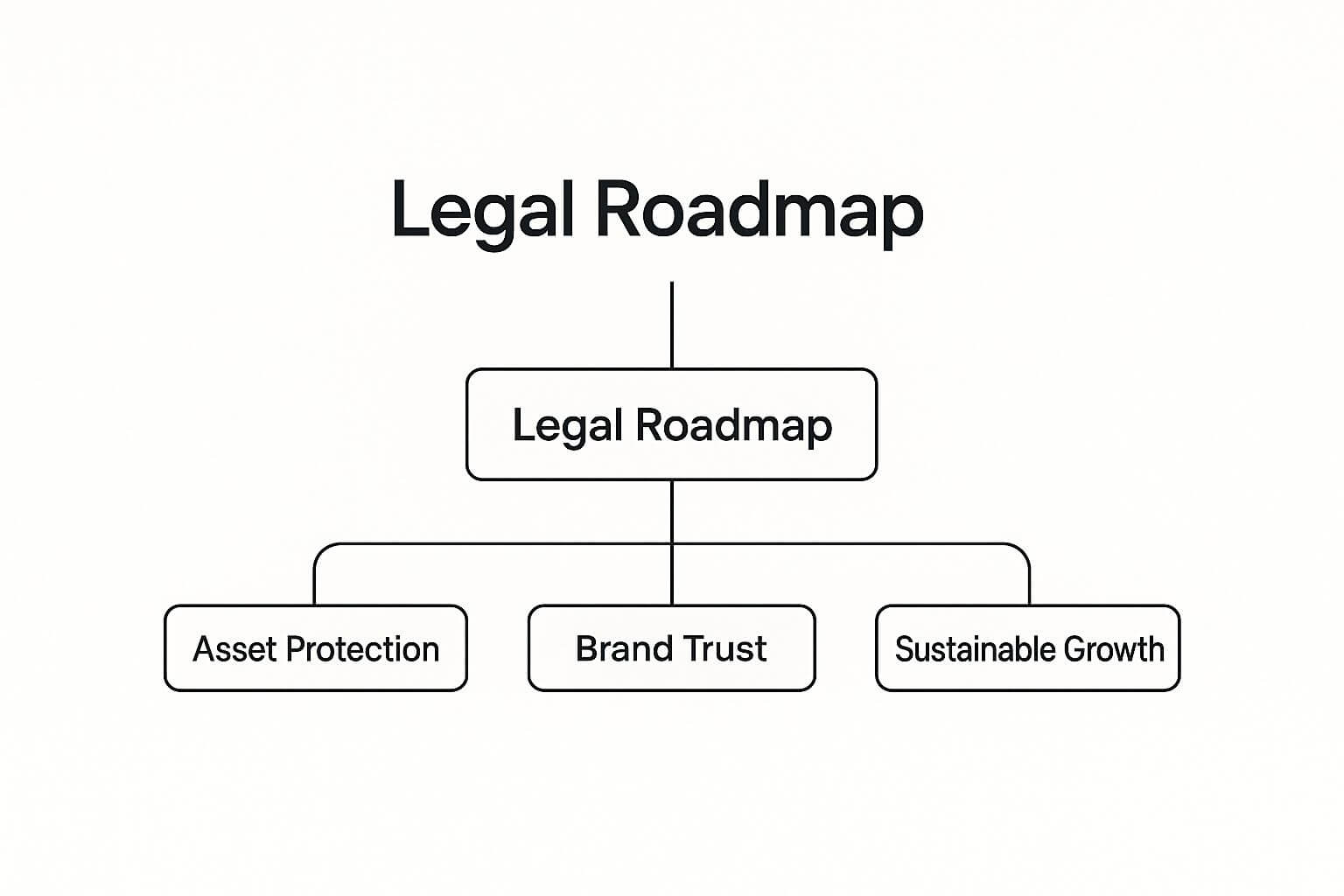
As you can see, these aren’t separate goals. They are deeply interconnected pillars, all supported by that strong legal foundation you build at the very beginning.
Why Legal Compliance Is Non-Negotiable
Trying to fly under the radar simply isn’t a strategy. A prime example is business registration and licensing, a step that’s practically universal in developed economies. In the United States alone, over 34.8 million small businesses are operating—that’s 99.9% of all U.S. firms—and every single one has to follow federal, state, and local laws specific to their industry and location.
This framework does more than just ensure fair play and protect consumers. It gives your business legitimacy.
A registered and licensed business is seen as more credible and professional, which can be a deciding factor for potential customers, investors, and even employees. It signals that you are serious about your venture and committed to operating ethically.
The Core Components of Your Legal Checklist
To get started, focus on the fundamental building blocks of legal compliance. While the details will absolutely change based on your business and location, almost every new venture has to tackle these key areas.
To help you get organized, here is a quick overview of the most critical legal milestones every new business owner must address.
Key Legal Milestones for New Businesses
| Legal Milestone | Why It’s Critical | Typical First Step |
|---|---|---|
| Business Structure | Determines personal liability, taxation, and administrative burden. | Decide between Sole Proprietorship, Partnership, LLC, or Corporation. |
| Official Registration | Legally establishes your business as a distinct entity with the state. | File formation documents (e.g., Articles of Organization) with your Secretary of State. |
| Tax Identification | The IRS requires an EIN for hiring employees and filing business tax returns. | Apply for an Employer Identification Number (EIN) on the official IRS website. |
| Licenses and Permits | Required for legal operation; varies widely by industry, city, and state. | Check with your local Small Business Administration (SBA) office or city clerk. |
Tackling these requirements one by one will transform what seems like an overwhelming obstacle into a series of achievable goals.
Navigating these steps demands careful attention to detail. Our comprehensive guide to small business legal services can offer more perspective on when it makes sense to bring in a professional.
Choosing the Right Legal Structure for Your Business
Deciding on your business’s legal structure is one of the first and most critical legal requirements you’ll face as a founder. This single choice dictates everything from how you file taxes to your personal liability if the business ever faces a lawsuit or racks up debt. It’s not just a box to check—it’s the legal firewall between your personal finances and your business operations.
Think of it like building a house for your business idea. Each option provides a different level of protection and complexity, and the right one depends entirely on your specific goals and how much risk you’re willing to take.

Sole Proprietorship: The Simple Tent
The Sole Proprietorship is the default, no-frills option. The moment you start doing business for yourself without setting up a formal company, you’re automatically a sole proprietor.
It’s like pitching a tent—incredibly easy to set up with almost zero paperwork or cost. But that simplicity comes with a major tradeoff: it offers virtually no protection from the elements. Legally, there is no distinction between you and the business. That means your personal assets—your house, car, and savings—are fair game if your business can’t pay its bills or gets sued.
Partnership: A Shared Campsite
A Partnership is essentially a sole proprietorship with two or more owners. It’s also quite simple to form, often requiring little more than a solid partnership agreement that spells out who is responsible for what and how profits are split.
This is like sharing that tent with a friend. You get to pool your resources and talents, but you also share all the risks. In a General Partnership, every partner can be held personally responsible for the entire business’s debts, even if another partner was the one who created them.
The most significant drawback of sole proprietorships and general partnerships is unlimited personal liability. This direct link between your personal and business finances is a risk that leads many entrepreneurs to choose a more formal structure as they grow.
Limited Liability Company: The Modern Home
The Limited Liability Company (LLC) has become wildly popular for a reason. It’s a hybrid structure that gives you the “limited liability” protection of a corporation but maintains the operational flexibility and tax simplicity of a partnership. An LLC creates a distinct legal separation between you and your business.
This structure is the equivalent of a modern home. It has strong walls to shield your personal assets from business liabilities, yet it’s still relatively easy to manage. Profits and losses typically pass through to your personal tax returns, which helps you avoid the dreaded “double taxation” that corporations can face. While there’s more administrative work than with a sole proprietorship, it’s a manageable step up for most small business owners. For a deeper look at these legal nuances, a founder’s guide to corporate and business law can offer valuable clarity on these foundational choices.
Corporation: The Secure Fortress
A Corporation, whether an S-Corp or a C-Corp, is the most complex and formal legal structure. It exists as a completely separate legal entity from its owners, who are known as shareholders.
Think of a corporation as a secure fortress. It offers the strongest possible protection for your personal assets, but it demands serious upkeep. This includes holding formal board meetings, keeping meticulous records, and complying with a host of strict regulations. C-Corporations are also subject to double taxation—the company pays taxes on its profits, and shareholders pay taxes again on any dividends they receive. S-Corps provide a way around this, but the structure is often best for businesses planning to raise significant capital from outside investors.
Registering Your Business and Securing Licenses
Once you’ve settled on a business structure, it’s time to make it official in the eyes of the law. This isn’t a step you can skip; registering your company is what transforms your idea into a legitimate venture that’s recognized and permitted to operate. Think of it as getting a birth certificate and a driver’s license for your business—one proves it exists, and the other gives it permission to hit the road.
This process involves several layers of compliance, starting at the federal level and drilling down to your specific city or county. Each tier has its own rules, from tax collection to public safety, and ignoring them can lead to hefty fines or even a forced shutdown.
Federal Registration and Your EIN
For most new businesses, the first federal hurdle is getting an Employer Identification Number (EIN) from the IRS. This unique, nine-digit number is basically a Social Security number for your company. You’ll need it for just about everything financial: filing federal taxes, opening a business bank account, and, most importantly, hiring employees.
If you plan to have anyone on payroll, operate as a corporation or partnership, or file certain tax returns, an EIN is non-negotiable. The good news? Applying is free and takes just a few minutes on the official IRS website. This number is the foundation for almost all your future financial and legal activities.
Securing an EIN is a simple but critical step. Without one, you can’t legally pay employees or manage your federal tax obligations, putting your business in a risky position from day one.
State-Level Business Registration
After you’ve handled the federal side, your next stop is your state government. This is where you’ll formally register your business entity, whether it’s an LLC, corporation, or partnership. The process usually involves filing specific formation documents with your Secretary of State’s office.
For instance, if you’re forming an LLC, you’ll file what’s known as “Articles of Organization.” For a corporation, it’s “Articles of Incorporation.” These documents are what officially create your business as a distinct legal entity within your state.
You’ll also need to register your business name. If you plan to operate under a name that’s different from your own legal name (as a sole proprietor) or your formal entity name (for an LLC), you’ll likely need to file for a “Doing Business As” (DBA) name. This is also called a fictitious or trade name, and it simply lets the public know who’s actually behind the business.
Registering your business name and structure at the state level is what gives your company its legal identity. It’s the step that transforms your idea from a concept into a recognized entity that can enter into contracts, own property, and conduct business legitimately.
Navigating Local Licenses and Permits
The final layer of compliance—and often the most confusing—is at the local level. These are the rules set by your city, county, or township, and they can vary dramatically from one block to the next. This is where the specific nature of your business really comes into play.
These permits are all about making sure your business meets local zoning laws, health codes, and public safety regulations. A home-based freelance writer will have wildly different requirements than a downtown restaurant or a construction contractor.
A great place to start figuring out what you need is the U.S. Small Business Administration’s (SBA) website. It offers guidance based on your industry and location. The screenshot below shows how the SBA tool can help you identify the specific permits you might need.

This resource is invaluable for cutting through the noise and pointing you toward the right state and federal agencies for your industry. It’s a must-use tool to ensure you don’t miss a critical requirement.
To see how much this can vary, consider these examples:
- A Food Truck: Needs a general business license, a food handler’s permit from the health department, a mobile food vendor license from the city, and maybe even special parking permits.
- An Online Consultant: Might only need a simple home occupation permit from their city to legally work from a residential address.
- A Retail Store: Requires a seller’s permit from the state to collect sales tax, plus a certificate of occupancy for its physical storefront.
Because these rules are so specific to your location, your best bet is to check directly with your city clerk’s office and county government. They are the final authority on what it takes to operate legally in your area. Missing just one local permit can result in serious fines and delays.
Understanding Your Tax and Financial Obligations
Getting your financial house in order is one of the most critical legal hurdles you’ll face as a small business owner. This isn’t just about satisfying the IRS; it’s about building a financially sound company that can survive market shifts and actually grow. Think of it as the foundation of your business—if it’s cracked from the start, the whole structure is at risk.
These responsibilities aren’t a once-a-year headache. They demand a disciplined, ongoing approach to tracking every dollar, understanding the different taxes you owe, and hitting every deadline. When you master this, you get a crystal-clear view of your company’s financial health, which is the key to making smart, strategic decisions.
The Core Types of Business Taxes
The specific taxes you’ll pay depend on your business structure, industry, and location, but nearly every small business will run into a few common categories. It’s absolutely essential to know which ones apply to your operation.
- Income Tax: This is the one everyone knows. All businesses, except partnerships, have to file an annual income tax return. If you’re in a partnership, the business files an information return, but you and your partners report your share of the profits on your personal tax returns.
- Self-Employment Tax: If you’re a sole proprietor, a partner, or a member of an LLC, this one’s for you. It covers your Social Security and Medicare contributions—in essence, you’re paying both the employer and employee side of the coin.
- Sales Tax: For any business selling goods or even certain services, collecting and paying sales tax is a huge responsibility. The rules and rates can change dramatically from one state, county, or even city to the next, so staying on top of local compliance is non-negotiable.
- Payroll Taxes: The moment you hire that first employee, you’re on the hook for withholding federal and state income taxes, Social Security, and Medicare from their paychecks. You’ll also need to pay federal unemployment (FUTA) tax.
Mismanaging any of these can trigger severe penalties from tax authorities, making this one of the highest-stakes areas of compliance you’ll deal with.
Why Clean Financial Records Are Your Best Defense
Keeping immaculate financial records isn’t just good practice; it’s your best line of defense. It’s the only way to accurately calculate what you owe and the first thing an auditor will demand to see. Your first move? Open a separate business bank account.
Mixing your personal and business finances is a massive red flag for the IRS. More importantly, it can shatter the liability protection your LLC or corporation provides, putting your personal assets on the line. A dedicated account simplifies bookkeeping, makes tracking expenses a breeze, and creates an undeniable paper trail.
Think of your business bank account as the official storybook of your company’s financial life. It proves your business is a legitimate entity, not just a side hobby, which is crucial for protecting your personal assets from business debts.
Small businesses are also facing intense economic pressures that directly shape their financial decisions. With inflation being a top worry for 46% of small businesses heading into 2025, owners are making tough calls. In fact, 55% have been forced to raise prices, and 36% have had to overhaul their supply chains just to stay afloat.
Thankfully, there’s some relief available, like the ongoing 20% qualified business income deduction and an increased SALT deduction cap. You can learn more about how small businesses are navigating these economic headwinds on uschamber.com.
This reality just hammers home why sharp financial management is so vital. Keeping your books clean isn’t just about following the law—it’s a core strategy for survival.
Navigating Employment and Labor Laws
Bringing on your first team member is a huge milestone. It’s the moment you officially graduate from a solo founder to an employer. But this exciting step also introduces a whole new set of small business legal requirements—specifically, employment and labor laws. Getting this right from day one isn’t just about ticking boxes; it’s about building a solid foundation for your team and protecting your company from expensive legal trouble down the road.
The world of employment law can seem intimidating, but its core purpose is simple: ensure your team is treated fairly, works in a safe environment, and is paid correctly. A slip-up here isn’t a minor mistake. It can lead to crippling fines, lawsuits, and a hit to your reputation that’s hard to recover from.

Employees Versus Independent Contractors
Before you do anything else, you have to get one thing straight: is the person you’re hiring an employee or an independent contractor? This distinction is one of the most critical you’ll make, with massive legal and financial consequences. Misclassifying an employee as a contractor—even by accident—can trigger a cascade of penalties for things like unpaid payroll taxes, unemployment insurance, and workers’ compensation.
Think of it like this: an employee is an integral part of your team who works under your direct supervision. You set their hours and control how the work gets done. A contractor is more like a hired gun—a specialist brought in for a specific project who controls their own process.
The IRS focuses heavily on the degree of control. If you have the right to dictate the when, where, and how of the work, that person is almost certainly an employee. Misclassification is a major red flag for tax authorities and one they actively look for.
The distinction can get murky, so it’s crucial to understand the key differences. This table breaks down the main factors the government uses to determine a worker’s status.
Employee vs. Independent Contractor Key Differences
| Factor | Employee | Independent Contractor |
|---|---|---|
| Behavioral Control | The business directs and controls how the work is performed and when. | The worker has significant autonomy over how the job is done. |
| Financial Control | The business handles pay on a set schedule and provides necessary tools. | The worker often invests in their own tools and submits invoices for payment. |
| Relationship | The relationship is expected to be ongoing, and benefits may be offered. | The relationship is typically temporary, defined by a contract for a specific project. |
Understanding these points is your first line of defense against costly misclassification errors. When in doubt, it’s always safer to classify a worker as an employee or seek legal advice.
Core Federal Labor Laws to Know
Once you officially have employees on payroll, a handful of major federal laws kick in immediately. These laws establish the baseline for how you must treat your team. Keep in mind, your state or city might have even stricter rules. For a comprehensive look at your duties, you can master employment law for employers with guides that break down these complex obligations.
Here are the non-negotiable federal laws you need to have on your radar:
- Fair Labor Standards Act (FLSA): This is the big one. The FLSA sets the federal minimum wage, dictates overtime pay—requiring 1.5 times the regular rate for hours over 40 in a week—and establishes firm rules around child labor.
- Occupational Safety and Health Act (OSHA): You have a legal responsibility to provide a workplace that is free from known hazards. OSHA creates and enforces the safety standards designed to protect your team from getting sick or injured on the job.
- Anti-Discrimination Laws: This isn’t one law but a collection of them, including Title VII of the Civil Rights Act. Together, they prohibit discrimination in every aspect of employment—from hiring to firing—based on race, color, religion, sex, or national origin. Other laws add protections for age, disability, and genetic information.
Following these laws isn’t just about staying compliant. It’s about building an ethical, resilient company culture where people feel safe and valued. In the long run, that’s one of the most powerful assets any growing business can have.
How to Protect Your Intellectual Property
Let’s be honest, your most valuable assets probably aren’t sitting in a warehouse. They’re your ideas, your brand name, and the unique content you create. This is your intellectual property (IP), and failing to protect it is like leaving the front door of your shop unlocked overnight.
Think of IP protection as a set of legal fences, each designed to guard a different part of your business. Knowing which fence to build—and when—is fundamental to securing your market advantage and creating real, long-term value. Time is of the essence; once an idea is out in the open, it’s exponentially harder to claim it as your own.
The Three Fences of IP Protection
The world of intellectual property can feel overwhelmingly complex, but for most small businesses, it boils down to three core safeguards: trademarks, copyrights, and patents. Each one does a very different job.
- Trademarks guard your brand identity. We’re talking about your business name, logo, slogans—even specific colors or sounds that make customers think of you. A registered trademark grants you exclusive rights, stopping competitors from causing confusion in the marketplace.
- Copyrights protect your original creative work. This covers the copy on your website, your blog posts, product photos, software code, and marketing videos. Copyright kicks in the moment you create something, but formally registering it gives you the legal firepower you’ll need if someone rips off your content.
- Patents secure inventions. If you’ve engineered a new and non-obvious process, machine, or design, a patent gives you the exclusive right to make and sell that invention for a limited time—typically 20 years. This is by far the most complex and expensive fence to build.
Securing your intellectual property isn’t just a defensive tactic; it’s a strategic asset. A strong IP portfolio can attract investors, create licensing revenue, and dramatically increase your company’s valuation.
First Steps to Lock Down Your IP
Protecting your brand and ideas starts with a few simple, proactive moves. Before you pour a dollar into a new brand name, run a comprehensive trademark search on the U.S. Patent and Trademark Office (USPTO) database. This one step can save you from a gut-wrenching legal fight or a costly rebrand later on.
For your creative content, get in the habit of adding a copyright notice (e.g., © 2024 Your Company Name) to your website footer and all published materials. And if you think you’ve invented something patentable? Your first call should be to an IP attorney—and keep it confidential until you do.
Common Questions About Business Legal Requirements
Diving into the legal side of starting a business can feel like trying to navigate a foreign city without a map. As you get deeper into building your company, you’re bound to run into specific questions that feel urgent and confusing. We’ve compiled direct answers to the most common queries we see, designed to give you the clarity and confidence to move forward.
Think of this as your legal GPS. These answers will help you decipher confusing terms and point you in the right direction, making sure your business is built on a solid, compliant foundation from day one.
Do I Need a Lawyer to Start a Small Business?
While the law doesn’t explicitly require you to hire a lawyer, it’s one of the most strategic investments you can make early on. It’s like bringing a seasoned guide on a trek through the Amazon; sure, you might make it alone, but the guide knows where the pitfalls are and the most efficient path to your destination.
For an incredibly simple sole proprietorship with no employees, a high-quality online legal service might suffice. But the moment you’re forming an LLC or corporation, drafting client contracts, or operating in a regulated industry, professional legal counsel becomes indispensable. It’s about preventing hugely expensive mistakes down the road.
A great business lawyer doesn’t just solve problems—they build the legal framework that prevents those problems from ever happening. That initial investment can save you a fortune in time, money, and stress later on.
What Is the Difference Between a Federal EIN and a State Tax ID?
This is a frequent point of confusion, but the distinction is actually quite simple once you see it. Your federal Employer Identification Number (EIN) is essentially a Social Security number for your business. It’s issued by the IRS for all federal tax matters, and you’ll need it to hire employees, file your federal tax returns, or open a business bank account.
A state tax ID number is a separate identifier issued by your state’s department of revenue. It’s all about state-level taxes—think sales tax you collect from customers or state payroll taxes for your team. If you have employees or sell taxable products or services, you will almost certainly need both.
How Often Do I Need to Renew My Business Licenses?
There’s no single answer here—renewal schedules are entirely dependent on the specific license and who issued it (your city, county, or state). This is one of those critical details you absolutely have to track among your small business legal requirements.
Here’s a general guide to keep in mind:
- General business operating licenses issued by your city or county are often up for renewal annually.
- Professional or industry-specific licenses, like a general contractor’s license or a salon permit, might have longer two- or three-year renewal cycles.
- Seller’s permits, which allow you to collect sales tax, often don’t need to be renewed at all as long as your business is active.
The most important takeaway is to never assume. The day you receive any license, put the expiration date in your calendar with multiple reminders. Letting a license lapse can lead to hefty fines or even a forced stop to your operations, so diligent tracking is non-negotiable.
Finding the right legal guidance can feel daunting. At Haute Lawyer Network, we connect you with a curated network of top-tier attorneys who specialize in protecting and growing businesses like yours. Elevate your legal strategy and ensure your company is built on a solid foundation. Explore our network of premier legal professionals at https://hauteliving.com/lawyernetwork.