
When you’ve been injured because of someone else’s carelessness, the aftermath is a whirlwind of chaos. You’re dealing with doctor’s appointments, mounting bills, lost time at work, and the constant, nagging pressure from insurance adjusters. The path to getting fair compensation can feel completely obscured.
This guide is your roadmap. It’s designed to cut through the confusion and give you a clear, step-by-step walkthrough of the entire personal injury claim process—from the moment the incident occurs to the day you receive a final, fair resolution.
Think of it as the blueprint for your case. We’re going to break down each stage, replacing uncertainty with a clear plan so you can move forward with confidence. Understanding this journey is the first critical step toward protecting your rights and securing your future.
Key Stages of a Claim
At its core, the personal injury claim process unfolds in three main phases: the incident, the investigation, and the resolution. Each stage builds on the last, constructing a powerful case for the compensation you deserve.
This timeline offers a bird’s-eye view of how a typical claim progresses.
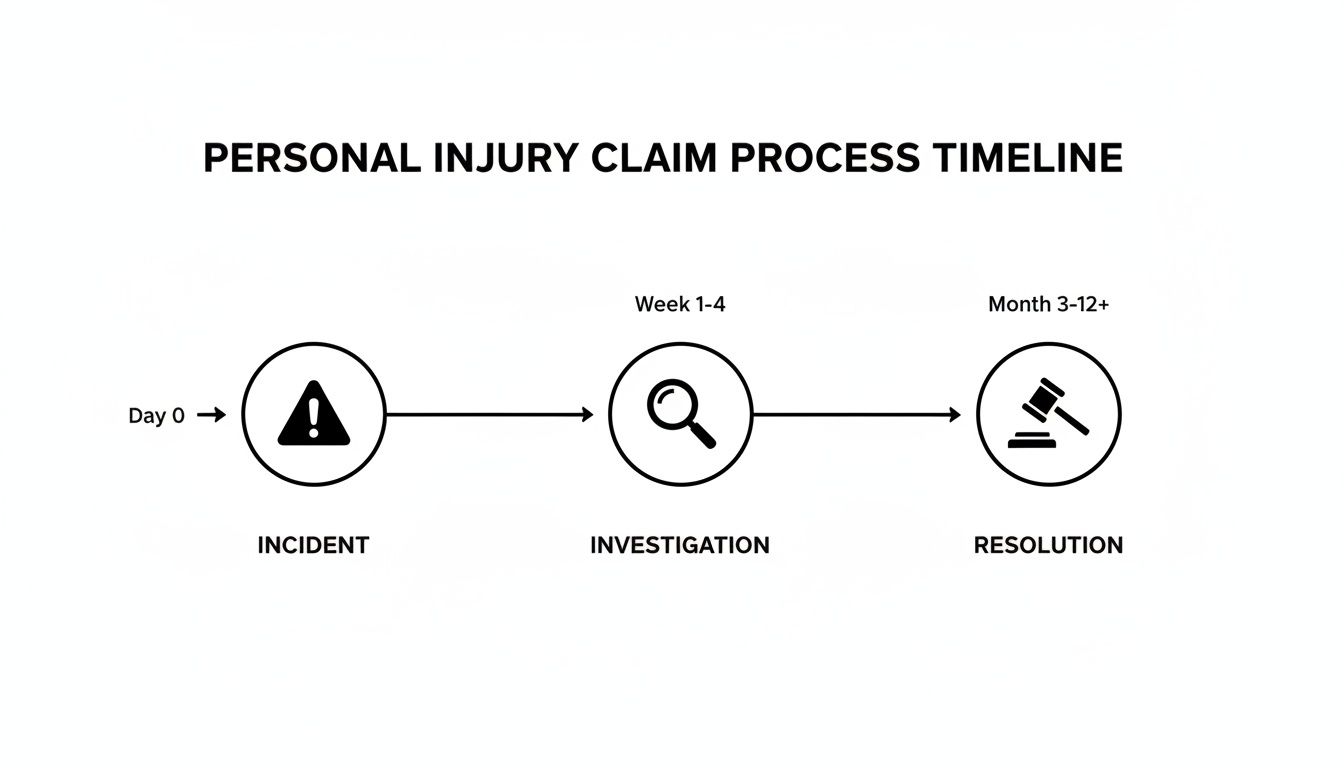
As you can see, every claim begins with a single event, moves into a critical evidence-gathering phase, and ultimately concludes with a resolution—most often, a negotiated settlement.
But getting through this process successfully requires more than just knowing the steps; it demands strategic action. The sheer volume of cases filed each year underscores just how complex this field is. In the U.S. alone, 39.5 million people require medical attention for injuries annually, leading to nearly 400,000 personal injury claims being formally filed. These numbers make it crystal clear why having experienced legal counsel is essential to turn overwhelming odds into a successful outcome.
To give you a clearer picture, here’s a high-level summary of what to expect.
The Personal Injury Claim Process at a Glance
| Stage | Primary Objective | Estimated Timeline |
|---|---|---|
| Investigation | Gather all evidence, document injuries, and establish liability. | Weeks to months |
| Negotiation | Present a demand to the insurer and negotiate a fair settlement. | Months to over a year |
| Litigation | File a lawsuit if negotiations fail, proceeding to trial if necessary. | 1-3+ years |
| Resolution | Finalize a settlement or receive a court verdict. | Varies |
This table simplifies a complex journey, but each stage involves detailed work and strategic decisions that can make or break your case.
A personal injury claim is the legal process an injured person uses to seek compensation from the party whose negligence caused their harm. If that party is found liable, they are legally responsible for damages like medical bills, lost income, and pain and suffering.
To build a winning case, you first need a solid grasp of what a claim legally entails. For a deeper dive into the core legal principles, our guide on what a personal injury claim is provides the foundational knowledge you need as we move into the specifics of the process.
Taking the Crucial First Steps After an Injury

The moves you make in the first few minutes and hours after an injury are foundational. They set the tone for the entire personal injury claim process, from proving what happened to preserving your right to compensation. Think of it as gathering the raw materials for your case; without them, even the most elite legal team starts at a disadvantage.
Every decision—seeking medical care, reporting the incident, documenting the scene—creates another piece of the puzzle. This isn’t just about reacting to a crisis. It’s about acting with purpose to protect your health and your future claim.
Prioritize Your Health and Document Your Injuries
The single most critical step is to get immediate medical attention. Your health is paramount, and a professional evaluation is the only way to diagnose and treat your injuries properly. Some severe conditions, like internal bleeding or a traumatic brain injury, don’t show obvious symptoms right away.
Beyond your physical recovery, this first medical visit serves a vital legal purpose. It creates a direct, time-stamped record linking the incident to your injuries. This documentation becomes the cornerstone of your claim, making it incredibly difficult for an insurance adjuster to later argue your injuries were pre-existing or unrelated.
Officially Report the Incident
How you report an incident depends on where it happened, but creating an official record is non-negotiable. This report acts as independent, third-party verification that the event occurred when and how you say it did.
Here’s how this plays out in different scenarios:
- Car Accidents: Always call the police. An official police report establishes the date, time, location, and parties involved, often with an officer’s initial assessment of fault.
- Slip and Falls: Find the property manager, owner, or an employee immediately. Insist on filling out a formal incident report and get a copy before you leave.
- Workplace Injuries: Report the injury to your supervisor right away and follow your company’s exact protocol for filing a workers’ compensation claim.
Each action creates a paper trail that solidifies the facts. For more specifics, our guide on what to do after a car accident offers a detailed checklist.
Understand the Statute of Limitations
The statute of limitations is a non-negotiable legal deadline that dictates how long you have to file a lawsuit after being injured. This isn’t a suggestion—it’s a hard cutoff. If you miss it, you will almost certainly lose your right to seek compensation forever, no matter how strong your case is.
Each state sets its own timeline. In Washington, for example, the deadline for most personal injury claims is three years from the date of the injury. But for certain intentional acts, it can shrink to just two years.
This ticking clock is precisely why you should contact an attorney without delay. An experienced lawyer will immediately pinpoint the correct deadline for your case, ensuring this critical requirement is met.
The Initial Attorney Consultation
Your first meeting with a personal injury lawyer is a two-way street—a strategic evaluation for both sides. It’s a no-risk opportunity for you to grasp your legal options and for the attorney to assess the viability of your case. Be ready to discuss the incident in detail.
The attorney will also explain their fee structure, which is almost always a contingency fee agreement. This means you pay nothing upfront. The lawyer’s fee is simply a pre-agreed percentage of the final settlement or award they win for you. If they don’t win, you owe them nothing.
Building Your Case with Evidence and Investigation

Once you’ve secured elite legal counsel, the dynamic shifts. This is where the real work begins, transitioning into an intensive investigation where your attorney’s team operates like a private intelligence unit. Their sole mission is to gather every shred of proof needed to build an ironclad case.
Think of it as constructing a fortress of facts. Each police report, photograph, and witness account is another stone reinforcing your claim. The objective is to build a narrative so compelling that it leaves no doubt about the other party’s negligence or the true extent of your losses. This meticulous early work is designed to dismantle the arguments insurance companies will inevitably try to use, positioning your case for a successful outcome from the start.
Securing Key Evidence and Witness Accounts
Time is of the essence. The investigation kicks off immediately to preserve critical evidence before it can degrade or disappear altogether. Your legal team systematically tracks down the documents and testimony that will become the foundation of your claim.
This initial phase casts a wide net, capturing every detail surrounding the incident. Key pieces of evidence always include:
- Official Reports: The police report from a car crash or an incident report from a business provides a formal, third-party narrative of what happened.
- Photos and Video Footage: Your team will secure any photos you took at the scene, but more importantly, they’ll hunt for surveillance footage from nearby traffic cameras or businesses that might have recorded the event.
- Witness Statements: Locating and interviewing anyone who witnessed the incident is a top priority. Their impartial testimony can be incredibly powerful in validating your version of events and proving fault.
Preventing the Destruction of Evidence
One of the most potent legal tools your attorney will deploy is a preservation letter, often called a spoliation letter. This is a formal legal demand sent to the at-fault party and their insurer, ordering them to preserve all potential evidence related to your case.
This isn’t a friendly request. It legally obligates them to safeguard everything from dashcam footage and employee records to maintenance logs and internal emails. If they destroy this evidence after receiving the notice, they can face severe sanctions from the court. This strategic move prevents crucial proof from being “accidentally” deleted—a common tactic used to weaken a valid claim.
A preservation letter is a legal backstop. It freezes all relevant evidence in place, forcing the opposing party to maintain a transparent record and ensuring key facts that prove your case aren’t conveniently lost.
This maneuver protects the integrity of the process and establishes a tone of accountability from day one.
Documenting Your Injuries and Medical Journey
While the investigative team builds the case for liability, a parallel effort is underway to document the full scope of your injuries. This goes far beyond just collecting medical bills; it’s about creating a detailed, comprehensive record of your entire recovery journey.
Your attorney’s team will meticulously compile:
- All Medical Records: This covers everything from the initial ER visit and specialist reports to physical therapy notes and diagnostic scans like X-rays and MRIs.
- A Complete Ledger of Medical Bills: Every single expense is tracked to establish the precise economic cost of your injuries.
- Future Medical Projections: For serious injuries, your legal team will bring in medical experts to calculate the costs of future surgeries, long-term care, and necessary medical equipment.
Each document serves as undeniable proof of what you’ve endured and the financial devastation it has caused. This detailed medical file is absolutely essential for calculating damages and is a critical weapon in persuading the insurance company of your claim’s true value.
Calculating Your Damages and Making the Demand
How do you put a number on pain, suffering, and a life turned upside down? This is where the real fight begins. After meticulously gathering evidence, the focus shifts to calculating the full, unfiltered value of your losses. This isn’t about pulling a number out of thin air; it’s a strategic process that accounts for every single way the injury has impacted your life, financially and personally.
This comprehensive valuation becomes the foundation for the demand letter. Think of this not as a simple request for payment, but as the opening salvo in a high-stakes negotiation. It’s a powerful legal document that lays out the facts, proves the other party’s fault, details every dollar of your damages, and makes a formal monetary demand to the insurance company. It sets the tone for everything that follows.
Economic vs. Non-Economic Damages: The Two Sides of Your Claim
To build a compelling case, your legal team will break down your losses into two distinct categories. Understanding the difference is crucial to appreciating the true potential value of your claim.
The first part is straightforward: special damages, also known as economic damages. These are the tangible, out-of-pocket financial losses you’ve incurred. If you have a receipt, invoice, or pay stub for it, it falls into this category.
Common examples include:
- Medical Expenses: Every bill, from the initial ER visit and surgery to ongoing physical therapy and prescription costs.
- Lost Wages: The income you lost because you were physically unable to work during your recovery.
- Future Lost Earning Capacity: Compensation if a permanent disability prevents you from returning to your former career or earning at the same level.
- Property Damage: The cost to repair or replace your vehicle and any other personal property destroyed in the incident.
The Art of Valuing Pain and Suffering
The second, and often larger, part of a claim involves general damages, or non-economic damages. These are the intangible losses that represent the true human cost of an injury—losses that don’t come with a neat price tag. How do you quantify chronic pain, emotional trauma, or the inability to enjoy the life you once had?
While there’s no single formula, experienced attorneys often use a “multiplier” method. They start with the total hard number for economic damages and multiply it by a factor (usually between 1.5 and 5) based on the severity and permanence of your injuries, the intensity of your pain, and the long-term impact on your quality of life.
A life-altering injury that requires years of care will command a much higher multiplier than a broken bone that heals in a few months. This is where an elite attorney’s skill becomes invaluable—they craft a compelling narrative that justifies the highest possible value for your suffering.
Before we dive into how these numbers are presented, here’s a quick breakdown of what you can claim.
Understanding Your Potential Compensation
This table outlines the key types of damages available in a personal injury claim, separating the clear-cut financial losses from the more subjective, yet equally important, personal impacts.
| Type of Damage | Description | Common Examples |
|---|---|---|
| Economic Damages | Direct, verifiable financial losses resulting from the injury. | Medical bills, lost income, physical therapy costs, property repair/replacement. |
| Non-Economic Damages | Intangible, non-financial losses related to the human cost of the injury. | Pain and suffering, emotional distress, loss of enjoyment of life, disfigurement. |
| Punitive Damages | Awarded in rare cases to punish the defendant for extreme negligence or malice. | A company knowingly selling a defective product, a driver intentionally causing harm. |
Recognizing all three categories is essential for ensuring no aspect of your loss is overlooked during the calculation and negotiation phases.
Crafting the Strategic Demand Letter
Once all damages have been calculated, they are assembled into the demand letter. This document is a masterclass in persuasion, presenting your case in the strongest possible light to the insurance company. A truly effective demand letter contains:
- A Factual Narrative: A clear, powerful summary of how the incident happened.
- A Theory of Liability: A legal argument explaining exactly why the other party is at fault for your injuries.
- An Itemized Damage Report: A detailed breakdown of all economic and non-economic losses, backed by medical records, expert reports, and other evidence.
- A Specific Monetary Demand: The total compensation you are seeking to resolve the claim without litigation.
This letter officially kicks off negotiations. The insurance adjuster’s first response will almost always be a counteroffer far below your demand—this is standard procedure. The back-and-forth that ensues is a normal and expected part of the process.
The overwhelming majority of claims are settled here. Data shows that two-thirds of personal injury cases are resolved out of court, and a mere 4% ever go to trial. While the average payout for a claim is around $52,900, settlements for catastrophic injuries can be 15 to 25 times that amount. Auto liability claims alone averaged $27,373 in a recent year. These figures, highlighted in a Clio.com analysis of personal injury statistics, reveal a system designed to settle, but one that rewards those who come to the table with a meticulously prepared and aggressive legal strategy.
Advancing to a Lawsuit and the Discovery Phase
When the insurance company’s final offer is so low it feels insulting, negotiations have officially hit a dead end. This is the point where the personal injury claim process escalates from informal talks to the structured, high-stakes world of litigation.
Filing a lawsuit isn’t a sign of weakness or a last resort; it’s a powerful strategic move. It tells the insurer you’re not backing down and forces them to re-evaluate your claim under the formal scrutiny of the court system. Your attorney initiates this by filing a Complaint, a legal document that lays out your case against the at-fault party. A Summons is then issued and served, legally requiring the defendant to answer for their actions. This one-two punch officially kicks off the litigation.
Entering the Discovery Phase
With a lawsuit filed, the case moves into a crucial and often lengthy stage known as discovery. Think of it as a mandatory “show your cards” moment for both sides. The rules of court compel each party to share the evidence and information they’ve gathered. The entire point is to prevent courtroom surprises and get a clear-eyed view of the case’s strengths and weaknesses.
This is a world away from your lawyer’s initial investigation. That was about building your side of the story. Discovery is about using legal force to see what the other side has. This highly structured exchange is governed by strict procedural rules and relies on a handful of powerful legal tools to get the job done.
This phase can take many months and is often the most time-consuming part of the entire process. But it’s absolutely essential. It’s where cases are truly built, defenses are dismantled, and the groundwork is laid for either a successful trial or, more commonly, a much more realistic settlement discussion.
Discovery is the great equalizer. It forces transparency and stops the other side from hiding damaging information. A sharp discovery strategy will expose the holes in the defense’s argument, dramatically shifting the settlement leverage in your favor.
Here, under the court’s supervision, the full story of what happened—and why—is pieced together, one fact at a time.
Key Tools Used in Discovery
During discovery, your attorney has a specific toolkit to extract information from the opposing party. Each tool serves a different purpose in painting the complete picture of the facts.
The primary tools include:
- Interrogatories: These are simply written questions sent to the other party, which they must answer in writing and under oath. They’re great for nailing down basic facts, like identifying all potential witnesses or getting the defendant’s official version of events on paper.
- Requests for Production: This is a formal demand for documents, records, and other physical evidence. Your lawyer might request the maintenance logs for a company vehicle, internal emails about a safety issue, the defendant’s cell phone records from around the time of the incident, or security camera footage.
- Requests for Admission: These are direct, yes-or-no written statements that the other party must either admit or deny. For instance: “Admit that the traffic light in your direction was red at the time of the collision.” This tactic is used to narrow the field of what’s actually being disputed.
- Depositions: This is arguably the most powerful tool in the discovery arsenal. A deposition is sworn, out-of-court testimony. A witness—whether it’s the plaintiff, defendant, or an expert—is questioned by the opposing counsel while a court reporter transcribes every single word.
Depositions are critical because they lock witnesses into their story, making it nearly impossible to change their testimony later at trial. It’s a high-pressure environment that reveals how a witness will hold up under cross-examination, and it often becomes the catalyst that pushes the other side toward a serious settlement offer.
Reaching a Final Resolution Through Mediation or Trial

Once discovery wraps up, the case enters its endgame. All the cards are on the table; both sides have a clear-eyed view of the case’s strengths and its vulnerabilities. From here, the path splits into two distinct directions: a negotiated settlement through mediation or a final, binding decision at trial.
This is where all the strategy, evidence, and legal skill come to a head. While movies love a dramatic courtroom showdown, the reality is that the overwhelming majority of personal injury cases never see the inside of a courtroom. The reason is simple: trials are expensive, unpredictable, and incredibly high-risk for everyone involved.
The Power of Mediation
Mediation is a formal, confidential negotiation overseen by a neutral third party—the mediator. This individual is typically a retired judge or a seasoned attorney with deep experience in these matters. Crucially, a mediator cannot force a decision on anyone. Their role is to facilitate a productive conversation, challenge each side’s assumptions, and guide them toward a middle ground they can both live with.
Think of the mediator as a diplomat navigating a tense negotiation. They often shuttle between separate rooms, carrying offers and counteroffers while providing a dose of reality about how a jury might perceive the evidence. For a deeper dive into this critical stage, our guide on how to prepare for mediation breaks down what to expect.
Mediation offers control. It allows both you and the defendant to have the final say in the outcome, rather than handing that power over to six or twelve strangers on a jury. This control, combined with its cost-effectiveness, is why most filed lawsuits settle at this stage.
When handled skillfully, this process can lead to a fair settlement without the immense stress and public nature of a trial.
When a Trial Becomes Necessary
If mediation stalls and the insurance company digs in its heels with an unreasonable offer, a trial becomes the only remaining path to justice. This is the final resort—a high-stakes arena where your attorney presents the entire narrative of your case to a judge and jury.
The trial process is highly structured and moves through several key phases:
- Jury Selection: Attorneys for both sides question prospective jurors to empanel an impartial group.
- Opening Statements: Each lawyer outlines a roadmap of what they intend to prove to the jury.
- Presentation of Evidence: Your attorney will call witnesses to the stand, introduce key documents, and cross-examine the defense’s witnesses.
- Closing Arguments: Both sides deliver a final, powerful summary of their case.
- Jury Deliberation and Verdict: The jury convenes privately to weigh the evidence and returns with a final decision on liability and damages.
A trial is a serious undertaking, both financially and emotionally. It can last for days or even weeks, and the outcome is never a sure thing—which is precisely why it’s reserved for situations where a fair settlement is completely off the table.
Finalizing the Settlement and Disbursement
Once a settlement is agreed upon or a verdict is won, the last step is to officially close the claim. You will sign a release agreement, a binding legal document that formally ends your right to any further claims in exchange for the compensation.
The insurer then sends the settlement check to your attorney, who deposits it into a dedicated client trust account. From there, your attorney manages the final accounting. They will satisfy any outstanding obligations, such as their legal fees, case costs (like expert witness fees), and any medical liens from hospitals or your health insurer.
After all these debts are settled, the remaining funds—your net compensation—are disbursed directly to you. This transparent final step ensures all financial loose ends are tied up, bringing the entire process to a complete close.
Common Questions About the Claim Process
Walking into a personal injury claim can feel overwhelming. Clients often have the same core questions about how long it will take, what it will cost, and who they should (and shouldn’t) be talking to. Let’s cut through the noise and address these directly.
How Long Does the Personal Injury Claim Process Take?
There’s no single answer here—the timeline is entirely case-dependent. A straightforward case with undisputed fault and minor injuries can often be resolved in as little as six to nine months.
However, the moment complexity enters the picture, the clock extends. If you’re dealing with severe, life-altering injuries, a defendant who refuses to accept responsibility, or the need to file a formal lawsuit, you could be looking at one to three years, sometimes longer, before reaching a final resolution.
What Is a Contingency Fee Agreement?
A contingency fee is the great equalizer in the justice system. It’s a payment structure that allows you to secure elite legal representation with absolutely no upfront cost. Instead of billing by the hour, your attorney’s fee is a pre-determined percentage of the final settlement or verdict they win on your behalf.
This fee typically ranges from 33% to 40% of the total recovery. The beauty of this model is its built-in alignment: if you don’t get paid, your lawyer doesn’t either. It ensures that your attorney is just as invested in a successful outcome as you are.
This arrangement removes the financial risk from your shoulders and places it squarely on your law firm, guaranteeing their incentives are directly tied to yours.
Should I Speak to the Other Insurance Adjuster?
The answer is an unequivocal no. You should never speak with the at-fault party’s insurance adjuster without your attorney managing the conversation. These adjusters are not on your side; they are professional negotiators trained with one objective: to minimize their company’s financial exposure.
They will try to record your statement, asking carefully worded questions designed to trip you up or get you to downplay your injuries. Anything you say can and will be used against you to devalue or outright deny your claim. The only smart move is to let your attorney handle all communications, protecting you and your case from these tactics.
Finding the right legal counsel is the single most critical decision you will make in this process. For those who demand premier representation, the Haute Lawyer Network offers a vetted directory of the country’s most distinguished attorneys, each selected for their track record of excellence and trusted by a high-net-worth clientele. Learn more about connecting with premier legal professionals.