The fundamental difference between a not guilty plea and a no contest plea is a matter of strategic defense. A not guilty plea is an outright denial of the charges, forcing the prosecution to prove its case at trial. In contrast, a no contest plea is a calculated move to accept punishment without formally admitting guilt, a crucial distinction when a related civil lawsuit is on the horizon.
For anyone facing criminal charges with potential civil repercussions, understanding this difference isn’t just academic—it’s essential.
Your Plea Is The First Step In Your Defense

When you’re formally charged with a crime, the court demands a plea. This isn’t a mere procedural formality; it’s the foundational move that dictates the entire trajectory of your case, from plea bargain negotiations to the possibility of a full-blown jury trial.
For professionals, business owners, and high-net-worth individuals, the consequences ripple far beyond the criminal court. Your reputation, professional licenses, and personal assets are often at stake, making a sophisticated understanding of each plea absolutely critical.
The Two Primary Plea Options
At its core, the decision boils down to two very different strategic paths for resolving a criminal case:
- Pleading Not Guilty: This plea activates the entire machinery of the justice system. You are formally asserting your innocence, placing the full burden of proof on the prosecution. They must convince a judge or jury of your guilt “beyond a reasonable doubt.”
- Pleading No Contest: Known in legal circles as nolo contendere (Latin for “I do not wish to contend”), this plea occupies a tactical middle ground. You are not admitting you committed the crime, but you are agreeing to let the court impose a punishment.
The single most significant advantage of a no contest plea lies in its effect on civil court. Because it’s not an admission of guilt, a nolo contendere plea generally cannot be used against you as evidence of fault in a subsequent lawsuit for damages.
At a Glance: Not Guilty vs. No Contest Pleas
To quickly grasp the functional differences, it helps to see how each plea operates in key legal contexts. The table below offers a clear, side-by-side comparison to help frame the strategic conversation with your legal counsel.
| Aspect | Not Guilty Plea | No Contest (Nolo Contendere) Plea |
|---|---|---|
| Admission of Guilt | You formally deny all charges and admit no wrongdoing. | You do not admit guilt but accept the court’s punishment. |
| Trial Requirement | The case proceeds toward a trial where the prosecution must prove guilt. | The case does not go to trial; you move directly to sentencing. |
| Impact on Civil Cases | A conviction after trial can be used as evidence of fault in a civil lawsuit. | The plea typically cannot be used as an admission of fault in a civil lawsuit. |
| Sentencing Outcome | Determined by a judge or jury only if you are found guilty after trial. | The judge sentences you as if you had pleaded guilty. |
As you can see, the choice is less about innocence and more about strategic positioning. One path leads to a fight in court; the other is a calculated move to contain the damage and protect your assets from civil claims.
The Legal Mechanics of Each Plea
When you walk into a courtroom, your plea isn’t just a simple answer—it’s a strategic move that sets an entire legal process in motion. The difference between pleading not guilty vs no contest is fundamental, as each choice triggers a completely different path through the justice system.
A “not guilty” plea is your most powerful assertion of innocence. It’s a formal declaration that puts the entire burden of proof squarely on the prosecution. You aren’t required to prove anything.
This plea is what preserves your constitutional right to a trial and activates several core legal protections:
- The Right to a Trial: You keep the option to have your case heard by a jury of your peers or, in some cases, a judge.
- The Presumption of Innocence: The court must treat you as legally innocent unless and until the prosecution convinces it otherwise.
- The Burden of Proof: The state must prove every single element of the crime beyond a reasonable doubt—the highest standard in our legal system.
Pleading not guilty is essentially a challenge: you are forcing the state to prove its case. The prosecution must present its evidence, put witnesses on the stand, and withstand cross-examination from your defense attorney. All the while, you maintain your innocence without having to say a word in your own defense.
Understanding the No Contest Plea
The “no contest” plea, known formally as nolo contendere, works in a profoundly different way. It’s Latin for “I do not wish to contend,” and that’s exactly what it means. It’s a strategic decision to sidestep the question of guilt entirely. You aren’t admitting you did anything wrong, but you are agreeing to let the court punish you as if you did.
This is a subtle but critical legal distinction. Once a judge accepts a no contest plea, the case moves straight to sentencing. For the criminal court’s purposes, the outcome is the same as a guilty plea: a conviction goes on your record, and a sentence is imposed.
The real power of a nolo contendere plea is its ability to create a legal firewall. It resolves the criminal case without you ever having to make a factual admission of guilt, which prevents that plea from being used against you in a separate civil lawsuit.
This is where the strategy comes in. Picture a business owner involved in a car accident that results in a reckless driving charge. At the same time, they’re facing a multi-million dollar personal injury lawsuit from the other driver.
Pleading guilty to reckless driving would be a direct admission of fault. The lawyer in the civil case could use that admission as a silver bullet to prove liability for damages. By pleading no contest instead, the business owner resolves the criminal charge while blocking that plea from being used as a slam-dunk in the civil trial. It forces the civil plaintiff to prove their entire case from scratch.
Analyzing the Long-Term Consequences of Your Plea

The decision you make at the plea hearing creates ripples that extend far beyond the courtroom walls. When weighing a not guilty vs no contest plea, it’s critical to look past the immediate sentence and analyze the true long-term impact on your career, finances, and personal life. Each path leaves a distinct footprint on your future.
A not guilty plea is a fight for total vindication. If successful, an acquittal is the cleanest possible outcome, allowing you to legally state you were not convicted of the crime. But this path demands a trial, which brings its own significant risks and uncertainties.
Conversely, a no contest plea results in a criminal conviction for sentencing purposes, just like a guilty plea. Its strategic power isn’t in avoiding a criminal record, but in containing the collateral damage—particularly in the civil arena.
The Impact on Your Criminal Record
Let’s be clear: a conviction from a “no contest” plea will appear on your criminal record, just as a conviction after a failed “not guilty” plea would. For most background checks, they look identical. An employer will see the charge and the final disposition: conviction.
The nuance, however, lies in the process. A “no contest” plea avoids a public trial where potentially damaging details could become part of the public record. For professionals whose reputation is everything, preventing a drawn-out, public airing of allegations can be a victory in itself.
Civil Liability: A Critical Differentiator
The most significant divergence between these pleas is how they affect related civil lawsuits. This is where the strategic power of a nolo contendere plea becomes crystal clear.
A “no contest” plea generally cannot be used as an admission of fault in a subsequent civil lawsuit. This creates a powerful legal shield, forcing the plaintiff in the civil case to prove your liability from scratch without using your criminal plea against you.
Imagine a business owner facing criminal negligence charges after a workplace accident. They are also facing a substantial lawsuit from the injured party.
- Pleading Not Guilty and Losing: If they go to trial and lose, that criminal conviction can be used in the civil case as conclusive evidence of their negligence, practically handing the plaintiff a win.
- Pleading No Contest: By pleading no contest, they accept the criminal penalty but block that plea from being used as a shortcut to prove fault in the civil suit. This strategic move could save them millions in potential damages.
This protection is precisely why defendants with significant personal or business assets strongly consider this option when facing parallel legal battles.
The downstream effects of a plea choice are far-reaching. To clarify the stakes, this matrix breaks down the typical impact across several critical life domains.
Consequence Matrix: Not Guilty vs No Contest
| Consequence Area | Impact of a Not Guilty Plea | Impact of a No Contest Plea |
|---|---|---|
| Criminal Record | If acquitted, no conviction is recorded. If convicted after trial, a conviction appears on your record. | A conviction is recorded, appearing identical to a conviction after trial on most background checks. |
| Civil Liability | A conviction after trial can be used as evidence of fault in a related civil case. | The plea cannot be used as an admission of fault in a related civil case. |
| Professional Licensing | An acquittal protects your license. A conviction after trial must be reported and can trigger sanctions. | The resulting conviction must be reported and can trigger identical sanctions from licensing boards. |
| Immigration Status | An acquittal avoids immigration consequences. A conviction after trial can trigger deportation for certain offenses. | The conviction itself triggers potential immigration consequences, regardless of the plea type. |
| Public Perception | An acquittal is a full vindication. A trial can create a negative public record, even if you win. | Avoids a public trial, containing the spread of potentially damaging information. The conviction still carries a stigma. |
As the matrix shows, while both paths can lead to a conviction on your record, the nolo contendere plea offers a crucial firewall against civil liability. This distinction is often the deciding factor in high-stakes cases.
Professional Licensing and Immigration Status
For licensed professionals like doctors, lawyers, or financial advisors, any criminal conviction can trigger a review by their licensing board. Both a conviction following a trial and one from a no contest plea must be reported. While “no contest” doesn’t admit guilt, the board sees the conviction and can impose sanctions, including suspension or revocation.
The same logic applies to non-citizens. Immigration law is almost exclusively concerned with the conviction itself, not the plea that led to it. Certain convictions can trigger deportation proceedings whether the plea was guilty, no contest, or followed a trial verdict.
Understanding these stakes helps clarify why plea negotiations are so intense. The “trial penalty”—where sentences after a trial loss are far harsher than plea deals—is a documented phenomenon. Federal sentences after trial average three times longer than those from plea deals, which is why 97% of federal cases end in a plea.
Even for something seemingly minor, like a DUI, the choice of plea can have lasting effects. You can explore a detailed breakdown in our guide on navigating a first-offense DUI.
Ultimately, the decision requires a cold calculation of probabilities. Pleading not guilty is a fight for total exoneration. Pleading no contest is a strategic move to contain the fallout and protect your future from further legal and financial jeopardy.
Strategic Scenarios for Each Plea
Deciding between a “not guilty” and a “no contest” plea isn’t about simply stating facts—it’s a critical strategic calculation. The right move hinges entirely on the specifics of your case, the prosecution’s evidence, and the potential for collateral damage like a civil lawsuit.
A not guilty plea is the only acceptable option when you are factually innocent. It’s also the default and strongest starting position when you have a powerful defense, whether it’s an alibi, a constitutional rights violation by law enforcement, or clear evidence of self-defense. This plea forces the prosecutor to prove their case beyond a reasonable doubt.
Pleading not guilty is also the smart play when the state’s case is shaky. If their evidence is thin, witness testimony is unreliable, or the chain of custody is broken, this plea challenges the government to meet its high burden of proof. It’s a clear signal you intend to fight.
When to Consider a No Contest Plea
The strategic power of a no contest plea comes into focus when the criminal evidence is overwhelming, but the risk of civil liability is just as dangerous. It’s a damage control tool, allowing you to resolve the criminal matter while building a firewall against a related civil suit.
This plea is often the superior choice in high-stakes situations:
- Professionals Facing Malpractice: A doctor accused of criminal negligence after a patient’s death faces prison time and a wrongful death lawsuit. A no contest plea can resolve the criminal case without handing the family an automatic win in civil court.
- Executives in Data Breach Cases: A tech executive facing regulatory charges after a major data breach could also face a massive class-action lawsuit. Pleading no contest contains the criminal fallout and forces civil plaintiffs to prove their case from scratch.
- Business Owners in Accident Cases: A construction company owner charged over an employee injury could face a huge personal injury lawsuit. A no contest plea settles the criminal side while protecting the business’s assets.
In every case, the defendant avoids a public trial and, more importantly, avoids admitting guilt—an admission that could be financially catastrophic in a civil court.
The High-Stakes Calculation for Professionals
For high-net-worth individuals and executives, this distinction is everything. A guilty plea is a formal admission that can be used to revoke professional licenses, void contracts, and justify enormous civil judgments. A no contest plea, while still a criminal conviction, sidesteps that direct admission, preserving a degree of financial and reputational armor. This is especially true in the world of white-collar criminal defense, where parallel civil and regulatory actions are standard.
The numbers show why avoiding trial is a key consideration. Of 71,954 federal defendants in 2022, only 0.4% (a mere 290 people) were acquitted at trial. This data from a detailed legal analysis shows the immense pressure to resolve cases pre-verdict, making the no contest plea a vital tool in a sophisticated defense.
By pleading nolo contendere, a defendant is effectively telling the court, “I will not fight these criminal charges, but I am not admitting fault for any other purpose.” It’s a calculated business decision aimed at minimizing total liability.
Ultimately, the choice is a cost-benefit analysis you must conduct with your attorney. If the evidence is overwhelming and a civil suit is on the horizon, a no contest plea often represents the most logical way to mitigate the total damage to your future. It’s about conceding one battle to win the larger war.
Navigating Jurisdictional Differences in Plea Rules
The strategic value of a not guilty vs. no contest plea isn’t a one-size-fits-all calculation. The rules of the game change dramatically from one courthouse to another, and a savvy move in a state case could be completely off the table in a federal one. This is why a deep understanding of local court rules isn’t just helpful—it’s paramount.
While a “not guilty” plea is a universal right, the “no contest” option is far more conditional. The availability and legal impact of a nolo contendere plea shift significantly between state and federal systems.
The Federal and State Court Divide
In the federal system, a no contest plea is a rare sight. The Federal Rules of Criminal Procedure technically allow it, but it’s not a defendant’s right. A federal judge must explicitly consent, and they often scrutinize the request with a skeptical eye, making it a difficult path to take.
State courts, in contrast, are generally much more familiar with no contest pleas. They are a common and efficient tool for resolving misdemeanors, traffic offenses, and other less severe charges. But even at the state level, the ground rules are far from uniform.
Some states mirror the federal approach: a nolo contendere plea counts as a conviction for sentencing but crucially not an admission of guilt for civil lawsuits. Yet other states have passed laws or set court precedents that completely erase this critical distinction.
In certain jurisdictions, a “no contest” plea is treated as a direct admission of guilt for all subsequent legal purposes, including civil lawsuits. This negates the primary strategic advantage of the plea, exposing a defendant to the very liability they hoped to avoid.
This is precisely why local legal expertise is non-negotiable. You need an attorney who intimately understands the specific statutes, the controlling case law, and even the unwritten tendencies of judges in that particular county or district.
Why Local Counsel Is Indispensable
The nuances of local plea rules have profound, real-world consequences. A plea of “no contest” to a felony in North Carolina, for instance, can trigger a ban on a student’s participation in high school athletics—a devastating outcome for a young person that has nothing to do with jail time.
These location-specific tripwires underscore the danger of applying a generic strategy to a local legal battle. The stakes are particularly high for affluent defendants, where a plea can either protect or expose significant personal assets.
For an entrepreneur facing charges in a jurisdiction like New York or California’s Southern District—where a staggering 94.7% of convictions in 2018 came from guilty pleas—the no contest option can be a vital shield against the admission trap in civil court. This becomes even more critical when you consider the systemic pressures that can push innocent people into pleading guilty, a phenomenon you can discover more insights about on cato.org.
Ultimately, navigating the maze of jurisdictional plea rules requires a guide who knows the territory cold. The decision between a not guilty vs. no contest plea must be made with a full understanding of how the local court will interpret and act on your choice.
Making an Informed Decision with Your Legal Counsel
Choosing between a not guilty vs no contest plea is never a decision you should make alone. It’s a calculated judgment call, one that demands a confidential, in-depth analysis of your unique situation with an experienced attorney. The right choice hinges on a careful weighing of the evidence against you, the inherent risks of a trial, potential sentences, and the vast landscape of collateral consequences.
This process is a strategic partnership. Your attorney’s job is to lay out the probabilities and potential outcomes with brutal honesty. Your role is to provide them with all the facts and make the final call based on their guidance. It requires total transparency and a clear understanding of what’s most important to you—be it your freedom, finances, or professional future.
Critical Questions for Your Attorney
To make a truly informed decision, you must ask targeted questions that get to the heart of the matter. Your discussion needs to move beyond generalities and focus on the precise, real-world impact a plea will have on your life.
Before meeting with your lawyer, prepare a list of questions. Think along these lines:
- Evidence Assessment: Looking at the prosecutor’s evidence, what’s our realistic chance of winning at trial?
- Professional Impact: How, exactly, will this plea affect my professional license and my ability to keep working in my field?
- Civil Case Exposure: How will this specific plea affect the pending civil lawsuit against my business or me personally?
- Sentencing Outcomes: What’s the likely sentence if I take this deal, versus the sentence I could face if a jury convicts me?
- Public Record: What will each plea look like on my public record, and what does that mean for background checks down the road?
This decision tree gives you a simplified look at how plea rules can differ between federal and state courts, which is a key factor in your discussion.
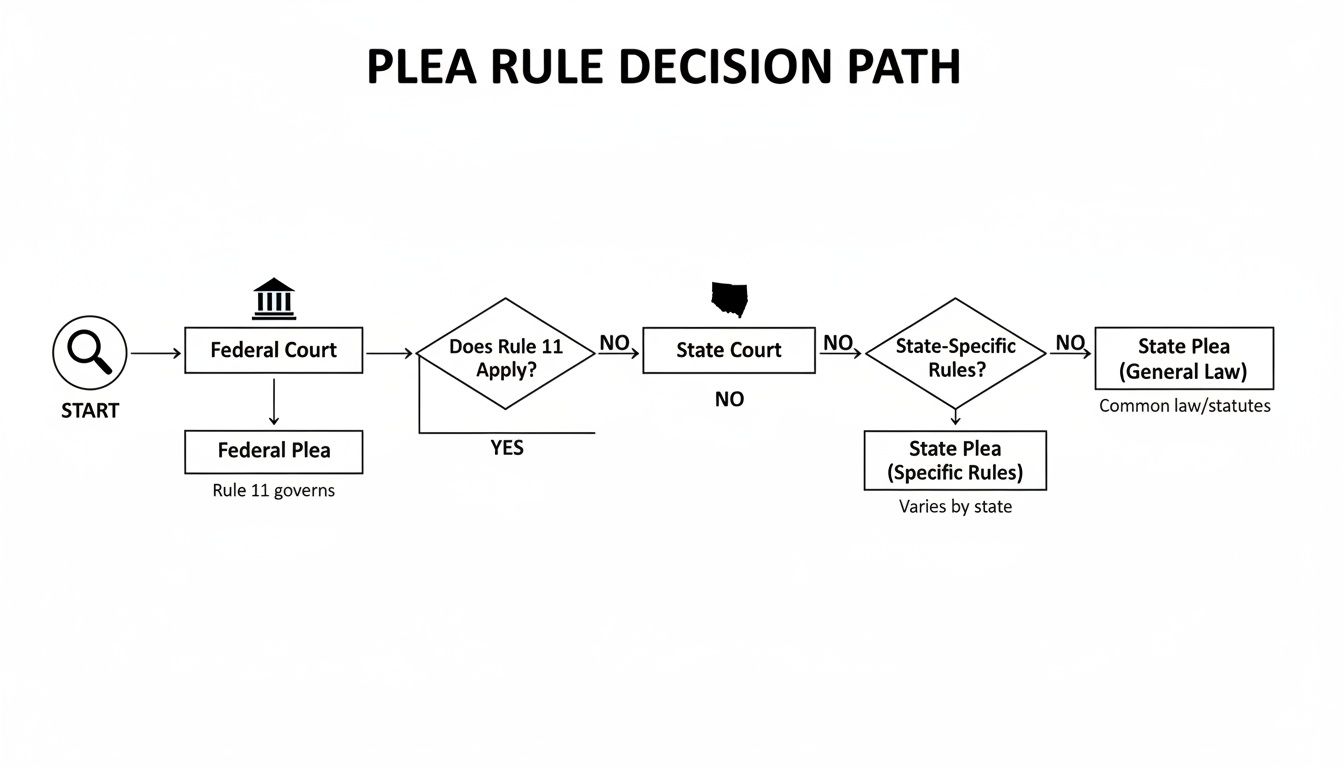
As you can see, the availability and strategic value of a no contest plea often come down to the specific court system handling your case.
The ultimate goal is to work with your legal team to make a strategic choice that protects your freedom, finances, and future. A well-considered plea isn’t an admission of defeat—it’s a tactical move designed to secure the best possible outcome under your specific circumstances.
Your attorney provides the legal roadmap, but you’re the one in the driver’s seat. For more guidance on this crucial partnership, you can learn more about how to choose the right attorney for your case. This collaborative approach is the only way to ensure your final decision truly aligns with your personal and professional priorities.
Common Questions About Criminal Pleas
When you’re facing criminal charges, the plea you enter is one of the most critical decisions you’ll make. The difference between not guilty vs no contest is often a point of confusion, yet it has massive implications for your future. Here are some clear answers to the questions our attorneys hear most often.
Is a No Contest Plea Always an Option?
Not at all. Whether you can plead “no contest” depends entirely on the court’s jurisdiction and the severity of the charge. Most courts see it as a practical tool to resolve minor cases—think misdemeanors and traffic offenses—without the time and expense of a full trial.
For serious felonies, however, judges are far more hesitant to accept a nolo contendere plea. The court’s permission is almost always required, and a judge will weigh the specific facts of the case before granting it. Your attorney is the only one who can tell you if this is a realistic path forward in your case.
Does Pleading No Contest Get You a Lighter Sentence?
This is a dangerous and widespread myth. No. From a criminal sentencing perspective, a “no contest” plea is treated exactly the same as a guilty plea. Once the judge accepts it, the case moves directly to sentencing, and the same guidelines and factors apply as if you had admitted guilt.
So, what’s the point? The strategic advantage of a no contest plea has nothing to do with the criminal sentence. Its real power is shielding you from civil liability by resolving the criminal case without a formal admission of guilt that could be used against you in a later lawsuit for damages.
Will the Sentence Be Worse If I Plead Not Guilty and Lose?
It can be, and it often is. This is what legal professionals call the “trial penalty.” Defendants who turn down a prosecutor’s plea offer and are later convicted at trial frequently receive a much harsher sentence than what was on the table.
Why does this happen? A plea bargain is an incentive for both sides to settle a case efficiently. By rejecting it, you force the state to expend significant resources on a trial. Once you’re convicted, the prosecutor has zero motivation to recommend the lenient sentence they offered before.
When facing a decision with lifelong consequences, securing counsel from a proven legal expert is non-negotiable. The Haute Lawyer Network offers a curated selection of the nation’s most respected legal professionals, each vetted for their distinguished careers and courtroom success. Find the right attorney to protect your future by exploring the network at https://hauteliving.com/lawyernetwork.