
Everyone knows the feeling. Your neighbor does something that drives you crazy. But when does their annoying behavior cross the line and become illegal harassment?
The law draws a clear distinction between a simple annoyance and targeted, illegal behavior. It all comes down to a pattern of intentional actions—what lawyers call a “course of conduct”—that serves no legitimate purpose and is designed to cause real emotional distress.
Think of it this way: a single loud party is frustrating, but it’s not harassment. But if that same neighbor starts blaring music directly at your bedroom window every single night? That’s a different story entirely.
Defining the Line Between Annoyance and Harassment
It’s a scenario many of us have faced. A neighbor’s actions start to chip away at your sense of peace and security at home. The critical question is, when does that disruption become something you can take legal action against?
The answer lies in understanding the difference between a one-off incident and a sustained campaign. Legally, harassment isn’t about a single bad day. It’s defined by a course of conduct, a persistent and unwelcome pattern of behavior over time. The law is there to protect you from targeted distress, not isolated frustrations.
The Three Pillars of a Harassment Claim
To successfully bring a harassment claim, you can’t just say your neighbor is annoying. You need to prove three specific things. Think of them as the three legs of a stool—without all three, your case will fall over.
- Intent to Harass: First, you have to show their actions are deliberate. They are meant to alarm, torment, or terrorize you. This is what separates an accidental disturbance, like a car alarm going off, from genuinely malicious behavior.
- A Pattern of Behavior: A single incident almost never counts. The behavior has to be repeated, establishing a clear and undeniable pattern. This proves it’s not just a simple disagreement that blew over.
- Severe Conduct: The actions must be serious enough that any “reasonable person” would suffer significant emotional distress. This objective standard is important—it prevents claims based on someone being overly sensitive.
From Nuisance to Harassment: What’s the Difference?
It helps to think about the difference between a nuisance and actual harassment. A nuisance is something that interferes with your ability to enjoy your property. For example, a neighbor who constantly lets their garbage cans overflow is creating a nuisance. It’s gross and annoying, but probably not intentionally aimed at you.
Harassment, on the other hand, feels personal because it is personal. It’s the difference between a dog that barks whenever someone walks by the house and a neighbor who purposely lets their dog out to bark at your fence every morning at 6 AM. One is a general annoyance; the other is a targeted, hostile act.
For an action to be considered harassment, it must generally lack any legitimate purpose. A neighbor building a new fence on the property line is a legitimate action, even if you hate the way it looks. But a neighbor repeatedly shining a high-powered floodlight into your bedroom window all night long? That serves no purpose other than to disturb you.
Understanding this distinction is the first and most critical step. A simple nuisance might be something you can resolve through your HOA or mediation. But true harassment often requires invoking the law to get a cease and desist letter or even a restraining order. Knowing where that line is empowers you to take the right steps to reclaim your peace.
Recognizing Common Forms of Neighbor Harassment
Harassment isn’t always a single, dramatic event. More often, it’s a slow burn—a series of small incidents that chip away at your sense of security until you’re constantly on edge. Recognizing these behaviors for what they are is the first, most critical step toward reclaiming your peace.
While some actions are openly hostile, many types of neighbor harassment are far more subtle. They’re designed to disrupt your life and create distress without leaving obvious fingerprints. By understanding the common patterns, you can start connecting the dots. What seemed like isolated annoyances can suddenly reveal themselves as a deliberate campaign, which is exactly what you need to build a solid case under neighbor harassment laws.
Psychological and Intimidating Tactics
This is where things get personal and direct. It’s when a disagreement morphs into something far more sinister: behavior intended to make you feel afraid in your own home. It’s no longer about a dispute over a fence line; it’s a power play designed to intimidate.
You’ll see this in a few key ways:
- Verbal Threats: Any explicit threat of harm aimed at you, your family, or even your pets.
- Constant Surveillance: This is beyond nosiness. It’s openly watching, following, or recording your movements to create an unnerving feeling of being constantly monitored.
- Aggressive Confrontations: Repeatedly yelling, using menacing body language, or physically blocking your path to your own property.
Property Damage and Deliberate Nuisance
When your neighbor’s actions start to physically affect your property or purposefully destroy your quiet enjoyment, they’ve crossed a major legal boundary. The good news? This kind of harassment is often much easier to prove because it leaves a trail of physical evidence.
Think of it as them weaponizing your shared environment. Common examples include:
- Vandalism: Intentionally damaging your fence, spray-painting your garage, destroying your garden, or keying your car.
- Targeted Noise: It’s not just a loud party. It’s blasting music directly at your bedroom wall at 2 AM, running a chainsaw for hours on end right by your home office, or constant, rhythmic banging specifically intended to drive you crazy.
- Trespassing: Repeatedly coming onto your property without permission, especially after you’ve clearly told them to stop.
A key legal distinction is that these actions serve no legitimate purpose. A neighbor using a leaf blower on their own lawn is normal. A neighbor aiming that leaf blower at your open windows every single morning is harassment.
Digital Harassment and Stalking
In our hyper-connected world, harassment has found a new playground: the internet. These digital attacks can feel just as invasive as physical ones, and the law is increasingly catching up to treat them with the same seriousness. As legal frameworks evolve, actions online are treated just as seriously as those offline. The evolution of these laws shows a global trend toward protecting individuals from harassment in all its forms. You can learn more about how harassment laws are adapting in other countries to get a broader perspective.
This modern form of harassment often includes:
- Online Defamation: Spreading lies and damaging rumors about you on social media, in neighborhood apps like Nextdoor, or on local community forums.
- Cyberstalking: Bombarding you with harassing emails or messages, creating fake profiles to spy on you, or posting your private information online (doxxing).
- Filing False Complaints: Repeatedly calling the police, animal control, or your HOA with baseless accusations designed to cause you official trouble and stress.
How to Build a Rock-Solid Evidence Log

When you’re dealing with neighbor harassment, your personal account is compelling, but a meticulously detailed evidence log is what wins cases. It’s the difference between a “he said, she said” dispute and presenting an undeniable, factual timeline that a judge, police officer, or landlord can act on.
Think of it this way: your log transforms a series of isolated, frustrating events into a clear, documented pattern. This is the “course of conduct” that sits at the very heart of most harassment laws. Without it, you just have stories. With it, you have proof.
What Every Entry Must Include
Consistency is everything. A few random notes won’t cut it, but a comprehensive, consistent log is incredibly authoritative. For every single incident—no matter how minor it seems at the time—you need to capture the same details. This builds a bulletproof record.
- Date and Time: Get specific. Pinpointing the exact moment something happened is far more powerful than a vague reference to “last week.”
- Detailed Description: Stick to the objective facts. Instead of saying your neighbor was “menacing,” describe what they actually did: “He stood on the property line and stared into my living room window for ten minutes without moving.”
- Witnesses: If anyone else saw or heard what happened, write down their name and contact information. Their corroboration is invaluable.
- Your Response: Note exactly what you did. Did you ask them to stop? Did you go inside and lock the door? This shows a judge you didn’t engage or escalate the situation.
The goal here isn’t just to remember what happened. It’s to create an objective, factual record that speaks for itself. This documentation is your single most important tool.
Gathering Different Types of Proof
Beyond your written notes, physical evidence can make your case irrefutable. But a word of caution: you must gather it legally. Any evidence obtained illegally will be thrown out in court and could even land you in legal trouble.
Consider supplementing your log with these types of proof:
- Photographs and Videos: Snap pictures of any vandalism, trespassing, or property damage. Video footage can capture excessive noise or intimidating behavior, but always check your state’s laws on recording other people first.
- Screenshots: Immediately save any harassing text messages, emails, or social media posts. Never delete them—they are direct evidence of intent.
- Police Reports: If you ever need to call the police, always request a copy of the official report. It’s an official record that validates your claims.
Your documentation is designed to build a case that is clear and easy for an outsider—like a lawyer or a judge—to understand. To help you stay organized, here is a simple checklist for every incident you record.
Harassment Documentation Checklist
| Element to Record | Why It’s Important | Example |
|---|---|---|
| Date and Exact Time | Establishes a precise timeline and shows frequency. | “March 15, 2024, at 10:17 PM” |
| Location | Pinpoints where the harassment occurred. | “On my front porch, near the mailbox” |
| Description of Events | Provides objective, factual details of what happened. | “Neighbor revved engine for 5 min, facing my bedroom window.” |
| Direct Quotes | Captures the exact words used, which can prove intent. | “He shouted, ‘I know when you’re home alone!'” |
| Witnesses | Adds third-party credibility to your account. | “Jane Doe (neighbor at 125 Main St) saw it from her window.” |
| Your Response | Shows you acted reasonably and did not provoke the incident. | “I went inside, locked the door, and did not engage.” |
| Associated Evidence | Links your written entry to physical proof. | “Took a 30-second video on my phone (File: IMG_4562.mov)” |
Using this checklist for every entry ensures you’re not just creating a diary, but a powerful legal tool.
Once you have this evidence organized, you’ll be ready to consult with an attorney. It’s helpful to know how those conversations are protected. You can read more about what is attorney-client privilege to understand how your communications will remain confidential. This level of careful preparation is the key to successfully using the law to restore your peace.
Your Legal Options for Stopping the Harassment
When you’re facing a relentless campaign of harassment from a neighbor, it’s easy to feel trapped and powerless. Fortunately, the law provides a clear, escalating pathway to reclaim your peace. Your actions can range from formal warnings to court-ordered protection, with each step building on the last.
The key is to start with the least confrontational, yet official, option first. This strategic approach not only shows you’ve made good-faith efforts to resolve the problem, but it also methodically builds a stronger case if you need to take more serious measures down the line.
Start with a Cease and Desist Letter
Think of a cease and desist letter as a formal, legal warning shot. It’s not a court order, but it’s a powerful document that officially puts your neighbor on notice. The letter clearly outlines the specific harassing behaviors, states that they violate neighbor harassment laws, and demands an immediate stop to the conduct.
Sending this letter, especially when drafted by an attorney, signals that you are serious and prepared to pursue legal action. It instantly elevates the dispute from a personal disagreement to a formal legal matter, creating a crucial piece of evidence that you tried to resolve things before escalating.
File a Police Report
If the harassment continues after the letter—or if it ever involves threats, vandalism, or physical intimidation—your next move is to contact law enforcement. Filing a police report is absolutely essential for creating an official, third-party record of what’s been happening.
When the police arrive, calmly and factually present your evidence log. Even if they don’t make an arrest on the spot, the report itself becomes a vital part of your documentation. Multiple police reports establish a clear pattern of behavior that will be invaluable if you later need to seek a restraining order.
A police report serves as official validation of your claims. It demonstrates to a court that the situation was severe enough to warrant law enforcement intervention, adding significant weight to your side of the story.
Seek a Restraining Order
For severe or persistent harassment, you can petition a court for a restraining order, often called a protective order. This is a legally enforceable directive that prohibits your neighbor from contacting you, coming within a certain distance of you or your property, or continuing any harassing behaviors.
To get one, you’ll need to present compelling evidence—your detailed log, photos, videos, witness statements, and police reports—to a judge. If the judge agrees that you are facing credible harassment, they will issue the order. Violating a restraining order is a criminal offense, frequently resulting in immediate arrest, making it one of the most effective tools for stopping harassment for good.
Consider a Civil Lawsuit
Your final option is to file a civil lawsuit against your neighbor. This legal action allows you to seek monetary damages for the harm you’ve suffered. You can sue for things like:
- Emotional Distress: Compensation for the anxiety, fear, and psychological harm the harassment has caused.
- Loss of Quiet Enjoyment: Damages for being deprived of the ability to peacefully live in and enjoy your own home.
- Property Damage: Full reimbursement for any costs related to vandalism or other property destruction.
A lawsuit is a significant step, and finding the right legal professional is critical for a successful outcome. To learn more about this process, our guide on how to find an attorney offers valuable insights. Taking this step can provide not just financial relief but also a powerful sense of justice.
Involving Your Landlord or HOA
If you live in a rental or a community managed by a Homeowners’ Association (HOA), you aren’t alone in this fight. These organizations aren’t just passive observers; they often have a clear legal and contractual duty to step in. For renters, this power comes from a concept baked into every lease: the covenant of quiet enjoyment.
Think of it as an unspoken promise from your landlord that you’ll be able to live in your home without being subjected to constant, unreasonable disruptions. When a neighbor’s harassment destroys that peace, it’s not just a dispute between two residents—it’s a potential lease violation that your landlord may be obligated to fix. Likewise, HOAs have governing documents that almost always prohibit nuisance behavior, giving them the power—and responsibility—to enforce the rules against a problem resident.
How to Formally Report Harassment
When you decide it’s time to bring in your landlord or HOA, a casual phone call won’t cut it. Your approach needs to be formal, factual, and backed by solid proof.
- Draft a Formal Letter or Email: Address it directly to your property manager or the HOA board. Clearly state that you are reporting an ongoing harassment problem that violates your right to quiet enjoyment or the community’s established rules.
- Provide a Factual Summary: Briefly lay out what’s been happening. Ditch the emotional language and stick to the objective facts you’ve recorded in your log.
- Attach Your Evidence: This is where you make your case undeniable. Include a copy of your detailed log, any relevant photos, screenshots of harassing messages, and police report numbers. This turns your complaint from a simple grievance into a documented legal issue they can’t ignore.
Putting this in writing creates a formal record that legally notifies your landlord or HOA. If they fail to take reasonable action, they could be held liable for breaching their duties to you. This is precisely why a paper trail is essential.
What happens next can vary. A common first step is for the landlord or HOA to issue a formal warning or a “cease and desist” letter to your neighbor. If that doesn’t work, they can escalate to fines or even begin eviction proceedings against a tenant causing the harassment.
Property managers are more motivated than ever to handle these situations decisively. In 2023 alone, the Department of Justice saw a 66.23% increase in housing harassment complaints, highlighting the serious legal risks landlords face when they choose to look the other way. You can see more data on this trend in the National Fair Housing Alliance’s recent report.
Navigating property rules and landlord obligations can get complicated. For complex cases, it’s wise to get professional advice from experts in real estate law who can clarify your rights and help you determine the best path forward.
How Harassment Laws Vary by State and Country
If you’re dealing with a neighbor from hell, you might assume there’s a single, nationwide rulebook to consult. There isn’t. When it comes to neighbor harassment, there is no overarching federal law that applies everywhere. Instead, you’re looking at a patchwork of state and local laws.
This means that what legally counts as harassment—and what you can do about it—can change dramatically just by crossing a state line. The process for getting a restraining order, the kind of evidence you need, and even the penalties your neighbor could face are all determined at the state level. This approach allows communities to set their own standards, but it can make things confusing.
State-Specific Differences in Harassment Laws
Let’s look at a real-world example. In California, you can get a civil harassment restraining order if someone’s behavior “seriously alarms, annoys, or harasses” you without any legitimate reason. The focus is on a pattern of conduct.
Head over to Texas, and the legal framework is different. The same situation might be classified under disorderly conduct or stalking laws, which often demand a different type of evidence to get legal protection. It’s a subtle but critical distinction.
These state-by-state variations have a huge impact on your case:
- What is “harassment”? Some states have a very clear definition of what a “course of conduct” looks like, while others treat incidents more individually.
- The burden of proof: Proving your neighbor’s intent can be much tougher in certain states, which may have a higher standard for evidence.
- What you can get: The damages you can sue for in civil court or the protections included in a court order are entirely dependent on state statutes.
And it’s not just you and your neighbor involved. Landlords often play a key role, and their responsibilities are also dictated by local and state law.
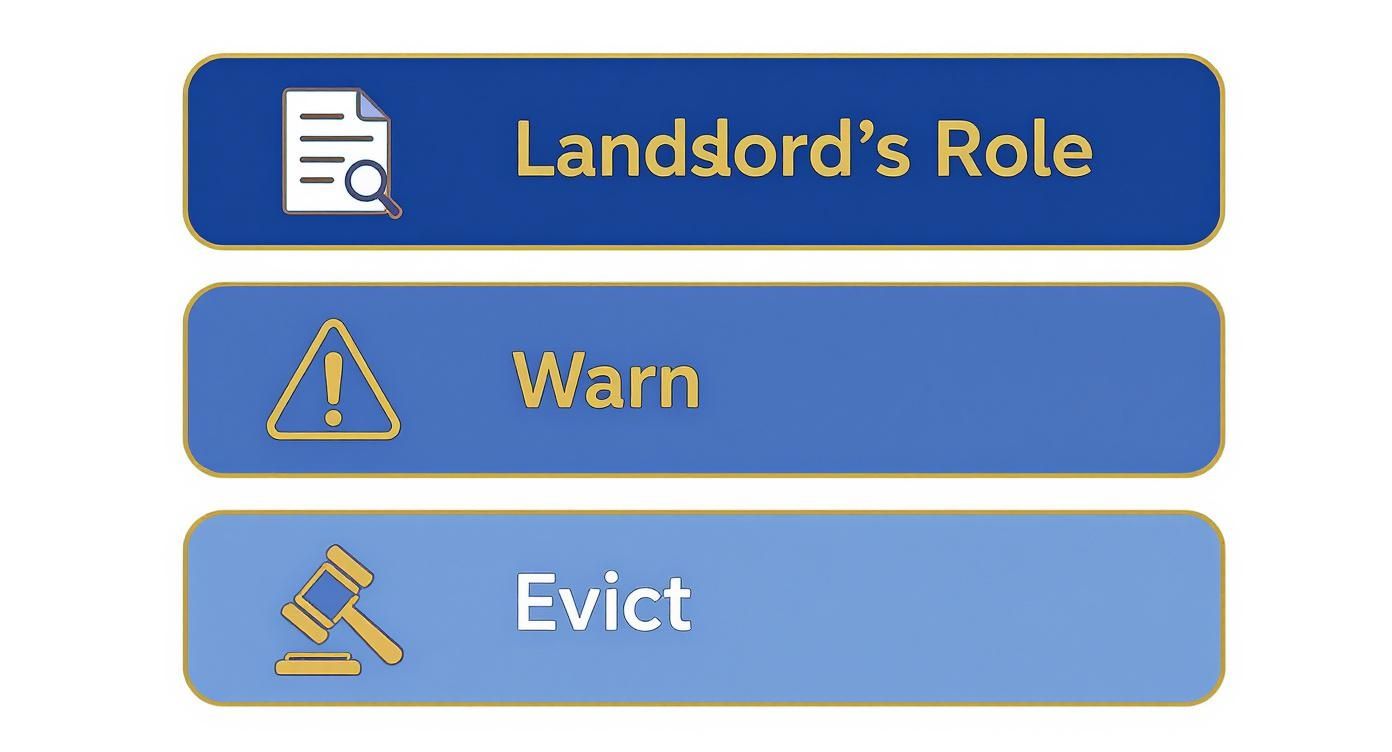
As you can see, a landlord’s power to intervene often follows a clear escalation path—from official reports to warnings and, as a last resort, eviction.
Harassment is not just a domestic issue; it’s a global one. The broader trend shows countries strengthening legal protections against intimidating behaviors in communities and workplaces.
This isn’t just an American problem. There’s a growing international movement to take harassment more seriously in all its forms. One report on global rights found that incidents of harassment and violence nearly doubled in a single year across multiple regions. While that study focused on labor rights, its findings reflect a worldwide demand for stronger laws protecting people’s safety and peace of mind. You can explore the full Global Rights Index findings to see the data for yourself.
Common Questions About Neighbor Harassment
When you’re dealing with a difficult neighbor, the legal lines can feel blurry. Understanding your rights is the first step toward reclaiming your peace of mind. Here are some straightforward answers to the questions we see most often.
What’s the Real Difference Between Annoyance and Legal Harassment?
This is where many people get stuck. The key isn’t a single incident—it’s the pattern and intent. A one-off loud party or a dog that barks occasionally is just an annoyance.
Legal harassment, on the other hand, is a deliberate course of conduct. Think repeated, targeted actions that have no legitimate purpose other than to alarm, torment, or cause you serious distress. Courts are looking for that persistent, intentional behavior, not an isolated argument over a parking spot.
Can I Legally Record My Neighbor?
This is a tricky area because the laws vary significantly from state to state. In “one-party consent” states, you’re generally free to record any conversation you are a part of.
However, in “two-party consent” states, you need everyone’s permission to hit record. While you can typically film things that are in plain public view from your property, pointing a camera where someone has a reasonable expectation of privacy—like through their bedroom window—is illegal everywhere. Before you do anything, check your local statutes.
I’m Worried Calling the Police Will Make Things Worse. Should I?
It’s a completely valid concern. Involving law enforcement can absolutely escalate an already tense situation. But if you’re facing credible threats, if your property is being damaged, or if you genuinely feel unsafe, it’s time to make the call.
Calling the police accomplishes two critical things: it provides immediate intervention to ensure your safety, and it creates an official report. That police report becomes a crucial piece of evidence if you later need to pursue a restraining order.
While taking legal action can be expensive, you have options. A formal cease and desist letter from an attorney might only cost a few hundred dollars. For more serious cases requiring a civil lawsuit, many local legal aid societies offer free or low-cost help.
When your peace and property are on the line, you need a trusted legal advocate. The Haute Lawyer Network is a curated selection of the nation’s top attorneys, connecting you with premier representation. Find the right legal professional to protect your rights by visiting the Haute Lawyer Network.