As an employer, you’re not just managing people; you’re navigating a complex web of rules that govern the entire employee relationship. This is the world of employment law. Getting it right isn’t just about dodging lawsuits—it’s the very blueprint for building a fair, secure, and high-performing workplace. Frankly, understanding this framework is the single best strategy for minimizing risk and making confident business decisions.
Your Guide to Modern Employment Law

Keeping up with employment law can feel like trying to assemble a puzzle where the pieces are constantly changing shape. This guide is your practical roadmap, designed to demystify the rules that impact your business from an applicant’s first interview to an employee’s final paycheck. We’ll show you how to look at these regulations not as obstacles, but as powerful tools for success.
Think of it as the foundation of your entire company. A weak foundation will eventually lead to costly cracks and instability. A strong legal foundation, on the other hand, supports sustainable growth, fosters a positive culture, and shields your business from unnecessary liability.
Why Compliance Is More Than a Checklist
Simply ticking boxes to follow the rules is the bare minimum. True compliance means weaving these legal principles directly into your company’s DNA. This requires a shift from a reactive stance—only dealing with problems as they flare up—to a proactive approach to managing your workplace.
This proactive mindset turns what feel like legal burdens into real business advantages. It helps you:
- Attract and retain top talent: A reputation for fairness is one of the most powerful recruiting tools you have.
- Improve morale and productivity: When people feel secure and valued, their performance skyrockets.
- Slash the risk of costly litigation: Proactive measures are always cheaper than defending a lawsuit.
- Strengthen your brand: Your internal culture has a direct and undeniable impact on how the public sees you.
The Ever-Changing Legal Landscape
The way we work is constantly evolving, and employment law is always running to keep up. New technologies and shifting social norms create fresh challenges for every business owner. For instance, as new regulations emerge to govern the use of AI in hiring, employers have to stay informed to remain compliant. In fact, understanding how artificial intelligence is revolutionizing legal practice in 2025 is quickly becoming essential for any modern leader.
Staying current isn’t just a best practice; it’s a core business function. Legislative updates, new court rulings, and federal agency guidance can change your responsibilities overnight.
This guide will serve as your foundational tour of this dynamic legal field. We’ll give you the knowledge you need to build a resilient and compliant organization, one that’s ready to face the challenges of today and tomorrow.
Building Your Team on a Solid Legal Foundation
Your legal duties as an employer kick in the very moment you decide to hire. This isn’t just about filling out forms; it’s about constructing your team on a compliant foundation that minimizes your legal exposure from day one. Every single step, from crafting the job description to sending the offer letter, is loaded with legal significance.
Think of the hiring process like building a house. You wouldn’t dream of putting up walls without first pouring a solid concrete foundation. In the same way, you shouldn’t bring a new employee into your company without a clear, compliant, and legally sound hiring framework already in place.
Crafting Compliant Job Descriptions
Your job description is the first document candidates see, making it a critical piece of employment law for employers to nail down. While its main job is to attract top talent, it also serves a vital legal purpose. A properly written description sticks exclusively to the essential functions and genuine qualifications for the role.
This means you must avoid any language that could even hint at discrimination. For example, instead of asking for a “recent graduate,” which could be seen as age discrimination, you should specify the required skills or number of years of experience. Always focus on what the job demands, not the type of person you picture doing it.
Conducting Lawful and Effective Interviews
The interview is where many well-meaning employers accidentally step onto a legal landmine. Your goal is to find the best fit, but certain questions veer into legally protected territory and can get you into serious trouble. It is illegal to ask candidates about their:
- Age, race, or national origin: These details have absolutely no bearing on someone’s ability to perform a job.
- Religion or marital status: A candidate’s personal life is off-limits and asking about it can easily lead to discrimination claims.
- Disability or medical history: You can only ask if a candidate can perform the essential duties of the job, with or without a reasonable accommodation.
- Pregnancy status or family plans: Questions about children or future family plans are blatantly discriminatory.
Instead, build your interview around behavioral and situational questions that directly relate to the job’s duties. For instance, rather than asking about their childcare arrangements, you can ask, “This position requires travel one week per month. Is that something you can commit to?” This keeps the conversation centered on professional capabilities, not private circumstances.
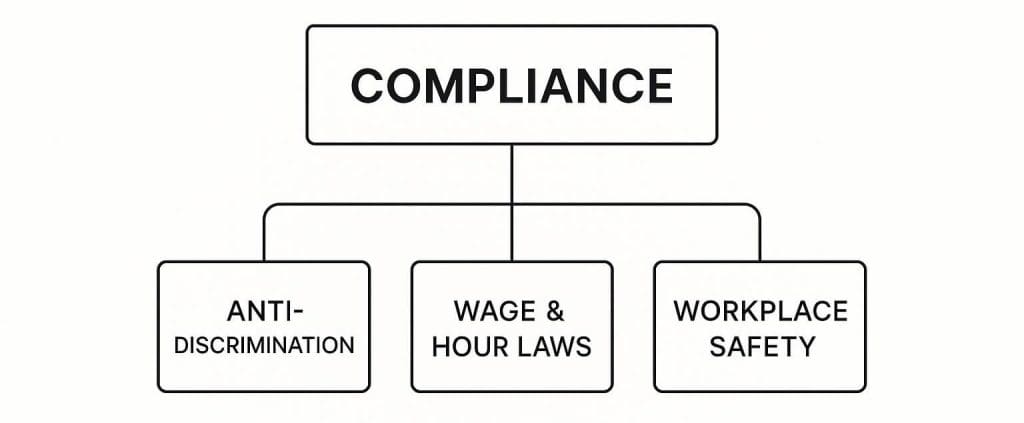
The diagram above shows how the core pillars of compliance—anti-discrimination, wage and hour rules, and workplace safety—all connect to create a comprehensive legal framework. It’s a great reminder that you need a holistic approach to stay protected.
The following table breaks down the key legal checkpoints you need to hit throughout the hiring process. It’s a quick reference to ensure you’re not missing a critical step.
Critical Legal Checkpoints in the Hiring Process
| Hiring Stage | Key Legal Consideration | Actionable Tip for Employers |
|---|---|---|
| Job Posting | Anti-Discrimination Laws (Title VII, ADEA, ADA) | Focus job descriptions on essential functions and qualifications. Avoid language implying preferences for age, gender, etc. |
| Application Review | Consistent Evaluation Criteria | Develop a standardized rubric to evaluate all candidates against the same job-related criteria to prevent bias. |
| Interviewing | Avoiding Prohibited Inquiries | Train interviewers to only ask behavioral and situational questions directly related to job duties. Create a list of “off-limits” topics. |
| Background Checks | Fair Credit Reporting Act (FCRA) Compliance | Always get written consent from the candidate before running a background check. Follow strict notification procedures if the results impact your hiring decision. |
| Offer Letter | Clear and Unambiguous Terms | Clearly state the job title, salary, start date, and “at-will” employment status to prevent future contract disputes. Have legal counsel review your template. |
| Onboarding | I-9 and W-4 Compliance | Complete and verify the Form I-9 within 3 days of the employee’s start date to confirm work eligibility. Ensure all tax forms are correctly filled out. |
Following these checkpoints doesn’t just keep you compliant; it establishes a professional and respectful tone with your new hires from the very beginning.
Managing Background Checks and Offer Letters
So, you’ve found your ideal candidate. Now it’s time for background checks and the formal offer. If you run background checks, you must adhere to the Fair Credit Reporting Act (FCRA). This means getting the candidate’s written consent before you start the check and following a very specific protocol if you decide against hiring them based on what you find.
Your offer letter is much more than a welcome packet—it’s a foundational legal document. It must clearly outline the core terms of employment, including:
- Job title and key responsibilities
- Official start date
- Salary and pay schedule
- Who they will report to
- At-will employment status (if applicable)
An employment contract or offer letter sets the initial terms of the legal relationship. Ambiguity in this document can lead to significant disputes down the road, so clarity is your best defense.
The legal landscape around hiring is constantly evolving, especially with new technology. International employment law is changing fast, with major developments expected in 2025. Experts predict more transparency requirements for AI hiring tools, largely driven by regulations like the EU’s AI Act, and a bigger push for pay equity through mandatory salary range disclosures. Staying informed about the nuances of labor & employment law is non-negotiable for any business today.
Finally, proper onboarding is your last critical checkpoint. This includes completing the Form I-9 to verify employment eligibility within three days of the employee’s start date. A structured, compliant hiring process not only shields your business from legal risk but also kicks off a positive and professional relationship with your new team member.
Getting Pay and Classification Right

If there’s one area of employment law for employers that’s a minefield, it’s getting pay right. Small mistakes here don’t just stay small—they have a nasty habit of snowballing into massive liabilities. This is the domain of the Fair Labor Standards Act (FLSA), a federal law that dictates the basic financial contract between you and your people.
The FLSA sets the rules for federal minimum wage, overtime, and what records you need to keep. While there’s a federal floor for minimum wage, many states and even cities have set their own, higher bars. Your obligation is simple but absolute: you must always pay whichever rate is highest, be it local, state, or federal.
Exempt vs. Non-Exempt Employees Explained
This is where so many businesses get into trouble. The distinction between exempt and non-exempt employees is one of the most critical classifications you’ll make, as it determines who gets overtime pay.
Think of it this way: non-exempt employees are paid for the time they put in, while exempt employees are paid a salary to get the job done, however long it takes.
- Non-Exempt Employees: These are your team members who must be paid overtime—at least 1.5 times their regular pay rate—for every hour worked over 40 in a week. This almost always includes hourly staff in roles like administration, customer service, or production.
- Exempt Employees: To be exempt, an employee has to pass very specific “duties tests” and meet a minimum salary threshold. These tests are strict and typically apply to executive, administrative, professional, and certain sales or computer-related positions.
Misclassifying someone as exempt is an expensive mistake. If you get it wrong, you could be on the hook for years of back-pay for unpaid overtime, plus significant penalties.
The Employee vs. Independent Contractor Dilemma
Right behind exempt/non-exempt issues is the temptation to classify workers as independent contractors. It’s easy to see the appeal—no payroll taxes, no benefits costs, less paperwork. But the Department of Labor and the IRS are incredibly strict about this.
Here’s a simple mental model: you hire a plumber to fix a burst pipe. You don’t tell them how to do their job, what tools to use, or what hours to work. That’s a contractor. Now, imagine you bring on a “consultant” who works from your office, on your schedule, using your computer, and taking direction from your managers. That person isn’t a contractor; they’re an employee.
The legal test boils down to one word: control. The more control you have over the how, when, and where of the work, the more certain it is that you have an employee on your hands.
Getting this wrong can lead to devastating financial consequences, from back taxes and benefit contributions to overtime wages. It’s a risk that’s rarely worth the reward.
Maintaining Flawless Payroll Records
Your best defense in any wage and hour dispute is bulletproof record-keeping. The FLSA mandates that you keep meticulous records for every single non-exempt employee, showing exactly when they worked and what they were paid.
This isn’t just good bookkeeping; it’s a legal requirement. Your records must clearly document:
- Hours Worked: Precise time logs for each non-exempt worker.
- Regular Pay Rate: The employee’s base hourly wage.
- Overtime Earnings: A clear calculation showing all overtime pay.
- Total Wages: A complete record of all compensation paid.
In a legal challenge, these records are your proof of compliance. If your records are sloppy or missing, defending against a claim becomes nearly impossible. Mastering pay and classification isn’t just about administrative hassle—it’s about building a fundamentally sound and legally defensible business.
Creating a Fair and Respectful Workplace
Beyond the black-and-white rules of payroll and hiring, a truly compliant business is built on a foundation of fairness. This isn’t just about creating a positive culture; it’s a non-negotiable legal mandate. At its heart, this means preventing discrimination, harassment, and retaliation—three distinct but often tangled legal minefields.
Don’t think of these as isolated HR incidents. See them as symptoms of a bigger environmental problem in your workplace. A single inappropriate joke might seem small, but it can be the first crack in the dam. Effective employment law for employers isn’t about patching those cracks; it’s about building a culture so solid they never appear in the first place.
Understanding and Preventing Discrimination
Workplace discrimination happens when you take an “adverse action” against an employee because they belong to a protected class. This covers the big decisions—hiring, firing, pay, promotions—but also the smaller, everyday ones. The list of protected characteristics is extensive, including race, gender, religion, age, disability, and national origin.
While most employers know better than to make overtly biased statements, discrimination often operates in the shadows. Think about patterns: consistently giving less desirable projects to older workers or passing over qualified women for leadership roles. Even without explicit intent, these patterns can build a powerful case for discrimination.
The antidote is objective consistency. Implement standardized, merit-based criteria for all employment decisions, from performance reviews to promotion tracks. This creates a fair, defensible process where every decision is based on performance, not prejudice.
Taking a Zero-Tolerance Stance on Harassment
Harassment is a toxic form of discrimination. It’s any unwelcome conduct based on a protected characteristic that becomes so severe or pervasive it creates what a reasonable person would call an intimidating, hostile, or abusive work environment.
It’s a common mistake to think this is just about quid pro quo sexual harassment, where a manager demands favors for job perks. The reality is much broader.
- Hostile Work Environment: This can be built from offensive jokes, slurs, displaying inappropriate images, or any other behavior that makes an employee feel unsafe because of who they are.
- Third-Party Harassment: You can also be on the hook for harassment from non-employees, like clients or vendors. If you know it’s happening and don’t take action, the liability can fall on you.
A strong anti-harassment policy is more than a legal document—it’s a public declaration of your company’s values. It needs to be clearly communicated, regularly reinforced with training, and, most importantly, enforced without exception.
The Critical Importance of Preventing Retaliation
Retaliation is, hands down, one of the most common claims employees file, and it’s a trap that’s surprisingly easy to fall into. It happens when an employer takes any adverse action against an employee for engaging in legally protected activity—most often, for reporting discrimination or harassment.
The “adverse action” doesn’t have to be as dramatic as a firing. It could be a demotion, a sudden negative performance review, an inconvenient shift change, or even just icing someone out of key meetings after they’ve raised a concern.
Protecting employees who speak up is non-negotiable. Your reporting system must be a safe harbor, where people can raise issues without fearing reprisal. This builds the trust you need to solve problems internally before they explode into costly legal battles.
Globally, employment laws are constantly evolving to strengthen these protections. For example, starting in May 2025, new rules in some jurisdictions will prevent automatic contract termination for severe disability, requiring employers to first explore reasonable adjustments. Courts in Spain now require employers to give employees a chance to defend themselves before a disciplinary dismissal. These shifts signal a worldwide trend toward procedural fairness, and you can explore more international employment law updates to stay ahead of the curve. Your commitment to a fair workplace has to evolve right along with these standards.
Managing Employee Leave and Accommodations

Life happens. Your employees will face medical crises, welcome new children, and observe deeply held religious beliefs. Your job as an employer is to navigate these very personal needs while keeping the business running—all within a complex legal framework designed to protect your people.
This area of employment law for employers is a real balancing act, demanding both compassion and strict procedural diligence. It’s not just about approving time off. It’s about knowing your obligations inside and out under critical laws like the Family and Medical Leave Act (FMLA) and the Americans with Disabilities Act (ADA).
Understanding Major Leave Laws
The Family and Medical Leave Act is a cornerstone of this landscape. For eligible employees at covered businesses (typically those with 50 or more employees), the FMLA provides up to 12 weeks of unpaid, job-protected leave each year. Think of it as a critical safety net for people dealing with major life events.
The reasons for FMLA leave are very specific and include:
- The birth and care of a newborn child.
- The placement of a child for adoption or foster care.
- Caring for an immediate family member (spouse, child, or parent) with a serious health condition.
- An employee’s own serious health condition that prevents them from doing their job.
- Certain situations that come up when a family member is on active military duty.
Your responsibility kicks in the moment you recognize a potential FMLA situation. You must provide the right notices and forms, keep the employee’s health benefits active during their leave, and—this is key—restore them to their original job or an equivalent position when they return.
The Duty to Provide Reasonable Accommodations
Beyond major leave events, employers have an ongoing duty to provide reasonable accommodations for employees with disabilities and for sincerely held religious practices. This is a proactive responsibility, not a passive one. It means you may have to adjust a job, tweak the work environment, or modify a policy so a qualified employee can perform their duties.
An accommodation is really just a bridge that helps an employee overcome a barrier created by their disability or religious need. It isn’t about giving someone an unfair advantage; it’s about giving them an equal shot at success.
For example, a reasonable accommodation might look like:
- For a disability: Providing an ergonomic keyboard for someone with carpal tunnel, allowing a flexible schedule for an employee undergoing medical treatments, or reassigning non-essential job tasks.
- For religion: Adjusting a work schedule so an employee can attend a weekly religious service, making an exception to the dress code for religious headwear, or designating a quiet space for prayer.
The crucial terms here are “reasonable” and “undue hardship.” The accommodation can’t cripple your business operations.
The interactive process isn’t a negotiation to be won or lost. It’s a collaborative, good-faith conversation aimed at finding a workable solution that respects an employee’s needs while preserving business operations.
Mastering the Interactive Process
When an employee requests an accommodation, the law doesn’t just expect a ‘yes’ or ‘no.’ It requires you to engage in an interactive process. In plain terms, this is a structured conversation between you and the employee to figure out the nature of their limitation and what could possibly help.
This conversation is your single most important compliance tool. It’s about listening, gathering relevant information (like a doctor’s note, when appropriate), and brainstorming potential solutions together.
Make sure you document every single step of this process. Note the initial request, summarize your conversations, list the options you considered, and record the final decision. This paper trail is your best defense against potential claims, proving you took your obligations seriously and acted in good faith to find a fair solution.
Navigating Employee Departures with Confidence
How you handle an employee’s exit is just as legally significant as how you brought them on board. When it comes to terminations, discipline, and layoffs, you need a smart approach that minimizes legal risk while still treating people with respect. It all boils down to two things: clear communication and ironclad documentation.
Think of an employee’s personnel file as the official story of their time with you. Consistent, fact-based records of performance issues, disciplinary warnings, and policy violations are your single strongest defense against claims of wrongful termination or discrimination. Without that paper trail, a firing can look abrupt and baseless, swinging the courthouse doors wide open.
Understanding At-Will Employment and Its Limits
Most states operate under the principle of at-will employment. In simple terms, this means either you or the employee can end the relationship at any time, for any reason—or even for no reason at all. But this is not the “get out of jail free” card many employers think it is.
Crucially, “any reason” cannot be an illegal one. You can’t fire someone because of their race, gender, age, disability, or any other protected status. You also can’t let them go for exercising a legal right, like filing a workers’ compensation claim or reporting harassment. This is precisely why documentation is so critical—it proves the termination was based on legitimate business needs, not discrimination.
A common mistake is assuming “at-will” employment is an absolute shield. In reality, it operates within the strict boundaries of anti-discrimination and anti-retaliation laws.
Getting this wrong can be financially devastating. A poorly handled termination can quickly spiral into a costly legal battle, with some cases resulting in staggering multi-million dollar verdicts. To see how these situations play out in the real world, you can read about a $2.3 million wrongful termination case and how employment law is changing.
Best Practices for Professional Terminations
When a termination is the only option left, the process itself needs to be handled with complete professionalism. The meeting should be brief, direct, and respectful.
- Be Prepared: Have all the necessary paperwork ready to go, including the final paycheck and information on benefits continuation.
- Be Clear and Concise: State the decision clearly and stick to the facts. This is not the time for a lengthy debate or argument.
- Have a Witness: It’s always a smart move to have another manager or an HR representative present during the conversation.
Finally, make sure you know the rules for final paychecks and severance agreements. Many states have strict deadlines for paying a departing employee’s final wages. If you offer a severance package, it should be in exchange for a release of legal claims—a document that absolutely must be drafted or reviewed by your legal counsel.
Common Questions on Employment Law
Even with a firm grasp of the big picture, the day-to-day realities of employment law for employers can get tricky. When specific situations pop up, you need clear answers. Here are some of the most frequent challenges business owners find themselves wrestling with.
What Is the Biggest Legal Mistake Small Business Owners Make?
Hands down, it’s misclassifying employees as independent contractors. The temptation is obvious—avoiding payroll taxes, overtime, and benefits—but the government applies incredibly strict tests to determine a worker’s real status.
Getting this wrong can be financially devastating. A misclassification can trigger years of back pay for unpaid overtime, crushing tax liabilities, and steep fines. Before you ever label someone a contractor, you have to understand the legal criteria. The potential savings are almost never worth the risk.
The entire legal test for worker classification boils down to a single concept: control. The more you dictate how, when, and where the work gets done, the more certain it is that you have an employee, not a contractor.
Do I Need an Employee Handbook for a Small Team?
Absolutely. A common misconception is that handbooks are only for large corporations, but they are a critical tool for a business of any size. It’s your opportunity to establish clear expectations, outline non-negotiable policies like anti-harassment rules, and create a consistent framework for managing your people.
Think of your handbook as the company’s constitution. When a dispute arises, a well-drafted handbook is often your single best piece of evidence to defend against claims of discrimination or unfair treatment. It proves you have established, impartial policies that apply to every single person on your team.
How Should I Handle an Employee Accommodation Request?
When an employee asks for an accommodation for a disability or religious practice, the law requires you to engage in an “interactive process.” This is just a formal way of saying you need to have a good-faith conversation to understand their needs and explore potential solutions.
A “reasonable accommodation” is the goal. You aren’t automatically required to provide the exact thing they ask for if another effective option exists, or if the request would cause an “undue hardship” on your business. The most critical step here is to document everything—every conversation, every option you considered, and the final decision you made and why.
Navigating the complexities of employment law requires genuine expertise. For attorneys looking to elevate their practice and connect with high-net-worth clients, Haute Lawyer Network provides a premier platform for visibility and branding. Discover how we connect the nation’s top legal professionals with an elite audience at https://hauteliving.com/lawyernetwork.