
Let’s be honest. A marketing plan isn’t just a document; it’s the strategic blueprint that separates the firms that thrive from those that merely survive. It’s your roadmap for defining precisely who you want to represent, articulating your unique value, and then executing a disciplined plan to attract those high-value cases.
This isn’t about random acts of marketing. It’s about building an intentional, measurable system for growth that ensures every dollar you invest and every hour you spend is aimed squarely at elevating your firm’s prestige and profitability.
Why Your Law Firm Needs a Real Marketing Plan

Most of us went to law school to practice law, not to become marketers. For generations, a sterling reputation and a steady stream of word-of-mouth referrals were all it took to build a successful practice.
That world is gone.
Relying solely on your existing network today is a slow, unpredictable path to growth. The entire client journey has shifted online. A staggering 96% of potential clients now begin their search for legal counsel on Google. This is exactly why sophisticated firms now allocate nearly 65% of their marketing budgets to digital channels, moving away from outdated print ads and directories.
Moving from Reactive to Proactive Growth
Without a documented plan, most firms fall into a familiar, frustrating pattern: a sporadic blog post, an occasional social media update, a last-minute sponsorship. This approach is rudderless and, unsurprisingly, delivers inconsistent results at best.
A formal marketing plan flips the script, moving your firm from a reactive stance to a proactive one. Think of it as the architectural drawings for your firm’s future. It aligns your ultimate business goals with concrete, actionable marketing efforts.
A well-designed plan empowers you to:
- Define Your Focus: Pinpoint the exact high-value clients you want to attract instead of just taking any case that walks through the door.
- Allocate Resources Wisely: Make strategic, data-informed decisions about where to invest your time and capital for the highest possible return.
- Measure What Matters: Track key performance indicators (KPIs) to see precisely what’s working and what isn’t, allowing you to double down on success.
- Build a Predictable Pipeline: Engineer a consistent flow of qualified leads, finally smoothing out that “feast or famine” cycle that plagues so many solo practitioners and small firms.
A great marketing plan doesn’t turn you into a salesperson. It builds a system that consistently showcases your expertise and attracts the right clients with integrity and authority.
Ultimately, a marketing plan isn’t about flashy ads or compromising your professional standards. It’s about intentional, sophisticated business development. It allows you to grow your firm with purpose, enhance your reputation as a leading authority, and ensure a steady stream of the exact cases you were meant to handle.
To get started, it helps to review some essential attorney marketing strategies that build a powerful foundation for growth.
Defining Your Firm and Attracting Your Ideal Client
Before you spend a single dollar on a Google ad or a fancy brochure, the most critical work begins. Any serious marketing plan for a law firm rests on two pillars: knowing what makes you different, and knowing exactly who you serve.
Get this part wrong, and you’re just throwing money into the wind. Your marketing becomes a series of expensive, disconnected guesses. You end up with a generic message that attracts a bit of everything but fails to land the high-value cases that truly build a practice. The goal here is to get brutally specific.
Articulating Your Unique Value Proposition
Your Unique Value Proposition (UVP) is the soul of your brand. It’s the answer to the question, “Why should I hire you over every other lawyer in town?” It’s not about what you do; it’s about the specific value you deliver that no one else can.
Think about the difference. A family law firm can go from forgettable to indispensable with one simple pivot in how they describe themselves.
- Generic: “We are an experienced family law firm.” (So is everyone else.)
- Specific UVP: “We provide discreet, strategic counsel for high-net-worth individuals navigating complex, high-asset divorces, ensuring the preservation of wealth and privacy.”
See the difference? The second one isn’t just a lawyer; it’s a specialist who understands the unique stakes of a very specific clientele. It speaks directly to their fears and priorities. To find your own UVP, ask yourself what only you can offer. Is it your background in finance? An unparalleled client service model? A laser-focus on a tiny, underserved niche?
Building Your Ideal Client Profile
Once you know your unique value, you have to define who needs it the most. An Ideal Client Profile (ICP) is a detailed sketch of the person or business you are best positioned to help. This isn’t just about age and income; it’s about their mindset, their problems, and where they spend their time.
Let’s say you’re a corporate attorney targeting tech startups. A vague profile won’t cut it. A powerful one looks like this:
| Characteristic | Profile Detail |
|---|---|
| Industry | Tech startups, specifically SaaS companies |
| Annual Revenue | $5M – $25M, typically post-Series A funding |
| Primary Pain Point | Protecting intellectual property and structuring investor contracts |
| Information Source | Tech-focused publications, industry podcasts, and heavily on LinkedIn |
| Decision Trigger | Actively preparing for a new funding round or a major product launch |
This level of detail is a strategic superpower. Suddenly, you know exactly where to advertise, what to write about in your blog, and how to frame your services. You’re no longer marketing to “businesses”—you’re speaking directly to a SaaS founder who is about to close a Series B and is worried about their IP.
Creating an ICP isn’t an academic exercise; it’s a practical tool for efficiency. It ensures your marketing budget is spent reaching prospects who are not only qualified but also profitable and perfectly aligned with your firm’s strengths.
This one-two punch—a sharp UVP and a detailed ICP—is the foundation of all successful marketing plans for lawyers. It transforms your marketing from a hopeful, broad cast of a net into a precision-guided magnet, pulling in the exact clients you want to work with. Everything else you do, from picking social media channels to writing your next article, will flow from this critical foundation.
Choosing Your Strategic Marketing Channels
You know who you want to reach. Now, the question is where to find them. This isn’t about blasting your firm’s message across every platform imaginable; it’s about making surgical strikes in the right places. A winning strategy means your firm shows up exactly where your ideal clients are already looking for answers, projecting authority and making you impossible to ignore.
Forget chasing every shiny new social media app. The most effective marketing plans for lawyers pick just a few core channels that perfectly match their ideal client’s habits. For instance, a personal injury firm targeting local residents will get incredible mileage from hyper-local Google Ads. Meanwhile, a corporate law firm aiming to get in front of general counsel will find far more success building a sphere of influence on LinkedIn.
It all comes down to a simple, powerful process: align your unique firm, define your ideal client, and then focus your marketing with laser precision.
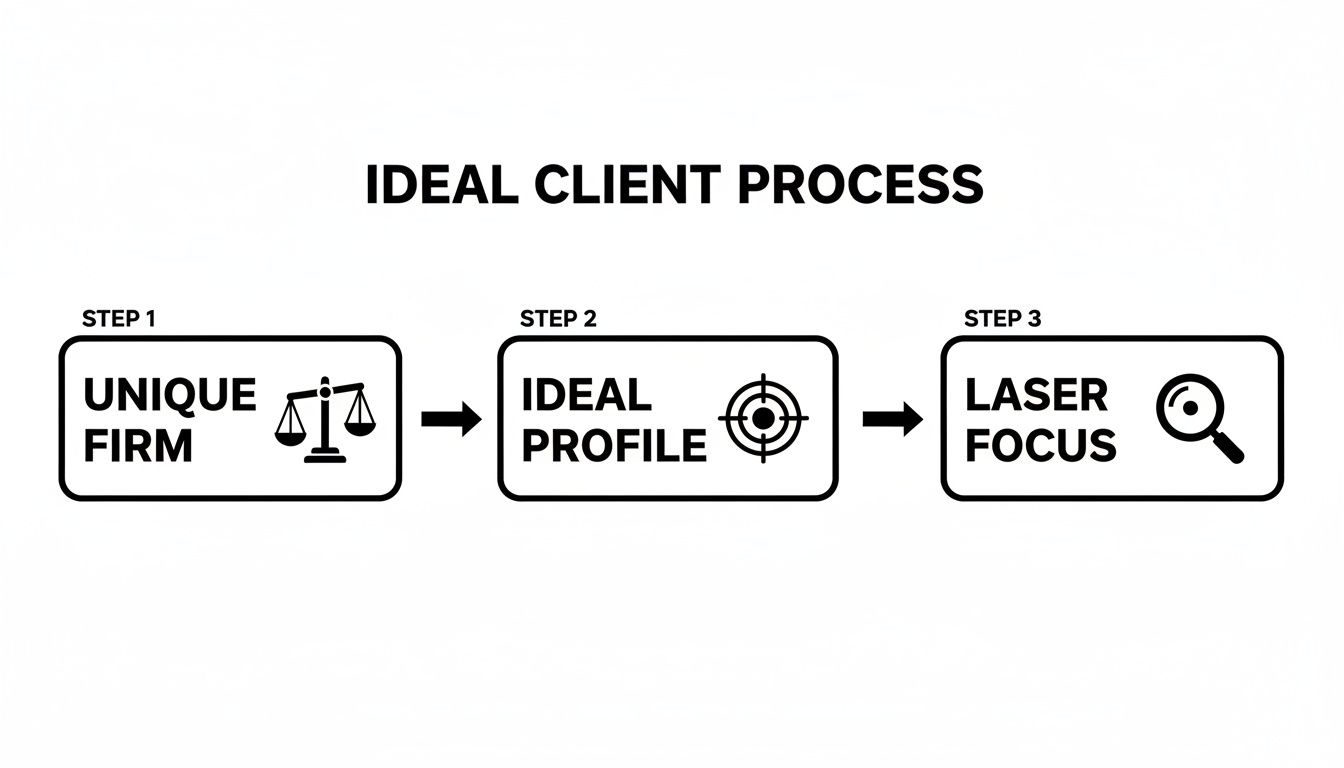
Following this ensures every dollar you spend is a strategic investment, not a shot in the dark. You’re putting your resources exactly where they’ll make the biggest impact.
Building Your Digital Authority Through SEO
In today’s world, Search Engine Optimization (SEO) is the non-negotiable bedrock of legal marketing. Think about it: when a high-net-worth individual needs a trust and estates attorney, their first move is almost always a quiet, discreet search on Google. Your firm needs to be the first name they see.
SEO goes way beyond just stuffing keywords onto a page. It’s about cementing your firm’s reputation as a credible authority. You achieve this with a smart mix of a technically sound website, high-value content that answers very specific legal questions, and earning links back to your site from other reputable sources.
It’s like building prime real estate online. A solid SEO foundation delivers a consistent flow of high-intent leads who are actively looking for the very services you offer.
The Power of Content Marketing
Content is the fuel for your SEO engine. When you create truly useful blog posts, in-depth guides, or clear videos that solve your ideal client’s problems, you build trust long before they ever think about scheduling a consultation.
A commercial real estate lawyer, for example, could publish a detailed breakdown of navigating complex zoning laws for new developments. This not only pulls in highly targeted search traffic but also proves their expertise, making them the obvious choice when it’s time to hire counsel.
Your content should never feel like a sales pitch. Its job is to educate and empower your potential clients. This positions your firm as a trusted advisor, not just another service provider.
This educational approach is what turns a casual visitor into a qualified lead who already respects your firm’s knowledge.
Modernizing Your Relationship Building
Networking and referrals are still the lifeblood of many practices, but the game has changed. Today, the best relationship-building is systematic and strategic, blending sharp digital engagement with high-touch, in-person connections.
Social media has become a powerhouse for this. A staggering 71% of attorneys now report that it’s a reliable way to generate new leads. For B2B lawyers, platforms like LinkedIn are invaluable for connecting with corporate decision-makers and sharing insightful commentary. In fact, many solo practitioners dedicate over 75% of their marketing budgets to social ads because of the immediate impact.
But simply having a profile isn’t enough. Your firm’s presence must be driven by a clear strategy. To sharpen your tactics, it’s worth exploring effective attorney social media marketing tips that can provide practical, actionable guidance.
High-Touch Strategies for Sophisticated Clients
When you’re targeting high-net-worth individuals or enterprise-level clients, generic, mass-market tactics will fall completely flat. This audience values exclusivity, deep expertise, and above all, trust. This is where high-touch strategies shine.
Consider these more targeted, impactful approaches:
- Exclusive Webinars: Host a private, invitation-only webinar on a niche topic like “Asset Protection Strategies for Tech Founders.” This creates an air of exclusivity and allows for direct, meaningful engagement with a hand-picked audience.
- Strategic Partnerships: Build relationships with wealth management firms, high-end accounting practices, or private banks. These professionals already serve the clients you want to reach and can become a phenomenal source of referrals.
- Targeted Public Relations: Get your experts featured in the publications your ideal clients actually read, from niche business journals to luxury lifestyle magazines. Being quoted as an authority provides third-party credibility that you simply can’t buy.
These methods are all about quality over quantity. The goal is to build deep, lasting relationships with a smaller, more valuable audience.
Choosing the Right Channel Mix
There’s no magic formula here—your ideal channel mix is determined entirely by your practice area and who you’re trying to attract. To put this into perspective, the table below shows how different types of firms might strategically allocate their efforts.
Marketing Channel Allocation For Law Firms
This table provides a strategic overview of key marketing channels, their primary goals, and the ideal client types they are best suited to attract.
| Marketing Channel | Primary Goal | Best For Attracting | Example Tactic |
|---|---|---|---|
| Local SEO & Google Ads | Generate immediate, local leads | Individuals seeking urgent help (e.g., PI, family law) | Running a Google Ad campaign targeting “divorce lawyer near me.” |
| LinkedIn & Content | Build B2B authority and relationships | Corporate clients, general counsel, startups | Publishing an in-depth article on intellectual property for SaaS companies. |
| Targeted PR & Events | Establish prestige and credibility | High-net-worth individuals, niche industries | Securing a speaking engagement at a private wealth management conference. |
| Email Marketing | Nurture leads and maintain relationships | Past clients, warm leads, referral partners | Sending a monthly newsletter with insights on estate planning law changes. |
Your initial plan should be to master one or two of these channels before trying to do everything at once. Start where your ideal client spends their time, build a commanding presence, and then begin layering in complementary channels to create a truly integrated and powerful marketing engine.
Developing a Brand Message and Content That Converts

Let’s be honest: your digital presence is the new handshake. Before a potential client ever considers calling you, they’ve already researched your firm online, read your articles, and formed a solid opinion about your expertise.
In this reality, your content isn’t just marketing fluff. It’s your single most important tool for building trust and proving you’re an authority in your field. This all starts with a powerful brand message—the core idea that runs through everything you publish.
Crafting Your Core Brand Message
Think of your message as the consistent thread weaving through your website, articles, and social media. It has to connect immediately with the high-stakes problems your clients are facing.
For a firm specializing in intellectual property for tech startups, a compelling message isn’t about the legal mechanics of patents. It’s about “Safeguarding Innovation and Securing a Founder’s Legacy.” See the difference?
A truly effective message has three critical components:
- Empathy: It shows you genuinely understand the client’s specific challenge, whether it’s the intense stress of a high-asset divorce or the dizzying complexity of a corporate merger.
- Authority: It positions you as the definitive expert, the one person truly capable of navigating that challenge.
- Solution: It offers a clear path toward their desired outcome—peace of mind, financial security, or business protection.
Once you nail this message, every piece of content you create becomes another piece of evidence, reinforcing why your firm is the only logical choice.
Your brand message is your promise to the client. It’s not just what you do, but why it matters to them. Get this right, and your content will naturally attract the cases you actually want.
Effective marketing plans for lawyers are built on this foundation. Without it, your content will feel generic and disconnected, failing to grab the attention of a discerning audience.
Building Your Content Engine
With a strong message locked in, you can start building a content strategy designed to turn readers into clients. This isn’t about publishing random blog posts whenever you have a spare moment; it’s about systematically answering your ideal client’s most pressing questions.
The goal here is to identify and own “pillar topics”—large, foundational subjects that become synonymous with your firm. For example, a family law practice might choose “High-Net-Worth Divorce in New York” as a pillar. From there, they can create a whole cluster of related content that explores every conceivable angle of that topic.
This strategy transforms your website from a simple brochure into a comprehensive resource. It signals to both potential clients and search engines that you are a true authority, generating a steady stream of qualified leads over the long term.
Content Formats for Different Client Needs
A one-size-fits-all approach to content simply won’t work. The format you choose should match the sophistication and preferences of your target audience.
- For Corporate Clients: Think in-depth white papers, detailed case studies, and exclusive webinars on complex regulatory changes. These demonstrate a high level of expertise they expect.
- For HNW Individuals: Thought leadership articles in respected publications, discreet private briefings, and high-production-value videos on wealth preservation build the kind of credibility and trust they demand.
- For Individuals Needing Personal Services: Empathetic, easy-to-understand blog posts, FAQ videos, and downloadable checklists can demystify the legal process and create a crucial personal connection.
By tailoring the format, you meet your clients where they already are. For more specific ideas, you can explore detailed strategies for content marketing for legal firms to find what fits your practice best.
Maximize Your Impact with Content Repurposing
Creating high-quality content takes a serious investment of time and expertise. To make it sustainable, you need to adopt a “create once, publish everywhere” mentality. A single piece of cornerstone content can be strategically repurposed to fuel your marketing for weeks.
Here’s a practical example of how that works:
- Start with a Webinar: Host an hour-long webinar on a key pillar topic, like “Navigating Commercial Real Estate Leases in a Volatile Market.”
- Create a Blog Series: Transcribe the webinar and slice the main talking points into four detailed blog posts.
- Produce Short-Form Video: Edit the webinar recording into 5-7 short, punchy video clips perfect for sharing on LinkedIn.
- Design an Infographic: Summarize the key data points and process steps into a visually compelling infographic.
- Develop a Newsletter: Feature the blog posts and videos in your firm’s email newsletter to nurture your existing contacts.
This is how you work smarter, not harder. This approach maximizes the return on your initial effort, ensuring your valuable insights reach the widest possible audience without multiplying your workload.
Budgeting Your Plan and Measuring What Matters
A brilliant strategy without a budget is just a wish. It’s an unfortunate truth, but one that separates the firms that grow from those that stagnate. Likewise, marketing without clear metrics is like flying blind—you’re spending money, but you have no real idea if you’re getting closer to your destination or just burning through fuel.
This is where we get serious. We’re shifting from big ideas to smart investments, turning your marketing from a perceived expense into a predictable system for generating new business. This requires a realistic budget and an unwavering focus on the numbers that actually move the needle.
How To Set A Realistic Marketing Budget
Figuring out how much to invest in marketing can feel like a shot in the dark, but it’s more science than art. Successful firms I’ve worked with almost always fall back on one of two battle-tested models.
The most common starting point is the Percentage of Revenue Model. It’s straightforward and easy to implement. A widely accepted benchmark is allocating 5% to 10% of your firm’s gross revenue to your marketing initiatives. A well-established practice with strong name recognition might land closer to 5%. A new firm, or one pushing aggressively for growth, should be leaning toward 10% or even more.
The other approach, which is far more strategic, is the Goal-Based Model. Here, you work backward from your desired outcome. Let’s say you want to add $500,000 in new revenue this year, and your average case value is $25,000. The math is simple: you need 20 new clients. From there, you can calculate how many qualified leads you need to hit that number and what you can afford to pay for each one.
A budget isn’t a restriction; it’s a tool for intentional growth. It forces you to allocate capital to the channels and activities delivering the highest return, saving you from wasting resources on what I call “random acts of marketing.”
Whichever model you land on, consistency is everything. Marketing is a long-term investment, not a switch you can flip on and off.
Stop Chasing Vanity Metrics
This is probably the single most important mental shift a law firm can make. It’s seductively easy to get distracted by numbers that look good on a report but do nothing for your bottom line. I’m talking about social media likes, website page views, or email open rates. These are vanity metrics. They feel good, but they don’t pay the bills.
A profitable, high-end marketing plan focuses relentlessly on the Key Performance Indicators (KPIs) that measure real business impact. These are the numbers that tell you if your marketing is actually working.
The KPIs That Truly Matter For Law Firms
To make intelligent, data-backed decisions, you must track the metrics that connect your marketing spend directly to revenue. I’ve broken down the essential KPIs every firm should have on its dashboard. These are the numbers that answer the only question that really matters: for every dollar I put into marketing, how many am I getting back?
Essential KPIs For Your Law Firm Marketing Plan
This table breaks down the most important metrics to track, explaining what each one measures and why it’s critical for your firm’s growth.
| KPI (Key Performance Indicator) | What It Measures | Why It Matters | How To Track It |
|---|---|---|---|
| Client Acquisition Cost (CAC) | The total cost to acquire one new paying client. | This is your ultimate marketing ROI metric. It tells you, definitively, if your marketing spend is profitable. | (Total Marketing Spend) / (Number of New Clients) |
| Cost Per Qualified Lead (CPQL) | How much you spend to generate one lead that meets your Ideal Client Profile. | This measures the efficiency of your lead generation, showing you which campaigns are working and which need to be optimized or cut. | (Marketing Campaign Spend) / (Number of Qualified Leads) |
| Client Lifetime Value (CLV) | The total revenue a single client is expected to generate for your firm over time. | Knowing your CLV allows you to make smarter decisions about how much you can afford to spend on CAC while remaining highly profitable. | (Average Case Value) x (Number of Cases Per Client) |
You don’t need a complex software suite to get started. Honestly, a simple spreadsheet, your firm’s intake records, and some basic data from Google Analytics are all you need. For instance, by setting up conversion goals in Google Analytics, you can see exactly which digital channels are driving people to fill out your contact form.
By focusing on CAC, CPQL, and CLV, you move from guessing to knowing. This is what transforms a marketing plan from a static document into a powerful, predictable system for growing your practice.
Your Top Questions About Legal Marketing Plans, Answered
Building a marketing plan that actually works can feel overwhelming. When I sit down with attorneys, the same handful of practical, real-world questions always come up. Forget the theory for a moment—let’s tackle the concerns that are probably on your mind right now.
These aren’t just academic exercises; they’re the hurdles that can stop a great plan before it even gets started. Getting the answers right is the difference between a document that gathers dust and a strategy that brings in high-value clients.
How Much Should a Small Law Firm Budget For Marketing?
There’s no single magic number, but a solid baseline is 5-10% of your firm’s gross revenue. If you’re a new firm or you’re in a serious growth mode, you should be pushing toward the higher end of that range—maybe even 15%.
But here’s the critical part: how you spend that money matters infinitely more than the total amount. I see too many firms spread a small budget so thin across a dozen different channels that it makes zero impact anywhere. It’s far better to dominate one or two high-impact channels than to be a faint whisper everywhere.
For example, a solo practitioner could pour a $1,500 monthly budget into a hyper-focused local SEO and Google Ads campaign. Why? Because you can directly measure the return. The only metric that truly matters is your Client Acquisition Cost (CAC). If you know a new client is worth an average of $10,000 to your firm, spending $1,000 to acquire them through a specific campaign isn’t an expense—it’s a brilliant investment.
Start small, measure everything, and double down on what works.
How Can I Market My Firm and Still Comply With Ethical Rules?
This is a big one, and rightly so. But ethical compliance shouldn’t be seen as a cage; think of it as the guardrails that keep your marketing professional and trustworthy. The heart of ethical marketing is simple: educate and add value, don’t make wild claims or guarantees.
Most state bar rules are designed to prevent a few key things:
- False or Misleading Advertising: Don’t make claims you can’t substantiate.
- Guarantees of Outcomes: You can never, ever promise a specific result for a case.
- Improper Solicitation: Know the regulations around directly contacting potential clients.
Build your marketing around these principles. Write blog posts that demystify complex legal processes. Showcase your expertise with professional, anonymized case studies. Always be transparent. Steer clear of absolutes like “the best” or “expert” unless you hold a formal certification your bar recognizes. A well-executed plan will always elevate your professional standing, not put it at risk.
Ethical marketing isn’t about what you can’t do; it’s about building trust. When you focus on demonstrating expertise and helping potential clients make informed decisions, you operate from a place of integrity that naturally attracts the right kind of cases.
What Are The Biggest Marketing Mistakes Lawyers Make?
The most common—and most expensive—mistake is what I call “random acts of marketing.” It’s a sporadic blog post one month, a few random social media updates the next, all with no cohesive strategy tying it together. It’s a guaranteed way to waste time and money.
Another massive error is failing to define a specific, ideal client. This leads to generic messaging that tries to appeal to everyone and ends up resonating with no one. You simply can’t position yourself as the premier attorney for high-asset divorces if your website also has language trying to attract slip-and-fall cases.
Finally, inconsistency will kill any plan. Effective legal marketing is a marathon, not a sprint. It demands patience and the disciplined, consistent execution of your strategy over months—not days—to see the powerful, long-term results you want.
Should I Hire a Marketing Agency or Do It Myself?
This decision really boils down to three resources your firm has: time, money, and in-house expertise.
If you or someone on your team has the time (think at least 10 hours a week) and a genuine knack for it, you can absolutely handle things like writing content or basic social media in-house. This can be a smart move for tasks that require your deep legal knowledge.
However, when it comes to the technical and specialized disciplines—like SEO, Google Ads management, and web development—hiring a specialized agency or consultant is almost always the more effective route.
Often, a hybrid model is the sweet spot. Use your internal team for the content that requires your legal brain, and outsource the technical strategy and execution to experts who live and breathe legal marketing every single day.
Elevate your firm’s prestige and attract the high-value clients you deserve. The Haute Lawyer Network is a curated marketing platform that aligns your brand with the authority of Haute Living, a luxury media icon. We provide elite-level visibility, connecting you with an exclusive network of high-net-worth individuals and business leaders. Discover how Haute Lawyer can transform your marketing strategy today.