
The fundamental difference between a legal separation and a divorce is stark: divorce formally terminates a marriage, clearing the path to remarry, while a legal separation preserves the marriage in name only, allowing you and your spouse to live apart under legally binding arrangements. The right choice hinges on a single question: do you require the finality of a divorce, or do the unique circumstances of your situation favor remaining legally married?
Understanding Legal Separation vs Divorce

When a marital relationship breaks down, couples arrive at a critical crossroads. While both legal separation and divorce tackle the same core issues—property division, support, and child custody—they lead to profoundly different legal outcomes.
A divorce legally dissolves the marriage, returning both individuals to the status of “single.” A legal separation, conversely, allows a couple to formalize the terms of their separation through the courts without officially ending the marital contract. For a deeper look at trends in marriage dissolution, see the latest facts from wf-lawyers.com.
Core Differences at a Glance: Legal Separation vs Divorce
To make an informed decision, it’s essential to grasp the practical implications of each path. A legal separation mirrors a divorce in many ways by setting financial and parental boundaries, yet it intentionally leaves the legal bond of marriage intact.
The most significant distinction is that you cannot remarry while legally separated. Only a final divorce decree legally dissolves the marital union, freeing both parties to enter into a new marriage.
This one factor is often the decider. If remarriage is a consideration for either you or your spouse, divorce is the only viable option. But if there are compelling religious, financial, or personal reasons to preserve the marriage—such as maintaining access to health benefits—a separation offers a structured and enforceable alternative.
For a clearer perspective, this table breaks down the most critical differences between the two.
| Attribute | Legal Separation | Divorce |
|---|---|---|
| Marital Status | Legally married, but living apart under court order. | Legally single; the marriage is terminated. |
| Ability to Remarry | No, you remain legally married to your spouse. | Yes, you are free to marry someone else. |
| Health Insurance | Often allows a spouse to remain on the other’s plan. | Requires the ex-spouse to secure their own coverage (e.g., COBRA). |
| Reversibility | Can be reversed if the couple reconciles. | Final and irreversible; remarriage is required to reunite. |
Ultimately, a separation provides a formal structure for living apart while keeping the door open for reconciliation. A divorce, on the other hand, provides a clean and permanent break, closing the marital chapter for good.
The Financial Impact on Assets, Debts, and Benefits

For many, the decision between legal separation and divorce pivots on the financial realities. Both processes mandate a formal division of assets and debts, yet the long-term consequences for your financial health, benefits, and future earnings can be starkly different.
In either case, the court oversees the equitable distribution of the marital estate. This includes everything from the family residence and vehicles to investment portfolios and bank accounts. Likewise, all debts incurred during the marriage—mortgages, loans, credit card balances—must be allocated between both spouses.
While the mechanics of financial disclosure and division are nearly identical, the choice of legal separation vs divorce unlocks different opportunities and obligations, especially when it comes to benefits tied directly to marital status.
Preserving Critical Health and Retirement Benefits
One of the most compelling reasons for choosing legal separation is the potential to keep health insurance coverage intact. A divorce decree is a “qualifying life event” that immediately terminates a spouse’s eligibility on their partner’s employer-sponsored health plan.
This can leave a non-working or lower-earning spouse facing the prohibitive costs of COBRA or a private marketplace plan. In sharp contrast, many corporate health plans allow a legally separated spouse to remain on the policy because the marriage, in a technical sense, still exists.
A critical note of caution: You must verify the specific terms of the insurance policy. Some plans treat legal separation the same as divorce, so confirming with the benefits administrator is a non-negotiable step before making a decision.
Legal separation can also be a strategic play for meeting the 10-year marriage requirement for Social Security spousal benefits. If a couple is nearing that milestone, a separation allows them to live apart while ensuring the lower-earning spouse qualifies to claim benefits based on their partner’s work history.
Asset Division and Future Earnings
While the division of existing assets is similar, the legal end date of the marriage fundamentally alters how future assets are treated.
- In a Divorce: The date the final decree is issued creates a hard cutoff. Any income, assets, or debt acquired by either person after this date is their separate property. It provides a clean financial break.
- In a Legal Separation: State laws make this more complex. Generally, assets and debts acquired after the formal date of separation are considered separate, but this line can blur if the couple’s finances remain intertwined.
This distinction is particularly important when handling retirement accounts. For those navigating this terrain, you can learn more about how to split a 401k in a divorce and the legal mechanisms involved in our detailed guide.
Tax Filing Status and Its Consequences
Your tax filing status represents another major financial fork in the road. Legally separated couples may be able to continue filing taxes jointly, depending on state law and living arrangements. This often leads to a lower tax burden than the “single” or “head of household” status required post-divorce.
Comparison of Tax Filing Options
| Filing Status | Legal Separation | Divorce |
|---|---|---|
| Married Filing Jointly | Potentially available, depending on state law and living arrangements. | Not available. |
| Married Filing Separately | Available, but often less advantageous than filing jointly. | Not available. |
| Single | Not available while legally married. | Required filing status if not qualifying for Head of Household. |
| Head of Household | May be available if you meet specific IRS criteria. | May be available if you meet specific IRS criteria. |
Opting to file jointly during a separation demands a high level of trust, as both spouses remain jointly liable for the entire tax bill. While the savings can be significant, a divorce offers a definitive separation of tax responsibilities, protecting each party from the other’s future financial missteps.
Navigating Co-Parenting Custody and Child Support

When children are involved, the calculus of choosing between legal separation and divorce shifts dramatically. While the court’s procedures for custody and support are virtually the same, the emotional fallout for the family can be profoundly different.
No matter which path you take, the court is guided by a single, unwavering principle: the best interest of the child. This standard supersedes parental preferences and dictates every decision, from living arrangements to financial support, ensuring the child’s stability and well-being remain the top priority.
This means the process of establishing custody, visitation, and child support is the same whether you separate or divorce. Both require a detailed parenting plan that becomes the foundational document for your new co-parenting reality.
The Legal Framework for Custody and Support
Whether through a legal separation or a divorce, the court will issue legally binding orders. These aren’t suggestions; they are enforceable mandates that create a predictable and stable structure for your children’s lives.
Both processes will formalize the same critical elements:
- Legal Custody: This grants the authority to make major life decisions for your child concerning their education, healthcare, and religious upbringing.
- Physical Custody: This defines where the child primarily resides and sets the specific day-to-day parenting schedule.
- Child Support: Financial obligations are determined by strict state guidelines, factoring in parental incomes and custodial time.
Since the legal outcomes are identical, the decision really hinges on the psychological impact on the family. To understand the mechanics of shared parenting in more detail, our guide explains how joint custody works in practice.
Emotional and Psychological Considerations for Children
While the legal documents may look alike, the message a child receives from a “separation” versus a “divorce” can feel worlds apart. A legal separation can act as a transitional period, introducing a new family structure without the stark finality of a divorce.
This gradual adjustment may ease anxiety for some children, as the idea of their parents remaining technically married can offer a sense of stability. It implicitly leaves the door open for reconciliation—a powerful source of hope for a child, though parents must manage this expectation carefully to prevent confusion.
Divorce, on the other hand, provides definitive closure. This clarity, while initially painful, allows children to begin the difficult but necessary process of adapting to a new, permanent reality without the lingering uncertainty a separation can create.
Ultimately, the right choice depends entirely on your family’s unique emotional landscape. A separation can offer a softer transition, while a divorce provides the clear ending some families need to move forward.
Practical Co-Parenting in Separation and Divorce
Day-to-day life is governed by the parenting plan, not by your marital status. This document is the practical roadmap for your co-parenting relationship.
Comparison of Co-Parenting Structures
| Co-Parenting Aspect | Legal Separation | Divorce |
|---|---|---|
| Decision-Making Authority | Defined by the court’s custody order (parenting plan). | Defined by the court’s custody order (parenting plan). |
| Parenting Schedule | Outlined in the separation agreement. | Outlined in the divorce decree. |
| Child-Related Expenses | Child support orders are established and enforceable. | Child support orders are established and enforceable. |
| Flexibility to Change | Orders can be modified if circumstances change. | Orders can be modified if circumstances change. |
As the comparison shows, the functional framework for raising your children is identical. The only real difference is your legal status as a couple. Your decision should therefore center on one question: which path will best support your children’s emotional stability and provide the consistent structure they need to thrive?
Understanding the Legal Process Timelines and Costs
When comparing legal separation vs divorce, there’s a common misconception that one is a shortcut—a faster, cheaper alternative to the other. In practice, the legal machinery for both is nearly identical. They involve the same filings, the same court oversight, and the same intensive financial disclosures.
The true variables dictating your timeline and final bill aren’t the legal titles but the level of conflict between you and your spouse. Cooperation is currency in family law; conflict is an expense.
Both paths start the same way: one spouse files a formal petition, which is then served to the other. From that point, you’re both required to produce detailed financial disclosures cataloging every asset, debt, income stream, and expense. This isn’t optional—it’s the bedrock upon which all negotiations are built.
Whether you’re aiming for a Decree of Legal Separation or a Decree of Dissolution of Marriage, you must resolve the same core issues: how to divide property, whether spousal support is appropriate, and how you’ll handle child custody and support. The final document is different, but the journey to get there is fundamentally the same.
How Timelines Diverge in Practice
While the legal steps are parallel, the time it takes to complete them can vary dramatically. This divergence has everything to do with how you and your spouse navigate the process. An uncontested case, where you agree on all major terms from the start, will always be the most efficient route.
A contested case, on the other hand, can drag on for months or even years. Disagreements over assets or custody arrangements lead to prolonged negotiations, mandatory mediation, and potentially a full-blown court battle. This is true for both separation and divorce. For a more detailed look at what to expect, our article explores a realistic timeline for how long a divorce takes.
The single most significant factor influencing your timeline is conflict. An amicable separation can be finalized in months, while a high-conflict divorce could easily surpass a year, regardless of the legal label.
Don’t fall for the myth that legal separation is a workaround. The court demands the same level of due diligence for both processes to ensure any agreement reached is equitable, enforceable, and legally sound.
A Realistic Breakdown of Potential Costs
Because the legal work is duplicative, the costs associated with separation and divorce start on nearly identical footing. Your final invoice is determined by the complexity and contentiousness of your case, not by your choice of legal status.
Expect to encounter several key expenses:
- Court Filing Fees: Every state imposes a fee to open a family law case, typically running from $200 to over $500.
- Attorney Fees: This is the most significant variable. In an uncontested matter, an attorney might work on a flat fee. When disputes arise, you’ll be billed hourly, and the costs escalate with every negotiation, motion, and court appearance.
- Mediation Costs: A professional mediator can be a cost-effective alternative to litigation, helping you and your spouse find common ground. Their services are billed hourly.
- Expert Fees: For high-net-worth cases, you may require specialists for business valuations, forensic accounting, real estate appraisals, or custody evaluations. These experts can add thousands to your total cost.
The Two-Step Process of Converting a Separation
A critical financial consideration is the potential cost of converting a legal separation into a divorce down the line. While a separation agreement can be reversed if you reconcile, it often serves as a precursor to dissolving the marriage.
If you eventually decide to divorce, you must return to court to file a new motion. The process is streamlined because your separation agreement typically becomes the foundation for the final divorce judgment. However, it’s not free. This second step requires additional court filing fees and attorney costs, turning your path into a more expensive two-stage journey.
Making the Right Choice: When to Choose Each Option
Theory is one thing, but the decision between a legal separation and an absolute divorce hinges on your unique personal, financial, and emotional reality. There’s no universal “right” answer—only the one that strategically aligns with your immediate needs and long-term vision for your life.
This is where the rubber meets the road. By looking at specific, real-world situations, you can move past the abstract definitions and see which path offers the most tangible advantages for you.
When Legal Separation is the Smarter Strategy
For many couples, the finality of a divorce is either premature, financially unworkable, or simply undesirable. Legal separation provides a formal, court-enforced framework that lets both parties live independent lives while keeping the legal marriage intact. It’s a powerful tool when maintaining the marital status offers clear, measurable benefits.
A legal separation is likely the superior choice if any of these scenarios resonate with you:
- Preserving Critical Health Insurance: This is often the most compelling reason. A final divorce decree automatically terminates a spouse’s coverage under an employer-sponsored health plan. If one spouse depends on that insurance and can’t afford the exorbitant cost of COBRA or a marketplace plan, separation may allow them to remain on the policy. Crucially, this must be verified with the specific plan administrator, as not all policies permit it.
- Meeting the 10-Year Social Security Milestone: To be eligible to claim spousal Social Security benefits, the marriage must have lasted at least 10 years. If you are nearing that critical date, a legal separation lets you live apart while the marriage officially continues, securing a potentially vital retirement benefit for the lower-earning spouse.
- Adhering to Religious or Moral Convictions: For individuals whose faith or deeply held personal beliefs prohibit divorce, a legal separation provides a practical solution. It allows for the formal separation of finances and lives, offering legal protection without dissolving what is considered a sacred bond.
- A Glimmer of Hope for Reconciliation: When the future of the marriage is genuinely uncertain, a legal separation acts as a structured “cooling-off” period. It gives a couple the breathing room to work on their issues, perhaps through counseling, while their financial and parental rights are legally protected. This leaves the door open to reconcile without the complexity of remarrying.
A legal separation is essentially a strategic pause button. It creates legal and financial boundaries identical to a divorce but stops short of ending the marriage, preserving specific benefits and the possibility of reconciliation.
When Divorce Provides Necessary Finality
While separation offers valuable flexibility, for many, the clean break and emotional closure of a divorce are essential to truly move forward. The finality of a divorce decree legally severs the ties, creating the certainty required to build a new life—and grants the freedom to remarry.
Divorce is almost always the better path in these circumstances:
- The Desire to Remarry: This is the most straightforward driver. If you or your spouse has any intention of marrying someone else, divorce is the only option. You cannot legally enter into a new marriage while you are still married to another person, even if legally separated.
- The Need for a Clean Financial Break: Legal separation can leave finances uncomfortably intertwined. You might still be filing joint tax returns or dealing with lingering liability for shared debts. Divorce creates a definitive endpoint for the accumulation of marital property and debt, insulating you from your ex-spouse’s future financial missteps.
- High-Conflict and Emotionally Damaging Situations: In relationships marked by intense conflict, deep mistrust, or ongoing emotional distress, the ambiguity of a separation can prolong the agony. The clear, final, and legally binding nature of a divorce provides the closure needed for both parties—and their children—to begin healing and establish a stable new normal.
Ultimately, the choice in the legal separation vs divorce debate requires a clear-eyed assessment of your practical needs and your emotional readiness. If preserving critical benefits is paramount or reconciliation remains a possibility, separation is a powerful tool. But if finality, freedom, and a clean slate are what you need to move on, divorce is the necessary step forward.
Common Questions About Separation and Divorce
Even after a thorough strategic analysis, the choice between legal separation and divorce often comes down to a few practical, lingering questions. These uncertainties can create friction, preventing you from moving forward with clarity and confidence. Addressing them is the final step in making a sound, fully-informed decision.
This flowchart maps out the decision-making process, aligning key personal and financial goals with the most suitable legal path.
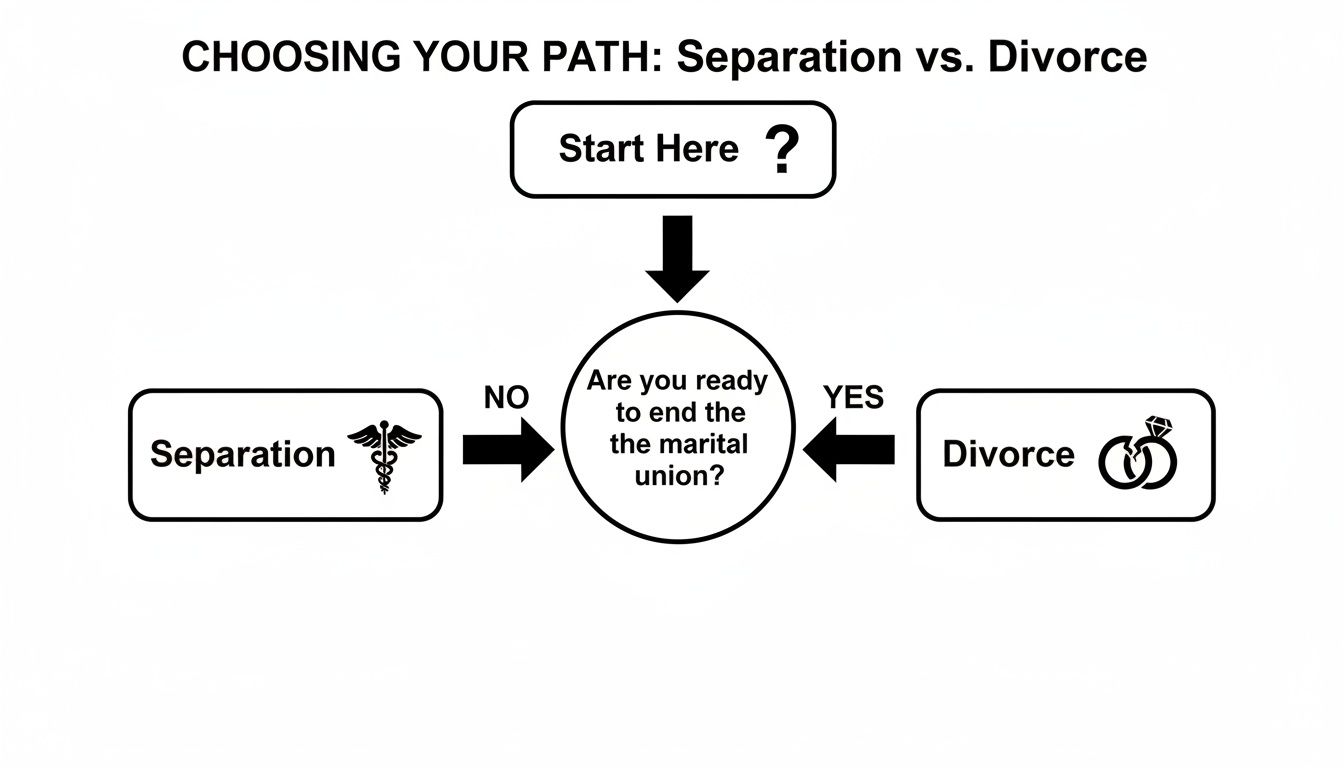
As the visual guide illustrates, factors like preserving critical benefits often point toward separation, whereas the desire for a clean marital break and the freedom to remarry leads directly to divorce.
Can I Convert a Legal Separation Into a Divorce Later?
Yes, in nearly every jurisdiction, converting a legal separation into a divorce is a standard procedure. It’s almost always simpler and more streamlined than initiating a new divorce case from scratch.
Because the most contentious issues—property division, support, and custody—were already negotiated and formalized in your separation agreement, that document becomes the blueprint for the final divorce decree. The process typically involves filing a motion to convert, and while a short waiting period may apply, it saves considerable time, expense, and emotional energy.
Does a Legal Separation Force Us to Reconcile?
Absolutely not. A legal separation imposes no obligation to reconcile. It is a flexible legal status designed to create enforceable rules for living apart while you remain legally married.
Some couples use this time as a structured trial period to work on their relationship, but many others remain separated indefinitely for practical reasons. The decision to reconcile, stay separated, or ultimately divorce remains entirely in your hands.
A legal separation provides structure without dictating the outcome of your relationship. It protects both parties’ rights while leaving future possibilities open.
Can I Date Other People While Legally Separated?
This is a delicate issue that demands extreme caution. Despite living apart, you are still legally married. In certain states, particularly those with “fault-based” divorce laws, a new romantic relationship could be considered adultery.
This could have serious legal consequences, potentially impacting spousal support awards or other aspects of a future divorce. It is imperative to discuss this with your family law attorney to understand the specific rules and potential ramifications in your jurisdiction before you consider dating.
Which Option Is Cheaper: Legal Separation or Divorce?
Initially, the costs are almost identical. Both a legal separation and an uncontested divorce require comprehensive agreements on assets, debts, support, and custody, involving similar legal work and court filing fees.
The long-term financial picture is where they diverge. If you later convert the separation into a divorce, you will incur a second round of court costs and attorney fees, making the two-step process more expensive overall. However, if the separation allows you to reconcile and avoid divorce entirely, it becomes by far the more cost-effective choice. The ultimate cost is driven by cooperation and your final outcome.
When navigating the complexities of family law, you need representation that meets the highest standards of expertise and discretion. The Haute Lawyer Network is an invitation-only directory of the nation’s most distinguished legal professionals, selected for their proven track record and commitment to achieving superior client outcomes. Find elite counsel to guide you through your legal separation or divorce by exploring our network at https://hauteliving.com/lawyernetwork.