
Lawyer reputation management is the strategic process of shaping how the public perceives a lawyer or law firm online. It involves actively monitoring, influencing, and protecting your digital presence to ensure it reflects the expertise and professionalism you bring to the table.
This is no longer optional; it’s a core component of client acquisition and brand stability.
Your Digital First Impression Is Non-Negotiable
Let’s be blunt: a prestigious firm history and a plaque on the wall don’t win over today’s clients. The client journey has been completely upended. It no longer begins with a referral call but with a Google search.
This shift makes your online presence the new handshake, the new corner office, and often, the final word on whether a potential client ever picks up the phone. Mastering this digital first impression is essential for growth in a fiercely competitive legal market. Active lawyer reputation management isn’t just about damage control; it’s a vital part of your client acquisition strategy.
The Declining Power of Traditional Prestige
The long-held belief that a big firm’s brand is all that matters is rapidly becoming a relic. Today’s clients are more discerning. They conduct their own due diligence online, looking for social proof like reviews, expert commentary in articles, and authentic engagement on social media.
This new reality creates something powerful: a level playing field for smaller firms and solo practitioners that never existed before.
Recent data from the Thomson Reuters Institute highlights this dramatic change. In the UK legal market, a firm’s general reputation saw its influence on client decisions plummet from 25% in 2012 to just 10% in 2023. The same report found that two-thirds of clients now point to recent personal contact with counsel as the key factor that keeps a firm top-of-mind.
The data tells a clear story: Clients are prioritizing demonstrated expertise and personal connection over legacy brand names. Your digital footprint is where they go to find that proof.
Why Proactive Management Matters
Waiting for a negative review or a misleading article to appear before taking action is a recipe for disaster. A proactive approach allows you to build a “digital fortress” of positive assets that can withstand potential threats.
These assets are your first line of defense:
- A strong review profile: Consistently generating positive reviews on platforms like Google and Avvo builds a buffer against the occasional negative comment.
- Controlled media assets: Your firm’s website, blog, and professional profiles are spaces where you control the narrative completely.
- Social media presence: An active social media profile demonstrates transparency and allows you to connect with clients on a more personal level. Our guide on effective attorney social media marketing provides more tips on this.
Ultimately, lawyer reputation management is about taking ownership of your online story. It ensures the first impression a potential client has of you is not left to chance but is a carefully crafted reflection of your skill, professionalism, and commitment to your clients.
Conducting Your Digital Reputation Audit
Before you can build a formidable online presence, you first need a clear picture of where you stand today. Think of a digital reputation audit as the essential first step in any serious lawyer reputation management strategy. It’s about seeing your firm exactly as a potential client would—without your own browsing history muddying the waters.
This process demands that you step into your client’s shoes. The first move? Open a new “incognito” or “private” browser window. This simple action prevents your past searches from influencing the results, giving you a raw, unfiltered view of what the public really sees.
Your Initial Search Reconnaissance
Start with the exact queries a potential client would use. Don’t just search for your firm’s name; you have to think like someone who’s just been referred or is starting their search from scratch.
Your initial search checklist should include a few key variations:
- Your Full Name: e.g., “Jane Smith attorney”
- Your Firm’s Name: e.g., “Smith & Associates Law”
- Firm Name + Reviews: e.g., “Smith & Associates Law reviews”
- Practice Area + Location: e.g., “family law attorney in Miami”
As you search, you need to meticulously document what appears on the first page of Google, Bing, and even DuckDuckGo. These top results make up 99% of a potential client’s entire first impression. You’re looking for your website, your professional profiles, any news articles, and—most importantly—review platforms.
The client vetting process has fundamentally changed. It’s no longer about firm prestige alone; it’s now dominated by what appears in a simple search.
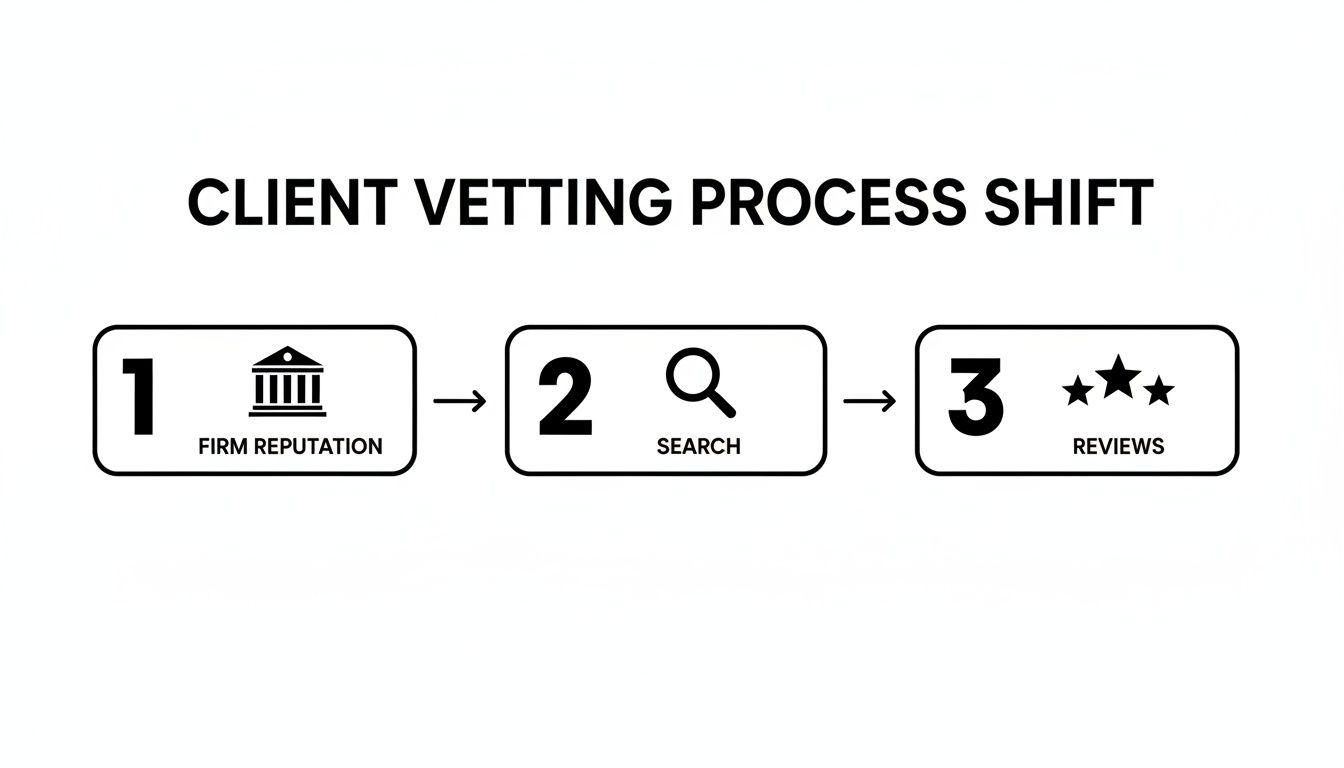
This shift is critical to understand. What clients find on search engines and review sites now carries far more weight than a firm’s historical brand.
To systematically tackle this, a checklist is your best friend. It ensures you don’t miss any critical digital touchpoints.
Reputation Audit Checklist
| Audit Area | Action Item | Key Metric to Assess |
|---|---|---|
| Search Engine Results | Search your name, firm, and practice areas in incognito mode. | What appears on the first page? Is it positive, negative, or neutral? |
| Google Business Profile | Review your profile for accuracy, completeness, and review scores. | Overall star rating, number of reviews, and recency of feedback. |
| Legal Directories | Check listings on Avvo, Justia, FindLaw, and local bar sites. | Accuracy of contact info, completeness of profile, and client reviews. |
| General Review Sites | Scrutinize reviews on Yelp, BBB, and other relevant platforms. | Recurring themes in positive/negative comments and overall sentiment. |
| Social Media Presence | Search for mentions on LinkedIn, Facebook, and X. | Public sentiment, tagged posts, and direct mentions of you or your firm. |
| Media & News Coverage | Search for your name/firm in Google News and other media archives. | Presence of positive press (assets) or negative coverage (threats). |
| Website & Blog | Analyze your firm’s website for professionalism and messaging. | Is your brand message consistent with your online reputation? |
This checklist provides a clear, honest baseline. Once you’ve completed it, you’ll know exactly what you’re working with—the good, the bad, and the ugly.
A Deep Dive into Your Digital Footprint
With a general overview from your initial searches, it’s time to dig into the platforms that truly define your online character. Each one tells a piece of your story.
1. Scrutinize Review Platforms Go directly to sites like Google, Avvo, Yelp, and your local bar association directory. Read every single review. Pay close attention to recurring themes. Are clients consistently praising your communication, or are there multiple complaints about unreturned phone calls?
Look beyond the simple star rating. The sentiment and recency of the feedback are what truly matter. A single one-star review from three years ago is an annoyance; a recent string of two-star comments is a crisis.
2. Analyze Social Media Mentions Perform advanced searches on platforms like LinkedIn, Facebook, and X (formerly Twitter) for any mention of your name or your firm. You’re looking at public posts, comments, and tags. This can reveal a layer of community sentiment that never makes it to formal review sites.
3. Verify Directory Listings Check your listings across all legal directories and local business sites. Is your contact information consistent and accurate everywhere? An old office address on a major directory doesn’t just frustrate a potential client—it signals a lack of attention to detail.
4. Assess Media and News Coverage Finally, search for news articles, press releases, or blog posts mentioning you or your firm. Positive features are powerful assets you should be promoting. Any negative or inaccurate coverage, on the other hand, represents an immediate threat that needs to be addressed head-on. This comprehensive inventory is the foundation for building a winning strategy.
Building Your Five-Star Reputation with Reviews
Once you’ve audited your firm’s digital footprint, it’s time to start actively shaping the reputation you want clients to see. Your most powerful tool isn’t a complex marketing scheme—it’s your client reviews. Think of them as the modern-day word-of-mouth referral, the bedrock of trust that also happens to be a major driver for your local search rankings.

It’s hard to overstate the influence of online feedback. A staggering 98% of potential clients read online reviews for social proof before hiring an attorney, and 80% admit those reviews are a key part of their final decision. More than 60% turn to Google Reviews first, and a shocking 47% will write off any firm with less than a 4-star average. These figures, highlighted in a report on legal marketing statistics on Andava.com, confirm that your review profile is a direct line to new business, not a vanity metric.
Timing Your Review Request Perfectly
The secret to a steady stream of positive feedback isn’t complicated. It’s all about timing.
Asking for a review at the wrong moment feels awkward and intrusive. The sweet spot is immediately after a positive case milestone or right at the conclusion of a successful matter. This is when your value is fresh in their minds and their gratitude is at its peak. Seize that moment of positive sentiment.
Creating a Simple and Ethical Request System
Your clients are busy. If asking for a review involves complicated steps, they simply won’t do it. A frictionless, ethical request system is the only way to go.
- Email Automation: When a case closes, have a pre-written but personalized email ready to go. Thank them for their trust, mention that their feedback is valuable to others, and provide a direct link straight to your Google Business Profile review page.
- Text Message Simplicity: For a more immediate touch, a simple text message works wonders. A short note like, “Thank you again for allowing us to represent you. If you have a moment, we’d appreciate your feedback on Google,” followed by the link, is often all it takes.
- In-Person Cues: During your final meeting, you can easily plant the seed. “We’re so glad we could achieve this outcome for you. So many of our clients find us through Google, and your honest feedback there would really help others in a similar situation.”
It’s critical to remember you’re asking for honest feedback, not demanding a five-star review. This small distinction keeps your request ethical and compliant with state bar advertising rules. Besides, a profile with a mix of authentic, detailed reviews is far more credible than a flawless but unbelievable record of perfect scores.
Responding to Every Single Review
Getting the review is only half the battle. Your work isn’t done until you’ve responded. Responding to every single review—good, bad, or neutral—is a public display of your firm’s character and commitment to client service. For positive reviews, a simple, personalized “Thank you” deepens the relationship.
Your response to a negative review, however, is where you can truly set yourself apart. It’s an opportunity to turn a potential crisis into a public demonstration of your professionalism.
A thoughtful response to criticism can be more powerful than a dozen five-star reviews. It shows prospective clients that you are accountable, professional, and committed to client satisfaction, even when faced with a difficult situation.
When a negative review pops up, have a clear protocol. Never engage emotionally. Instead, rely on a template designed to de-escalate the situation and move the conversation offline.
Example Negative Review Response Template
“Thank you for sharing your feedback. We are sorry to hear that your experience did not meet your expectations. We take all client concerns very seriously and are committed to providing the highest level of service. To protect client confidentiality, we cannot discuss specific case details here, but we would welcome the opportunity to speak with you directly to better understand and address your concerns. Please contact our office manager, [Name], at [Phone Number] at your convenience.”
This response hits all the right notes: it acknowledges their feedback without admitting fault, shows a commitment to resolution, and pulls a sensitive discussion into a private channel. This strategic approach is a cornerstone of effective reputation management and a critical element of learning how to get clients as a lawyer.
Controlling Your Narrative with Content and SEO
Waiting for reviews to dictate your online reputation is a losing game. It’s purely defensive. A truly proactive lawyer reputation management strategy means seizing control of the narrative long before a potential client even thinks about looking you up on a review site.
You do this by building a digital fortress of assets you actually own and control—your website, your blog, and your key professional profiles.

When someone searches your name or your firm’s name, the goal is simple: you want the entire first page of Google to be dominated by positive, authoritative content that you created. This strategic use of content and Search Engine Optimization (SEO) ensures your expertise defines your story, not some random comment on a third-party directory.
The mission is to make your owned properties the most powerful and relevant results for any search related to you and your practice.
Building Your Digital Fortress with SEO
Think of SEO as the architectural blueprint for your fortress. It’s the practice of optimizing your online content so that search engines like Google show it as a top result for the exact phrases your clients are using.
For attorneys, this means getting laser-focused on the keywords that matter. Don’t just target broad, generic terms; get specific. You need to own your niche.
- Practice Area + Location: Instead of “personal injury lawyer,” you need to dominate searches for “personal injury lawyer in Austin.”
- Problem-Focused Queries: What questions are keeping your clients up at night? Target those. Think “what to do after a car accident in Texas.”
- Your Name and Firm: This is non-negotiable. You must rank number one for “John Doe attorney” and “Doe Law Firm PLLC.”
By meticulously optimizing your website’s pages and blog posts around these keywords, you can systematically climb the search rankings. This pushes less desirable or irrelevant results further down the page where they’re far less likely to be seen.
A Content Strategy That Proves Your Expertise
Content is the stone and mortar you use to build your fortress. Generic, self-promotional fluff won’t cut it. Your articles must provide genuine, tangible value by answering the specific, urgent questions your potential clients have. This approach immediately builds trust and positions you as a leading authority in your field.
A powerful content plan for a law firm should include:
- Insightful Blog Posts: Write detailed articles that unpack complex legal topics. A family law attorney, for instance, could author a definitive guide titled “Understanding Asset Division in a High-Net-Worth Divorce in Florida.”
- Detailed Case Studies: Anonymize past cases to showcase your process, your strategic thinking, and your successful outcomes. This is powerful social proof that illustrates your expertise in a real-world context.
- In-Depth FAQ Pages: Create dedicated pages answering the most common questions you hear during initial consultations. This helps you rank for “question-based” searches and pre-qualifies potential clients.
Your content’s primary job is to prove your expertise before a client ever contacts you. Each article should serve as a mini-consultation, demonstrating your command of the subject matter and building a foundation of trust.
This proactive approach is the core of modern legal marketing. For a deeper dive into creating articles that attract and convert, our guide on content marketing for legal firms offers more advanced strategies.
Leveraging Professional Profiles as Key Assets
Your firm’s website isn’t your only owned asset. Your profiles on platforms like Avvo, Justia, and even LinkedIn are powerful tools in your reputation arsenal. These sites already have high authority in Google’s eyes, which means they often rank very well with minimal effort.
Take the time to meticulously complete every section of these profiles. Your bio should be detailed, your practice areas must be clearly listed, and your contact information needs to be perfectly consistent across every single platform. A well-optimized Avvo profile can often rank right below your own website, giving you another piece of prime digital real estate on that critical first page of search results.
By combining a keyword-focused SEO strategy with a value-driven content plan, you actively shape what the world sees. You aren’t just managing a reputation; you’re building a brand that broadcasts authority, trustworthiness, and expertise.
Elevating Your Authority with Strategic PR
Having a polished website and a solid review profile is the foundation. But reaching the pinnacle of lawyer reputation management means earning validation from respected, independent sources. This is where a smart public relations strategy comes into play, shifting your brand from simply being present online to being genuinely authoritative.
It’s the critical difference between telling people you’re an expert and having a trusted media outlet say it for you.
This isn’t about just getting your name out there—it’s about carefully curating associations that build deep-seated trust before a potential client even thinks about picking up the phone. When you align your personal brand with high-prestige platforms, you elevate your status, amplify your credibility, and start attracting the exact high-net-worth clientele you want to serve.
Associating with Excellence
Picture this: a prospective client Googles your name. They don’t just find your firm’s website. Instead, the top result is a feature article about you on a nationally recognized luxury media platform. The impact is immediate and powerful. This type of placement is an invaluable endorsement, signaling to the world that you operate at the highest echelon of your profession.
Platforms like the Haute Lawyer Network, powered by the renowned luxury publication Haute Living, are a perfect example of this strategy in action. By positioning attorneys within a curated, high-end ecosystem, they deliver several powerful reputation-building benefits at once:
- Powerful SEO Backlinks: A single link from a high-authority domain like HauteLiving.com sends a massive signal to Google, significantly boosting your own website’s search rankings.
- Positive Media Coverage: These features create professional, positive content about you that naturally ranks high in search results, helping to suppress any less desirable information that might be out there.
- Invaluable Third-Party Validation: The association with a luxury brand already trusted by an affluent audience acts as a powerful character reference, building instant credibility for your practice.
This is more than just marketing; it’s strategic brand alignment. When your name appears alongside global icons and premier luxury brands, it fundamentally changes how prospective clients perceive your firm and your capabilities.
Becoming a Go-To Media Commentator
Beyond securing featured profiles, a core PR tactic is positioning yourself as the go-to expert for media commentary. Journalists are always on deadline, hunting for credible legal minds to break down complex issues for their audience. By making yourself available, responsive, and insightful, you can quickly become one of their trusted sources.
Start by identifying the local, trade, or national journalists covering your practice area. Connect with them on platforms like LinkedIn or X (formerly Twitter) and thoughtfully share their work. When a relevant legal story breaks, don’t hesitate to send a concise, insightful pitch offering your expert analysis.
One well-placed quote in a reputable news article can do more for your authority than ten blog posts. It showcases your expertise in a public forum and provides a powerful asset to share across your own platforms.
Securing Speaking Engagements
Speaking at industry conferences, bar association events, or even local business seminars is another fantastic way to cement your status as a thought leader. These engagements do more than just put you in front of a room full of potential clients or referral partners; they create valuable digital assets.
Always try to record your talks. Post key clips on social media. Write a follow-up blog post summarizing your key takeaways for your website. Suddenly, a single speaking engagement becomes a dozen pieces of content that reinforce your expertise online, long after the event is over.
This multi-faceted approach to PR ensures you’re not just participating in the conversation—you’re leading it. This active, public demonstration of authority is what separates good lawyers from the elite.
Navigating a Reputation Crisis Like a Pro
Even with the most meticulously built digital fortress, a reputation crisis can erupt in an instant. It often starts small—a single, blistering online review that goes viral, an unflattering news story, or a disgruntled client’s social media rant that catches fire. In these high-stakes moments, a calm, strategic response is the only tool that matters in lawyer reputation management.
The enemy here is panic. Your first instinct might be to fire back, to defend your firm’s honor with a passionate, emotional response. Don’t. That’s like throwing gasoline on a fire. The real first step is to activate your crisis protocol—something you should have in place before you need it. This means taking a breath, pulling your key team members together, and gathering every single fact you can find.
The Critical First Steps
While you’re digging into the details, you have to control the immediate narrative. This is where a holding statement becomes your best friend. It’s a brief, professional acknowledgment that you’re aware of the situation and taking it seriously. It does one thing exceptionally well: it buys you time.
Your holding statement should be concise and direct. Think along these lines:
- Acknowledge Awareness: “We are aware of the concerns raised and are looking into the matter.”
- State Your Commitment: “We take all client feedback seriously and are committed to the highest standards of professional service.”
- Signal Action: “Our team is conducting a thorough review to understand the situation fully.”
This isn’t an admission of guilt or a speculative guess; it’s a temporary shield. It shows the public and your clients that you are responsive and responsible, preventing the information vacuum from being filled with more negativity and speculation.
In a crisis, silence is almost always interpreted as guilt. A simple holding statement shows you’re engaged and in control, even while you’re still piecing the full picture together.
Deciding Between a Public or Private Response
Once you have the facts, the next critical decision is the channel for your full response. Not every firestorm requires a public press release.
For individual client complaints, even those posted publicly, a private response is almost always the right move. The strategy is simple: acknowledge their concern publicly (as we’ll cover in our review response templates) and then immediately pivot the conversation to a private channel—a phone call, a direct message, or an email. This takes the heat out of the public forum and demonstrates respect for client confidentiality.
A full-blown public response is reserved for when the issue is widespread, involves dangerous misinformation that could seriously harm your firm, or has captured significant media attention. When this happens, transparency and empathy must be your guiding principles. Acknowledge any valid shortcomings, clearly outline the steps you’re taking to make things right, and anchor your response in your firm’s core values. This isn’t about winning an argument; it’s about rebuilding trust.
Your Top Reputation Questions Answered
When attorneys first dig into managing their firm’s reputation, a few practical questions almost always come up. Let’s cut through the noise and get straight to the answers you need to build a powerful and resilient brand.
How Long Does It Realistically Take to Fix a Negative Online Reputation?
The honest answer? It depends entirely on the damage.
If you’re dealing with a single negative review, a focused effort to generate a steady flow of new, positive client feedback can often bury it within a few weeks. In the world of online reviews, recency and volume matter.
However, a more serious issue—like a damaging news article showing up on page one of Google for your name—is a much heavier lift. Dislodging that kind of result requires a sustained campaign of high-quality content creation, search engine optimization (SEO), and strategic media outreach. This isn’t a quick fix; you’re looking at several months of consistent work to build enough positive authority to outrank the negative press.
The key takeaway is this: reputation management is a discipline, not a one-off project. Building a strong, positive online presence proactively is always faster and more effective than scrambling to do damage control.
Can Lawyers Ethically Ask Clients for Online Reviews?
Absolutely, but you have to do it the right way. It is generally ethical for attorneys to request honest feedback, but you must be meticulous about following your state bar’s rules on advertising and solicitation.
The critical distinction is that you’re asking for genuine reviews, not just positive ones. Never, under any circumstances, offer compensation or any quid-pro-quo for a review. That’s a clear ethical red line.
The best practice is to build a simple, standardized process for requesting feedback from all clients after their matter is concluded. This creates a fair and compliant system that avoids any appearance of “cherry-picking” testimonials, which could be viewed as misleading.
What’s the Single Most Important Platform to Monitor?
While a comprehensive strategy is best, if you can only focus on one thing, make it your Google Business Profile. For most potential clients, this is the very first impression they will have of you and your firm.
Your Google profile directly impacts your visibility in local search and is often the final checkpoint a prospect reviews before deciding to call you.
Beyond that, keep a close watch on major legal directories like Avvo and general review platforms like Yelp. A simple and effective tool is to set up Google Alerts for your name, your partners’ names, and your firm’s name. It’s free and will instantly notify you when you’re mentioned online, letting you stay ahead of the conversation.
Elevate your firm’s prestige and attract high-net-worth clients by joining the Haute Lawyer Network. We align top attorneys with the power of a nationally recognized luxury media brand. Learn more and apply for membership.