
Think of law firm content marketing as the modern-day equivalent of publishing a definitive article in a respected journal or speaking at an industry-leading conference. It’s not about shouting your firm’s name from a billboard; it’s about earning the trust of sophisticated clients by demonstrating your expertise before they ever pick up the phone.
Instead of interrupting potential clients with ads, you’re inviting them into a conversation by providing valuable, relevant content—articles, videos, and guides that answer their most pressing questions. This strategy positions your firm not just as a service provider, but as a credible authority they actively seek out.
Why Content Is Your Firm’s Most Valuable Asset
In today’s crowded legal market, your firm’s reputation is forged online long before a prospective client makes that first call. Traditional marketing was an interruption. Law firm content marketing is an invitation. It builds authority and establishes the deep-seated trust that high-net-worth clients demand.

This isn’t just a passing trend. It’s a fundamental shift in how clients, particularly affluent individuals, vet their legal counsel. They aren’t swayed by flashy advertisements; they demand proof of expertise. Your content is that proof, acting as your firm’s best advocate, working 24/7 to address concerns and showcase your unique value.
The Digital Shift In Client Acquisition
The days of relying solely on referrals and a firm handshake are fading. The modern client journey almost always begins with a search engine. Among the 418,181 law firms in the U.S., a staggering 89% of firms now see content as ‘very important’ to their marketing strategy.
Why? Because 57% of potential clients look for a lawyer online first. This reality has pushed 81% of law firms to make content marketing their top investment priority. You can dig into more eye-opening law firm marketing statistics from the experts at MyCase.
These numbers paint a clear picture: your digital presence is your modern storefront. If potential clients can’t find clear, authoritative answers from your firm online, they will absolutely find them somewhere else.
Content marketing is no longer an optional add-on for law firms. It’s the core engine for building a brand that attracts sophisticated clients, transforming your firm from a passive service provider into an active, trusted authority in your practice area.
Evolving From Interruption To Invitation
This move toward content marketing is about more than just tactics; it’s a change in mindset. Old-school marketing fought for attention. Content marketing earns it by delivering genuine value—an approach far better suited to building the long-term, trust-based relationships that high-value clients expect.
Here’s a look at how the game has changed.
Old School vs. New School Marketing for Law Firms
| Attribute | Traditional Marketing (e.g., Print Ads, Billboards) | Content Marketing (e.g., Articles, Videos) |
|---|---|---|
| Approach | Interruptive; pushes a message onto a broad audience. | Invitational; pulls in a specific audience with valuable information. |
| Goal | Short-term attention and immediate lead generation. | Long-term trust, brand authority, and relationship building. |
| Client Role | A passive recipient of an advertisement. | An engaged seeker of information and solutions. |
| Trust Factor | Low; often viewed with skepticism as a sales pitch. | High; builds credibility by demonstrating expertise without a hard sell. |
Ultimately, traditional methods ask for a client’s business, while content marketing proves your firm deserves it. For the discerning clients you want to attract, that distinction makes all the difference.
Here is the rewritten section, crafted to match the specified human-like, expert tone and style.
Building Your High-Value Client Content Strategy
Effective content marketing for an elite law firm isn’t about casting a wide net. It’s about crafting the perfect hook for the exact type of sophisticated client you want to land. For firms serving high-net-worth individuals or corporate leaders, this means forgetting generic legal topics and adopting a strategy of surgical precision.
The whole game is about rejecting the “spray and pray” approach. Instead, every single article, video, or white paper must be engineered to resonate with an audience whose primary concerns are risk, efficiency, and unparalleled expert guidance. Your strategy is the blueprint for speaking directly to these core needs.
Define Your Business Objectives First
Before you write a single word, you have to know what a “win” looks like for your firm. A content strategy without clear goals is just noise. Are you trying to generate more qualified inquiries for your M&A practice, or is the goal to become the undisputed thought leader in high-stakes trust litigation?
Your goals will dictate everything that follows.
- The Goal: Generate leads for a highly specialized practice area.
- The Strategy: Create deep-dive articles and guides that solve the specific, complex problems those clients face. Think of a piece on the cross-border tax implications of international art investments—that’s not a topic for the masses.
- The Goal: Build brand authority and attract high-level referrals.
- The Strategy: Develop true thought leadership—webinars or white papers that tackle emerging legal trends, positioning your attorneys as the forward-thinking experts peers and clients turn to.
Nailing these objectives upfront ensures your content efforts are tied to real business outcomes, not just vanity metrics like website traffic.
Create Your Ideal High-Value Client Avatar
To connect with high-value clients, you have to understand their world in granular detail. This goes way beyond basic demographics. A proper client avatar is a detailed profile of your ideal client, mapping out their professional challenges, personal anxieties, and where they actually consume information.
Think of it like building a dossier on a single, representative individual you want to attract.
An effective client avatar isn’t just a description; it’s a tool for empathy. It forces you to step out of the lawyer mindset and into the client’s shoes, asking, “What problem keeps them awake at night, and how can my content offer the first step toward a solution?”
When building your avatar, dig into these questions:
- What are their biggest business hurdles? Are they navigating multi-jurisdictional regulatory compliance, protecting a billion-dollar IP portfolio, or planning a complex business succession?
- What are their personal legal anxieties? This could be anything from asset protection and generational wealth transfer to contentious, high-asset family law matters.
- Where do they really get their information? High-net-worth individuals aren’t scrolling through generic social media feeds for legal advice. They’re reading niche industry publications, attending exclusive conferences, and relying on their trusted peer networks.
- What does value mean to them? It’s never about the cheapest option. It’s about finding the most capable, discreet, and insightful counsel available, period.
Answering these questions allows you to create content that addresses their precise pain points and place it where they are already looking for answers.
Crafting A Sophisticated Brand Voice
For this audience, how you say something is just as important as what you say. Your brand voice must strike a delicate balance between authority and accessibility. It needs to convey deep, nuanced expertise without drowning the reader in impenetrable legalese.
Your tone should always be:
- Confident, not arrogant: Present information with the conviction that comes from experience, not ego.
- Clear, not simplistic: Break down incredibly complex topics into understandable concepts without ever dumbing them down.
- Professional, not robotic: Write like a seasoned professional having a conversation. Acknowledge the client’s high-stakes situation with a tone that builds trust and connection.
This voice must be ironclad across every platform, from your website copy to your private client newsletters. It’s the unifying thread that builds a recognizable and trusted brand. For this discerning audience, insightful, value-driven content is the only currency that truly matters—and a sophisticated voice is how you deliver it with impact.
The Four Pillars of Authority-Building Content
A winning content strategy for any law firm rests on a foundation of four distinct, high-impact content types. Think of these as the pillars supporting your firm’s digital authority. Each one serves a unique purpose, from capturing the attention of someone actively searching for answers to nurturing long-term relationships with high-net-worth clients and key referral partners.
Of course, execution requires a crystal-clear understanding of who you’re talking to and what you want to achieve. The best plans start with a well-defined objective and flow down into a detailed client avatar, which in turn shapes your brand voice.
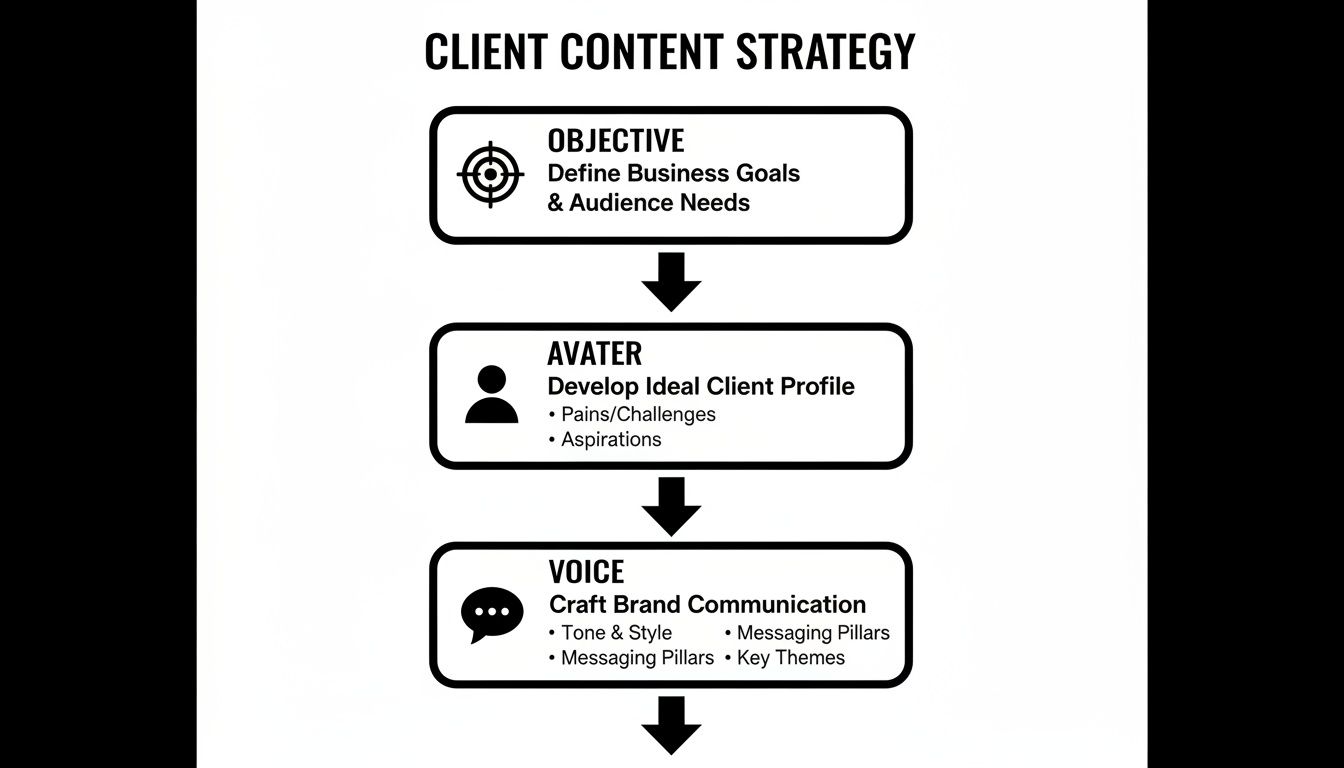
This hierarchy is critical. Without a sharp focus on your ideal client and a specific goal, your content will feel generic, lack direction, and ultimately fail to deliver results.
Pillar 1: Authoritative Articles
These are the absolute workhorses of your content strategy. Forget simple blog posts; we’re talking about deep, insightful answers to the complex questions your ideal clients are typing into Google. This is your chance to dominate search rankings for high-intent keywords that signal a real, pressing legal need.
For instance, a family law firm targeting high-net-worth individuals wouldn’t just write about “divorce.” They’d publish an in-depth guide on “Navigating Asset Division for Private Equity Partners.” This specific, value-packed content immediately establishes credibility and attracts precisely the right kind of attention.
The power of this approach is undeniable. In fact, high-quality, SEO-driven content achieves an impressive 7.5% conversion rate—more than triple the rate of paid ads.
Pillar 2: In-Depth Thought Leadership
While articles build your search presence, true thought leadership cements your status as an undisputed industry leader. This pillar is about going deeper with formats like white papers, eBooks, and comprehensive industry reports. This content isn’t for casual readers; it’s for corporate decision-makers, sophisticated investors, and influential referral sources.
Thought leadership moves beyond answering existing questions and starts shaping the conversation. It tackles emerging legal trends, offers novel interpretations of complex regulations, or provides a framework for navigating high-stakes business challenges.
Here’s what this looks like in practice:
- An M&A firm could publish a definitive white paper on the legal implications of AI in corporate due diligence.
- An intellectual property practice might create an eBook on protecting trade secrets in the era of remote work.
This type of content is a powerful lead-generation tool, often placed behind a simple form to capture contact details from highly motivated prospects. To dig deeper into this concept, see our guide on what thought leadership truly means and how you can develop it effectively.
Pillar 3: Professional Video Content
In a digital world, video is the fastest way to build a genuine human connection. For law firms, professional video demystifies intimidating legal topics and puts a relatable face to the names on your website. High-net-worth clients aren’t just hiring a firm; they are entrusting their most critical issues to a specific person.
Video allows you to build that personal trust at scale. It’s perfect for:
- Explaining complex processes: A short, clear video can break down the stages of trust litigation far more effectively than a thousand words of text.
- Showcasing attorney expertise: A recorded webinar or interview allows your partners to demonstrate their command of a subject in a dynamic, engaging format.
- Sharing client success stories: While always maintaining confidentiality, testimonials can powerfully convey the real-world results you achieve for clients.
Pillar 4: Exclusive Email Briefings
Finally, exclusive email briefings—or newsletters—are your key to nurturing relationships over the long term. Not every prospect is ready to hire you today. A well-crafted email briefing keeps your firm top of mind by delivering consistent, high-value insights directly to their inbox.
This isn’t a generic marketing blast. Think of it as a curated intelligence report for your most important contacts, including past clients, active prospects, and key referral sources. By consistently providing value without asking for anything in return, you become the first and only call they make when a legal need finally arises.
To help tie these pillars together, here’s a blueprint for aligning your content creation with your firm’s strategic goals.
Strategic Content Pillar Blueprint
This table outlines the purpose, ideal format, and success metric for each of the four core content types, helping you align creation with business goals.
| Content Pillar | Primary Goal | Best Format for High-Net-Worth Audience | Key Performance Indicator (KPI) |
|---|---|---|---|
| Authoritative Articles | Attract qualified organic traffic through search engines | In-depth guides, “how-to” articles, analysis of recent legal rulings | Organic search rankings, traffic to key pages, new user growth |
| Thought Leadership | Establish market-leading authority and generate high-value leads | Gated white papers, eBooks, proprietary research reports | Lead magnet downloads, new email subscribers, consultation requests |
| Professional Video | Build personal trust and humanize the firm | Attorney Q&A sessions, client case studies, complex topic explainers | Video views, watch time, engagement rate, website click-throughs |
| Exclusive Email Briefings | Nurture long-term relationships with clients and referral sources | Curated newsletters with exclusive insights, legal trend analysis, case updates | Open rates, click-through rates, direct replies, referral tracking |
By strategically deploying all four content pillars, your firm can build a powerful, multi-channel presence that not only attracts but also engages and converts the sophisticated clients you want to serve.
Amplifying Your Content with SEO and Strategic PR
Creating brilliant, authority-building content is a huge win, but it’s only half the job. Think of it like a world-class trial lawyer delivering a closing argument in an empty courtroom—the power is lost without an audience. Your content is the same; its true value is only unlocked when it reaches the high-net-worth individuals and corporate decision-makers you need to influence.
This is where amplification comes into play. It’s a powerful one-two punch that combines the long-term discoverability of search engine optimization (SEO) with the immediate credibility of strategic public relations (PR). This ensures your expertise isn’t just published—it’s actively found by clients looking for answers and validated by publications they already respect.

Mastering Attorney SEO for High-Value Discovery
SEO for law firms isn’t about gaming the system. It’s about making it dead simple for search engines like Google to see your content as the most credible answer to a specific legal question. When a potential client searches for a solution to a complex problem, your content needs to be the first thing they see.
This demands a smart approach to keyword research. Forget generic terms like “business lawyer.” You need to focus on the precise language your ideal client uses, such as “legal counsel for series B funding” or “high-asset divorce representation.” Weaving these phrases naturally into your articles, headlines, and subheadings is the key to attracting qualified traffic.
The investment is real, but so is the return. Law firms are now investing between $60,000 and $114,000 annually on SEO and seeing concrete results in just four to six months. This trend highlights a critical insight: visibility on search engines directly translates to new clients. For more on this, check out these law firm marketing investments from MyCase.
A crucial piece of modern SEO is getting featured in Google News. This platform surfaces timely, authoritative content, and a placement here can be a massive boost to your visibility and credibility. It tells both Google and potential clients that your firm is a primary source for commentary on breaking legal matters. You can learn more in our guide on the best SEO strategies for lawyers.
Leveraging Strategic PR for Credibility and Reach
While SEO makes you discoverable, strategic PR makes you credible. This is all about getting your attorneys and your insights featured in the respected business and legal publications your target audience already reads and trusts. This isn’t just about brand awareness; it’s about earning powerful backlinks.
A backlink is simply a link from another website to yours. When a reputable publication links to your firm’s content, it’s a powerful vote of confidence in the eyes of search engines, giving your own website’s authority a significant lift.
PR in law firm content marketing isn’t about blasting out press releases. It’s about earning media placements that validate your expertise, build powerful backlinks, and put your firm’s name in front of an audience you couldn’t otherwise reach.
Consider these high-impact PR tactics:
- Guest Articles: Author bylined articles for industry journals or major business publications, establishing your expertise on a niche legal topic.
- Expert Commentary: Position your attorneys as the go-to sources for journalists covering legal news, securing quotes and mentions that build authority.
- Case Study Placements: Pitch compelling, anonymized case studies to relevant media outlets to showcase your firm’s real-world problem-solving skills.
Every successful placement amplifies your message and cements your firm’s reputation as a leader in your field.
The Force Multiplier: Specialized Networks
For law firms targeting an exclusive clientele, specialized networks act as a powerful force multiplier. Platforms like Haute Lawyer move beyond traditional SEO and PR by placing your content directly within a curated ecosystem built on luxury and influence.
This strategy offers a clear advantage. Instead of shouting to be heard in a crowded digital space, your firm is positioned alongside world-class luxury brands and introduced directly to an affluent audience. It’s a strategic move that aligns your firm’s brand with the lifestyle and interests of the exact high-net-worth clients you want to attract. This targeted visibility ensures your expertise not only gets seen but gets seen by the right people.
Navigating Ethical Rules in Your Content Marketing
For law firms, content marketing plays by a different set of rules—and they’re non-negotiable. Every blog post, video, or social media update you publish falls under the watchful eye of state bar advertising regulations. Getting this right isn’t just about dodging penalties; it’s about building the unshakable trust that high-net-worth clients demand before they’ll even consider picking up the phone.
Think of these ethical guidelines less as restrictions and more as guardrails protecting your firm’s reputation. High-value clients are sharp, discerning, and deeply risk-averse. They can spot an over-the-top sales pitch or an empty claim from a mile away. In this context, ethical marketing becomes your most powerful differentiator, sending a clear signal of credibility and professionalism.
Common Ethical Traps to Avoid
It’s surprisingly easy for well-meaning firms to wander into ethical gray areas. Most slip-ups aren’t malicious; they come from a simple misunderstanding of how marketing content is legally interpreted. Staying compliant means being hyper-aware of a few key issues.
Keep an eye out for these common mistakes:
- Making Unsubstantiated Claims: Using phrases like “the best litigator” or “expert in M&A” is a red flag unless you have objective, third-party proof. Stick to factual statements about your experience, credentials, and track record.
- Implying Guaranteed Outcomes: Language that even hints at a specific result—like “we will win your case”—is a serious ethical breach. Your content must be clear that past success doesn’t guarantee future results.
- Inadvertently Forming an Attorney-Client Relationship: Your content is there to provide general information, not specific legal advice. Without a rock-solid disclaimer, a reader could mistakenly believe your article is formal counsel, creating an obligation you never intended.
- Failing to Label Content as Advertising: Many state bars require marketing materials to be clearly marked as “Advertising Material” or something similar. This is especially crucial for newsletters, emails, and other direct outreach.
Your content’s job is to educate and showcase your expertise—not to make promises. Every claim has to be backed by facts, every statement must be unambiguous, and every piece must respect the bright line between general information and specific legal advice.
A Checklist for Ethical Content Creation
You can turn compliance from a chore into a competitive advantage by building it directly into your workflow. Before you hit “publish” on anything, run it through this simple checklist. This ensures your marketing consistently reinforces your firm’s integrity. Our guide on modern legal ethics issues offers a deeper dive into this critical topic.
- Add Clear Disclaimers: Every single blog post, video, and web page needs a disclaimer. It should state that the content is for informational purposes only, does not constitute legal advice, and does not create an attorney-client relationship.
- Review for Superlatives and Guarantees: Hunt down and eliminate absolute words like “best,” “expert,” or “guarantee.” Swap them for defensible language like “experienced,” “focused on,” or “knowledgeable in.”
- Verify All Factual Claims: If you mention a verdict amount, a case result, or any statistic, it must be 100% accurate. You need to have the documentation to prove it.
- Identify Content as Advertising Where Required: Check your state bar’s rules. If you’re ever in doubt, the safest move is to include an “Attorney Advertising” label.
By making these practices a core part of your law firm content marketing process, you transform ethical rules from a hurdle into a cornerstone of your brand.
Measuring What Matters for Sustainable Growth
A successful content program isn’t measured by clicks or page views. While those numbers might feel good, they’re often just vanity metrics—indicators of activity, not progress. True success is defined by tangible business outcomes that contribute directly to your firm’s bottom line.
The goal is to shift your focus from simply attracting an audience to attracting the right audience and turning them into clients. This requires a disciplined approach to tracking the key performance indicators (KPIs) that connect your content efforts to real revenue. Without this data, you’re just guessing.
From Vanity Metrics To Business Drivers
It’s easy to get excited about a blog post that gets thousands of views. But if none of those visitors are qualified potential clients, what was the point? Your measurement strategy has to be built around the metrics that truly matter for a high-value law practice.
These are the core KPIs you should be tracking:
- Qualified Leads Generated: This is the most important metric. It measures how many ideal potential clients contacted your firm directly because of your content. This can be tracked with dedicated contact forms, call tracking numbers, or a simple “How did you hear about us?” question during intake.
- Lead-to-Consultation Rate: Of the qualified leads your content brings in, what percentage actually book a consultation? This tells you how well your content isn’t just attracting interest but compelling action.
- Client Acquisition Cost (CAC) from Content: How much are you spending to acquire a new client specifically through your content? By tracking your investment against the new business it generates, you can prove the channel’s financial value.
- Conversion Rate on Key Pages: Track the percentage of visitors who take a desired action—like filling out a form—on your most important articles and service pages. A high conversion rate means your content is persuasive and effective.
Measuring content is about asking the right questions. Instead of, “How many people saw our content?” you need to be asking, “How many qualified prospects did our content bring in, and what was the return on our investment?”
The Accelerator Effect of Strategic Partnerships
Building a content engine that consistently delivers on these KPIs takes time, expertise, and a significant amount of resources. For firms serious about dominating their market, the right partnership can act as a powerful accelerator, providing a turnkey solution for elevating your brand and generating leads.
While traditional networking still leads the pack for ROI at 43%, data shows that law firm content marketing is a major driver, with 13% of firms reporting it as their highest return generator. For attorneys focused on elite visibility, this statistic underscores why a strategic partnership can deliver such outsized value. You can find more insights on law firm marketing ROI in recent industry reports.
Platforms like Haute Lawyer are designed specifically to amplify this growth. By aligning your firm with world-class luxury brands and providing direct access to an exclusive network of high-net-worth individuals, it solves the distribution challenge instantly. This isn’t just marketing; it’s a strategic investment in placing your expertise in front of the exact clients you want to attract, accelerating your journey from creating content to acquiring high-value cases. For firms ready to lead their market, it’s the definitive move.
Answering the Tough Questions
Even the most buttoned-up content strategy brings up real-world questions. Let’s tackle some of the most common ones attorneys and marketing teams ask as they put their plans into action.
How Much Time Does This Really Take?
There’s no magic number, but let’s be realistic. A boutique firm can see incredible results by committing 10-15 hours a month to produce and promote one exceptional, in-depth article. A larger firm with a dedicated team might be looking at 40+ hours.
But the guiding principle is always quality over quantity. One deeply insightful analysis published monthly will always outperform four shallow, generic blog posts. Consistency is what builds authority, not sheer volume.
Can’t We Just Use AI for All of This?
AI tools are fantastic for brainstorming outlines or tightening up a first draft. But leaning on them exclusively for sophisticated legal content is a serious misstep. Your law firm content marketing hinges on deep expertise, an understanding of ethical nuances, and a voice that inspires trust—three things an algorithm simply can’t fake.
Think of AI as a highly efficient paralegal, not senior counsel. Use it to speed up your process, but every single piece must be reviewed, edited, and infused with unique insights from a skilled attorney. Your content is a direct reflection of your firm’s authority, and it has to be authentic to connect with discerning clients and stay compliant with bar association rules.
What Is the One Metric That Truly Matters?
While it’s tempting to get caught up in search rankings and website traffic, the single most important metric is qualified leads generated. This is the number that connects your marketing spend directly to your bottom line.
The most important metric for any law firm is ‘qualified leads generated.’ This tracks how many ideal potential clients contacted you directly because of your content, providing a direct link between your marketing efforts and actual revenue.
How do you track it? You can use dedicated contact forms on key articles, call-tracking numbers, or just make it a habit to ask every new client how they found you. This KPI proves the ROI of your content far more effectively than any vanity metric.
For firms targeting an elite clientele, this can be taken a step further. Platforms like the Haute Lawyer Network amplify content by placing top attorneys within a luxury media ecosystem. Profiles featured on HauteLiving.com get indexed in Google News, delivering a powerful SEO advantage. You can find more data on how strategic marketing partnerships deliver value for law firms on mycase.com. This approach aligns your firm’s brand with other elite names, capturing the attention of high-net-worth clients who are looking for proven authority.
Elevate your firm’s brand and connect with an exclusive audience of high-net-worth individuals. Haute Lawyer Network offers a curated marketing platform that aligns your expertise with the power of a nationally recognized luxury media brand. Learn more and apply for membership today.