
Deciding if it’s better to file for divorce first is less about a single right answer and more about making a calculated strategic choice. It’s a classic tug-of-war between taking control and potentially dialing up the conflict.
Filing first puts you in the driver’s seat, but it can feel like you’re the one officially ending the marriage. Waiting might feel more passive, but it can also open the door for a more peaceful resolution. The best path forward depends entirely on your situation, your spouse, and what you hope to achieve.
Should You File for Divorce First? A Quick Guide
Initiating the divorce—which legally makes you the petitioner—gives you immediate control. You get to set the timeline, frame the initial legal arguments, and get your financial ducks in a row without the pressure of a looming deadline. This proactive approach often provides a serious psychological and procedural advantage.
It’s not just a feeling, either. Research suggests the person who files first often has an edge in negotiations. In fact, a high percentage of filings by women lead to more favorable outcomes in both custody and financial settlements. You can find more insights on global divorce trends from the team at AustralianFamilyLawyers.com.au.
On the flip side, being the respondent (the one served with papers) isn’t necessarily a weak position. It can give you and your spouse more time to work things out amicably before the courts get deeply involved. You also avoid the upfront costs of court filing fees and hiring a process server. It all comes down to understanding the trade-offs.
Filing First vs. Responding: Key Differences
To make sense of the strategic nuances, it helps to see the core differences side-by-side. This table breaks down what it really means to be the one filing versus the one responding.
| Consideration | Filing First (Petitioner) | Responding (Respondent) |
|---|---|---|
| Control Over Timing | You dictate when the legal clock starts ticking. | You’re reacting to a timeline your spouse initiated. |
| Choice of Jurisdiction | You can select the court location if multiple options exist. | You must respond in the court where your spouse filed. |
| Initial Legal Tone | You present your side of the story and your requests first. | Your first legal move is a direct reaction to their claims. |
| Upfront Costs | You’re on the hook for initial court filing and service fees. | Lower initial costs, though you’ll still have a response fee. |
| Emotional Impact | Can feel empowering, but may also escalate the conflict. | Can feel blindsiding, but it avoids being the one to “start the war.” |
Ultimately, whether you’re filing or responding, the goal is to position yourself for the best possible outcome. This choice is just the first of many strategic decisions you’ll make.
This data just goes to show that divorce is a global reality, but how it plays out is heavily influenced by local laws, societal views, and economic pressures. It’s a powerful reminder that a one-size-fits-all strategy rarely works.
The First-Mover Advantage in Divorce Proceedings

When you choose to file for divorce first, you’re doing more than just starting the paperwork. You’re seizing a powerful strategic position as the petitioner, which allows you to set the initial tone for the entire legal process.
You get to draft the first petition, outlining your requests for everything from asset division and spousal support to child custody. This isn’t just a procedural step; it carries significant psychological weight. You immediately create the narrative, and your spouse—the respondent—is forced to react to it. They’re instantly put on the defensive, compelled to answer your claims rather than introducing their own vision.
Framing the Narrative for the Court
The initial documents you file are the court’s very first impression of your case. As the petitioner, you have the invaluable opportunity to present the facts and your desired outcomes in the most favorable light. This initial framing can subtly shape a judge’s perception right from the start.
For instance, you can request specific temporary orders to maintain financial stability or establish an immediate parenting plan. If the court grants these early orders, they can create a precedent that’s tough to unwind later. The respondent is then left arguing against a court-sanctioned arrangement that’s already in place.
By initiating the divorce, you control the initial flow of information to the court. This lets you highlight key issues and propose solutions on your terms, compelling your spouse to respond to your agenda, not their own.
The Strategic Edge in Negotiations
This first-mover advantage flows directly into settlement negotiations. You walk into the room with your positions already clearly articulated in legal filings, projecting strength and preparation. Meanwhile, your spouse and their legal team are often still playing catch-up, gathering documents and scrambling to build a counter-strategy.
Think about a case involving a complex business valuation. By filing first, you can hire a forensic accountant and build a strong case for the business’s value before your spouse has even retained an expert. This puts you in a position to make a well-supported initial settlement offer, pressuring them to either accept it or spend considerable time and money trying to poke holes in your findings.
Of course, this proactive approach isn’t without risk. Serving divorce papers can feel like an aggressive act, potentially escalating conflict with a spouse who might have otherwise been open to a more collaborative path. The decision to file first requires a careful calculation—do the strategic benefits of control outweigh the potential for a more adversarial fight?
How Filing Location Shapes Your Strategy

The question of whether it is better to file for divorce first often hinges on a single, critical factor: geography. Where you file can dramatically alter the rules of the game, creating distinct advantages or unexpected hurdles depending on state and even local laws.
Choosing the right jurisdiction isn’t just a procedural step; it’s a strategic decision that can influence everything from property division to the final timeline of your case. By filing first, you often gain the ability to select the jurisdiction—as long as you meet the legal residency requirements—forcing the case to be heard in a court that may have more favorable laws regarding spousal support or asset distribution.
The Impact of State-Specific Laws
State laws create a patchwork of different legal environments, and the differences can be profound. For instance, community property states like California and Texas mandate a 50/50 split of marital assets. In contrast, equitable distribution states give judges far more discretion to divide property in a way they deem “fair,” which may not be equal at all.
Filing first in an equitable distribution state gives you the initial opportunity to frame the narrative and argue why a certain division is fair. The impact can be massive, particularly in high-net-worth cases where asset division is incredibly complex. Understanding the specific needs of ultra-wealthy families in these situations can provide deeper insight into how location impacts outcomes.
Additionally, some states still recognize “fault-based” divorce, where actions like adultery or abandonment can directly influence alimony or property awards. If you have grounds, filing first in such a state lets you introduce this evidence from the very beginning, immediately shaping the entire case.
Choosing the jurisdiction is not just a logistical step; it’s a strategic move that can define the legal framework for your entire divorce. An advantageous filing location can provide leverage that lasts through final negotiations.
International and Local Procedural Differences
These procedural variations extend well beyond state lines. Global data shows that countries with more accessible and inexpensive divorce procedures, like the Maldives and Russia, record some of the world’s highest divorce rates. This underscores a simple reality: procedural ease encourages proactive filings.
Even within the same state, the differences can be significant. One county’s court may have a backlog that delays cases for months, while an adjacent county might move much faster. An experienced family law attorney will understand these local nuances. They can advise you on the best location to file to either expedite the process or, in some cases, use delays to your strategic advantage. It’s this level of planning that highlights just how critical it is to choose where your legal journey begins.
When to File: Analyzing the Impact of Timing

Deciding if it is better to file for divorce first is about more than just claiming the role of petitioner—it’s a calculated move. The specific date you file creates a legal snapshot of your marital estate, which can dramatically alter how assets and debts are ultimately divided. Filing at the right moment is a powerful tool for protecting your financial future.
Think about it this way: what if your spouse is about to receive a massive annual bonus, inherit a significant sum of money, or have their stock options vest? If you file for divorce before these windfalls materialize, those future assets are often classified as separate property, keeping them out of the marital pot entirely. Waiting until after the fact could easily make them marital property, subject to division.
Key Financial Timelines to Consider
Timing your filing around major financial events is a cornerstone of any sound divorce strategy. Waiting just a few weeks—or moving forward immediately—can change the final outcome by tens of thousands of dollars, or even more.
Here are a few scenarios where the timing of your filing is absolutely critical:
- Bonuses and Commissions: Filing before a large, performance-based bonus is paid out can sometimes exclude it from the marital estate.
- Inheritance or Gifts: If a spouse is set to receive a substantial inheritance, filing beforehand almost always ensures it remains their separate property.
- Property Acquisition: The purchase date of a major asset, like a vacation home or investment property, determines whether it’s considered marital or separate.
- Retirement Account Milestones: Filing before a pension or 401(k) hits a key vesting date can significantly impact its valuation and how it’s divided.
Strategic timing isn’t about being manipulative; it’s about being prepared. Understanding how the filing date impacts asset classification is essential for securing an equitable financial outcome and preventing future disputes.
This is especially true in “gray divorces.” We’ve seen a significant rise in divorces among those aged 50 and older, with higher-income individuals often filing first to protect complex assets and retirement interests. You can discover more insights about these divorce rate trends on Divorce.com.
Timing can also influence child-related matters. Understanding the details of how joint custody works can help you propose a plan that aligns with key dates, like the start of a school year. Consulting an attorney to analyze your financial calendar is a non-negotiable step before initiating any proceedings.
Weighing Your Options: Filing First vs. Responding
The question of whether it’s better to file for divorce first isn’t about winning or losing—it’s about strategy. There is no universal “right” answer. The best approach hinges on your unique circumstances, strategic goals, and emotional readiness for what lies ahead.
Filing first immediately casts you in a proactive role. You dictate the timing of the entire process, you choose the jurisdiction (which can be a massive strategic advantage), and you frame the initial narrative that the court sees. This can put you in the driver’s seat from day one, forcing your spouse to play catch-up.
On the other hand, being the respondent—the one who is served divorce papers—isn’t necessarily a disadvantage. It grants you the breathing room to absorb the reality of the situation, gather critical financial documents without a looming deadline, and prepare a measured, thoughtful response. For couples hoping for a more collaborative split, this reactive position can sometimes set a less confrontational tone.
The Trade-Offs: Control vs. Cost
One of the clearest benefits of filing first is control. As the petitioner, you set the pace. You decide precisely when the legal clock starts ticking, a move that can be strategically timed around bonuses, stock vesting, or other key financial events. But this control comes with upfront costs, namely the court filing fees and the expense of formally serving your spouse.
Responding, in contrast, means you are reacting to a timeline someone else has established. A strict deadline will be imposed for you to file your official response with the court, which can feel incredibly rushed and overwhelming. The silver lining? Your initial out-of-pocket costs are typically lower, though the total legal spend for the divorce will ultimately depend far more on its complexity than on who filed the first piece of paper.
The choice often boils down to a strategic trade-off. Filing first offers control at an initial cost, while responding sacrifices some control for more preparation time and lower upfront expenses.
The data below shows how being the petitioner versus the respondent can impact key outcomes in a divorce case.
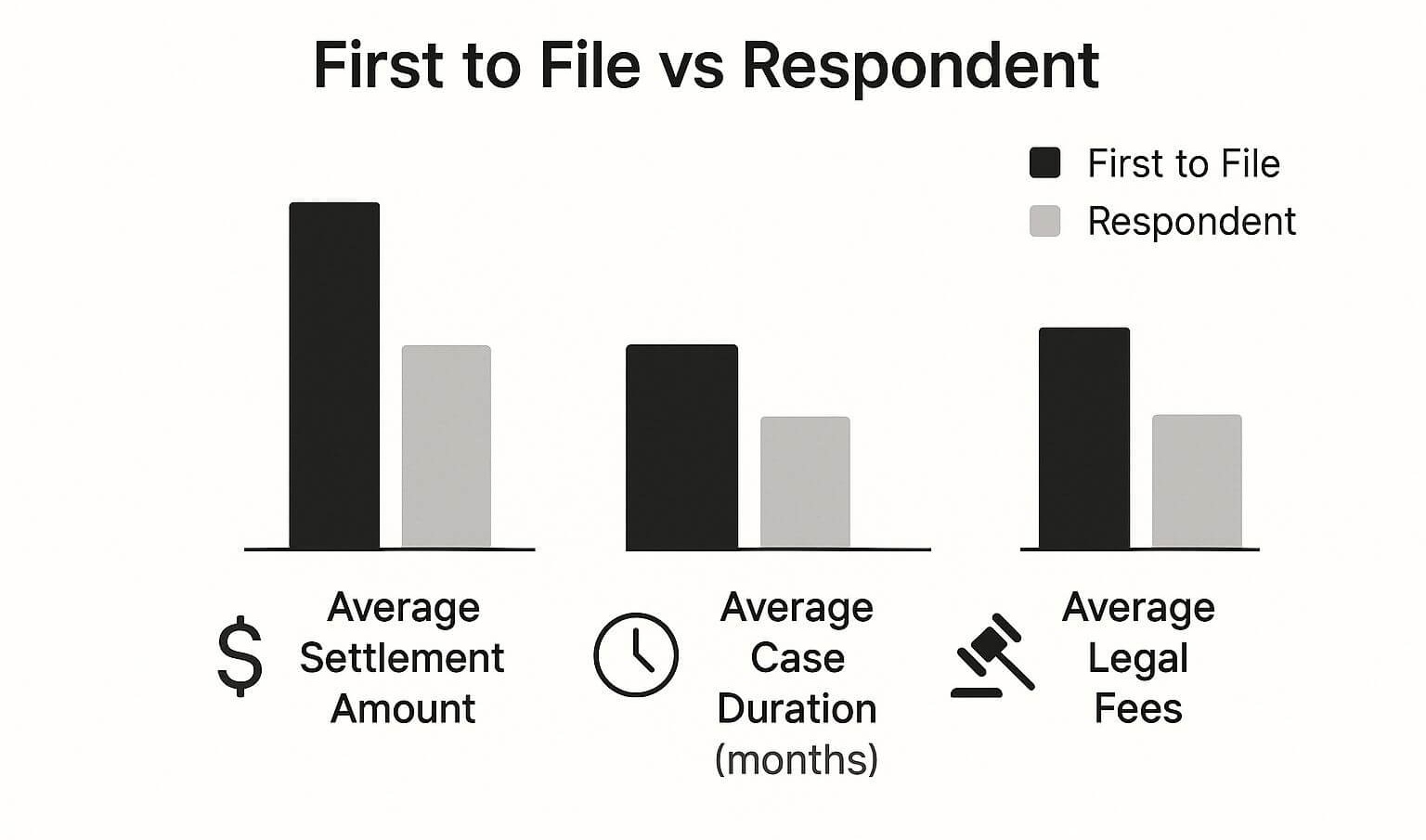
While every case is different, these figures suggest that petitioners, despite higher initial fees, may see slightly more favorable outcomes. This is likely due to the powerful strategic advantages gained by taking control of the process from the very beginning.
Decision Matrix: Filing First vs. Responding
To help clarify the strategic implications, this matrix breaks down how your role as petitioner or respondent can influence different aspects of the divorce process.
| Factor | Impact of Filing First | Impact of Responding |
|---|---|---|
| Control | You set the timeline and jurisdiction, framing the initial court narrative. | You react to a timeline set by your spouse and must respond within a set deadline. |
| Initial Costs | Higher upfront expenses due to court filing and service fees. | Lower initial costs, as the petitioner covers the first round of fees. |
| Preparation Time | You prepare on your own schedule before filing, allowing for thorough planning. | You’re given a limited, legally mandated timeframe to prepare your response. |
| Emotional Impact | Requires emotional readiness to initiate a definitive, life-altering legal action. | Can be emotionally jarring to be served, but removes the burden of initiating. |
| Strategic Advantage | Allows for tactical timing and presents a posture of confidence and readiness. | Provides an opportunity to see your spouse’s initial demands before formulating a strategy. |
Choosing which path to take is a deeply personal and strategic decision. Both roles ultimately lead to the same legal endpoint, but the journey to get there can look very different depending on where you start.
Emotional and Strategic Readiness
Your personal state of mind is a critical, often overlooked, factor. Filing for divorce is a profound and emotionally draining step. If you are already organized, mentally prepared, and have a clear legal strategy in place, filing first can project a level of confidence that becomes a powerful asset during negotiations.
But if you feel blindsided or overwhelmed, being served with divorce papers can be the jolt needed to get organized and find the right legal counsel. It takes the immense pressure of initiating the split off your shoulders, allowing you to focus completely on crafting your response. For couples who believe collaboration is still on the table, exploring the differences between divorce mediation vs. litigation can offer a less adversarial path forward, no matter who files first.
Making The Right Choice For Your Situation
The question of whether it is better to file for divorce first doesn’t have a universal answer. The right move is deeply personal, hinging on your goals, financial reality, and the current dynamic with your spouse. What works in theory might not hold up in practice.
Making a smart decision requires moving beyond abstract advantages and into a frank assessment of your circumstances. This means honest self-reflection, but more importantly, it requires sophisticated legal guidance. An experienced family law attorney can translate a complex, emotional question into a clear, strategic path forward.
Creating Your Decision Framework
Before you even meet with a lawyer, you can bring immense clarity to the situation by evaluating your position across four critical areas. Answering these questions for yourself will make your first legal consultation far more productive and help you decide if filing first is truly in your best interest.
- Financial Readiness: Have you collected key financial documents like tax returns, bank and brokerage statements, and retirement account information? You can’t make a strategic move without a complete map of the marital estate.
- Spousal Communication: What’s the temperature of your relationship? An aggressive filing could pour fuel on an already contentious fire. Conversely, waiting too long in a high-conflict situation could be misinterpreted as weakness or leave you vulnerable.
- Child Custody Concerns: Are there immediate risks to your children’s stability? Is there a chance your spouse might relocate with them or disrupt their routines? Filing first lets you request temporary custody orders, establishing a stable baseline from the start.
- Emotional Preparedness: Initiating a divorce is a marathon, not a sprint. Are you mentally and emotionally ready for a formal legal battle? It’s a demanding process that requires resilience and a solid support system.
Making the right choice is less about speed and more about strategic preparation. Your decision to file or wait should be a calculated move based on a thorough evaluation of your financial, emotional, and familial circumstances.
Once you’ve reflected on these points, you’re ready to build a strategy with your attorney. They will explain how local laws and judicial tendencies apply to your specific facts, advising on the timing and approach that best protects you and your future. This measured process ensures you walk into your divorce not with reactive uncertainty, but with a confident, strategic plan.
Unpacking Common Questions About Filing First
Starting the divorce process is filled with uncertainty. Here are straightforward answers to the most pressing questions people have when deciding whether to file first.
Does Filing First Affect Child Custody Decisions?
While it won’t automatically win you custody, filing first gives you a critical procedural edge. As the petitioner, you get the first opportunity to present a proposed parenting plan to the court and ask for temporary custody orders.
These initial orders often create a “status quo” for the children’s living arrangements and schedules. Judges are often hesitant to disrupt a stable routine later on, which means your initial proposal can carry significant influence as the case progresses. Ultimately, however, the court’s final ruling will always be based on the child’s best interests.
Can Filing for Divorce First Make My Spouse More Hostile?
It’s a definite possibility. Being served with divorce papers can feel like a blindside, especially if your spouse wasn’t expecting it. That shock can quickly escalate conflict and make it much harder to reach an amicable agreement.
On the other hand, if your relationship is already contentious, filing first grants you immediate legal protections. Temporary orders can stop a spouse from draining bank accounts, hiding assets, or making unilateral decisions about the children. It creates a structured environment where negotiations can happen under the court’s supervision.
The choice to file first is a strategic one, weighing the risk of heightened conflict against the critical need for immediate legal protection. An experienced attorney can help you determine which is the greater concern in your specific circumstances.
Is It More Expensive to Be the One Who Files?
Initially, yes. The petitioner is responsible for the court’s filing fee and the cost of having the divorce papers professionally served. The respondent also has fees to pay when they file their response, but the petitioner’s upfront costs are typically higher.
Keep in mind, these initial fees are a very small piece of the total expense. The real cost drivers in any divorce are the level of conflict between the parties and the complexity of the issues, not who filed the first document.
When facing a high-stakes divorce, the quality of your legal representation is paramount. Haute Lawyer Network connects you with a curated selection of the nation’s most respected attorneys, ensuring you have elite counsel to protect your interests. Find your expert legal advocate by exploring the network at https://hauteliving.com/lawyernetwork.