
When you think of a company’s most valuable assets, you might picture office buildings, inventory, or a healthy bank account. But for many of today’s most successful businesses, their greatest treasures are the ones you can’t touch: a brilliant invention, an iconic brand name, or a secret recipe. An intellectual property attorney is the legal specialist who protects these intangible—yet invaluable—creations from being copied or stolen.
Think of them less as lawyers and more as architects, building a legal fortress around the ideas that give your business its competitive edge.
Why an IP Attorney Is Your Idea’s Best Defense
In the high-stakes world of business, your groundbreaking ideas are what set you apart. That proprietary software, your instantly recognizable logo, or the unique manufacturing process you developed are the very things that drive your success. An intellectual property attorney’s entire focus is safeguarding these assets, transforming them from vulnerable concepts into legally protected, revenue-generating property.
Without that protection, your innovation is an open invitation for competitors. They could legally copy your flagship product, launch a confusingly similar brand, or reverse-engineer your software—eroding your market share and devaluing years of hard work. This is precisely where an IP attorney shifts from a legal expense to a critical strategic partner.
Building Your Legal Fortress
A top-tier IP attorney does far more than just file paperwork. They develop a comprehensive defensive strategy built on the four pillars of intellectual property law. Their job is to deeply analyze your business assets and deploy the strongest, most appropriate form of protection available.
- Patents for novel inventions, technologies, and industrial processes.
- Trademarks for the brand names, logos, and slogans that define your market presence.
- Copyrights for original creative expressions like software code, books, and artistic designs.
- Trade Secrets for confidential information that gives you a competitive advantage, like formulas or client lists.
Each of these pillars offers a different kind of shield, and a truly skilled IP lawyer knows how to combine them for impenetrable coverage. For instance, a new smartphone may hold dozens of patents on its technology, a trademark on its name, and copyrights on its software code and user interface.
Securing your intellectual property is not merely a defensive legal maneuver; it is a foundational business strategy that converts innovation into tangible, defensible assets, creating long-term value and a durable competitive advantage.
An Investment in Your Future
Engaging an intellectual property attorney is a strategic investment, not a cost center. The upfront expense of securing your IP is a small fraction of the potential losses from a competitor’s infringement or the staggering cost of litigation after the fact. A well-managed IP portfolio can become a significant revenue stream through licensing, attract sophisticated investors, and dramatically increase your company’s valuation during a sale or merger.
To truly understand how to protect your assets, it’s helpful to see how each type of IP serves a unique purpose.
At-a-Glance Guide to Intellectual Property Types
Here’s a quick breakdown of the four main types of intellectual property, what they protect, and how long that protection typically lasts.
| IP Type | What It Protects | Best For | Typical Duration |
|---|---|---|---|
| Patent | Inventions, machines, processes, and chemical compositions | Protecting a new gadget, software algorithm, or manufacturing method | 20 years from filing date |
| Trademark | Brand names, logos, slogans, and sounds | Building a recognizable brand identity like a company name or product logo | Potentially forever, with continued use and renewals |
| Copyright | Original works of authorship | Books, music, software code, architectural drawings, and photographs | The author’s life plus 70 years |
| Trade Secret | Confidential business information that provides a competitive edge | Secret recipes, client lists, or proprietary formulas | Indefinitely, as long as it remains secret |
Choosing the right combination of these protections is key. A seasoned IP attorney can assess your specific needs and build a tailored strategy to ensure your most valuable assets—your ideas—remain securely yours.
Understanding the Four Pillars of IP
Before you can work effectively with an intellectual property attorney, you need to know what you’re protecting. Think of your IP portfolio as a fortress; it isn’t defended by a single wall but by four distinct legal fortifications. Each one—patents, trademarks, copyrights, and trade secrets—guards a different kind of asset. A seasoned attorney knows exactly which defense to deploy for any given situation.
These pillars are not interchangeable. Trying to protect an invention with copyright law is like trying to stop a tank with a wooden fence—it’s the wrong tool for the job. Understanding what each pillar does is the first step toward building an impenetrable defense around your most valuable creations.
Patents: The Blueprint for Invention
A patent is a powerful, government-granted monopoly over an invention. It gives you the exclusive right to make, use, and sell your creation for a set period, typically 20 years from the filing date. In exchange, you must publicly disclose how your invention works, adding to the collective pool of human knowledge.
Imagine you’ve engineered a new type of solar panel that is 50% more efficient than anything on the market. A patent acts as a legal blueprint, preventing anyone else from manufacturing or selling that specific technology without your permission. This protection is vital for innovators, giving them a crucial window to commercialize an idea and recoup R&D costs without being immediately undercut by copycats. Navigating this complex process almost always requires specialized counsel; you can learn more about the role of a patent attorney and how they secure these critical protections.
Trademarks: The Signature of Your Brand
While a patent protects what you make, a trademark protects your brand identity. It’s any recognizable sign, design, or expression that identifies your products or services and distinguishes them from the competition. This includes your company name, logo, slogans, and even specific sounds or colors.
Think of the iconic swoosh on a pair of Nike shoes or the distinct shape of a Coca-Cola bottle. These are far more than just designs; they are powerful trademarks that instantly communicate a brand’s reputation and quality. An IP attorney helps secure these marks, ensuring no competitor can use a confusingly similar name or logo that might trick customers and dilute your brand’s hard-won value. Unlike a patent, a trademark can last forever as long as it’s actively used and renewed.
This concept map shows how these different IP pillars work together to form a comprehensive legal shield for your assets.
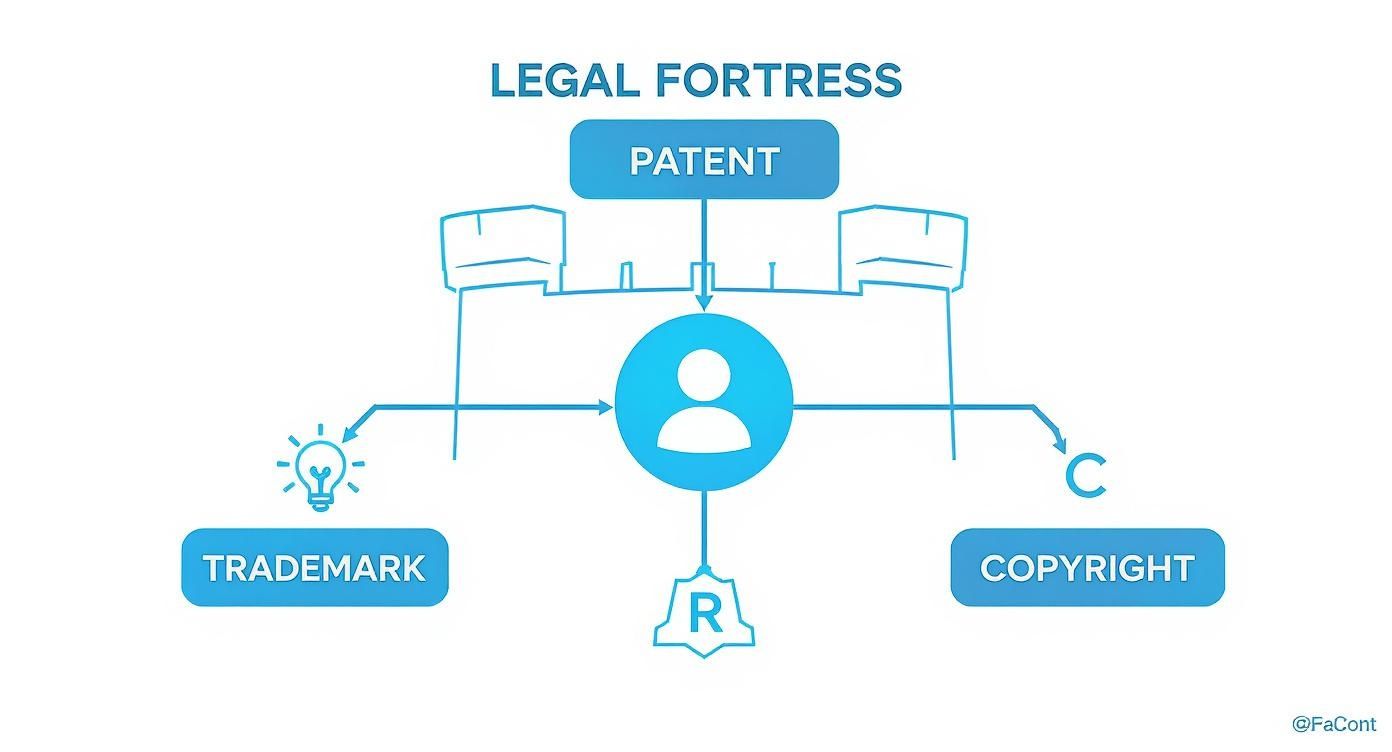
As the visualization shows, a single person or business often relies on multiple forms of IP protection simultaneously to create a truly robust defense.
Copyrights: The Rights to Creative Works
Copyright law protects original works of authorship the moment they are fixed in a tangible form. This broad category covers a massive range of creative output, safeguarding the expression of an idea—not the idea itself.
Here are just a few examples of what can be copyrighted:
- Literary Works: Books, articles, and even blog posts.
- Software Code: The source and object code that powers applications.
- Artistic Works: Paintings, photographs, sculptures, and musical compositions.
- Architectural Designs: The blueprints and plans for a building.
If you write a novel, the copyright prevents others from publishing it without your permission. If you compose a song, copyright gives you control over who can perform or record it. This protection is automatic upon creation, but formally registering your copyright with the U.S. Copyright Office gives you much stronger legal standing if you ever need to sue for infringement.
While patents protect inventions and trademarks protect brands, copyright is the legal shield for artistry and expression. It ensures that creators, from software developers to novelists, can control and benefit from their original works.
Trade Secrets: The Secret Recipe for Success
The final pillar is perhaps the most intriguing: the trade secret. This is any confidential business information that gives a company a competitive edge. Unlike other forms of IP, it isn’t registered with any government office. Its protection lasts for as long as the information remains a secret.
The most famous example is the formula for Coca-Cola, which has been fiercely guarded for over a century. Other common trade secrets include:
- Customer lists and sales data.
- Proprietary manufacturing processes.
- Marketing strategies and future business plans.
To qualify for trade secret protection, a business must take active and reasonable steps to keep the information confidential. This means using non-disclosure agreements (NDAs) and implementing strict internal security. An intellectual property attorney is crucial for establishing these protocols and can take swift legal action if a trade secret is stolen by an employee or competitor.
What an IP Attorney Actually Does for You

Many people think an intellectual property attorney just files paperwork. That couldn’t be further from the truth. They are strategic advisors—part architect, part guardian—who build and defend your company’s most valuable intangible assets. Their work is a sophisticated mix of proactive protection and reactive defense, all designed to secure your market position.
Think of them as a master strategist for your ideas. Long before an application is filed, they perform the critical due diligence, conducting exhaustive searches to ensure your invention or brand name is actually unique. This initial step is foundational; it prevents you from building a brand on a name you can’t own or investing millions in a technology that infringes on someone else’s patent.
A misstep here can invalidate an entire IP strategy, wasting years of effort and capital.
From Proactive Strategy to Airtight Protection
Once an asset’s uniqueness is confirmed, the attorney shifts into a creator role. Their specialized drafting skills are paramount here. They don’t just describe an invention; they define its legal boundaries with surgical precision, aiming for the broadest protection possible that can withstand challenges from competitors.
This requires a deep understanding of both the law and your specific industry, whether it’s software, biotech, or luxury goods. A top intellectual property attorney anticipates future loopholes and drafts applications that are not only strong today but will remain resilient for years.
- Strategic Counseling: Advising on the right type of protection—patent, trademark, or copyright—for each asset.
- Airtight Drafting: Writing detailed, legally robust applications that maximize protection and minimize the risk of rejection.
- Global Prosecution: Navigating the complex legal requirements of different countries to secure international IP rights.
The Guardian Role: Enforcement and Litigation
Securing your IP rights is only half the battle. Defending them is the other. An IP attorney constantly monitors the marketplace for infringers who might be copying your tech, using a similar brand name, or stealing your creative work. When they find one, they become an enforcer.
This enforcement can be as simple as a formal cease-and-desist letter or as collaborative as negotiating a licensing deal where the other party pays you. But when disputes can’t be resolved, your attorney becomes a litigator, representing you in court to defend your rights and uphold the value of your assets.
An IP attorney’s true value lies in their ability to translate complex legal processes into a tangible competitive advantage, ensuring your innovation remains a source of exclusive value, not a blueprint for your competitors.
The global IP landscape is constantly changing. Leading firms are at the forefront of this evolution. For example, K&L Gates LLP’s IP practice includes over 215 lawyers who collectively filed more than 5,540 patent applications and 4,400 trademark registrations worldwide in 2024 alone, highlighting the immense scale and demand for this expertise.
Beyond Legal Defense: A Partner in Growth
Ultimately, a top-tier IP attorney is a long-term business partner. They help you build and manage a valuable IP portfolio that can be leveraged for growth, whether that means licensing your technology for a new revenue stream or positioning your trademark portfolio to increase your company’s valuation for a sale.
Understanding these nuances is crucial; our guide on choosing the right trademark attorney offers deeper insight into protecting your brand specifically. A great IP lawyer transforms your ideas from mere concepts into powerful, defensible, and profitable business tools.
Key Moments to Hire an IP Attorney
Knowing when to hire an intellectual property attorney is every bit as important as knowing why. It’s a question of timing, and getting it wrong can lead to costly, often irreversible, mistakes. The right moment isn’t always obvious, but certain business milestones are clear signals that it’s time to bring in an expert.
For a startup, that moment often arrives long before the first dollar is earned. It’s that initial spark—the instant a game-changing product idea hits a whiteboard or a perfect brand name is chosen. For an established company, the trigger might be a strategic pivot, like expanding into Europe or preparing to license a core technology. Recognizing these inflection points is the secret to proactive IP protection.
Ignoring these signals is a high-stakes gamble. Delaying legal counsel can mean accidentally forfeiting your rights, discovering a competitor already owns your brand name, or facing a crippling infringement lawsuit down the road. Engaging an IP attorney at these key moments transforms legal advice from a reactive fix into a powerful strategic advantage.
The Inventor’s Dilemma
Picture an engineer who develops a groundbreaking battery efficiency algorithm in her garage. Thrilled, she starts discussing it with potential partners and manufacturers. This is a critical mistake. Without filing a patent application first, these public disclosures could completely destroy her ability to claim the invention as her own.
An intellectual property attorney would have immediately advised her to file a provisional patent application. This simple step secures a priority date and gives her a one-year window to refine the idea before committing to the full, non-provisional application—all while keeping her invention protected.
Here are the primary triggers for inventors and product developers:
- Before Public Disclosure: Any time you plan to discuss, display, or sell a new invention.
- Prior to Seeking Funding: Investors will scrutinize your IP portfolio. Having patents pending signals a defensible business model.
- When Developing a Prototype: This is the ideal time to assess which elements of your creation are unique and patentable.
The Brand’s Border Crisis
Imagine a successful U.S. e-commerce brand that decides to expand into the European market. They launch their marketing campaigns, only to be hit with a cease-and-desist letter. It turns out a competitor in Germany already owns the trademark for their brand name across the EU.
This is a common and incredibly expensive oversight. Trademark rights are territorial; owning a mark in one country offers zero protection in another. An IP attorney would have conducted international trademark clearance searches and filed applications in target regions before the expansion began, avoiding a costly rebranding effort and a nasty legal fight.
Engaging an IP attorney isn’t about solving a problem after it appears; it’s about anticipating future challenges and building a legal framework that allows your business to grow without friction or unforeseen threats.
When Licensing or Selling Your Creations
For an individual creator—a photographer, a musician, or a software developer—the key moment to hire an IP attorney arrives when you’re ready to monetize your work. A major company wants to license your photos for a global ad campaign, or a corporation wants to buy your software application outright.
These deals hinge on meticulously drafted contracts that define the scope of use, royalty payments, and ownership rights. An attorney ensures the agreement protects your long-term interests and prevents you from unknowingly signing away more than you intended. Without legal counsel, you might accept a contract that allows for unlimited use of your work for a one-time fee, forfeiting a massive potential revenue stream. The risks of DIY legal work here are simply too high.
Choosing the Right Intellectual Property Attorney

Selecting an intellectual property attorney is one of the most consequential decisions you’ll make for your business or creative work. This isn’t just about hiring a lawyer; it’s about finding a strategic partner who understands your vision and can build the legal fortress to protect it. The right attorney becomes the custodian of your most valuable assets.
Forget generic advice. Your choice should hinge on specific, practical criteria. The goal is to find an expert who not only grasps the law but also speaks the language of your industry. A one-size-fits-all approach just won’t cut it when your competitive advantage is on the line.
Aligning Technical Expertise with Your Needs
The single most critical factor in choosing an intellectual property attorney is making sure their technical background aligns with your innovation. IP law isn’t a monolith. An attorney who excels at trademarking luxury fashion brands likely lacks the specific knowledge needed to patent a complex software algorithm.
For instance, if you’ve developed a new biotech process, you need a lawyer with a background in biology or chemistry. Created a new machine learning model? Your attorney should ideally have a degree in computer science or electrical engineering. This specialized knowledge is non-negotiable for patent work, as the U.S. Patent and Trademark Office (USPTO) legally requires it for representation.
This technical fluency means they can:
- Understand Your Invention: They get the nuances of your creation without you having to dumb it down.
- Draft Stronger Applications: Their expertise translates directly into more precise and defensible patent claims.
- Anticipate Challenges: They know the existing technology landscape and can foresee potential objections from patent examiners.
Choosing an IP attorney without the right technical background is like hiring a real estate lawyer to handle a medical malpractice case. Both are lawyers, but only one possesses the specific expertise required for success.
Understanding the Financial Commitment
Before you engage an attorney, you need a crystal-clear understanding of their fee structure. Transparency here prevents sticker shock and ensures the relationship starts on a foundation of trust. Most IP attorneys use one of three common models.
Common Fee Structures:
| Fee Model | How It Works | Best For |
|---|---|---|
| Hourly Rate | You are billed for each hour the attorney spends on your case. Rates vary widely based on experience and firm size. | Ongoing, complex matters like patent litigation or extensive IP portfolio management. |
| Flat Fee | A single, fixed price is charged for a clearly defined project, like a trademark application or copyright registration. | Straightforward, predictable tasks where the scope of work is well-defined from the start. |
| Retainer | You make an upfront payment to secure the attorney’s services, and they bill their hourly rate against this amount. | Businesses that need continuous access to legal counsel for various IP issues. |
Always ask for a detailed fee schedule during your initial consultation. A reputable attorney will be upfront about all potential costs, including filing fees and other administrative expenses. This is a crucial step when you are learning how to choose the right attorney for your case.
Key Questions to Ask a Potential IP Attorney
Think of your initial consultation as an interview. You’re vetting a potential long-term partner, and asking sharp questions is vital. This is your chance to assess their experience, communication style, and strategic thinking.
Here are some essential questions to guide the conversation:
- Can you share an example of a project you’ve handled that is similar to mine? This gauges their direct experience in your specific field.
- What is your technical background, and how does it apply to my industry? This confirms their expertise aligns with your needs.
- How will you keep me updated on the progress of my case? This sets clear expectations for communication.
- What potential challenges or obstacles do you foresee with my IP? A good attorney spots risks early and proposes a strategy to mitigate them.
- How do you and your firm stay current with changes in IP law and technology? This is especially important in a field that moves at lightning speed.
The legal world itself is adapting. The adoption of new tools, including artificial intelligence, is changing how IP attorneys work. In 2024, surveys showed that a staggering 79% of legal professionals have integrated AI tools into their practice, a massive jump from just 19% in 2023. You can read the full research about these legal industry trends on Fedbar.org. Asking about their use of technology can reveal just how efficient and modern their practice is.
Common Questions About IP Attorneys
Diving into the world of intellectual property can feel like learning a new language. You have a brilliant idea, a killer brand name, or a groundbreaking piece of code, but the path to protecting it is often filled with practical questions about costs, timelines, and whether you truly need a specialist.
Let’s cut through the noise. Here are straightforward answers to the questions we see most often from innovators and business leaders. Think of this as your practical guide to making smart decisions about protecting your most valuable assets.
How Much Does an Intellectual Property Attorney Cost?
This is always the first question, and for good reason. The honest answer is: it depends entirely on what you need done. There’s no one-size-fits-all price tag when it comes to securing high-value legal protection for your ideas.
Here’s a realistic breakdown of how the fees usually work:
- Flat Fees: For routine, predictable tasks, many IP attorneys charge a flat fee. Think of filing a simple trademark application or registering a copyright. This gives you cost certainty, which is a huge advantage for budgeting.
- Hourly Rates: When things get more complex—like navigating the back-and-forth of a patent application, fighting a competitor in court, or structuring a multi-million dollar licensing deal—attorneys will bill by the hour. These rates can range from a few hundred dollars to over $1,000 per hour, reflecting the lawyer’s specific expertise and track record.
- Retainers: Businesses with a steady stream of IP needs often keep a law firm on retainer. By paying a set monthly fee, they get an attorney on-demand for ongoing advice, portfolio management, and quick enforcement actions.
Always ask for a transparent fee schedule in your first conversation. A reputable attorney will be upfront about all costs, including mandatory government filing fees, so you’re never caught by surprise.
Can I File for a Patent or Trademark Myself?
Technically, yes, you can. The U.S. Patent and Trademark Office (USPTO) allows individuals to file on their own (this is called filing “pro se”). But should you? For any serious business asset, the answer is a resounding no.
The world of IP law is a minefield of procedural deadlines and highly specific language. What looks like a simple form is actually a complex legal document where a single misplaced word can render your protection useless. A tiny mistake in how you word a patent claim could shrink your competitive advantage to almost nothing. Likewise, a flawed trademark search could lead you to invest millions in a brand you don’t even have the right to own, forcing a devastating and expensive rebrand later.
An intellectual property attorney does far more than just fill out paperwork—they build a legal fortress around your idea. Their job is to craft an application that is broad, enforceable, and designed to survive challenges. The investment in an expert upfront is a fraction of the cost of a failed DIY attempt.
What Is the Difference Between a Patent Attorney and a Regular Lawyer?
This is a critical distinction that many people miss. While every patent attorney is a lawyer, very few lawyers can call themselves a patent attorney. It’s an exclusive designation that requires passing a second, notoriously difficult exam known as the patent bar.
But here’s the real kicker: to even sit for the patent bar, you must have a hard science or engineering degree. This dual expertise—deep technical knowledge combined with legal skill—is a federal requirement to represent inventors before the USPTO. It ensures your lawyer doesn’t just understand the law; they understand the invention itself, whether it’s a complex algorithm, a biotech breakthrough, or a mechanical device.
How Long Does It Take to Get a Patent or Trademark?
Protecting intellectual property is a marathon, not a sprint. The timelines can be surprisingly long, and patience is essential.
- Trademarks: A clean trademark application with no major roadblocks typically takes 12 to 18 months from filing to full registration.
- Utility Patents: The patent journey is significantly longer. You can expect the process to take anywhere from 2 to 5 years, and sometimes more for cutting-edge technologies in crowded fields.
The value of these rights is recognized globally. Strong IP protection is a hallmark of innovative and prosperous economies. According to the 2025 International Property Rights Index (IPRI), the United States has a robust framework, scoring 8.01. The index also found a powerful 0.93 correlation between strong IP rights and a nation’s preparedness for artificial intelligence, proving that IP law is the bedrock of future growth. You can explore more of these global IP trends at internationalpropertyrightsindex.org.
Securing your intellectual property starts with finding an attorney who has the right expertise and a proven history of success. The Haute Lawyer Network was created to eliminate the guesswork, connecting you with an elite, pre-vetted group of legal professionals who are masters of their craft.
Find a Top-Tier Intellectual Property Attorney on the Haute Lawyer Network