
When most people think of a law firm, they picture leather-bound books and mahogany desks—a profession steeped in tradition. But for the elite firms serving today’s most discerning clients, that image is wildly out of date. The practice of law is undergoing a quiet, but profound, transformation.
This isn’t about some far-off, sci-fi future. It’s about real, practical changes happening right now that redefine what it means to deliver high-value legal counsel. It’s about using artificial intelligence to do in minutes what once took days, creating fee structures that actually align with client success, and running a law practice with the same data-driven precision as a modern technology company.
What Innovation in Law Actually Means Today
For decades, the legal profession ran on a proven formula: deep expertise, billed by the hour. It worked, but it often put lawyers in a reactive position, called in only after a problem arose. The new wave of legal innovation completely flips that script. It’s about becoming a proactive, strategic partner who not only solves problems but prevents them, driving business success and protecting personal wealth with incredible efficiency.
Think of it less like a library of old cases and more like an engineering firm. The goal is to build streamlined, predictable, and highly effective solutions for clients. This new blueprint for legal excellence is built on three core pillars that are quickly becoming the new standard for premier law practices.
The Three Pillars of a Modern Law Practice
This shift isn’t just about a single new tool or trend. It’s a complete operational overhaul where technology, client relationships, and business strategy are deeply interconnected.
- Technology as a Force Multiplier: This is the most visible change. It means leveraging sophisticated AI to sift through thousands of documents, automating the routine administrative work that used to eat up valuable time, and using data analytics to forecast legal trends or litigation outcomes. The result? Attorneys are freed up to focus entirely on high-level strategy and client counsel.
- Client-First Business Models: The billable hour is no longer the only game in town. Forward-thinking firms are embracing Alternative Fee Arrangements (AFAs), like fixed fees for specific projects or success-based pricing. This simple change does something revolutionary: it ties the firm’s financial success directly to the client’s desired outcome, building a foundation of transparency and trust.
- Smarter Business Operations (Legal Ops): This is about applying proven business management principles to the art of practicing law. Legal Ops is the discipline of optimizing workflows, managing resources intelligently, and using hard data to make better decisions on everything from staffing to technology investments. It’s about running the law firm like the sophisticated, modern enterprise it is.
“Innovation in law is the conscious effort to deliver legal services in a way that is more accessible, more affordable, and more effective for the client. It’s about challenging the ‘because that’s how we’ve always done it’ mentality.”
For high-net-worth individuals and the businesses they run, these changes aren’t just nice-to-haves; they are firm expectations. They demand legal partners who operate with the same efficiency and strategic foresight as the other elite professional services they depend on. Adopting this new standard is no longer optional—it’s what separates the firms of the future from the relics of the past.
How AI Is Reshaping Legal Workflows
Artificial intelligence isn’t just another tool in the legal kit; it’s completely redesigning the workshop. For attorneys who built their careers on manual, labor-intensive processes, AI is a powerful force multiplier. It takes over the repetitive tasks and unlocks new layers of analytical depth, freeing up legal minds to focus less on the what and more on the why—from tedious document review to high-level strategic counsel.
Imagine compressing hours of painstaking contract analysis into minutes of sharp, focused risk assessment. That’s the real-world power of innovation in law when fueled by AI. These systems can instantly spot non-standard clauses, flag potential liabilities, and even benchmark agreements against a firm’s own best practices. The result is consistency and quality at scale, giving attorneys the space to negotiate better terms and deliver more insightful advice.
This modern approach to legal services rests on three core pillars.
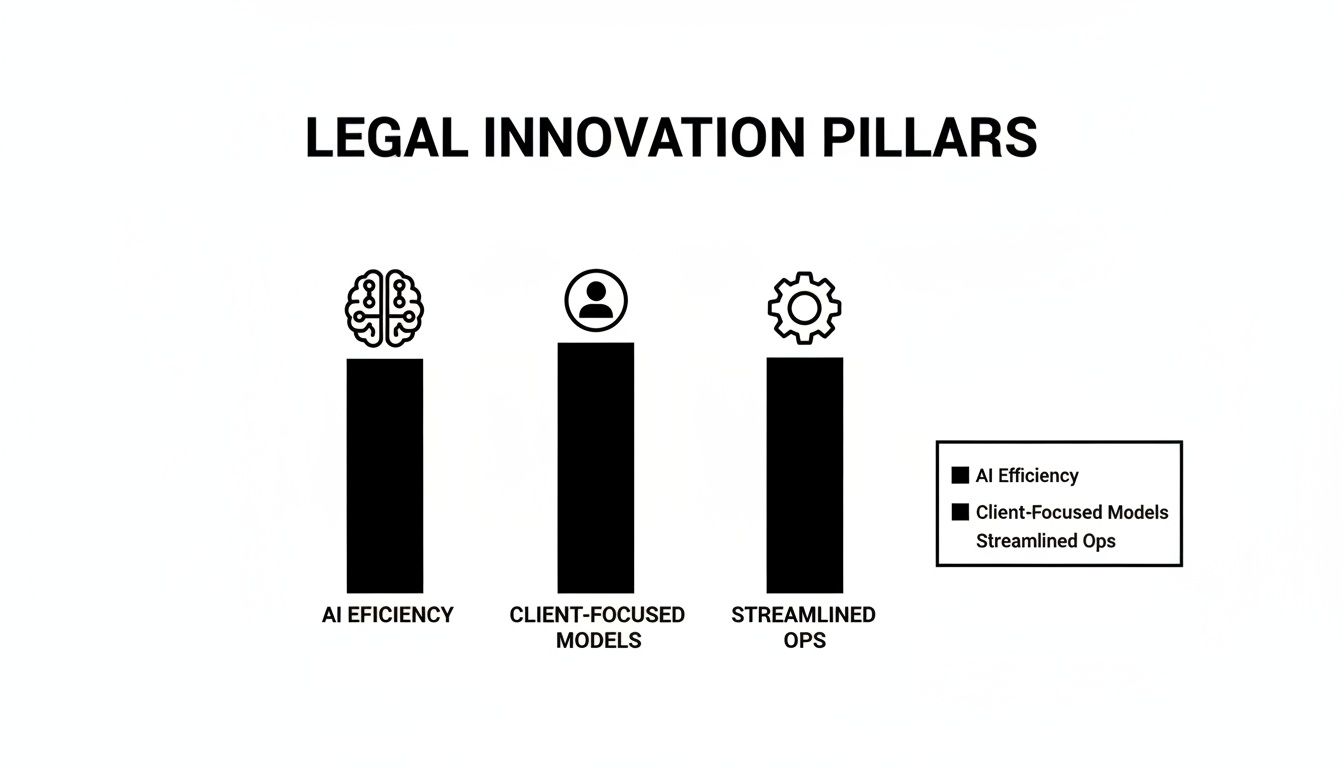
As you can see, AI-driven efficiency is the foundation, working in concert with new client-focused models and streamlined operations to build a far more effective legal practice.
From Research to Predictive Analytics
Legal research is one of the first areas to feel AI’s impact. Gone are the days of keyword searches that return thousands of marginally relevant documents. AI-powered platforms actually understand legal concepts and context. An attorney can now ask a complex question in plain English and get back a curated list of the most critical case law, statutes, and precedents, complete with summaries and analysis.
But it goes well beyond simply finding information. The most advanced AI tools now offer predictive analytics, crunching vast datasets of past case outcomes to forecast the likely results of current litigation. For a high-net-worth client staring down a complex dispute, that kind of data-driven insight is indispensable for deciding whether to settle or fight it out in court.
The Generative AI Revolution
The arrival of generative AI has put this entire transformation into overdrive. These models can produce first drafts of legal documents—from simple motions to complex transactional agreements—in a fraction of the time a human would need. This gives attorneys a powerful head start, allowing them to apply their expertise to refining and perfecting the final product.
The legal industry now shows the highest generative AI adoption of any professional group. A stunning 28% of law firms and 23% of corporate legal departments are already using GenAI tools. That’s a massive jump from 2024, when only 14% reported using them. As firms bake these tools into their daily work for drafting, research, and analysis, a competitive divide is forming. Technological sophistication now directly translates to client value. You can find more details in this in-depth analysis of AI’s role in the legal sector.
The New Competitive Landscape
Firms that embrace AI aren’t just getting more efficient; they are changing what they offer clients. They can deliver faster turnarounds, more predictable costs, and deeper, data-backed insights. This creates a powerful advantage in attracting and keeping sophisticated clients who expect their legal advisors to be operating on the front lines of technology.
An AI strategy is no longer a forward-thinking luxury; it’s a baseline requirement for staying relevant. Firms that don’t integrate these tools will be outmaneuvered by competitors who can deliver better results, faster and more cost-effectively.
The key is to see AI not as a replacement for legal expertise but as an amplifier of it. The best results happen when technology handles the repetitive, data-heavy work, empowering attorneys to focus on the uniquely human skills clients value most: strategic thinking, creative problem-solving, and trusted counsel.
By weaving AI into the fabric of their daily workflows, law firms can redefine their entire operational model and deliver a level of service that was once unimaginable. This technological shift is a core component of modern legal innovation, setting an entirely new standard for excellence.
Building Client Trust with Modern Business Models
True innovation in law goes far beyond just adopting new software. It’s about fundamentally rewiring the economic relationship between a firm and its clients. For generations, the billable hour was the unquestioned foundation of legal services. Today, elite firms understand that how they price their services can be just as impactful as the technology they use, creating a powerful new basis for trust and partnership.
This is a profound shift in mindset. It moves away from a model that rewards time spent toward one that rewards results achieved, proving to clients—especially high-net-worth individuals accustomed to clear value propositions—that your success is directly tied to theirs.

This evolution is about building a business structure that is as modern and client-focused as the legal advice it delivers.
Moving Beyond the Billable Hour
The most significant tremor in legal business models is the embrace of Alternative Fee Arrangements (AFAs). These structures replace the dreaded unpredictability of hourly billing with clear, upfront costs aligned with specific outcomes. For discerning clients, this predictability is everything.
Several popular AFA models are gaining serious traction:
- Flat Fees: A single, fixed price for a well-defined project, like drafting an estate plan or handling a specific corporate transaction. This gives clients absolute cost certainty from day one.
- Capped Fees: An hourly billing structure with a guaranteed maximum. This model offers flexibility while still protecting the client from runaway budgets.
- Success-Based Fees: A portion of the fee is contingent on achieving a predefined successful outcome. This puts the firm’s skin in the game, directly aligning its financial incentives with the client’s ultimate goals.
- Subscription Models: Clients pay a recurring fee for ongoing legal counsel, essentially putting the law firm on retainer as a proactive, integrated part of their team.
By offering these options, firms signal a deep commitment to transparency and value. The conversation shifts from hours logged to progress made, building far more resilient client relationships.
The table below breaks down the core differences between the old way and the new.
Comparing Traditional vs. Innovative Legal Service Models
This table contrasts the conventional billable hour model with modern Alternative Fee Arrangements (AFAs) to highlight the differences in client focus, incentives, and value proposition.
| Attribute | Traditional Billable Hour | Alternative Fee Arrangements (AFAs) |
|---|---|---|
| Primary Incentive | Maximize hours worked | Achieve a specific, valuable outcome |
| Client Focus | Activity and effort | Results and efficiency |
| Cost Predictability | Low; often unpredictable | High; costs are defined upfront |
| Risk Allocation | Client assumes all financial risk | Risk is shared between client and firm |
| Relationship Dynamic | Transactional; firm as a vendor | Collaborative; firm as a strategic partner |
As you can see, AFAs fundamentally change the dynamic, transforming the relationship from a simple service transaction into a true strategic partnership.
The Rise of Legal Operations
Alongside new pricing models, another discipline is reshaping how premier law firms operate: Legal Operations, or “Legal Ops.” Think of it as applying the same data-driven business principles common in finance and tech to the management of a law firm.
Instead of relying on tradition or gut feelings, Legal Ops focuses on optimizing every facet of service delivery. It treats the practice of law like the sophisticated business it is, demanding efficiency, strategic resource allocation, and measurable performance.
Legal Ops asks the tough questions: Where are our workflow bottlenecks? Are we using our technology to its full potential? Which types of matters are actually the most profitable? It’s about making smarter, data-backed decisions that ultimately benefit the client through better efficiency and effectiveness.
This operational rigor is a cornerstone of innovation in law. It ensures that investments in new technology and top talent produce real returns, both for the firm’s bottom line and for the clients it serves. A firm that runs with this level of precision signals a commitment to excellence that sophisticated clients immediately recognize and value.
When you pair modern business models with a strong Legal Ops function, you create a powerful synergy. They enable a firm to deliver exceptional legal work with the financial transparency and operational efficiency that today’s clients don’t just appreciate—they demand.
Connecting Innovation to Your Bottom Line
It’s easy to talk about investing in new technology, but how does that actually translate to a healthier bottom line? The link between innovation in law and real financial growth is direct, measurable, and quickly becoming the dividing line between firms that are thriving and those just getting by. Think of it not as an expense, but as a strategic investment in your firm’s long-term financial stability.
The most immediate payoff comes from simple efficiency. When you automate routine, non-billable grunt work—think document management, conflict checks, or that initial client intake—you instantly cut down on administrative overhead. This does more than just save a few hours; it liberates your paralegals and attorneys to focus entirely on high-value, billable work, which immediately boosts the margins on every single case.
This newfound efficiency also dramatically increases your firm’s capacity. With routine tasks handled by software, your legal team can take on a much greater volume of sophisticated work without needing to hire more people. That’s a direct route to improving profitability per employee.https://www.youtube.com/embed/_-yNyHNGMkY
Finding Hidden Money in Your Data
Beyond just trimming costs, legal innovation opens up entirely new ways to generate revenue. Modern practice management systems are treasure troves of data, tracking everything from individual attorney productivity to which clients are truly profitable. Analyzing this information is what allows firm leaders to stop guessing and start making smart, strategic moves.
For instance, data analytics can show you which practice areas are your actual profit centers, not just the ones that keep you the busiest. Armed with that knowledge, a firm can double down on its strengths, directing marketing spend and hiring efforts toward the activities that deliver the highest returns. It can also shine a light on under-serviced client needs, creating perfect opportunities to cross-sell other services and make existing relationships even stronger.
This shift from managing by gut feeling to relying on data is what separates a modern legal business from a traditional practice. It’s about finally knowing where your profits come from and building systems to replicate that success again and again.
Turning Superior Service into a Profit Center
Innovation isn’t just about what happens behind the scenes; its most potent use is in elevating the client experience. Tools like secure client portals, automated case updates, and painless digital billing create a transparent, frictionless relationship. For high-net-worth clients who demand seamless interactions in every part of their lives, this level of service is a massive differentiator.
A fantastic client experience delivers two critical financial benefits:
- Higher Client Retention: Happy clients stick around, and they’re far less sensitive to price. Slashing client churn is one of the most powerful ways to build stable, predictable revenue.
- Better Referrals: A client who is blown away by your firm’s efficiency and communication is going to become your biggest advocate, sending high-quality referrals your way that cost nothing to acquire.
The numbers back this up. Innovation is fundamentally changing the economics of law, and technology adoption is now directly tied to revenue growth. Recent data shows that growing law firms nearly doubled their revenue over four years while their client base grew by only 50%. This proves that efficiency and pricing power—not just more clients—were the real drivers of their success. In stark contrast, shrinking firms saw a 50% drop in revenue and were far less likely to be using modern legal tech. With 82% of legal professionals planning to increase their AI use, technology is no longer optional. For a closer look, you can explore the 2025 Clio Legal Trends Report.
Ultimately, connecting innovation to your bottom line means tracking the right things. It’s about measuring real improvements in efficiency, profitability per matter, and the lifetime value of a client. For a deeper dive into this, check out our comprehensive guide to attorney time tracking software, which explains how accurate measurement is the bedrock of any profitable, forward-thinking practice.
Marketing Your Firm as an Industry Innovator
Adopting new tech and modern business models is only half the job. What truly matters is being known for it. In a legal market this crowded, broadcasting your commitment to innovation in law is how you stand out and attract the caliber of clients you want.
It’s a clear signal to the market: your firm is efficient, forward-thinking, and built for how business is done today. But just slapping the word “innovative” on your website won’t cut it. You have to prove it.
Show, Don’t Just Tell
The best way to market your modern approach is to make it real for potential clients. Instead of just saying you use AI, explain how that tech cuts research time, saving your clients money. Don’t just list Alternative Fee Arrangements as an option; publish case studies showing how a flat-fee structure gave a client total budget certainty on a complex international merger.
This isn’t about buzzwords; it’s about creating high-value content that educates your audience. Your marketing should focus on:
- Thought Leadership: Publish articles and white papers that analyze legal trends through the lens of technology and efficiency.
- Case Studies: Detail specific, confidential examples of how your firm’s processes delivered a superior outcome for a client.
- Webinars and Seminars: Host events that teach clients and peers about the real-world benefits of legal tech or new service models.
The goal is to shift a client’s perception. You’re not just a service provider anymore; you’re a strategic business partner. When clients see you as a leader in the field, they’ll trust you with their most critical legal challenges.
Building Your Digital Authority
A firm’s reputation used to be built on handshakes and word-of-mouth. Today, it’s forged online. Communicating your firm’s edge to a sophisticated, global audience demands a sharp digital presence—a modern website, active professional social media, and a clear SEO strategy.
Legal innovation isn’t just changing casework; it’s reshaping marketing, visibility, and client acquisition, especially for top-tier firms. The legal marketing tech space is exploding, with the number of providers jumping from 200 in 2024 to 309 in 2025—a 54.5% increase in just one year. Ranked firms are leading this charge, adopting AI-driven tools for content and business development far faster than their unranked peers. You can review the full 2025 Legal Marketing Technology Ecosystem Study to see the data for yourself.
For attorneys targeting high-net-worth clients, curated media platforms are no longer optional—they are strategic investments that signal expertise and quality.
One of the most potent tools in this arena is thought leadership marketing, which builds your credibility long before a potential client ever needs a lawyer. To go deeper, you can explore our guide on what thought leadership marketing is and how to build credibility fast. Platforms like the Haute Lawyer Network are built specifically to amplify this authority, connecting premier attorneys with a high-net-worth audience through a trusted luxury media brand.
By strategically communicating your commitment to innovation in law, you do more than attract new business. You build a brand that stands for excellence and a relentless focus on client success—qualities that resonate deeply with the clients you were meant to serve.
Putting Legal Innovation into Practice
Talk is cheap. Results are what matter. Moving your firm from a traditional, established model to one built around innovation in law can feel like an impossible task, but it doesn’t have to be a massive, disruptive overhaul.
The key is to think in terms of deliberate, high-impact steps that build on each other. The journey doesn’t start with a flashy, six-figure technology purchase. It begins with a simple, honest look at your current operations.
Start by mapping out your firm’s most critical workflows. Where does friction always seem to pop up? Is it during client intake, document discovery, or the billing and collections cycle? Pinpointing these specific pain points is the most important first step you can take. It guarantees your initial efforts will solve a real, tangible problem—instantly showing your entire team the value of trying something new.

Launching Your First Pilot Project
Once you’ve identified a significant bottleneck, the next move is to design a small-scale pilot project to fix it. The goal here is to keep the initial test contained and measurable. This lets you learn and adapt without risking major disruption to your practice, minimizing risk while maximizing what you learn.
Consider these practical first moves:
- Technology Pilot: Take a single, nagging issue—like the slog of contract review—and test a specific AI tool with a small group of attorneys. Diligently track the time saved and compare the accuracy against your old manual process.
- AFA Experiment: Pick a trusted, long-term client with a predictable matter on the horizon. Propose a flat-fee arrangement for the project, walking them through the benefits of cost certainty. This controlled experiment helps you fine-tune your pricing for future alternative fee offerings.
- Process Improvement: Target an internal administrative headache, like conflict checks. Implement a new software solution or a streamlined workflow for just that one process and measure the reduction in non-billable hours.
Fostering a Culture That Supports Change
New technology and billing models are only as good as the firm culture that embraces them. Truly integrating legal innovation demands a cultural shift away from the “this is how we’ve always done it” mindset and toward a spirit of continuous improvement.
Innovation isn’t a one-and-done project. It’s a continuous journey of identifying problems, experimenting with solutions, and measuring the results. The goal is to build a firm that is agile, resilient, and always focused on delivering maximum value to the client.
To build this kind of culture, firm leadership must actively encourage people to try new things, even if some of those experiments fail. Create clear feedback channels where attorneys and staff can share what’s working—and what isn’t—without fearing criticism. Most importantly, celebrate the small wins from your pilot projects. This builds enthusiasm and shows everyone that these changes are making their work more meaningful and impactful.
This sustained commitment is what turns a traditional law practice into a modern legal business. It secures your firm’s relevance, strengthens your reputation for excellence, and ensures you remain the go-to counsel for high-value clients who expect a forward-thinking partner.
Common Questions on Legal Innovation
Stepping into a more modern legal practice is a smart move, but it naturally brings up questions. Many attorneys recognize the power of new tools and business models but aren’t quite sure where to begin or how to navigate the ethical lines. Here are some straightforward answers to the most common sticking points.
I’m a Solo Practitioner. Where Do I Even Start?
For a smaller practice, the trick is to forget about a massive, expensive overhaul. Instead, think surgically. Pinpoint your single biggest operational headache and solve that first.
Start with modern practice management software. It’s an easy win that can automate your billing, time tracking, and even client communication. From there, you can explore AI-powered legal research tools. Many offer free trials or flexible pricing that works for smaller caseloads. The goal is steady, incremental progress that pays for itself almost immediately without breaking the bank.
How Do I Use AI Without Violating My Ethical Duties?
This is non-negotiable. When you integrate artificial intelligence, ethical oversight is everything. The most important rule is simple: you, the attorney, are always responsible for the final work product. Never, ever trust AI output without a thorough human review.
Think of AI as an incredibly powerful paralegal, not a replacement for your own professional judgment. Your duties of competence and confidentiality are still squarely on your shoulders.
To keep your practice compliant and your clients safe, stick to these core principles:
- Supervise and Verify: Meticulously review every AI-generated draft, citation, or piece of legal analysis. Check it for accuracy, context, and completeness.
- Guard Client Confidentiality: Never feed sensitive or confidential client information into a public, unsecured AI platform. Only use systems built with legal-grade security protocols.
- Practice Transparency: Let clients know how you’re using AI in their matters, particularly when it comes to their data and your security measures.
- Stay Current: Your state bar association is constantly releasing new guidance on technology. Make it a point to stay on top of the evolving rules.
Is the Billable Hour Really Dead?
It’s not dead, but its reign is definitely over. Sophisticated clients, especially high-net-worth individuals, are demanding predictability and a clear return on their legal spend. The market is shifting decisively toward value-based pricing that ties your firm’s success directly to your client’s success.
Today, many of the most competitive firms operate on a hybrid model. They offer Alternative Fee Arrangements (AFAs)—like flat fees or success-based pricing—for predictable work, while keeping the billable hour for complex litigation where the scope is less certain. Being able to offer AFAs is no longer a perk; it’s a powerful competitive advantage.
At the Haute Lawyer Network, we specialize in connecting elite attorneys with the high-net-worth clients who seek out this kind of forward-thinking counsel. Our platform showcases your expertise and modern approach through the trusted voice of Haute Living, making sure your brand is seen as a leader. Elevate your practice and connect with your ideal clients by exploring the Haute Lawyer Network.