Protecting your intellectual property really boils down to one thing: figuring out what you’ve created and then picking the right legal shield for it. It’s a two-step dance of understanding the four main types of IP—copyrights, patents, trademarks, and trade secrets—and then formally locking in the correct one. This is how you make sure your unique creations, from brand names to new inventions, are legally yours and yours alone.
Your First Steps in Protecting Intellectual Property
Before you can even think about defending your IP, you have to know what you’re working with. Look at your creations as different kinds of assets, because each one needs a specific type of protection. You wouldn’t use a car key to unlock your front door, and you wouldn’t use a copyright to protect a new piece of machinery.
The process always starts with an internal audit. Get your team together and ask: what valuable, intangible assets do we actually have? This isn’t just about groundbreaking inventions; it covers a whole spectrum of materials.
- Your Brand Identity: This is your company name, the logos you use, any slogans, and even the design of your product packaging.
- Your Creative Output: Think about all the content you produce—blog posts, professional photographs, website code, music, and marketing videos.
- Your Inventions and Processes: This is for new devices, unique software features, or a proprietary manufacturing method you’ve developed.
- Your Confidential Information: This is your “secret sauce.” It could be your customer lists, internal marketing strategies, or even a literal secret recipe.
Matching Your Asset to the Right Protection
Once you have a clear inventory of your assets, the next move is to match them to the four primary categories of intellectual property. Each one serves a very different purpose and gives you a distinct kind of legal defense.
To make this easier, this decision tree can help you visualize the process.
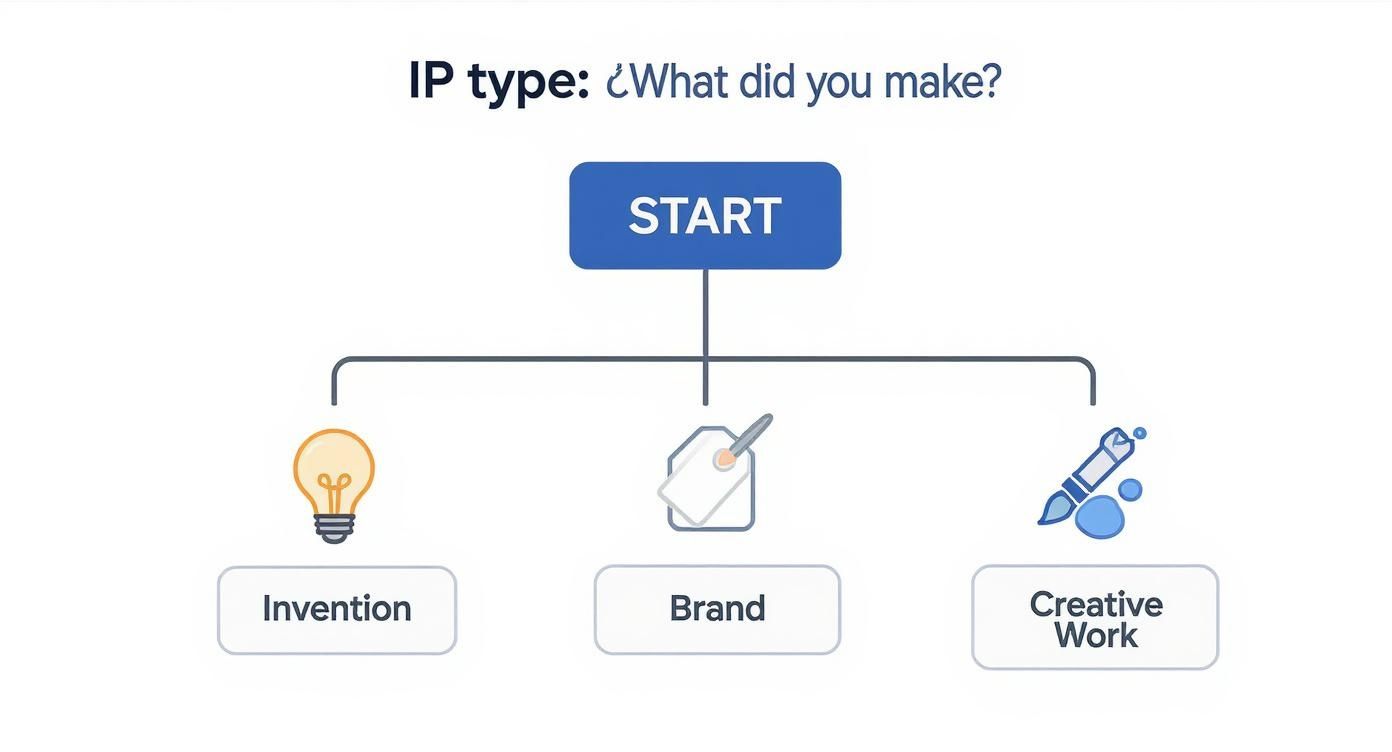
This visual guide cuts through the noise by starting with the simple question of what you’ve created, then branching out to the right IP category. Getting these distinctions right from the start is fundamental to building a strong protective strategy. If your main concern is protecting your brand identity, for example, it’s wise to explore the benefits of hiring a specialized trademark attorney to secure your logos and names properly.
To help you get a quick overview, here’s a simple breakdown of the four main IP types.
Quick Guide to Intellectual Property Types
| IP Type | What It Protects | Typical Duration | Real-World Example |
|---|---|---|---|
| Trademark | Brand names, logos, slogans, and other identifiers that distinguish goods or services. | Potentially forever, as long as it’s in use and renewed. | The Nike “swoosh” logo. |
| Copyright | Original creative works, such as books, music, art, software code, and photographs. | The life of the author plus 70 years. | The source code for Microsoft Windows. |
| Patent | New and useful inventions, processes, machines, or compositions of matter. | Up to 20 years from the filing date. | The technology behind the first iPhone. |
| Trade Secret | Confidential business information that provides a competitive edge, like formulas or practices. | Indefinitely, as long as it remains a secret. | The formula for Coca-Cola. |
This table simplifies the core differences, but the real-world application can get complex, which is why professional guidance is often necessary.
The importance of securing these rights has never been higher. The value of IP is at an all-time high, and you can see it in the record-breaking filing numbers worldwide. WIPO reports that China is leading the charge with approximately 1.8 million patent applications, with the United States and Japan following. At the same time, emerging economies like India are seeing massive growth in filings, showing a clear global trend toward formal IP protection.
Key Takeaway: The type of IP you choose dictates the scope of your legal rights. A patent protects an invention’s functionality, while a trademark protects the brand associated with it. Choosing correctly from the start prevents costly mistakes and ensures your most valuable assets are truly secure.
Securing Your Brand and Inventions

Once you’ve cataloged your company’s intellectual property, it’s time to take action. This is where the abstract concept of IP protection becomes a tangible, value-driving strategy, especially for businesses with groundbreaking inventions or a rapidly growing brand.
Let’s move from theory to practice and look at how to secure patents and trademarks.
Guarding Your Innovations with Patents
For any true inventor, a patent is the ultimate defense. It gives you an exclusive monopoly to make, use, and sell your invention for a specific duration, which is typically 20 years. It’s a powerful tool, but not every idea can earn this level of protection.
The United States Patent and Trademark Office (USPTO) has a high bar. To qualify, your invention must be:
- Novel: It has to be genuinely new and not previously disclosed to the public.
- Useful: The invention must have a real-world, practical purpose.
- Non-obvious: It can’t be a minor tweak to an existing product that someone skilled in the field would easily think of.
Before you even think about filing, a prior art search is non-negotiable. This deep dive into existing patents, academic journals, and public records determines if your invention—or something dangerously close—is already out there. Skipping this step is a recipe for a rejected application and thousands in wasted fees.
Expert Tip: Document everything. I mean everything. Keep detailed, dated logs of your brainstorming sessions, sketches, prototype builds, and test results. This “inventor’s notebook” is invaluable if you ever need to prove the exact date your invention was conceived.
The patent application itself is a notoriously technical document. It demands a meticulous description of the invention, legally precise claims that define your protection, and often, highly detailed technical drawings. For serious inventors, attempting this without professional guidance is a major risk. Partnering with a skilled patent attorney is a critical investment to ensure your application is built to withstand scrutiny.
Building and Defending Your Brand with Trademarks
While patents protect what your company creates, trademarks protect who your company is. Your brand name, logo, and slogans are what connect you to your customers. In a marketplace full of noise, a strong trademark is often your most valuable asset.
It all starts with choosing a distinctive mark. The more unique and memorable your name or logo is, the stronger your legal position will be. Generic or descriptive names (think “Fresh Juice Company”) are incredibly difficult to defend.
Before you sink a dollar into marketing or design, a comprehensive clearance search is essential. You have to be sure another company isn’t already using a similar mark for related products or services. A conflict discovered later can trigger a legal nightmare.
The USPTO’s public database is the best place to start.
Here’s the official government portal where you can begin your initial search.
This screenshot shows the gateway to key tools like the Trademark Electronic Search System (TESS), which is indispensable for any initial clearance check.
Understanding Trademark Symbols ™ vs ®
You see these symbols everywhere, but what do they actually mean? The difference is small but has major legal implications.
- The ™ Symbol: You can—and should—start using the ™ symbol the moment you begin using a name or logo in your business. It requires no registration. Its job is to signal to the world that you are claiming that mark as your own.
- The ® Symbol: This is the big one. It signifies that your trademark is officially registered with the USPTO. Using the ® symbol before your registration is finalized is illegal. Once you have it, you gain much stronger legal footing, including the right to sue for infringement in federal court.
Filing an application involves submitting your mark, defining the exact goods or services it applies to, and paying the government fees. Be prepared to wait. The process can take anywhere from 12 to 18 months, and that’s only if everything goes smoothly.
Securing your brand and inventions isn’t a one-and-done task; it’s an ongoing commitment. By taking these concrete steps, you transform your ideas from simple concepts into defensible assets that can become the foundation of your company’s long-term value.
Protecting Your Creative Works and Confidential Data

Not all of your company’s value is tied up in a catchy logo or a groundbreaking invention. Often, the most critical assets are the creative content you produce and the confidential information that gives you a genuine edge over the competition.
This is where copyrights and trade secrets become indispensable. They protect the artistic soul of your brand and the strategic brain of your operations. Knowing how to use them isn’t just good practice—it’s essential for any serious creator or entrepreneur.
Copyrights for Creatives
If you’re a writer, musician, photographer, or software developer, copyright is your single most important form of protection. It automatically protects original works the moment they’re put into a tangible form. The second you write down lyrics, save a digital photo, or finalize a block of code, you own the copyright.
While this automatic protection is a nice start, it’s dangerously limited. If you ever have to sue someone for ripping off your work, you’ll find yourself wishing you had taken the extra step to formally register it.
Key Insight: Formal registration with the U.S. Copyright Office is your golden ticket. It creates a public record of your ownership, and more importantly, it’s a prerequisite for filing an infringement lawsuit in federal court. It also opens the door to claiming statutory damages and attorney’s fees—a powerful deterrent for would-be infringers.
The registration process is surprisingly straightforward and affordable. It’s one of the highest-leverage actions any creator can take to secure their work.
Trade Secrets: The Hidden IP
While copyrights shield your public-facing creative work, trade secrets protect the confidential information that gives your business its unique advantage. Think of it as the secret sauce—something that isn’t public knowledge and provides real, tangible economic value precisely because it’s secret.
What qualifies is incredibly broad and can include things like:
- Formulas and Recipes: The classic example is Coca-Cola’s closely guarded formula.
- Customer Lists: A curated list of high-value clients and their preferences is a massive asset.
- Marketing Strategies: Your internal playbook for a major product launch.
- Manufacturing Processes: A unique, more efficient method for producing your goods.
- Proprietary Software: The specific algorithms and internal logic that make your tech work.
Unlike patents, trade secrets don’t require government registration and can theoretically last forever, as long as the secret is kept. The catch? The burden of protection falls entirely on you. You have to prove that you took active, reasonable measures to keep the information under wraps.
Implementing Strong Trade Secret Protections
Just calling something a “trade secret” means nothing in a courtroom. You have to build a fortress of protective measures around your sensitive data. If you ever have to enforce your rights, you’ll need to demonstrate a consistent history of treating the information like a valuable secret.
Here are the essential steps every business must take:
- Use Non-Disclosure Agreements (NDAs): This is non-negotiable. Anyone who gets access to sensitive info—employees, contractors, potential partners—must sign a well-drafted NDA before anything is shared.
- Implement Access Controls: Not everyone needs to know everything. Restrict access to digital files and physical documents on a strict “need-to-know” basis using password protection, encrypted servers, and locked filing cabinets.
- Label Confidential Documents: Clearly mark documents—both physical and digital—as “Confidential” or “Trade Secret.” This simple act removes ambiguity and reinforces the information’s protected status.
- Conduct Employee Training: Your team is your first line of defense. Regularly educate them on what constitutes a trade secret and their personal responsibility in protecting it.
Should a dispute ever arise, these documented measures become your most critical evidence. The conversations you have while implementing these protections will likely involve legal counsel. To better understand how those discussions are safeguarded, it’s helpful to learn about the principles of what is attorney-client privilege and its role in protecting your legal strategy.
How to Respond When Your IP Is Infringed

It’s a gut-punching moment: discovering someone has copied your work, stolen your design, or started using your logo. The initial reaction is usually a mix of anger and panic, but a calculated response is always more effective. Having a game plan ready turns you from a victim into a prepared advocate for your own brand.
This isn’t a minor annoyance; it’s a massive global problem. Industry estimates place annual losses from IP theft somewhere between $225 billion and $600 billion worldwide. That number alone shows why knowing how to react is just as critical as knowing how to protect your assets in the first place. You can learn more about the rising trends in IP theft and its economic impact to understand the scale of the issue.
Your response starts the second you find the infringement. Before firing off an angry email, your first move is to gather evidence.
Document Every Detail
Think like a detective. Your goal is to build an undeniable record of the infringement before the other party gets spooked and tries to erase it. This evidence becomes the foundation for every step you take next.
Start collecting these key items immediately:
- Screenshots and URLs: Take clear, dated screenshots of the website, social media post, or online listing. Crucially, make sure the full URL is visible in the shot.
- Purchase the Product: If someone is selling a counterfeit physical product, buy one. It gives you tangible proof of the infringement, shows the (likely poor) quality, and provides valuable seller details.
- Save Communications: Archive any emails, direct messages, or other conversations connected to the infringement. Don’t delete anything.
This initial documentation is everything. It establishes a timeline and gives you the concrete proof needed for a simple takedown notice or a formal legal complaint down the road.
Expert Tip: Create a dedicated digital folder for all your evidence. Name files with dates and clear descriptions (e.g., “2024-10-26_Screenshot_Infringing_Website_URL.png”). This organization will be a lifesaver, especially if you end up bringing in an attorney.
The Power of a Cease and Desist Letter
With your evidence organized, the next logical step is sending a cease and desist letter. This is a formal communication telling the other party you know what they’re doing, they are violating your legal rights, and they need to stop—now.
A sharply written letter can work surprisingly well. Many infringers are either ignorant that they’re breaking the law or are just testing the waters to see if you’ll notice. A firm, professional letter is often all it takes to get them to comply without further action.
A proper letter must include:
- Your Identity: Who you are and what IP you own.
- The Specific IP: A clear description of your copyrighted work, trademark, or patent being infringed upon.
- Proof of Infringement: Reference the evidence you collected, showing where and how they are infringing.
- A Demand to Stop: State clearly that they must cease all infringing activities by a specific date.
- A Statement of Further Action: A warning that you are prepared to pursue legal remedies if they ignore your demand.
While having an attorney draft the letter adds weight, you can often handle the initial one yourself in straightforward cases. It’s a low-cost, high-impact opening move.
Escalating Your Response
If your cease and desist letter is ignored, it’s time to escalate. For online content, the most direct route is usually a DMCA takedown notice. The Digital Millennium Copyright Act gives you a legal path to request that service providers—like social media platforms, e-commerce sites, or web hosts—remove content that infringes on your copyright.
When the situation is more complex, especially with trademark or patent infringement, litigation might be the only answer. This means filing a lawsuit, a step you should never take without consulting an experienced IP attorney. Litigation is expensive and can be a long haul, but for protecting high-value assets, it’s the ultimate tool for defending your rights and recovering damages for the harm done to your business.
Expanding Your IP Protection Globally
Taking your business into the international arena is a huge step. But it also means you’re fighting on new fronts to protect your intellectual property. I’ve seen countless entrepreneurs make the costly mistake of assuming their U.S. patent or trademark automatically protects them everywhere.
The hard truth is that IP rights are territorial. This means your U.S. patent is only good within the United States. Your American trademark registration won’t stop a competitor from hijacking your brand in Germany. To be safe abroad, you have to secure your rights in each specific country where you operate.
Strategizing Your International Filing
The idea of filing in dozens of countries feels overwhelming, not to mention impossibly expensive. The secret isn’t to file everywhere—it’s to be surgical about where you invest your resources. You need a priority list built around your actual business operations and future goals.
To build your international IP roadmap, start by asking yourself these critical questions:
- Where are our key markets? Prioritize countries where you’re currently selling or have concrete plans to expand into soon.
- Where is our manufacturing base? Securing IP in countries where your products are made is non-negotiable. It’s your first line of defense against unauthorized production and counterfeit exports.
- Who are our main competitors? Think about filing in your competitors’ home markets to defend your position on their turf.
- What are the biggest potential markets? Look ahead. Where could your business be in five years? It’s always cheaper to file now than to fight to reclaim your brand later.
Answering these questions transforms your strategy from a vague “we need global protection” wish into a focused, budget-conscious action plan.
Streamlining the Process with International Treaties
Thankfully, you don’t have to navigate each country’s unique application process from scratch. Several international agreements exist to make this much more efficient. Think of them as central hubs that distribute your application to multiple member countries at once, saving you an incredible amount of time and administrative pain.
Two of the most powerful tools in your arsenal are:
- The Patent Cooperation Treaty (PCT): For patents, the PCT lets you file a single “international patent application.” While it doesn’t grant a global patent, it buys you up to 30 months to decide which specific member countries you want to pursue protection in. It’s an invaluable tool for delaying massive costs and assessing a market before you fully commit.
- The Madrid Protocol: This is the trademark equivalent. By filing one application in your home country, you can designate any of the 130 member countries where you want your mark protected. It centralizes the management and renewal of your entire international trademark portfolio, turning a logistical nightmare into a manageable task.
Key Takeaway: Using these treaties is a strategic move. They don’t replace national rights, but they serve as a streamlined gateway to securing them, allowing you to manage your international IP strategy much more effectively.
Comparing IP Protection Strength in Key Markets
Of course, the effectiveness of any filing depends heavily on the local legal environment. The strength of IP protection and enforcement can vary wildly from one country to another, which directly impacts everything from innovation to economic growth. The table below, based on data from the International Property Rights Index, offers a snapshot of the landscape in several key markets.
| Country/Region | IPRI Score (out of 10) | Key Strengths | Common Challenges |
|---|---|---|---|
| United States | 8.1 | Strong patent system, robust copyright enforcement | High litigation costs, patent trolling issues |
| Germany | 7.9 | Efficient patent office, strong trade secret laws | Complex court system for IP disputes |
| Japan | 7.8 | High-quality patent examination, strong brand protection | Language barriers, unique legal procedures |
| China | 5.3 | Improving IP laws, specialized IP courts | Inconsistent enforcement, high levels of counterfeiting |
| United Kingdom | 7.8 | Clear legal precedents, effective enforcement | Post-Brexit regulatory changes creating uncertainty |
| India | 4.6 | Growing digital copyright framework | Weak patent enforcement, bureaucratic delays |
This data underscores why a one-size-fits-all approach doesn’t work. According to the full International Property Rights Index, which assesses 126 countries, the U.S. currently leads in IP rights protection, but understanding the nuances of other markets is critical for shaping a resilient global strategy.
Common Questions About Protecting Your IP
Navigating the IP landscape often feels like learning a new language. As you start the journey of safeguarding your creations, a lot of practical questions will inevitably come up. Below are clear, straightforward answers to the most common questions creators and business owners ask.
How Much Does It Cost to Protect Intellectual Property?
There’s no single price tag for IP protection; costs vary dramatically based on the type of asset you’re dealing with. It’s best to think of it as a spectrum, from highly affordable to a significant corporate investment.
- Copyright Registration: This is the most accessible. Filing directly with the U.S. Copyright Office can cost less than $100, making it a high-value, low-cost move for any creator of original works.
- Trademark Filing: A DIY application with the USPTO will run a few hundred dollars in government fees. However, engaging an attorney for a comprehensive search and filing can push the total into the low thousands—an investment that often prevents much costlier legal battles down the road.
- Patent Application: Patents are in a different league entirely. The journey from a prior art search to a fully granted patent often costs between $10,000 to $20,000+, depending on the invention’s complexity. You always need to budget for filing fees, attorney costs, and ongoing maintenance fees to keep it active.
Key Insight: Don’t view these expenses as just costs. See them as an investment in a tangible, defensible business asset. Strong IP can dramatically increase your company’s valuation and market position.
Can I Protect Just an Idea?
This is one of the most frequent and important questions, and the answer is a firm no. IP law does not protect abstract ideas. It only protects the concrete, tangible expression or specific implementation of that idea.
For example, you can’t patent the idea of a food delivery app. But you can potentially patent a unique algorithm that predicts delivery times with incredible accuracy. You can’t copyright the concept of a wizarding school, but you can copyright the specific book you wrote about one.
The key is to transform your idea into something real and defined.
How Long Does It Take to Get a Patent or Trademark?
Patience is an absolute must when dealing with IP registration. The timelines are often much longer than people expect, and it’s crucial to plan your business strategy around them.
Here’s a realistic breakdown:
- Copyright Registration: This is the fastest process. It is often completed within a few months, giving you official recognition relatively quickly.
- Trademark Registration: For a standard trademark application with no major issues, expect the process to take anywhere from 12 to 18 months from filing to final approval.
- Patent Application: The patent process is a marathon, not a sprint. It typically takes 2 to 5 years to get a patent granted, and sometimes even longer for highly technical fields like software or biotechnology.
Do I Really Need a Lawyer for This?
While you can file for copyrights and trademarks yourself, the real question is whether you should. For patents, the complexity makes it almost impossible to succeed without a specialized IP attorney. Their technical and legal expertise is critical for drafting claims that will withstand examination by the patent office.
For trademarks, an attorney’s value comes from conducting a deep clearance search that goes far beyond a basic database check, preventing you from building a brand on a name you can’t legally defend. You might save some money upfront by filing yourself, but a small mistake can lead to a rejected application or a weak registration that offers little real protection when you actually need it.
When navigating these complex legal waters, having an expert on your side is invaluable. The Haute Lawyer Network connects you with premier, vetted attorneys who specialize in intellectual property and can provide the strategic guidance needed to protect your most valuable assets. Elevate your legal strategy and secure your brand’s future by exploring our curated network of top-tier legal professionals. Find your expert at https://hauteliving.com/lawyernetwork.