Successfully preparing for mediation involves gathering essential documents, organizing your evidence, and defining your goals and negotiation limits. It’s about building your case piece by piece well before you sit at the table. That groundwork gives you the clarity and confidence to negotiate from a position of strength.
Building Your Foundation For A Successful Mediation
Walking into mediation without a solid foundation can derail your goals. Think of preparation as sculpting your arguments into a coherent story, anchored by facts and figures. Early work on your case transforms vague ideas into persuasive proof.
Mediation Preparation Quick Start Checklist: Before diving into the full preparation process, use this overview to stay on track.
| Task Category | Key Actions | Why It Matters |
|---|---|---|
| Documents | Collect financials, contracts, and communications | Ensures factual accuracy and credibility |
| Evidence Organization | Label files by topic and date; create a timeline | Makes retrieval fast and highlights the sequence of events |
| Goal Setting | Define objectives and your BATNA (Best Alternative to a Negotiated Agreement) | Clarifies your negotiation boundaries and fallback position |
Keep this overview handy as you work through each task.
Gather Your Essential Documents
At this stage, nothing is too small to save. You never know which tiny detail will tip the balance in your favor. Lay out everything before you start weeding out what isn’t relevant.
- Financial Records: Bank statements, pay stubs, tax returns, credit card statements, and records of major assets or debts
- Communication Records: Emails, text messages, or letters that track key conversations and agreements
- Contracts And Agreements: Signed contracts, formal agreements, and written policies that define legal obligations
Organize For Clarity And Impact
A messy pile of paperwork screams unprepared. Conversely, a well-indexed file speaks volumes about your professionalism and keeps discussions focused.
A well-prepared party is a credible party. Instant document production not only strengthens your claims but signals that you’ve done your homework.
Preparation principles hold true whether you’re working through a corporate dispute or a personal matter like divorce. To see how groundwork shifts the balance in family law, check out the comparison between divorce mediation vs litigation.
This infographic lays out the core workflow—from gathering to organizing and strategizing.
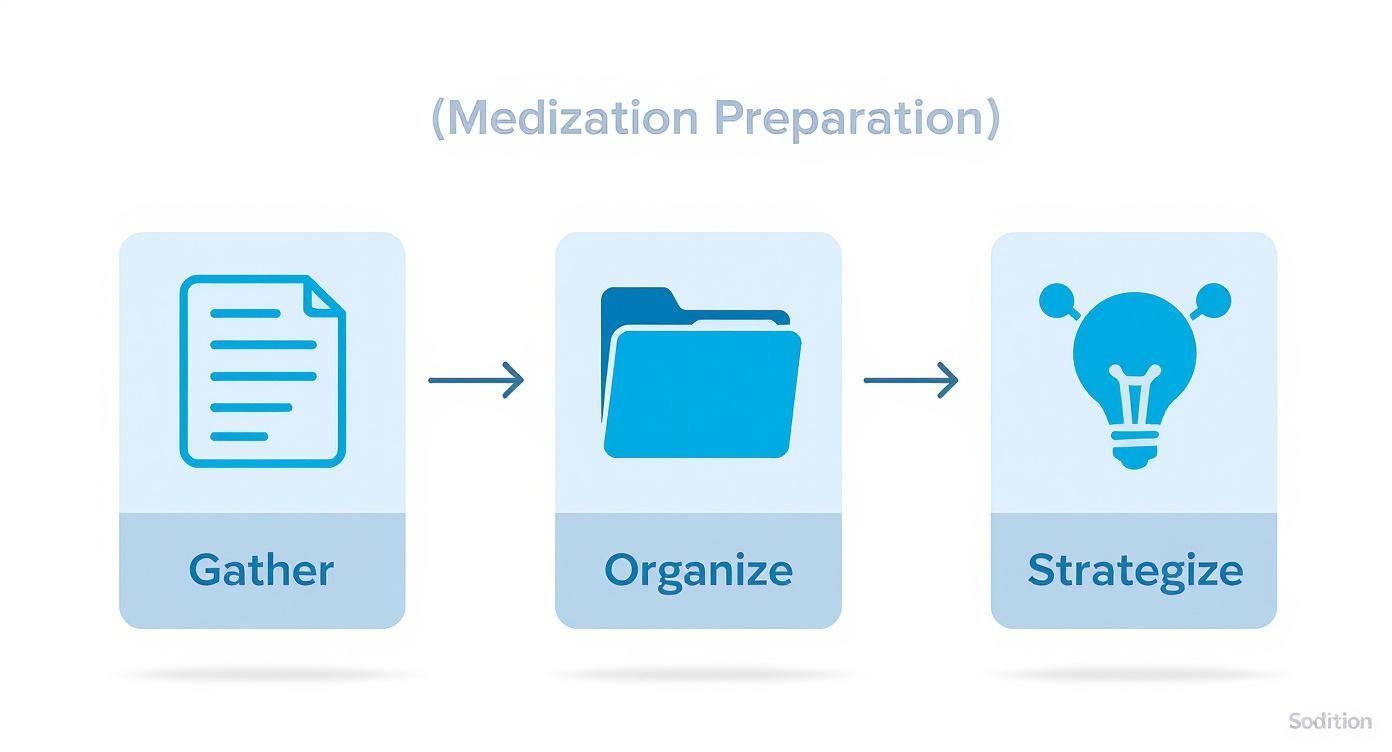
These steps set the stage for every move that follows in mediation. With solid preparation behind you, you’ll negotiate with both clarity and purpose.
Organizing Your Documents for Maximum Impact
In mediation, the strength of your argument often comes down to the quality of your evidence. Showing up with a disorganized stack of papers doesn’t just look sloppy—it actively undermines your credibility and wastes everyone’s time.
Think of yourself as the director of a documentary. Each document is a scene that needs to advance the plot and support your core narrative. Strategic organization isn’t about just collecting files; it’s about curating them to tell a clear, compelling story the mediator can follow instantly.
Weaving a Narrative With Your Evidence
Start by sorting everything into logical categories. This initial pass provides structure and helps you find specific items under pressure. More importantly, it gives you a high-level view of your case, revealing both its strengths and any glaring gaps long before you step into the room.
Consider these foundational document groups:
- Financial Records: This means bank statements, pay stubs, tax returns, and records for any loans, investments, or credit cards. For a business conflict, you’ll want profit-and-loss statements, balance sheets, and shareholder agreements.
- Communication Logs: Pull together every relevant email, text message, and piece of written correspondence. Arrange them chronologically to build a timeline that maps out promises, conflicts, or key events.
- Formal Agreements & Reports: Gather all contracts, property deeds, employment agreements, police reports, or medical evaluations that are central to the dispute.
This level of detail is a non-negotiable part of preparing for mediation effectively. A well-organized file shows you’re serious, prepared, and ready to negotiate in good faith.
Crafting a Powerful Mediation Brief
Once your evidence is organized, the next move is to synthesize it into a concise Mediation Brief. This is your opening act—a short, persuasive summary of your case written specifically for the mediator. It’s your chance to frame the issues from your perspective before the session even starts.
A good brief doesn’t just list facts; it connects the dots. For instance, in a partnership dispute, you might create a timeline of key events and footnote specific emails (e.g., “See Exhibit A: Email from June 5th”) that back up each point. This makes your argument incredibly easy for the mediator to follow and verify.
A mediator can grasp the core issues much faster when presented with a clear, indexed set of documents. This efficiency allows the session to move beyond fact-finding and into productive negotiation more quickly.
For the biggest impact, your final document package should contain three things:
- The Summary or Brief: A 2-3 page narrative outlining your position, the key facts, and what you want to achieve.
- A Document Index: Essentially a table of contents that lists every supporting document.
- The Organized Documents: The complete, tabbed, and labeled set of files, matching the index perfectly.
This methodical approach prevents you from fumbling for papers under pressure. When you can instantly pull up the exact bank statement or email you need, you project confidence and control, reinforcing the validity of your claims and setting a professional tone for the entire day.
Crafting Your Negotiation Strategy and Goals
Winning in mediation isn’t about crushing the other party; it’s about walking away with a practical, durable resolution. To get there, you need a strategy built on clear-headed goals, not emotional reactions. This strategic clarity is the single most powerful tool you have for guiding the negotiation toward an outcome you can live with.
The first move is a mental one: shift from confrontation to problem-solving. Success hinges on knowing exactly what you want—and what you’re willing to give up—long before you sit down at the table. Globally, mediation boasts a success rate north of 70%, which means most disputes get resolved without the agony of litigation when parties come prepared. That number is driven by people who understand their objectives and boundaries. You can discover more insights about mediation trends and see for yourself how preparation directly fuels positive results.
Define Your BATNA and WATNA
Two concepts form the absolute bedrock of a solid negotiation strategy: BATNA and WATNA. Getting a handle on these will define your negotiation boundaries and stop you from making a decision you’ll regret down the road.
- BATNA (Best Alternative to a Negotiated Agreement): This is your best-case scenario if mediation fails and you’re forced to go to court. What’s the most realistic positive outcome a judge might grant you?
- WATNA (Worst Alternative to a Negotiated Agreement): Conversely, what’s your nightmare scenario if you lose in court? What is the absolute most you could stand to lose?
Answering these questions demands a brutally honest assessment of your risks. Litigation is wildly expensive and unpredictable. You have to factor in attorney fees, court costs, expert witness expenses, and the immense personal cost of your time and emotional energy. Your BATNA isn’t just a potential award; it’s that award minus all those draining costs.
Knowing your BATNA is your source of power. It’s your walk-away point. If the other side’s final offer is worse than your best alternative, you can confidently say “no” and never look back.
Prioritize Your Goals and Concessions
Once you’ve established your BATNA and WATNA, you can start separating your needs from your wants. This is a crucial step that builds the flexibility needed for a successful negotiation. Without this clarity, every issue feels like a hill to die on, and that leads straight to a stalemate.
Create a prioritized list of your objectives. This goes way beyond money; it can include non-monetary terms like a formal apology, a change in business practices, or specific co-parenting arrangements.
Example Prioritization Framework:
| Priority Tier | Description | Example (Business Dispute) |
|---|---|---|
| Must-Haves | Non-negotiable terms. The deal is dead without these. | Recovering $50,000 in unpaid invoices. |
| Nice-to-Haves | Important goals you are willing to trade for something of equal or greater value. | Securing a public apology from the other party. |
| Giveaways | Minor concessions you can offer to build goodwill or secure a must-have. | Waiving interest on the late payment. |
A framework like this transforms your goals from a rigid, fragile list into a flexible toolkit for negotiation. It empowers you to see exactly where you can be firm and where you have room to compromise. By knowing your bottom line before you enter the room, you negotiate from a place of rational strength, not reactive emotion. This is the preparation that truly lets you guide the conversation and face mediation with confidence.
Assembling Your Mediation Team
The people you have in your corner can make or break the outcome of your mediation. Think of them less as observers and more as an active team designed to guide you to a favorable result. Putting the right players in place isn’t just a preliminary step—it’s a core part of your strategy.
Your first big call is choosing the mediator. This isn’t just about finding a neutral referee; you need a facilitator, a creative problem-solver, and someone who can offer a reality check when needed. It is absolutely essential to find someone with deep expertise in your specific type of dispute, whether it’s commercial, employment, or family law. A mediator who gets the nuances of your situation can ask smarter questions and propose solutions that actually make sense.
Selecting the Right Mediator
Don’t be shy about interviewing potential mediators. Ask about their specific approach. Are they more facilitative, encouraging the parties to find their own way, or evaluative, offering direct opinions on the merits of the case? Their style has to mesh with what you think will work for your particular conflict.
You should also dig into their credentials and track record. Professional standards are constantly improving to give you more clarity. For instance, in Australia, the system is moving toward a tiered accreditation model to better define a mediator’s experience level. This reflects a global push for higher standards and helps you know exactly what you’re paying for.
The right mediator does more than just manage the conversation; they create an environment where resolution is actually possible. Their experience, style, and subject matter expertise are your greatest assets when a negotiation hits a wall.
Collaborating with Your Legal Counsel
The relationship with your own attorney is just as critical. They’re your advocate, strategist, and advisor rolled into one. Effective, hands-on preparation with your lawyer is non-negotiable if you want to walk into that room as a unified, powerful front. If you’re still looking for the right fit, our guide on how to choose the right attorney for your case is a great place to start.
The work you do with your lawyer beforehand should be intense and practical. Don’t just talk about the facts; you need to actively practice for the session.
- Role-Play Tough Conversations: Rehearse how you’ll handle tough questions or emotionally loaded statements. This prep work is what helps you stay cool and focused when the pressure is on.
- Refine Your Opening Statement: Work together on a concise and forward-looking opening. Your goal is to set a constructive tone while clearly and firmly stating your objectives.
- Establish Communication Signals: Agree on subtle, non-verbal cues for the joint sessions. A simple hand gesture can mean “I need a private word,” “I disagree,” or “It’s time for a break.”
This kind of collaboration turns your attorney from a simple legal advisor into a true strategic partner. A cohesive, well-prepared team is your single strongest asset for navigating the complexities of any negotiation.
Navigating the Day of Your Mediation
After weeks, maybe even months, of intense preparation, the day is finally here. This is where all your hard work pays off. Knowing what to expect isn’t just about logistics; it’s about managing your own stress and keeping your focus razor-sharp. The entire environment is engineered for resolution, not for another round of arguments.
The day almost always kicks off with the mediator laying out the ground rules. This might feel like a formality, but it’s crucial—it sets a professional, respectful tone for the day. Shortly after, you or your attorney will have a chance to make a brief opening statement. This isn’t the time to re-litigate the past or point fingers. Instead, your goal is to clearly state what you hope to achieve and signal that you’re here to find a workable solution.
Understanding the Flow of the Day
Mediation isn’t just one long meeting. It typically alternates between joint sessions, where everyone is in the room together, and private caucuses. The caucus is where the real work often gets done. It’s a confidential meeting with just you, your legal team, and the mediator.
This is your chance to speak candidly about your bottom line, your concerns, and your strategy without the other side present. It’s essential to understand that these discussions are protected. If you’re unsure about the boundaries of confidentiality, take a moment to review what is attorney-client privilege.
The mediator then acts as a shuttle diplomat, moving between the private caucuses. They relay offers, float potential compromises, and offer a neutral reality check to both sides. It’s a process that allows for honest negotiation without the raw emotion of a face-to-face confrontation. Be patient. This back-and-forth can feel slow, but it’s often the very thing that breaks a deadlock.
Etiquette and Personal Management
How you conduct yourself speaks volumes. Your credibility hinges on your ability to remain professional, even when the discussion gets tense.
- Listen Actively: Don’t just wait for your turn to talk. Pay close attention to what the other side is saying—and what they aren’t saying. Often, their true interests are hidden beneath their stated positions.
- Speak Respectfully: It’s a simple but effective tactic to direct your comments to the mediator, not directly at the other party. This small shift keeps the conversation from spiraling into a personal argument.
- Stay Composed: If you feel your emotions getting the best of you, it’s completely fine to ask for a short break. A few deep breaths and a moment to collect your thoughts can make all the difference.
The goal is to focus on the problem, not the personalities. A calm and professional demeanor demonstrates that you are there to solve the issue, which builds credibility and encourages cooperation.
The mediation industry has seen explosive growth, becoming a market valued at approximately $566.7 million in the US as of 2025. This isn’t just a trivial statistic; it means there’s a wider acceptance of mediation as a legitimate and effective path to resolution. It also means you have access to a deep pool of highly skilled mediators and resources to help you succeed. You can discover more insights about the growth of mediation services and understand how this trend can benefit your case.
Finally, don’t neglect your own well-being. Mediation sessions can be grueling, often lasting a full day or longer. Dress professionally but comfortably. Bring water, snacks, and anything else you need to stay energized. By taking care of the small things, you free up your mental bandwidth to focus on what truly matters: negotiating a successful outcome.
Lingering Questions Before Mediation Begins
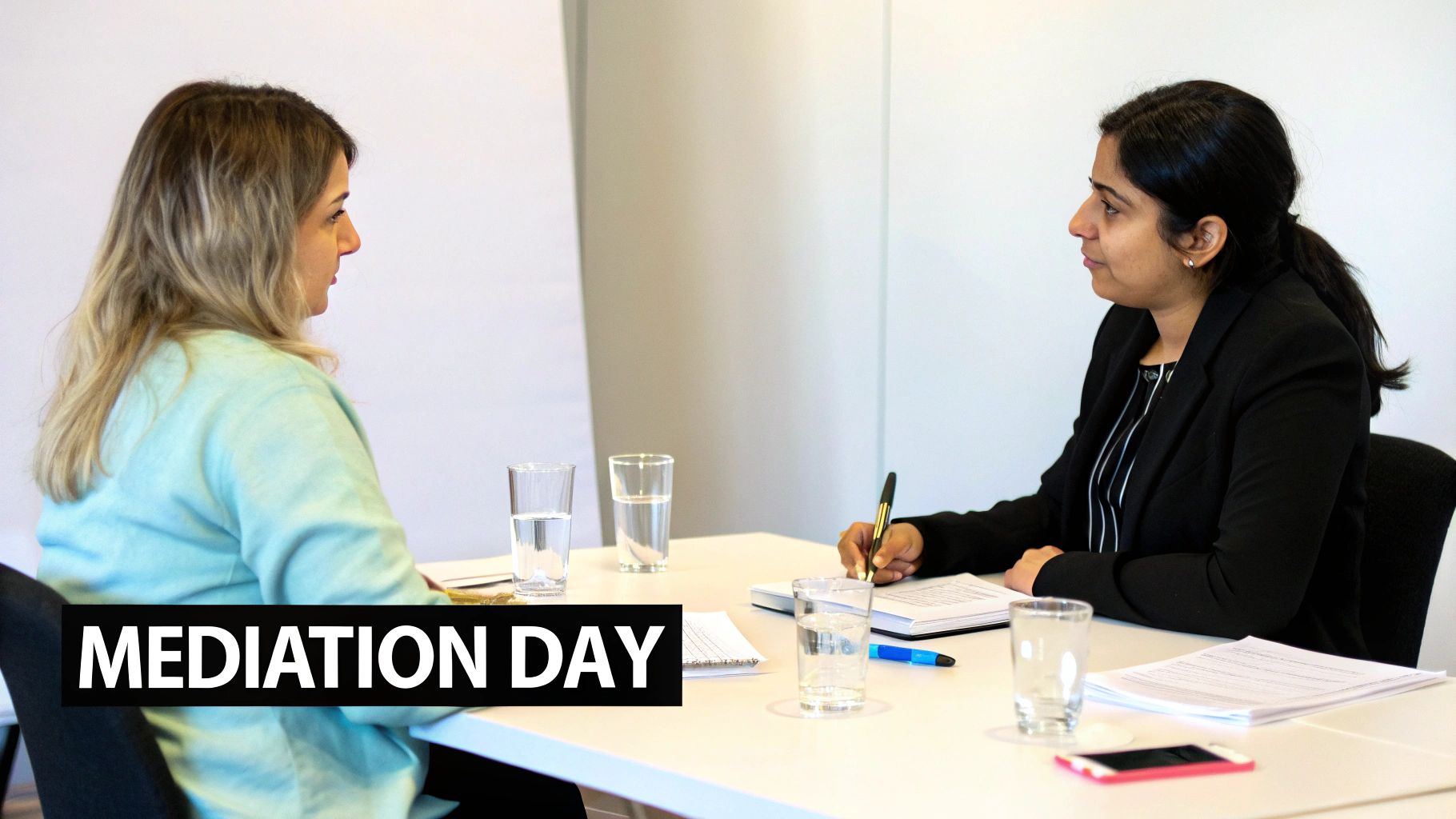
Even with the most thorough preparation, it’s natural for a few key questions to surface as the mediation date gets closer. Addressing these common uncertainties head-on can give you the final measure of confidence you need to walk into the room fully prepared.
Think of this as the final step—turning those last-minute unknowns into strategic advantages. When you demystify the process, you can focus your energy on productive negotiation instead of worrying about procedure.
What Is the Single Most Important Part of Preparation?
Hands down, the most critical step is defining your goals and establishing your BATNA (Best Alternative to a Negotiated Agreement). In simple terms, you must know exactly what you will do if you walk away from the table without a deal.
Your BATNA is your ultimate source of power in a negotiation. It’s what keeps you from accepting a terrible offer out of fear or, just as damaging, rejecting a perfectly good one out of pride. This clarity grounds your entire strategy, shifting your mindset from emotional reactions to a rational assessment of what’s truly in your best interest.
Should I Write an Opening Statement?
Yes, you absolutely should. A well-prepared opening statement is an incredibly powerful tool for setting the right tone from the very start. The key is to keep it brief, calm, and laser-focused on finding a path to resolution.
This is your moment to frame the core issues from your perspective and signal your intent to negotiate in good faith. It’s not the time to assign blame or rehash old arguments. A thoughtfully crafted statement tells everyone in the room—especially the mediator—that you are serious, prepared, and ready to engage constructively.
How Can I Manage My Emotions During a Tense Mediation?
Mediation can be emotionally taxing, and your preparation is your best defense against making a reactive, heat-of-the-moment decision. One of the best ways to prepare is to practice having those difficult conversations with your attorney beforehand.
If you feel yourself getting overwhelmed, take a deliberate breath or a slow sip of water. Never hesitate to ask the mediator for a short break. It is always better to step out for five minutes to recenter yourself than to say or do something impulsive that could derail the entire negotiation.
Try to concentrate on the problems that need solving, not the personalities involved. This simple mental shift helps maintain a professional, productive atmosphere, even when the topics are deeply personal or contentious.
What Happens When We Finally Reach an Agreement?
Once a resolution is reached, the mediator will help draft what is often called a Mediated Settlement Agreement. This document outlines every single term you’ve agreed upon. This stage requires your absolute, undivided attention.
You and your attorney must scrutinize every line to ensure it perfectly reflects your understanding of the deal. Once that document is signed, it becomes a legally binding contract. Don’t rush this final, critical step. The details committed to writing are what will dictate your obligations and interactions for years to come.
Navigating a complex process like mediation requires an expert legal guide. At Haute Lawyer Network, we connect you with a curated network of premier attorneys, each selected for their proven professional excellence. Elevate your legal strategy by finding representation that aligns with your specific needs. Explore our network at https://hauteliving.com/lawyernetwork.