
When you’re facing a custody hearing, the stress can feel overwhelming. The key is to channel that anxiety into a clear, actionable strategy. Preparing for a custody hearing properly means focusing on meticulous organization, detailed documentation, and always, always keeping your child’s best interests at the forefront.
This approach doesn’t just get you ready for a potential trial; it positions you for a much more likely outcome: a strong, negotiated settlement.
Your Strategic Foundation for the Custody Hearing
Let’s start with a crucial mindset shift. The dramatic courtroom showdowns you see on TV are mostly fiction. The reality is that the vast majority of custody cases never see a trial verdict.
In fact, research shows that around 90% of custody disputes are resolved without going to trial. This single statistic should shape your entire approach. You’re preparing for constructive settlement talks and a potential court date at the same time, with the goal of securing the best outcome long before a judge has to decide.
This isn’t about winning an argument. It’s about building a compelling narrative that proves your stability, your fitness as a parent, and your unwavering commitment to your child’s well-being. The court’s only concern is the “best interests of the child,” and every single piece of evidence you gather must speak directly to that standard.
The Three Pillars of Custody Hearing Preparation
Your entire strategy will rest on three core pillars: organization, documentation, and a child-focused perspective. When you master these, you create an unshakeable foundation for your case and give your legal team the ammunition they need to fight for you effectively.
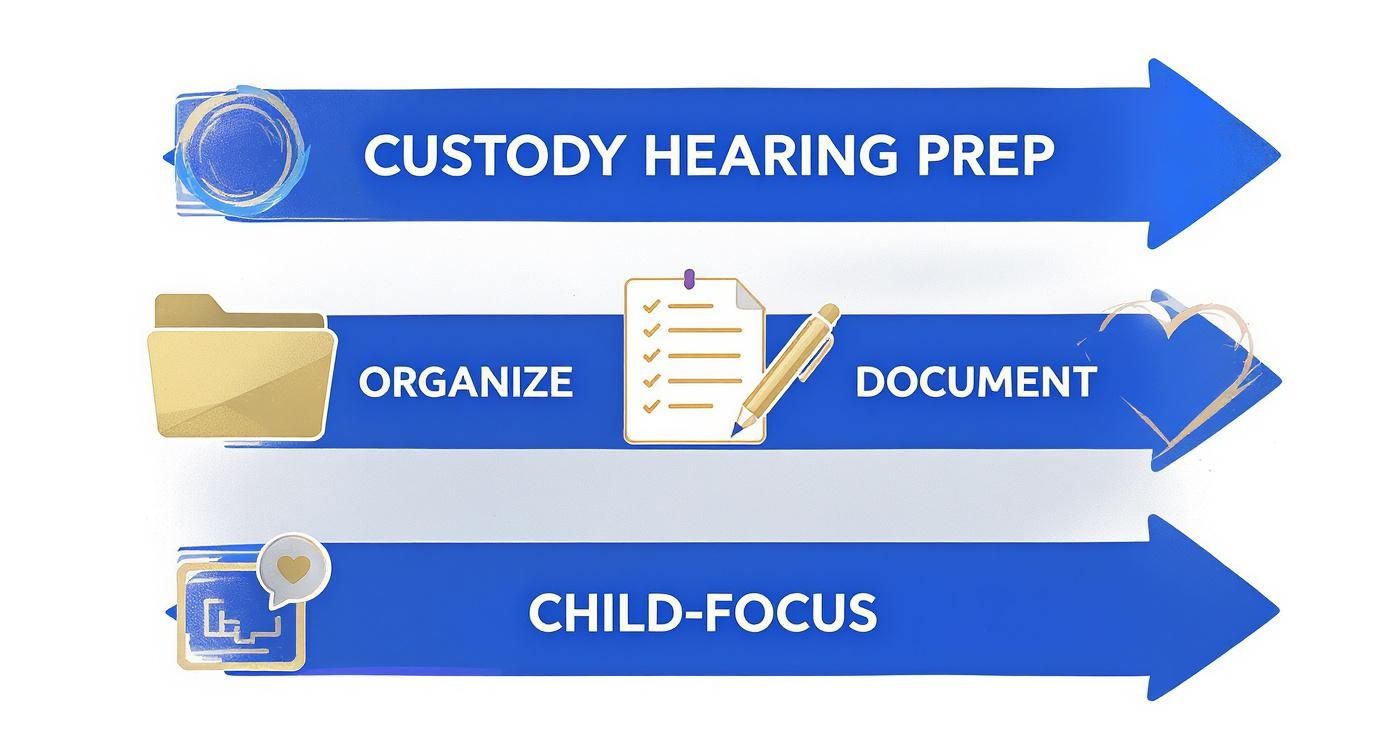
Think of yourself as the project manager for your own case. While your attorney is the legal strategist, you are the one responsible for supplying the raw materials—the facts, records, and details that bring your story to life. If you’re just starting out, knowing how to find a family lawyer you can trust is the critical first step in building that team.
The most persuasive cases are not built on emotional appeals, but on a mountain of organized, factual evidence that clearly demonstrates a parent’s positive and consistent role in their child’s life.
Your Initial 4-Point Preparation Checklist
To get the ball rolling, you need to focus your energy on a few high-impact areas right away. This simple checklist provides a starting point to get you organized from day one, building momentum for the more detailed work that lies ahead.
This table breaks down the core pillars into immediate, actionable steps.
| Pillar | Key Actions | Why It Matters |
|---|---|---|
| Organization | Create a dedicated physical binder or secure digital folder for all case-related documents. | Prevents last-minute scrambling and ensures you and your attorney can quickly access critical information. |
| Communication Log | Document every interaction with the other parent (texts, emails, calls) in a neutral, factual log. | This creates an objective record of co-parenting efforts, communication styles, and any potential conflicts. |
| Financial Transparency | Gather key financial records like pay stubs, tax returns, and receipts for child-related expenses. | Proves your ability to provide for the child and substantiates any claims related to child support calculations. |
| Child-Centric Calendar | Maintain a detailed calendar marking your parenting time, school events, doctor’s appointments, and extracurriculars. | Visually demonstrates your consistent, active involvement in the day-to-day details of your child’s life. |
This proactive approach does more than just get you ready for court; it empowers you. It shifts your focus from worry to constructive action, giving you a sense of control during an incredibly uncertain time. Every document you file and every event you log is another brick in the foundation of your case, strengthening your position for a favorable outcome.
Assembling Your Custody Documentation

In a custody hearing, your story is told not by what you say, but by what you can prove. The strength of your case rests entirely on a foundation of clear, organized, and compelling evidence. This documentation becomes the factual narrative a judge relies on to decide your child’s future.
The goal isn’t just to collect papers; it’s to build an evidence-based timeline of your commitment, stability, and deep involvement in your child’s life. This is your chance to move beyond emotional claims and present the tangible proof that defines your role as a parent.
Creating Your Custody Binder
Your first move should be to create a central command for every piece of relevant information. Think of it as your case bible. This could be a physical three-ring binder with meticulously organized tabs or, more commonly today, a secure cloud-based folder with clearly labeled subfolders.
This “custody binder” becomes an indispensable tool for you and your legal team, ensuring that any document can be located in seconds. Proper organization transforms a chaotic pile of receipts and emails into a powerful, easy-to-follow story for the court.
Organize your binder into these essential categories:
- Child’s Well-Being: All records directly tied to your child’s health, education, and development.
- Parental Involvement: Hard evidence of your active role and presence in your child’s day-to-day life.
- Financial Stability: Proof that you can provide for your child’s needs.
- Co-Parenting Communication: An objective record of your interactions with the other parent.
Documenting Your Child’s Well-Being and Your Involvement
This is where you paint a detailed picture of your consistent care. You need to show, not just tell, the judge how involved you are. A vague statement like, “I’m a very involved parent,” carries almost no weight. A folder filled with concrete proof, on the other hand, is undeniable.
Start gathering specific items that validate your claims:
- Academic Records: Report cards, attendance sheets, notes from teachers, and every email about parent-teacher conferences you attended.
- Medical and Health Records: Collect vaccination records, summaries from doctor’s visits, and receipts for any prescriptions you filled. This demonstrates you are proactively managing your child’s health.
- Extracurricular Activities: Keep schedules for sports, music lessons, or clubs. Include photos, programs, or emails that show your attendance and support at these events.
A well-organized custody binder does more than just store documents; it builds a timeline of your parental dedication. Each report card and doctor’s note serves as a factual data point proving your consistent involvement.
Proving Financial Stability and Responsible Co-Parenting
Financial transparency is non-negotiable. The court needs absolute certainty that you can provide a stable home, and this requires detailed financial records produced without hesitation.
At the same time, how you communicate with the other parent is under a microscope. Courts overwhelmingly favor parents who demonstrate an ability to co-parent respectfully, even through significant disagreement.
For your financial records, you’ll need to compile:
- Income Verification: At least two years of tax returns and your three most recent pay stubs.
- Expense Reports: A detailed log or spreadsheet of child-related expenses you cover, backed by receipts (e.g., school supplies, clothing, activity fees).
- Proof of Residence: A copy of your lease or mortgage statement to prove you have a stable living situation.
Your communication log is equally critical. You must document every text, email, and phone call with the other parent. The key is to be factual and neutral, simply noting the date, time, and an objective summary of the conversation.
Tools like OurFamilyWizard are invaluable here, as they create a verified, unalterable record of all communications. When conflict is high, this documentation is essential for both litigation and mediation. In fact, if disputes are frequent, you should learn how to prepare for mediation as a potential path to resolution. The evidence you gather will be crucial in either arena.
Choosing the Right Witnesses to Bolster Your Custody Case

While a meticulously organized paper trail is crucial, the human element that credible witnesses bring to a courtroom can be what truly tips the scales. A powerful witness transforms your claims from mere allegations into undeniable facts, offering a third-party perspective that validates your narrative and gives the judge a clearer, more complete picture of your child’s world.
This isn’t just about lining up people who will say you’re a great parent. It’s a strategic decision. You need individuals who can provide concrete, objective observations that directly support your position as the more stable and involved parent.
Fact Witnesses vs. Character Witnesses
It’s essential to understand the distinction between the types of witnesses you can call. Each plays a very different role, and a well-constructed case often relies on a strategic blend of both. Your attorney will be instrumental in finding the right balance.
- Fact Witnesses: These are the people who can testify about specific events they saw firsthand. They provide direct, factual knowledge relevant to your parenting and involvement in your child’s life.
- Character Witnesses: These individuals speak to your general reputation—your honesty, temperament, and responsibility. Their testimony is broader, but it helps construct an overall picture of you as a stable and loving parent.
Think of it this way: a child’s teacher who can testify that you’ve attended every single parent-teacher conference for the last three years is a powerful fact witness. A lifelong friend who can speak to your patient and gentle nature with children is a character witness. Both are valuable, but the fact witness often carries more weight.
Identifying Your Strongest Allies
The most impactful witnesses are almost always neutral, credible individuals with no obvious axe to grind. While you can certainly have family members testify, judges inherently understand their bias and often discount their testimony accordingly. Your goal should be to find people whose observations are objective and centered entirely on your child’s best interests.
Look for people in different corners of your child’s life:
- From School: Teachers, principals, or school counselors who can speak to your active participation in your child’s education.
- From Healthcare: Your child’s pediatrician or therapist can attest to your diligence in managing their physical and mental well-being.
- From the Community: Think about coaches, neighbors, or even faith leaders who have seen you interact with your child in a real-world setting.
Who has seen you in action when you didn’t know anyone was watching? A coach who saw you calmly handle a sideline meltdown provides a far more compelling narrative than a relative who simply claims you have a lot of patience.
When considering a witness, ask this critical question: “What specific, positive observation can this person share about my parenting that a judge absolutely needs to hear?” The more specific and unbiased the testimony, the greater its impact.
Preparing Witnesses for Your Hearing
Properly preparing your witnesses is not about feeding them a script—that’s coaching, and it will destroy their credibility on the stand in minutes. Preparation is about making sure they understand the process so they can comfortably and confidently share their honest observations. This is a task your attorney should spearhead.
Key preparation steps always include:
- Explaining the Courtroom Environment: Walk them through what the courtroom will look like, who will be there, and what to expect during direct and cross-examination. Demystifying the process is key to reducing their anxiety.
- Reviewing Their Potential Testimony: Talk through the specific facts and events they might be asked about. This helps them recall details accurately without putting words in their mouth.
- Emphasizing Honesty Above All: Remind them their only job is to tell the truth. A witness who tries to embellish or guess at answers will be quickly discredited by opposing counsel.
- Setting Cross-Examination Expectations: Let them know they will likely face tough, pointed questions from the other parent’s attorney. Preparing them for this helps them stay calm and composed on the stand.
The Role of an Expert Witness
In more complex custody matters, particularly those involving significant assets or specific concerns about a child’s needs, bringing in an expert witness may be a strategic necessity. These are professionals—child psychologists, custody evaluators, or even forensic accountants—who are retained to provide a formal expert opinion on a specific aspect of the case.
Unlike a fact witness, an expert is permitted to offer professional opinions based on their specialized knowledge. A child psychologist, for instance, might testify on the potential emotional impact of a proposed custody schedule. Deploying an expert is a high-level strategic decision made with your counsel to address sophisticated issues that demand specialized insight.
7. Mastering Courtroom Etiquette and Demeanor
Long before you utter a single word, the judge is already forming an impression. Your attire, your posture, how you interact with your counsel—it all weaves a powerful non-verbal story about your character, stability, and fitness as a parent.
Mastering courtroom etiquette isn’t just about following rules. It’s a strategic imperative. This is your chance to project an image of a composed, responsible, and credible parent who can handle immense pressure with grace, a crucial quality for raising a child in any circumstance.
Projecting Confidence and Respect
Court is a formal arena, and your appearance should signal that you take these proceedings with the utmost seriousness. Think of it as the most important interview of your life.
- Dressing the Part: Opt for conservative, professional attire. A suit or slacks with a sport coat is appropriate for men. For women, a pantsuit, modest dress, or skirt and blouse is best. Avoid anything flashy, casual, or distracting.
- Commanding Body Language: Sit upright and maintain eye contact, especially when speaking or being addressed. Keep your hands relaxed. Fidgeting, sighing, or rolling your eyes—particularly when the other parent is speaking—broadcasts immaturity and disrespect to the court.
- Addressing the Court: The judge is always addressed as “Your Honor.” You will stand when the judge enters or leaves, and you’ll stand anytime you speak to them directly. This is a non-negotiable sign of respect for the institution.
Navigating Your Testimony
Your time on the witness stand is the linchpin of your case. How you answer questions, from both your lawyer and opposing counsel, is where many cases are won or lost. The goal is to be direct, unflinchingly honest, and emotionally centered.
When your attorney is questioning you (direct examination), your job is to tell your story with clarity. Speak slowly and audibly. When the other party’s lawyer questions you (cross-examination), the atmosphere will shift, becoming more adversarial.
Cross-examination is designed to provoke you, to poke holes in your story, or to bait you into an emotional outburst. Your most critical task is to remain calm. Listen to the entire question before you answer, and then answer only what was asked. Never volunteer extra information.
If a question is confusing, simply state, “I’m sorry, I don’t understand the question. Could you rephrase it?” It’s far better than guessing. Your strongest position is built on short, direct, and truthful answers.
Maintaining a Child-Focused Narrative
The judge has one primary objective: to determine the best interests of your child. Every answer you give should subtly reinforce that you share that singular focus.
It is absolutely essential to avoid disparaging the other parent unless it pertains to a documented issue of safety or well-being.
For instance, instead of saying, “He’s completely unreliable and always late,” you reframe it around the child: “Our child thrives on routine, and consistent pickup times have been a challenge, which impacts their sense of stability.” This elevates the conversation from a personal grievance to a legitimate, child-centered concern.
This approach is especially powerful for fathers seeking custody. Historically, the system has been slow to adapt, but the tide is turning. As of 2018, fathers now represent 20% of all custodial parents in the U.S., a figure that reflects the courts’ growing recognition that fathers are equally capable caregivers. You can find more insights on the shifting landscape of fathers’ custody rights on CustodyXChange.com.
By demonstrating a calm, collaborative, and child-first mindset, you prove you are the parent best equipped to provide a stable, loving home.
Handling International Custody Hearing Issues

When a custody dispute crosses international borders, the legal complexity skyrockets. You’re no longer just dealing with a single state’s laws; you’re suddenly caught in a web of international treaties, conflicting national legal systems, and intense jurisdictional battles.
Preparing for an international custody hearing is a completely different ballgame. What’s considered standard practice in a U.S. family court can be utterly foreign—or even inadmissible—in another country.
Navigating the Hague Convention
The foundational legal framework for most of these cases is the Hague Convention on the Civil Aspects of International Child Abduction. It’s a treaty designed with one primary goal: to secure the prompt return of children who have been wrongfully removed to or retained in a foreign country.
Its purpose isn’t to decide who gets custody. Instead, it aims to return the child to their country of “habitual residence” so the correct court can make that decision. This jurisdictional fight is often the first, and most critical, battle.
These aren’t rare situations. In 2021 alone, 2,579 incoming applications were processed under this convention worldwide. The United States handled the highest number of these cases at 517. You can see the full statistical analysis on international child abduction to grasp just how common these disputes have become.
Gathering Specialized Documentation
The paperwork that suffices for a domestic hearing is merely the starting point here. In an international case, every piece of evidence must hold up under the legal scrutiny of multiple, often very different, jurisdictions.
Simple photocopies won’t cut it. You’re going to need a much higher level of authentication.
- Certified Translations: Every single document, from your child’s birth certificate to text messages, must be professionally translated into the official language of the foreign court by a certified translator.
- Apostille Certification: Many countries are signatories to a treaty that requires an Apostille. This is a specific, internationally recognized certification that authenticates the origin of a public document.
- Proof of Residency and Legal Status: Passports, visas, school records, and rental agreements are all vital. These documents are the bedrock of your argument to establish your child’s “habitual residence” and, therefore, the correct jurisdiction.
In an international custody hearing, meticulous documentation isn’t just a good idea—it’s the foundation of your entire jurisdictional argument. One improperly certified document can be thrown out, potentially torpedoing a key element of your case.
Why You Need a Specialist Attorney
Trying to navigate a cross-border custody dispute without an attorney who has specific, proven experience in international family law is an enormous gamble. This is not a field for a general practitioner. The stakes are simply too high.
An international family law specialist knows how to:
- Coordinate with Foreign Counsel: They will have an established network of attorneys in other countries who can act as local counsel and navigate the foreign court system on the ground.
- Navigate Treaty Law: They can build and argue a case under the intricate rules of the Hague Convention and other international agreements.
- Manage Jurisdictional Fights: They understand the nuanced strategies required to establish proper jurisdiction—often the most challenging part of the entire process.
Securing the right legal expert is the single most important step you can take. Their guidance is the roadmap you need to protect your parental rights, no matter which border you have to cross.
Lingering Questions Before a Custody Hearing
Even with meticulous preparation, it’s completely natural to have questions as your hearing date approaches. The courtroom has its own set of rules, and understanding them can make all the difference. Let’s tackle some of the most pressing concerns that come up time and again.
What Should I Never Say or Do in Court?
Your behavior in the courtroom is under a microscope. The single most damaging thing you can do is have an emotional outburst. That means no interrupting the judge, no audible sighs, and no dramatic reactions when the other parent is testifying. Any loss of composure suggests to the judge that you can’t handle conflict, which is a massive red flag in a custody case.
Keep your testimony focused on the child’s best interests, not on settling scores. Avoid speaking negatively about the other parent unless it’s directly relevant to a specific, provable safety issue.
And a critical point: never, ever discuss the case details with your child. A judge will view this as an attempt to manipulate or alienate them, which can be devastating to your case.
How Much Weight Does My Child’s Preference Carry?
This is a delicate and frequent question. A child’s preference is certainly a factor, but its influence is tied directly to their age, maturity, and the specific laws in your state. There’s no magical age where a child’s opinion becomes the final word.
A judge will naturally give more weight to the wishes of a thoughtful teenager than a seven-year-old.
To hear from a child without the trauma of open-court testimony, judges have a few options:
- In-Camera Interview: A private conversation between the judge and child in chambers, with only a court reporter present.
- Guardian ad Litem (GAL): An attorney appointed by the court to represent the child’s best interests. The GAL conducts interviews and makes an independent recommendation.
- Custody Evaluation: A neutral mental health expert evaluates the entire family dynamic and includes the child’s perspective in a formal report to the court.
It’s absolutely crucial that you do not coach your child on what to say. Evaluators and judges are experts at spotting when a child’s words aren’t their own. Any sign of influence will severely damage your credibility.
What Are the Real Costs of a Custody Hearing?
The financial reality is that custody hearings can be incredibly expensive, with costs swinging wildly depending on the case’s complexity. There really is no “average,” as expenses can run from a few thousand dollars to well into the six figures for a contentious, drawn-out battle.
Your primary costs will be:
- Attorney’s Fees: This is almost always the largest expense, billed at an hourly rate.
- Court Filing Fees: Required for every motion and document filed with the court.
- Expert Witness Fees: Hiring a custody evaluator or child psychologist can be a significant investment.
- Mediation Costs: You’ll be responsible for the mediator’s professional fees.
The best way to control costs is to be exceptionally organized for your legal team—this saves them time and you money. Remaining open to a reasonable settlement is also key, as prolonged litigation is the number one driver of high legal bills. Getting child custody legal advice you can trust early on is the best way to develop a cost-effective strategy.
What if I Disagree With the Judge’s Final Order?
It can be heartbreaking to receive a custody order you feel isn’t right for your child, but it’s not necessarily the end of the line. You have a couple of potential options, though both come with high legal hurdles and strict deadlines.
- Motion for Reconsideration: You’re asking the same judge to rethink their decision, typically arguing they overlooked a critical fact or misapplied the law. These are rarely successful.
- Appeal: This takes the case to a higher court. An appeal isn’t a do-over; it can only succeed if you can prove the judge made a specific legal error, not just because you dislike the outcome.
The more common path is to file for a modification later on. To do this, you must prove there has been a “substantial and material change in circumstances” since the order was issued. This is a very high standard to meet, which highlights just how critical it is to get it right the first time.
At Haute Lawyer Network, we connect clients with elite legal professionals who possess the expertise to guide you through the complexities of family law. When the stakes are this high, having a top-tier attorney is not a luxury—it’s a necessity. Find the right legal partner for your custody case by exploring our curated network. Learn more at Haute Lawyer Network.