You don’t win a commercial lease negotiation at the signing table. You win it weeks, or even months, before you ever speak to a landlord.
Favorable terms aren’t the result of last-minute cleverness; they’re earned through meticulous preparation and a solid strategy.
Building Your Pre-Negotiation Strategy
Rushing the prep work is a rookie mistake that can lock your business into a bad deal for years. Before you even glance at a property listing or think about drafting a Letter of Intent (LOI), you need to get your facts straight.
The goal is to shift the power dynamic. Instead of just reacting to the landlord’s terms, you’ll walk in as a well-informed business partner who knows their value and the market inside and out. You’ll be the one setting the tone.
Conduct Targeted Market Research
In real estate, knowledge isn’t just power—it’s leverage. You need to dive deep into the local commercial market to figure out what’s a fair deal. National trends are meaningless here; it’s all about what’s happening on the ground, right where you want to be.
Focus on gathering a few key data points:
- Comparable Rents (Comps): What are businesses like yours actually paying per square foot in the area? You need data on recently signed leases, not just the optimistic asking prices you see online. A good tenant-rep broker will have this information.
- Vacancy Rates: A high vacancy rate is your best friend. It means landlords are competing for tenants, which gives you serious bargaining power. If the area is tight with low vacancy, you’ll know you need a more strategic approach.
- Landlord Concessions: What perks are landlords offering to sweeten the deal? This could be a few months of free rent (rent abatement) or a generous tenant improvement (TI) allowance to fund your build-out. Knowing the local standard helps you frame your requests realistically.
Define Your Must-Haves Versus Nice-to-Haves
It’s easy to get sidetracked by a great view or fancy lobby. That’s why you need to create a brutally honest list of your non-negotiable needs versus your “would-be-nice” wants before you start touring spaces. This keeps you focused on what will actually make or break your business operations.
Think through these critical factors:
- Square Footage and Layout: How much space do you truly need today, and what’s your growth plan for the next 3-5 years? A tech startup might need a wide-open floor plan, while a medical practice has non-negotiable needs for specific plumbing and private exam rooms.
- Exit Strategies: What happens if the business explodes and you need more space? Or if you need to downsize? A sublease clause (letting you rent your space to someone else) or an early termination option should be on your “must-have” list.
- Operational Needs: Get into the weeds here. Think about parking, ADA accessibility, independent HVAC controls, and access to fiber internet. A restaurant’s list of needs is going to look completely different from a logistics company’s.
A well-defined list of priorities is your negotiation roadmap. It gives you the confidence to trade a “nice-to-have,” like that corner office, for a critical “must-have,” like the right to expand into the unit next door.
Assemble Your Professional Team Early
Going into a commercial lease negotiation alone is like walking into a courtroom without a lawyer. The landlord has a team of seasoned pros on their side; you need your own experts to level the playing field.
Your essential team should include two key players:
- A Commercial Real Estate Broker: Specifically, a broker who represents tenants, not landlords. Their job is to fight for your best interests. They’ll dig up the market data, find off-market opportunities, and handle the back-and-forth so you can stay focused on your business.
- A Commercial Real Estate Attorney: The broker handles the business terms, but the attorney is your shield against legal landmines buried in the lease agreement. They’ll scrutinize every clause to make sure the language matches what you agreed to and doesn’t leave your business exposed.
Bringing these pros in from day one isn’t an expense—it’s a critical investment. Understanding the scope of small business legal requirements is a critical first step for any entrepreneur, and your lease is one of the biggest legal commitments you’ll make.
Decoding the Critical Clauses in Your Lease
A commercial lease agreement can feel like a labyrinth of dense, legal jargon. But here’s the reality: while every word matters, a handful of specific clauses hold the power to either protect your business’s future or slowly drain its resources.
Too many business owners get tunnel vision on the base rent. The real financial story, however, is told in the fine print—the details of rent escalations, operating expenses, and renewal options. It’s in these easily overlooked sections where landlords often secure their biggest advantages. Your job is to level the playing field by dissecting these clauses and negotiating with precision.
Key Commercial Lease Clauses to Negotiate
Before diving deep, it helps to have a high-level map of the most critical terms. This table breaks down the key clauses you’ll encounter, what they actually mean for your bottom line, and what your primary goal should be in the negotiation.
| Lease Clause | What It Covers | Your Negotiation Goal |
|---|---|---|
| Triple Net (NNN) / CAM | Your share of property taxes, insurance, and common area maintenance. | Cap annual increases (3-5% is a good target) and clearly define what expenses are excluded (especially capital improvements). |
| Renewal Option | Your right to extend the lease term after the initial period expires. | Secure the right (not obligation) to renew at a pre-determined or fair market rate. Lock this in from day one. |
| Tenant Improvement (TI) Allowance | Funds from the landlord to customize or “build out” your space for your business’s needs. | Maximize the allowance (e.g., $50 per square foot) to reduce your out-of-pocket construction costs. |
| Sublease & Assignment | Your ability to rent out your space to another business or transfer the lease if you need to move or sell. | Ensure the landlord cannot “unreasonably withhold, condition, or delayed” their consent, giving you crucial flexibility. |
| Exclusivity Clause | Prevents the landlord from leasing space in the same property to one of your direct competitors. | Protect your market share by securing this clause, especially critical for retail and service-based businesses. |
Think of these clauses as the five most important battlegrounds in your lease negotiation. Winning on these points will have a far greater long-term impact on your business’s financial health than a small reduction in the base rent ever could.
Beyond the Base Rent: Understanding Lease Structures
First things first, you need to know what kind of lease you’re even looking at. Most commercial leases you’ll run into are Triple Net (NNN) leases.
In a NNN lease, you pay your base rent plus your proportional share of the building’s three main operating costs:
- Property taxes
- Building insurance
- Common Area Maintenance (CAM)
This structure essentially shifts a huge amount of financial risk from the landlord directly onto you. If property taxes spike or the parking lot needs a major repaving, your monthly check gets bigger. The key here is to negotiate a cap on your exposure to these increases.
Navigating Operating Expenses and CAM Charges
Common Area Maintenance, or CAM, charges are often the most contentious part of a lease after the rent itself. This is the bucket of money used for upkeep on shared spaces—lobbies, parking lots, landscaping, security, and elevators.
Without careful negotiation, CAM clauses become a blank check for the landlord. Your primary goal is to get absolute clarity and control.
Demand a detailed list of what’s included and—more importantly—what’s excluded from CAM. Capital expenditures, which are major improvements that increase the property’s value like a new HVAC system or a total roof replacement, should be the landlord’s burden, not yours. Push for language that explicitly excludes capital improvements, or at the very least, requires the landlord to amortize their cost over their useful life.
Key Takeaway: Always aim to cap annual CAM increases. A reasonable cap, like 3-5% per year, protects you from unpredictable, budget-busting expenses and incentivizes the landlord to manage the property efficiently.
Securing Your Future with Renewal and Expansion Options
What happens when your lease is up? Without a pre-negotiated renewal option, you could be forced to move or accept a massive rent hike. An option to renew gives you the right—but not the obligation—to extend your lease for a set period.
Fight for this right from the very beginning. A strong renewal clause will clearly define:
- How many renewal options you get (e.g., two additional five-year terms).
- The window for exercising the option (you’ll likely need to notify the landlord 6-12 months before the lease expires).
- How the new rent will be set (e.g., a fixed percentage increase or tied to Fair Market Value).
If your business is growing, you should also negotiate for a Right of First Refusal (ROFR) on any adjacent spaces. This gives you a massive strategic advantage, ensuring you have the first shot at expanding if your neighbor moves out.
The Power of Tenant Improvement Allowances
Let’s be honest, almost no commercial space is move-in ready. You’ll need a “build-out” to fit your operational needs, from putting up walls to customizing the lighting. This work is funded by a Tenant Improvement (TI) allowance—money the landlord provides for the construction.
The TI allowance is one of the most valuable concessions you can get. It’s usually quoted per square foot (e.g., $50 per square foot). Your market research should give you a solid idea of what other landlords in the area are offering.
Don’t be afraid to ask for more, especially if you’re a strong tenant signing a long-term lease. You can frame it as an investment that improves the landlord’s property for the long run.
The essentials for your pre-negotiation process can be summarized into three core phases of preparation.
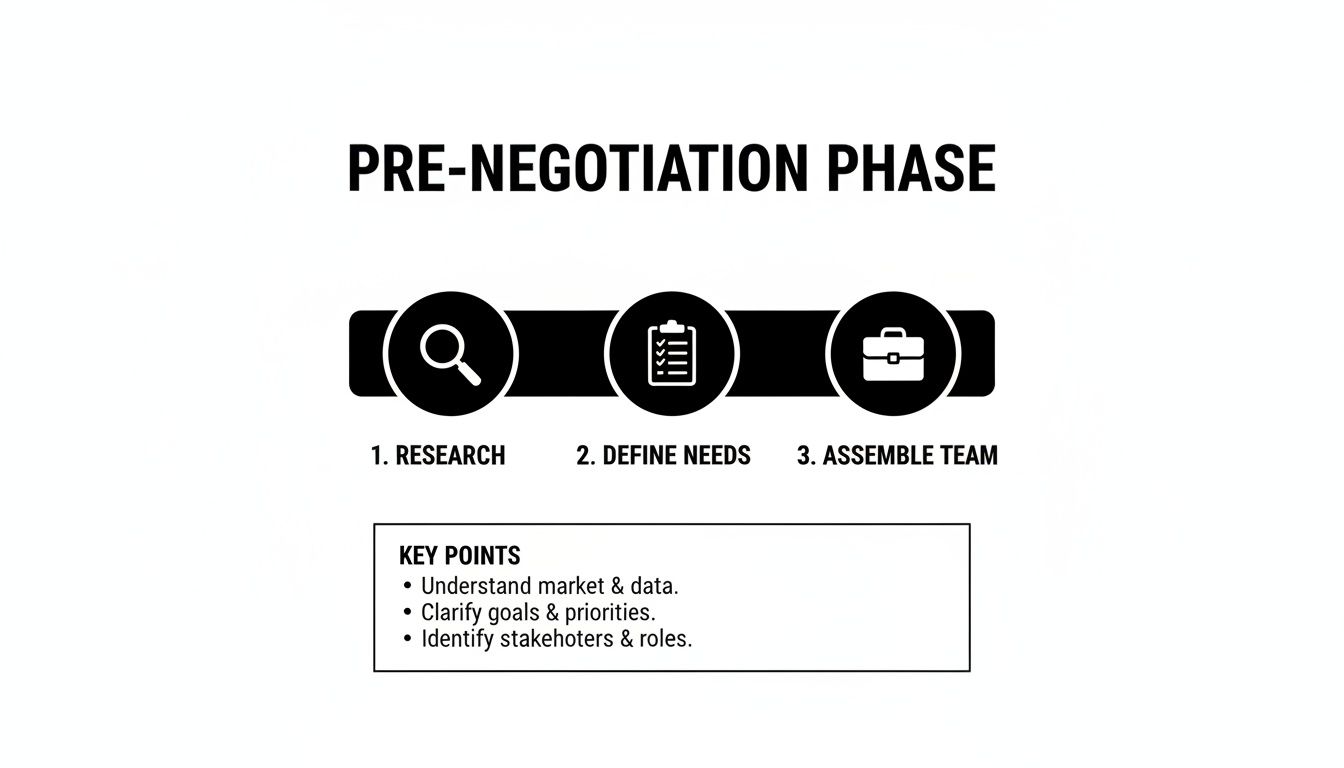
This structured approach—thorough research, clear needs-definition, and expert team assembly—forms the bedrock of a successful negotiation strategy.
In the bustling North American commercial real estate market, particularly the United States, lease terms typically span 5-10 years with clearly defined structures, giving savvy business owners a solid window to negotiate favorable concessions. This longer duration contrasts sharply with shorter terms elsewhere, allowing for strategic haggling over rent escalations, tenant improvements, and renewal options. To gain a broader perspective, you can explore more insights on international lease negotiations from Vestian.
Protecting Your Business Operations and Flexibility
Finally, a few clauses directly impact your daily operations and long-term flexibility. For many retail and service businesses, an exclusivity clause is absolutely vital. It prevents the landlord from leasing another space in the property to a direct competitor, protecting your market share.
Equally important is the sublease and assignment clause. This governs your ability to rent out your space to another business (sublease) or transfer the lease entirely (assignment). Business is unpredictable. A flexible sublease clause can be a lifesaver if you need to downsize, relocate, or sell your company. Landlords will always require their consent, but you must negotiate for language stating their consent “shall not be unreasonably withheld, conditioned, or delayed.”
Effective Negotiation Tactics at the Bargaining Table

Once you’ve done your homework and pinpointed the critical lease clauses, it’s time to actually negotiate. This is where your preparation pays off. The best negotiators I’ve seen don’t just know what to ask for; they know how to frame their requests to create a win-win scenario.
Your goal is to be firm but fair. Assertive, but never aggressive. You want to build a relationship where the landlord sees you as a long-term partner, not just another tenant. A little goodwill upfront can make a huge difference down the road.
Anchor Your Requests in Market Data
Never walk into a negotiation with vague asks. “I want a lower rent” is a weak position. Instead, you need to present a case backed by hard numbers. This is where all that market research becomes your most valuable weapon.
When you tie your requests to real-world data, the conversation shifts from subjective wants to objective facts. It’s much harder for a landlord to dismiss a proposal that clearly reflects current market conditions.
For example, when asking for a larger Tenant Improvement (TI) allowance, try this:
“Our research on comparable Class A spaces right here in this submarket shows landlords are offering TI allowances between $55 and $65 per square foot for tenants with our credit profile on a seven-year term. Our request for $60 per square foot puts us right in the middle of the market standard and helps us build out a space that will add significant long-term value to your property.”
This approach immediately signals that you’re a serious, informed tenant and that your request is reasonable, not just a number you pulled out of thin air.
Maintain a Firm Stance on Your Core Needs
While you want to be collaborative, you absolutely cannot waiver on your non-negotiables. These are the handful of deal-breakers you identified early on—the “must-haves” that are foundational to your business’s success in that space. This might be a specific cap on CAM increases, a flexible sublease clause, or an ironclad right to renew.
Communicate these points with quiet confidence. Crucially, explain why they are so important to your business operations. When a landlord understands the business logic behind a request, they are far more likely to see it as a legitimate need instead of an arbitrary demand.
A classic mistake is giving up a core need too early just to seem agreeable. Don’t fall into that trap. Negotiation is a marathon, not a sprint. Hold your ground on what really matters and be prepared to show flexibility on your “nice-to-haves.”
Foster a Collaborative Atmosphere
You have to advocate for your own interests, but framing the negotiation as a partnership is always more effective than treating it like a battle. The language you use has a massive impact on the tone of the entire discussion.
Try using phrases that highlight mutual benefit:
- “We see this as a long-term relationship, and having predictable costs helps us commit to being a stable tenant for years to come.”
- “How can we work together to find a middle ground on the CAM cap that works for both of us?”
- “By investing in a high-quality build-out, we’re not just helping ourselves—we’re enhancing the future value of your property.”
This approach builds rapport. A landlord who feels you’re working with them is much more likely to get creative and find solutions that help you hit your goals.
Master the Art of Strategic Silence
Sometimes the most powerful tool in a negotiation is saying nothing at all. After you make a clear, data-supported proposal, there’s an almost universal temptation to fill the silence. You might want to re-explain your position or even offer a small concession. Resist that urge.
State your case, then stop talking and wait. This strategic pause accomplishes two things:
- It signals confidence in your position.
- It puts the onus on the other party to respond to your offer.
More often than not, the other side will jump in to fill the void, sometimes revealing valuable information or making a counteroffer that moves the needle in your favor. It’s a simple but incredibly powerful tactic.
Prepare Scripts for Tough Conversations
Skilled negotiators don’t wing it; they anticipate the tough spots and prepare for them. Think through the points where you expect pushback and script out some clear, concise talking points.
Scenario: Asking for a firm cap on CAM increases.
- Landlord: “We can’t commit to a fixed 3% cap. Our operating costs are just too unpredictable.”
- Your Prepared Response: “I completely understand the concern around unpredictable costs. That’s the very reason we need predictability in our budget to ensure we remain a healthy, stable tenant for the entire lease term. Perhaps we could land on a 4% cap, or maybe tie the cap to a metric like the CPI? That would protect you from major inflation while still giving us the financial certainty we need.”
Having these responses ready means you won’t get caught flat-footed. You can respond professionally and thoughtfully, keeping the conversation productive even when you hit a point of friction. This is a critical part of knowing how to negotiate a commercial lease effectively.
Calculating the True Cost of Your Lease
The base rent is just the tip of the iceberg. Any experienced business owner knows the number on the front page of the lease rarely reflects your actual financial commitment. To understand if a space is genuinely affordable, you have to calculate its total occupancy cost. This means digging into every pass-through expense, hidden fee, and annual increase that will hit your bank account.
Getting a clear-eyed view of these numbers isn’t just a budgeting exercise; it’s a foundational part of negotiating a smart commercial lease. This financial analysis lets you compare different properties with real accuracy and gives you the hard data needed to push for concessions that actually matter.
Determining Your Effective Rent
The effective rent is the true net rent you pay after factoring in all the valuable financial concessions the landlord provides. It’s a critical metric for comparing two seemingly different offers. An offer with a higher base rent but a massive tenant improvement allowance might actually be the better deal—but you won’t know without running the numbers.
To figure it out, you have to account for the perks that reduce your total cash outlay over the lease term. The most common and valuable concessions include:
- Free Rent Periods: Often called rent abatement, this is a period where you occupy the space without paying base rent, usually at the beginning of the lease. Negotiating even two or three months of free rent can save you tens of thousands of dollars.
- Tenant Improvement (TI) Allowance: This is the capital the landlord contributes to your build-out. A larger TI allowance directly reduces your upfront capital expenditure, making a massive difference to your business’s cash flow.
Think of these concessions as direct cash infusions from the landlord. By subtracting their total value from your total base rent payments, you uncover the true rent you’re actually paying.
Analyzing and Projecting CAM Escalations
Common Area Maintenance (CAM) charges are where many tenants get hit with unexpected and often crippling cost increases. These charges, which cover your share of maintaining shared spaces, are notorious for escalating year after year. A low starting CAM rate can quickly balloon, erasing any savings you negotiated on the base rent.
Your mission is to prevent this by demanding transparency and negotiating a protective cap. The landlord should provide a detailed breakdown of what CAM includes and the property’s expense history for the past few years. This lets you spot any unusual spikes and project future costs more accurately.
Expert Tip: Never accept an open-ended CAM clause. The single most important financial protection you can negotiate is a cap on annual increases. Aim for a hard cap of 3-5% per year to ensure your occupancy costs remain predictable and manageable.
This simple clause prevents the landlord from passing on exorbitant costs from major, one-time projects and forces them to manage the property more efficiently.
Shining a Light on Other Hidden Costs
Beyond rent and CAM, a commercial lease is often seeded with other financial landmines. Scrutinizing the fine print for these potential costs is absolutely essential for an accurate budget.
Be on the lookout for these common “gotchas”:
- Security Deposits: Unlike residential leases, commercial security deposits can be massive, often equaling several months of gross rent. This can tie up a significant amount of your working capital, so try to negotiate a lower amount or a phased-in deposit.
- Restoration Clauses: This is a ticking financial time bomb. A strict restoration clause can require you to demolish your entire build-out and return the space to its original “shell” condition at your own expense. Negotiate to soften this, aiming to leave the space “broom clean” with normal wear and tear accepted.
- Insurance Requirements: The lease will dictate the specific types and minimum coverage levels of insurance you must carry. These policies can be expensive, so get quotes from your insurance provider early to factor these premiums into your total cost calculation.
Failing to account for these ancillary costs can lead to a financial strain that jeopardizes your entire business. By calculating every potential expense, you can negotiate from a position of financial clarity and secure a lease that truly supports your long-term success.
Why an Attorney Is Your Most Valuable Player
While a great broker finds you the perfect space, a skilled commercial real estate attorney ensures that space doesn’t become a long-term financial trap. Too many business owners try to cut corners here, letting their broker handle the entire deal. This is a critical—and often costly—mistake.
A broker’s expertise is in market dynamics, comps, and getting the business terms right. An attorney’s world is legal risk, contractual integrity, and protecting you from what’s hidden in the fine print. Their roles are fundamentally different, and you need both.
Beyond the LOI: Protecting Your Interests
The Letter of Intent (LOI) feels like a win, but the real battle begins when the landlord’s lease draft arrives. This is where your business is most vulnerable. That document wasn’t written to be fair; it was drafted by the landlord’s attorney to maximize their rights and minimize yours at every turn.
An experienced real estate attorney is trained to spot these hidden grenades. They see the vague language around CAM expenses that could inflate your costs unexpectedly or a restrictive sublease clause that could trap you if your business needs to pivot. They are your last line of defense against a decade of potential problems.
These attorneys aren’t just proofreaders. They are strategists who understand the long-term operational and financial consequences of every single sentence in that document.
An attorney’s value isn’t just in what they add to a lease, but in what they prevent. They are your safeguard against future disputes, unforeseen costs, and operational restrictions that could cripple your business years down the road.
When to Engage Your Attorney
The best time to bring in your lawyer is right after you and your broker have a handshake deal on the main business terms in the LOI. While an LOI is mostly non-binding, some clauses can be enforceable, so a quick legal review at this stage is a smart, proactive move.
Their most critical work, however, starts the moment you receive that first lease draft from the landlord. From this point on, your attorney should take the lead on all revisions and communications with the landlord’s legal team.
Here’s how an attorney protects you during the lease review:
- Translating Legalese: They turn dense legal jargon into clear business risks you can actually understand and make decisions on.
- Risk Mitigation: They pinpoint and rework clauses covering default, liability, and restoration obligations—the very sections that can cost you hundreds of thousands of dollars if left unchecked.
- Ensuring Enforceability: They make sure the terms you fought for, like your renewal options or TI allowance, are ironclad and legally enforceable.
A single overlooked clause can have devastating financial consequences. The potential cost of a lease dispute far outweighs the attorney’s fees. As one real estate closing disaster that cost $400,000 shows, failing to secure a proper legal review is a risk not worth taking.
Ultimately, hiring a qualified real estate attorney provides more than just legal advice; it provides peace of mind. They ensure the document you sign is a foundation for growth, not a source of future headaches.
Common Questions About Commercial Lease Negotiations
Even after you’ve done your homework on negotiation tactics and run all the numbers, a few key questions almost always pop up for business owners navigating a commercial lease. Let’s clear up some of the most frequent sticking points.
What Is the Difference Between an LOI and a Lease?
Think of a Letter of Intent (LOI) as the high-level handshake agreement. It’s a preliminary document—usually non-binding—that sketches out the big-picture business terms like rent, the lease term, and any tenant improvement allowance. It’s your way of saying, “We’re serious about this space,” and it lays the foundation for the real deal.
The lease agreement is the complete opposite. It’s the final, ironclad, legally binding contract. Every single right, responsibility, and obligation for both you and the landlord lives in this document. The LOI is the blueprint, but the lease is the enforceable architecture that will govern your business’s home for years to come.
How Much Can I Actually Negotiate Off the Asking Rent?
There’s no magic formula here. Your ability to negotiate a rent reduction hinges entirely on market dynamics, how desirable the property is, and your strength as a potential tenant—meaning your credit and business track record.
In a tenant’s market, where vacancy rates are high, landlords get nervous. That’s your moment to push for significant rent cuts and valuable concessions, like several months of free rent to get you started.
But in a hot market, the landlord might be fielding multiple offers. In that scenario, fighting over a small percentage off the base rent is a losing battle. Instead, pivot your negotiation to other money-saving clauses, like securing a larger TI allowance for your build-out or getting a firm cap on CAM increases. Your broker’s intel on what other tenants recently signed for nearby is your best asset.
Key Insight: A savvy negotiation isn’t just about shaving a few dollars off the monthly rent. Focusing on other financial clauses can deliver far greater savings over the life of the lease, especially when the market gives the landlord the upper hand.
What Are the Biggest Red Flags in a Lease Document?
Some lease clauses are more than just unfriendly—they’re landmines that can create massive financial exposure down the road. Vague language around how operating expenses (CAM) are calculated is a huge one; it’s basically giving the landlord a blank check to pass on unlimited costs to you.
Other major red flags to watch for include:
- Restrictive Sublease Clauses: These can trap you in a space you’ve outgrown or need to exit.
- Demanding Restoration Clauses: You could be on the hook for demolishing your entire build-out, at your own expense, when you move out.
- Lack of an SNDA Clause: This is a non-negotiable. The Subordination, Non-Disturbance, and Attornment clause is what protects your right to stay if the landlord defaults on their loan and the bank forecloses.
When you spot these kinds of issues, it’s time to bring in an expert. Knowing what questions to ask a lawyer is the first step in making sure you’re protected before you sign anything.
When legal complexities arise, connecting with the right expert is crucial. The Haute Lawyer Network is a curated network of top attorneys selected for their professional excellence. We provide them with elite-level branding and visibility, helping you find the respected legal professionals you need to protect your business. Learn more about our exclusive network.