
Bringing in new legal clients today requires a blend of timeless strategies and modern tactics. It’s a mix of digital marketing, strategic networking, and building a powerful personal brand. The core idea is straightforward: be visible where your ideal clients are looking, and make it undeniably clear why you are the right choice to solve their legal problem.
But it all starts with laying the proper groundwork.
Build Your Foundation for Client Attraction

Before you spend a dime on advertising or an hour at a networking event, you have to build the bedrock of your client attraction strategy. Without it, even the most aggressive marketing campaigns will fail to deliver.
The goal is to shift from a reactive, “hope the phone rings” mindset to a proactive system that consistently draws the right people to your firm. This foundational work is all about clarity and preparation—defining exactly who you serve and what makes your firm the only logical solution for them.
Define Your Ideal Client with Precision
The first step in getting clients is knowing which clients you actually want. A generic approach yields generic results. Don’t just aim for “anyone with a personal injury case”—get granular.
Think about a family law attorney. Their ideal client isn’t just “someone getting divorced.” It’s far more specific:
- High-net-worth professionals over 40 in a specific metropolitan area who own a business.
- Stay-at-home parents who need to re-enter the workforce and are worried about spousal support.
- Business owners facing complex asset division that involves company valuations.
Each of these profiles has wildly different concerns, financial realities, and places they go for information. Understanding these nuances lets you tailor every message and focus your marketing budget where it will have the most impact. This detailed persona becomes the North Star for every decision you make.
Craft a Compelling Value Proposition
Once you know who you’re talking to, you have to nail what you’re going to say. A value proposition is not a laundry list of your legal services. It’s a sharp, clear statement that answers a potential client’s biggest question: “Why should I hire you over every other lawyer out there?”
It must translate your legal expertise into a tangible benefit for the client. Think outcomes, not services.
Clients don’t buy legal services; they buy outcomes. They’re looking for peace of mind, financial security, or a clear path forward. Your value proposition has to speak directly to those powerful emotional needs.
For example, instead of saying, “We offer estate planning services,” a far stronger proposition is, “We help families protect their assets and legacy, ensuring their wishes are honored without creating conflict for the next generation.” This flips the script from the process to the priceless result.
Assemble Your Essential Marketing Assets
With your ideal client and value proposition locked in, it’s time to build the tools you’ll use to communicate your message. These are the non-negotiables for any modern law practice. This isn’t just about bringing in new leads; it’s about creating loyalty from day one.
Remember, acquiring a new client can cost five to twenty-five times more than retaining an existing one. And with even a 5% increase in client retention boosting profits by 25% to 95%, making a killer first impression is critical for long-term success. You can discover more legal marketing statistics that highlight the incredible value of keeping clients happy.
Before you can attract those clients, you need to have your house in order. The following table breaks down the core components every law practice needs to have in place.
Core Components of a Client-Ready Law Practice
| Component | Key Objective | Example Action |
|---|---|---|
| Professional Website | Establish credibility and serve as your digital hub. | A mobile-friendly site with clear calls-to-action and client-focused copy. |
| Elevator Pitch | Concisely explain your value in under 30 seconds. | “I help tech founders navigate intellectual property to protect their innovations.” |
| Client Testimonials | Build trust and provide social proof. | Feature video testimonials and Google reviews prominently on your homepage. |
| Defined Niche | Position yourself as the go-to expert for a specific problem. | Specializing in “e-commerce contract disputes” instead of “general business law.” |
| Value Proposition | Clearly articulate why a client should choose you. | “We resolve complex tax disputes for small businesses, saving them time and money.” |
These assets are the building blocks of a system that not only attracts but also converts and retains high-value clients. With this foundation, you’re ready to start actively pursuing new business.
Dominate Digital Channels to Find Modern Clients

While referrals and networking are still the lifeblood of many practices, your digital presence is your firm’s modern-day front door. For the vast majority of potential clients, their search for a lawyer doesn’t start with a phone call to a friend—it starts with a few words typed into a search bar.
The goal isn’t just to exist online; it’s to be found by the right people at the exact moment they need your expertise. It’s about making your firm the obvious choice when a potential client is facing a serious legal challenge.
Master Local SEO to Capture Immediate Demand
When someone in your city searches for “divorce lawyer near me” or “business litigation attorney,” you absolutely must appear at the top of the results. This is the entire point of Local Search Engine Optimization (SEO), and its foundation is your Google Business Profile (GBP).
Your GBP is often the very first impression a potential client has of your firm. It’s not just a map listing; it’s a powerful tool that drives phone calls, website visits, and direct consultations.
To make it work, you have to get the details right:
- Complete Every Section: Fill out all available fields with accurate, detailed information about your firm—your specific services, hours, and a compelling description of what makes you different.
- Gather Consistent Reviews: Actively and systematically ask for reviews from satisfied clients. A steady flow of recent, positive reviews is one of the most powerful local ranking factors.
- Use High-Quality Photos: Add professional photos of yourself, your team, and your office. It builds trust and gives your profile a human touch.
A well-optimized Google Business Profile is the single most important asset for capturing local client intent. It puts your firm directly in front of people actively looking for the services you provide, right now.
Think of it this way—if a client is searching locally, they have a pressing need. Winning that click can mean the difference between landing a high-value case and losing it to a competitor down the street.
Create Content That Answers Urgent Questions
Beyond hyper-local searches, potential clients use search engines to understand their problems before they’re ready to hire. They’re asking questions like, “What are the first steps in a personal injury claim?” or “How do I protect my assets in a divorce?”
Your content strategy should directly answer these questions.
Creating helpful blog posts, articles, and short videos doesn’t just improve your search rankings; it establishes your authority. When you provide clear, valuable answers without asking for anything in return, you build trust long before a potential client ever picks up the phone. This approach, known as content marketing, positions you as a helpful expert, not just another service provider.
A recent nationwide survey confirmed that search engines are the dominant tool for finding a lawyer. It revealed that a staggering 86.7% of potential legal clients use Google during their research. While traditional search is king, emerging tools are gaining ground fast. For instance, the use of AI tools like ChatGPT for lawyer research surged from 9% to 28.1% in just one year. You can learn more about how clients are discovering lawyers in 2025 and what these trends mean for your practice.
Leverage Social Media for Authority, Not Just Ads
Many lawyers write off social media as a time-sink with little return. The key is to use it strategically. For most practice areas, LinkedIn is the premier platform for building professional authority and generating high-value leads.
It’s not about posting generic firm updates. The focus should be on sharing your expertise in a way that helps your ideal clients and referral sources. This means active engagement, not just having a profile. For a deeper dive into making these platforms work, check out these effective attorney social media marketing tips for lawyers.
Consider these actionable LinkedIn strategies:
- Share Insights on Legal Developments: Write short posts analyzing new regulations or court decisions relevant to your industry niche.
- Engage with Industry Leaders: Comment thoughtfully on posts from potential clients or referral partners, adding real value to their conversations.
- Publish Long-Form Articles: Use LinkedIn’s article feature to repurpose your blog content, reaching a new and highly professional audience.
By consistently providing value, you transform your social media presence from a static profile into an active tool for demonstrating expertise and building the relationships that lead to new clients.
Build a Powerful Referral Engine That Works for You
While your digital strategy churns in the background, one of the most timeless and effective client sources is sitting right in front of you: a powerful referral network. This isn’t about passing out business cards at mixers. It’s about methodically building a pipeline of high-quality, pre-qualified leads that come directly to your door.
The most successful lawyers I know understand this. The best clients almost always come from a trusted recommendation. In fact, research shows that 43% of people looking for legal help start by asking a friend or family member for a referral. This makes your network one of the most valuable, and often overlooked, assets your firm has.
Identify Your Strategic Referral Partners
The key to networking that actually works is to be purposeful. Forget random connections. You need to focus on professionals who regularly interact with your ideal clients before they even realize they need a lawyer. These partners become your eyes and ears, spotting potential issues and sending business your way.
Think for a minute: who do your clients trust with other professional advice? If you’re a family law attorney, your ideal partners aren’t just other lawyers in different practice areas. They are people like:
- Accountants and CPAs who are the first to see financial distress or the complexities of asset division brewing.
- Financial Advisors who guide clients through major life events like marriage, inheritance, or selling a business.
- Therapists and Marriage Counselors who are quite literally on the front lines of relationship breakdowns.
- Real Estate Agents working with couples who are buying or selling property during a separation.
Each one of these professionals has a direct line to people who will likely need your specific legal skills. A few solid relationships in these adjacent fields can generate more high-quality leads than months of cold outreach ever will.
The goal of networking isn’t just to get referrals; it’s to give them. When you approach every interaction with the mindset of “How can I help this person?” you build relationships based on mutual value, not just self-interest. That’s the foundation of a network that lasts a career.
Cultivate Relationships Built on Mutual Value
Once you’ve identified your ideal partners, the real work starts. A referral relationship is like a garden—it needs consistent effort and genuine care. This means moving beyond the occasional email and building real, professional friendships.
Your approach should be systematic and value-driven. I suggest creating a “Top 10” list of referral targets and planning intentional touchpoints.
- Schedule a “Get to Know You” Coffee: Set up a quick, informal meeting. The only goal is to understand their business and who their ideal clients are.
- Offer to Be a Resource: Position yourself as their go-to legal expert. Let them know they can call you with a quick question without feeling like they have to send a formal referral.
- Make the First Referral: The absolute fastest way to get a referral is to give one. Actively listen for opportunities to send business to your networking partners.
This strategy changes everything. It turns networking from a transactional chore into a collaborative partnership. When a financial advisor knows you understand their business and are actively looking for ways to help them, they are far more likely to do the same for you.
Leverage Your Alumni Network
One of the most underutilized referral sources is your law school’s alumni network. Think about it: your fellow graduates are practicing in countless fields and locations, creating a built-in web of potential connections. Platforms like LinkedIn make it incredibly easy to reconnect and stay on their radar.
For instance, just look at the vast network available through a major institution’s alumni page on LinkedIn.

This screenshot shows thousands of alumni you can search by location, company, and industry. It’s a ready-made list of potential referral partners. By engaging with your alma mater’s group, sharing relevant content, and reaching out to classmates in complementary practice areas, you tap into a warm network built on a shared foundation. This is how you get clients as a lawyer through established, trusted connections.
Become the Go-To Expert in Your Niche
Potential clients don’t just hire a law firm; they hire the lawyer they believe is the foremost expert on their specific problem. Moving beyond standard marketing to become a recognized authority in your niche is the ultimate strategy for attracting high-value clients.
When you’re seen as the go-to expert, the dynamic shifts completely. Instead of you chasing leads, high-value cases begin flowing to you organically because your reputation precedes you. The goal is to elevate your profile so that when your ideal client faces a legal crisis, your name is the first—and only—one that comes to mind.
Speak Where Your Clients Listen
One of the most direct ways to build authority is by speaking at industry events your ideal clients actually attend. This isn’t about lecturing at legal conferences filled with your peers. It’s about getting in front of the business owners, professionals, or individuals you want to serve.
If you’re a corporate attorney targeting tech startups, you should be speaking at tech incubators and venture capital summits. An employment lawyer? Your audience is at HR management conferences. This strategy positions you as an educator and a trusted advisor, not just another lawyer trying to land business.
Publish Insightful Content on Key Platforms
Your expertise needs to be visible online, and LinkedIn is a powerful arena for this. Publishing insightful articles demonstrates your deep understanding of your niche and keeps you top-of-mind with your professional network.
But don’t just share firm news. Write about tangible issues your clients are grappling with right now.
- A real estate attorney could write a short analysis of a new zoning law’s impact on local developers.
- An IP lawyer might break down a recent high-profile trademark dispute and its lessons for small businesses.
This kind of content provides immediate value and showcases your expertise in a practical, non-salesy way. It proves you understand their world. For certain practice areas, like estate planning, this visibility is absolutely critical. To go deeper, exploring specific estate planning lawyer marketing that actually works can provide a more targeted roadmap.
Become a Trusted Media Source
Local and national media outlets are constantly looking for experts to provide commentary on breaking news with legal angles. By making yourself available as a source, you can gain incredible visibility and credibility almost overnight.
When a journalist quotes you as an expert, it serves as a powerful third-party endorsement. It tells the public that you are a trusted authority in your field, which is far more persuasive than any advertisement.
Start by identifying local reporters who cover your beat—whether it’s business, real estate, or crime. Reach out, introduce yourself, and offer to be a resource for any future stories where they need legal context. A single quote in a reputable publication can lead to a significant influx of calls.
Host Educational Webinars on Timely Topics
Webinars are an excellent tool for generating qualified leads while simultaneously building your expert status. The key is to choose a hot-button issue that creates uncertainty or anxiety for your ideal client and offer a free, educational session to provide clarity.
For example, a family law attorney could host a webinar on “Navigating Child Custody During the Holidays.” A data privacy lawyer might present on “What Small Businesses Need to Know About New Consumer Data Laws.”
By providing actionable advice, you build trust and goodwill. When the session ends, attendees who need further assistance will see you as the logical choice for legal help, turning an educational event into a direct client acquisition channel.
Decide Between In-House And Outsourced Marketing
As your firm grows, you’ll eventually face a critical decision. The marketing hustle that got you here—squeezing in tasks between cases and court dates—simply won’t scale. This brings you to a fork in the road with major implications for your budget, time, and future growth.
Do you build a marketing team from scratch, or do you partner with a specialized agency?
There’s no one-size-fits-all answer. The right choice depends entirely on your firm’s current size, financial footing, and long-term ambitions. The wrong one can lead to wasted money and stalled momentum, but the right one can become a powerful engine for client acquisition.
The Case For An In-House Marketing Team
Hiring an in-house marketer means you get a dedicated team member who lives and breathes your firm’s culture every single day. They become completely immersed in your practice, understanding the subtle nuances of your ideal clients and your unique value on a deep, personal level.
This approach gives you total control and seamless integration. Need a blog post drafted about a recent court ruling? Your in-house person is just down the hall. Want to launch a quick social media campaign for a local event? They can get it done on the spot.
However, this path comes with significant costs. You’re not just covering a salary; you’re on the hook for benefits, payroll taxes, software subscriptions, and ongoing training. Plus, finding a single person who is an expert in SEO, content, paid ads, and social media is a unicorn hunt. You often end up with a generalist who is decent at many things but a true master of none.
The Argument For Outsourcing To An Agency
Partnering with a marketing agency gives you immediate access to an entire team of specialists. For a single monthly retainer, you can have an SEO expert, a content strategist, a PPC manager, and a web designer all focused on your firm’s growth. This model provides a level of specialized expertise that would be incredibly expensive to build in-house.
Modern legal marketing is complex, which is why outsourcing has become the go-to model. A staggering 83% of law firms now hire external marketing agencies to handle their campaigns. This trend allows lawyers to focus on billable hours while seasoned experts manage the intricate work of finding new clients online.
This infographic gives you a clear visual breakdown of the core trade-offs.
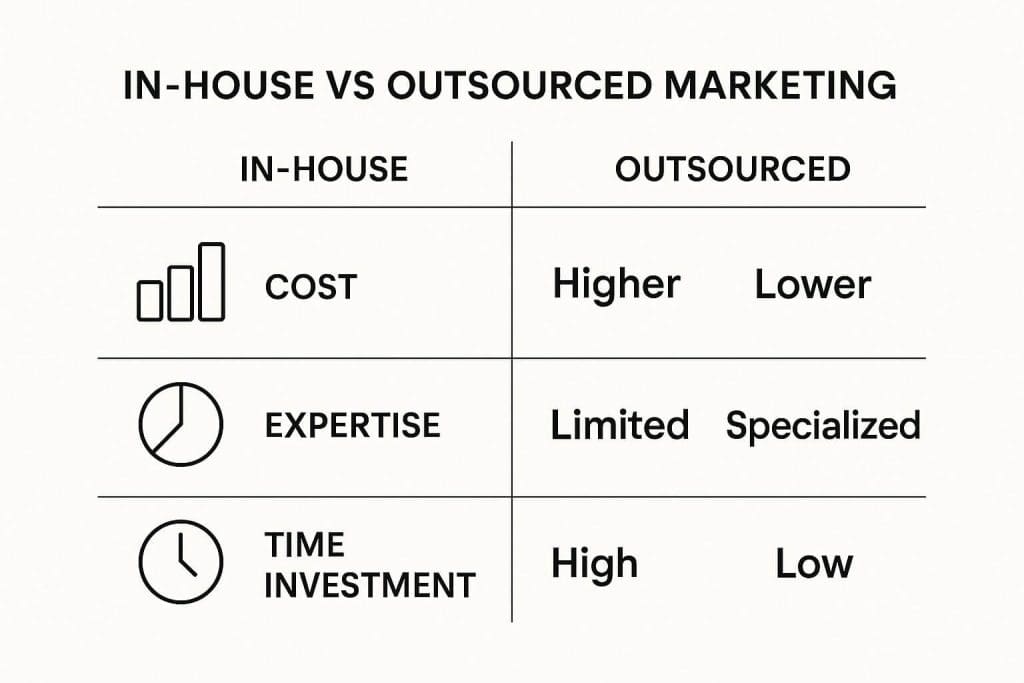
As you can see, outsourcing generally offers a more cost-effective way to access a higher level of specialized skill while demanding less of your direct management time. For a deeper look at what to prioritize, check out these essential attorney marketing strategies.
Deciding between hiring in-house staff and partnering with an agency is a common challenge for growing law firms. This table breaks down the key factors to help you make an informed choice based on your specific needs, budget, and goals.
In-House vs Outsourced Legal Marketing A Comparison
| Factor | In-House Marketing | Outsourced Agency |
|---|---|---|
| Cost | High fixed costs (salary, benefits, tools, overhead). Can be very expensive to build a full team. | Predictable monthly retainer. More cost-effective for accessing a full range of expertise. |
| Expertise | Often relies on a generalist or a small team with limited specialization. A single person can’t master everything. | Immediate access to a team of specialists (SEO, PPC, content, design) with deep industry knowledge. |
| Control & Focus | 100% dedicated to your firm. Deeply integrated into your culture and daily operations. | Manages multiple clients. May not have the same level of cultural immersion as an employee. |
| Scalability | Scaling up or down requires a slow and costly hiring or firing process. | Flexible and scalable. Can easily adjust services and budget as your firm’s needs change. |
| Time Investment | Requires significant time for hiring, training, and ongoing management. | Minimal management required. The agency handles strategy, execution, and reporting, freeing you up. |
Ultimately, the best choice depends on your firm’s unique circumstances. While an in-house team offers deep integration, an outsourced agency provides a more efficient and scalable path to accessing high-level marketing expertise.
The decision isn’t just about cost; it’s about opportunity cost. Every hour you spend trying to manage a marketing campaign or learn a new digital tool is an hour you’re not spending practicing law.
A large, well-funded firm might even benefit from a hybrid model—an in-house marketing director who manages several specialized agencies. But for most solo practitioners and small to mid-sized firms aiming for efficient growth, outsourcing provides the most direct path to sophisticated marketing and a consistent flow of new clients.
Common Questions from Top-Tier Attorneys
Even the most sophisticated legal practitioners run into the same practical questions when it comes to business development. Let’s tackle the most common hurdles attorneys face when scaling their practice.
How Much Should We Invest in Marketing?
There isn’t a single magic number, but the benchmarks are clear. Established firms typically allocate 2-5% of gross revenue to marketing. For firms in a serious growth phase—or new practices aiming to make an immediate impact—that figure often climbs to 7-15%.
The key is to stop thinking of marketing as an expense. It’s a strategic investment.
Your budget should be a direct reflection of your client acquisition goals.
- Goal: Secure one new high-value corporate client each quarter. Your investment will likely target a niche industry event sponsorship and a highly focused LinkedIn campaign.
- Goal: Drive a 20% increase in local family law consultations. The budget here would concentrate on Local SEO and geographically targeted Google Ads.
Start with a manageable, trackable budget. Once you see which channels are delivering a real return, you can confidently double down on what works.
What Is the Fastest Way to Acquire New Clients?
For immediate results, nothing beats the one-two punch of paid advertising and a robust referral network.
Pay-per-click (PPC) campaigns put your firm directly in front of prospects the moment they search for legal help. Think of it as turning on a faucet for leads. At the same time, proactively cultivating your professional network for referrals can bring in high-quality, pre-vetted clients far faster than building a brand from zero.
To make an immediate impact, you have to capture existing demand. That means being hyper-visible where clients are actively searching (like Google) and leveraging the trust already built by your professional peers.
Long-term plays like SEO and content marketing are crucial for building a sustainable practice, but for pure speed, direct response is the name of the game.
Should I Specialize or Remain a Generalist?
In today’s market, specialization is the most direct path to attracting high-value clients. Being a generalist makes it nearly impossible to differentiate yourself.
Focusing on a niche allows you to become the definitive expert for a specific, often complex, problem. That level of expertise commands higher fees and builds a rock-solid reputation.
Think about the difference in perception:
- The Generalist: “I’m a business lawyer.”
- The Specialist: “I help SaaS companies navigate intellectual property law to secure Series A funding.”
The specialist immediately signals deep, relevant expertise to a lucrative client profile. All of your marketing, from your website to your networking conversations, becomes sharper and more effective. It may feel like you’re shrinking your potential client pool, but you’re actually magnifying your appeal to the clients who matter most.
How Can I Ask for Referrals Without Sounding Desperate?
The secret is to make it a natural part of your client service process, framing it as a professional collaboration rather than a request for a favor.
The perfect time to bring it up is at the successful conclusion of a matter or when a colleague thanks you for your insight.
With a satisfied client, you could say: “I’m thrilled we achieved this result for you. I find my best clients often come from introductions made by people like yourself. If you know any other business owners who could benefit from this kind of outcome, an introduction would be greatly appreciated.”
For a professional contact, try a more collaborative angle: “It was great catching up. I’m always looking to connect with financial advisors who serve high-net-worth families, as our work often intersects. I’ll certainly keep you in mind for my clients as well.”
This approach positions you as a confident, connected professional, not someone in need of a handout.
Elevate your practice and connect with the clients you deserve. Haute Lawyer Network offers a curated platform for top attorneys to gain visibility with an elite audience. Discover how our unique blend of luxury branding and targeted exposure can transform your client acquisition strategy. Learn more.